
 Deutsch
 Español
 Français
 Italiano
 Magyar
 Polski
 Slovenčina
 Čeština
Expect to pay a low to mid four-figure amount for a basic white label app, a moderate five-figure amount for a mid-tier build, and considerably more once you add enterprise integrations. Ongoing fees such as hosting, app-store listings, and maintenance add to the initial cost and are important parts of the total cost of ownership. Most small and medium businesses land comfortably in the basic-to-mid band, especially when their goal is a branded loyalty or booking app rather than a marketplace platform.
TL;DR:
- White label basic apps generally cost between $2,000 and $15,000, with most purchases including standard features like loyalty modules and push notifications.
- Mid-tier applications range from $10,000 to $50,000, adding functionalities such as payment processing, appointment booking, and advanced admin dashboards.
- Enterprise-level apps exceeding $50,000 often involve complex integrations with POS or ERP systems and require significant custom development.
- Ongoing expenses like hosting, app-store fees, and maintenance typically increase the total cost of ownership over time, especially under subscription or revenue-share pricing models.
- Scope, industry complexity, and specific features, such as AI personalization or multi-vendor functionality, can significantly elevate project costs, sometimes surpassing the original app price.
Price bands explained: what basic, mid and enterprise packages include
The gap between a $3,000 app and a $50,000 app comes down to how much of the software is already built versus how much gets custom-coded around your brand. White label pricing tends to cluster into three recognisable bands, and knowing which one matches your ambitions saves weeks of vendor calls.
Basic ($2,000–$15,000). This buys you a rebranded version of an existing app framework: your logo, your colours, your name in the app stores. You get standard features already baked in, usually a loyalty module, push notifications, and a simple admin panel. A production-ready white-label package with native iOS and Android apps plus an admin dashboard commonly sells as a fixed one-time fee between $6,800 and $16,000, which sits right at the top of this band.
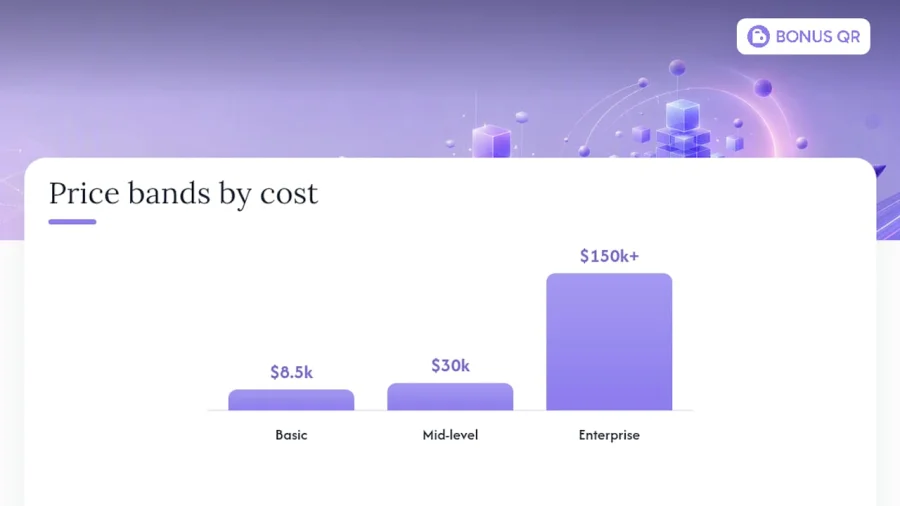
Mid-level ($10,000–$50,000). Here you’re adding functional depth: payment processing, appointment booking, order management, or a more capable admin dashboard with reporting. This is where most retailers, restaurants, and service businesses that want more than a digital stamp card end up.
Enterprise ($50,000+). This tier covers deep integrations with existing POS or ERP systems, compliance work (healthcare, finance), and heavily bespoke interface design. Basic-to-enterprise cost bands show the top end exceeding $150,000 once multiple integrations and custom workflows stack up.
- A single-location café rebranding a stamp-card app: basic band.
- A regional gym chain adding class booking and membership billing: mid band.
- A hotel group syncing loyalty data with a property management system: enterprise band.
Pricing models and which cashflow profile suits each
How you pay changes the shape of your budget as much as what you buy. Three structures dominate white label app pricing, and each suits a different kind of business.
One-time licence plus maintenance. You pay a lump sum upfront, then a smaller annual or monthly fee for support and updates. This gives you predictable costs after the initial hit, but it demands more capital on day one, usually the full basic or mid-tier figure before you’ve onboarded a single customer.
Subscription (SaaS). Lower entry cost, typically $50 to $500 a month for smaller operators, scaling into four figures for larger user bases with advanced features. Long-term operating expenditure can exceed the one-time licence if you run the app for several years, but cashflow stays gentle from the start.
- One-time licence: best when you have capital reserves and want cost certainty.
- Subscription: best when you’re testing an idea or want to preserve working capital.
- Revenue share: best when upfront cash is tight and you’re confident in transaction volume.
Revenue share. Little or no upfront fee, but the vendor takes a cut of transactions or subscriptions processed through the app. It looks cheap at the start and can become the most expensive option as your business grows, a dynamic worth mapping out before you sign anything.
Feature and integration cost drivers: line-item effects on a quote
Every feature you add to a white label build has a price tag, and some cost far more than they look like they should. Basic rebranding, new logo, colour scheme, app icon, adds relatively little to a quote. A full UI redesign that changes navigation flow and screen layouts is a different matter, often multiplying the design portion of the bill.
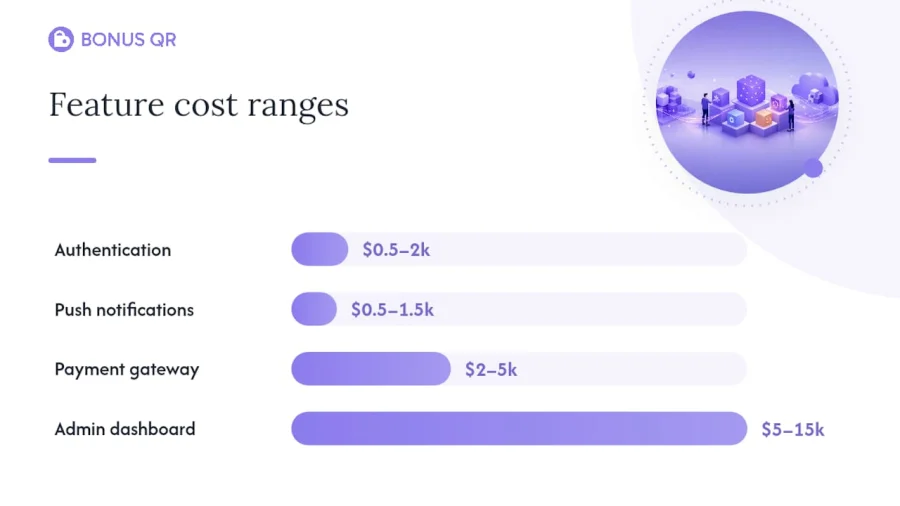
Authentication systems, push notification setups, and payment gateway integrations are the most common add-ons requested by SMBs, and each carries a distinct uplift.
- Authentication (login, social sign-in): $500–$2,000
- Push notifications: $500–$1,500
- Payment gateway integration: $2,000–$5,000
- Admin dashboards with reporting: $5,000–$15,000
Pro Tip: Ask your vendor for a line-item quote rather than a single bundled figure. It’s the fastest way to spot which feature is inflating your budget and whether you actually need it at launch.
AI-driven personalisation, real-time GPS tracking, and multi-vendor marketplace functionality sit at the top of the cost curve. These features frequently add several thousand dollars each to a build, because they require custom backend logic rather than configuration of an existing module.
Cost callout: A single complex feature, a bespoke integration or an AI-based recommendation engine, can add more to your quote than the entire basic app package costs on its own. Scope these features deliberately rather than by default.
Costs by complexity and industry examples
Your industry shapes your feature list more than almost anything else, which makes it a useful shortcut for estimating your own budget before you request quotes.
- Restaurant or booking business: table reservations, order-ahead, and a loyalty stamp card. Typically mid-band, $15,000–$30,000, because scheduling logic and payment integration both add complexity.
- Retail with loyalty rewards: points tracking, push offers, and a digital wallet card. Often sits at the lower end of mid-band or upper basic band, $8,000–$20,000, since the feature set is largely standard.
- Salon or spa booking app: staff calendars, deposit payments, and reminder notifications. Mid-band, $12,000–$25,000, driven by calendar-sync complexity.
- Ecommerce with loyalty tie-in: product catalogue, cart, payment processing, and rewards. Frequently enterprise-adjacent, $40,000–$80,000, because ecommerce checkout flows demand more custom engineering.
A mid-range configuration for a two-location retail business, rebranded app, points and stamp-card loyalty, push notifications, and a basic admin dashboard, typically lands around $18,000 to $25,000 as a one-time fee, plus a modest monthly maintenance retainer.
White label versus custom: total cost of ownership and the break-even calculus
White label development can cut initial build costs by 60% to 80% compared with custom development and shrinks time to market from months to weeks. That makes it the sensible starting point for most SMBs. The calculus shifts, though, once you factor in what’s often called the “success tax”: subscription and revenue-share models scale their fees alongside your growth, so the cheaper option today can become the pricier one later.
TCO modelling for white label versus custom suggests the crossover point where custom development becomes cheaper typically falls around 18 to 24 months, depending on revenue volume and which pricing model you’re on.
- Under $500,000 in annual revenue or fewer than 5,000 active app users: white label almost always wins on cost.
- Approaching $2 million in revenue with rapid user growth: model out the revenue-share fees against a custom build’s fixed costs.
- Needing deep, unique integrations no white label vendor offers: custom development becomes the only realistic path regardless of budget.
A rough rule of thumb: if your app is a support tool for an existing business, white label. If the app itself is the business, run the TCO numbers before you commit to either model.
Budgeting and procurement checklist: questions to get comparable quotes
Vendor quotes rarely arrive in comparable shapes, which makes it easy to pick the “cheaper” option without realising it excludes half of what a rival quote includes. Standardising your request for deliverables, support windows, and IP ownership fixes that.
Budget separately for the costs that rarely appear in the headline price: app-store fees (Apple charges $99 a year, Google Play a one-time $25), hosting that ranges from $20 to over $2,000 a month depending on scale, third-party API charges, and maintenance retainers that typically run $2,000 to $50,000 a year depending on support level. Many providers include initial support for a limited period before charging separate maintenance fees, so clarify when ongoing charges begin.
- Request an itemised breakdown, not a single bundled figure.
- Ask what happens to source code and app-store ownership if you switch providers.
- Confirm the length of included support before paid maintenance begins.
- Ask for the SLA on bug fixes and downtime.
- Request phased pricing, launch with core features, add modules later, to reduce upfront spend.
Pro Tip: Send the exact same feature list to every vendor you’re comparing. Even small wording differences (“push notifications included” versus “push notifications available”) can hide a $1,500 difference in the final invoice.
What loyalty-app clients actually pay, in practice
Most small businesses we talk to start budgeting in the $3,000 to $10,000 range, then discover integration work and marketing setup weren’t priced in. That gap, not the base app fee, is where projects usually blow their budget. Rapid white label launches tend to deliver faster returns for loyalty programmes precisely because they skip months of custom build time.
— Michal
How Bonusqr prices white-label loyalty apps
Bonusqr is the practical alternative to a from-scratch custom build for businesses that want a branded loyalty app without months of development. The White-label Setup runs as a one-off fee of €690, with an ongoing Monthly Subscription at €69, a fraction of the $50,000-plus enterprise quotes covered above, and it launches without needing POS integration first.
If you’d rather test the loyalty features before committing to a branded app, the Free, Basic and Premium plans let you run stamp cards, points, and cashback from €19 a month. For businesses that eventually outgrow the modular setup, Custom App Development starts from €1,500 with Monthly Maintenance from €69.
Before requesting a quote, list your must-have modules, expected user numbers, and any systems you need the app to talk to. That preparation gets you a tailored number fast, and it’s the same list a custom-development vendor would ask for anyway.
Sources
- White Label App Development Cost 2026 — Full Guide | iCoderz
- White Label App Development: The Complete Guide for 2026 | Bitcot
- How Much Does a White-Label Mobile App Cost? (2026 Pricing Guide) | Prebuilt Apps
- White Label App Development vs Custom: TCO Guide 2026 | TeaCode
FAQ
Can I buy a white label app?
Yes. White label apps are pre-built platforms you rebrand with your logo, colours, and content, typically priced from $2,000 for a basic package to over $50,000 for enterprise-level customisation. Bonusqr’s white-label setup is one such option, priced as a one-off €690 fee plus a €69 monthly subscription.
How much does a white label app cost?
Costs typically range from $2,000 to $15,000 for basic builds, $10,000 to $50,000 for mid-tier apps with added features, and $50,000 or more for enterprise integrations, according to industry cost breakdowns. Ongoing hosting, maintenance, and app-store fees add to that figure over time.
Do I need an LLC to start an app?
No white label vendor requires a specific business structure to purchase or launch an app, though operating as a registered business entity is common practice for liability and tax reasons. Requirements vary by country and by how you plan to process payments, so check with a local accountant or business adviser rather than assuming one structure fits every case.
What is a white label app?
A white label app is a pre-built software platform that a business rebrands as its own, adding its logo, name, and colour scheme without building the underlying technology from scratch. It’s distinct from custom app development, where every feature is coded specifically for one client, and it typically reduces both cost and time to market by 60% to 80%.