
 Deutsch
 Español
 Français
 Italiano
 Magyar
 Polski
 Slovenčina
 Čeština
Loyalty points are a digital currency your business creates and issues to reward the behaviour you want more of, usually repeat purchases, referrals or app sign‑ups. Their value to you is straightforward: customers who earn points buy more often and hand you first‑party data you can act on. Platforms like Bonusqr let small and medium‑sized businesses launch a working points system in days rather than months.
TL;DR:
- Loyalty points are a self-issued reward currency that you control, not bank-issued credit card points, making their mechanics and rules entirely your choice.
- Common triggers for earning points include purchase amount, account registration, referrals, and in-app actions, with flexible redemption options like discounts, free products, or cash credits.
- The typical points liability ranges from 0.5% to 2% of net revenue, requiring ongoing reconciliation and modeling based on redemption and breakage rates.
- Real-time balance updates, personalized offers, and frictionless redemption methods significantly boost customer engagement and reward usage.
- Simple, transparent rules, quick rewards, and initial promotional boosts like double points are key to maximizing loyalty program success within a short launch timeframe.
What is credit card reward points versus loyalty points: getting the definition right
Before going further, a quick clarification matters. Search around this topic and you will find plenty written about bank‑issued credit card reward points, the kind cardholders earn on spending and redeem for flights or cashback through a financial institution. That is not what this article covers, and it is not what most small business owners actually need to understand when they are choosing a customer loyalty system.
The subject here is customer loyalty programme points: a reward currency your own business issues, controls, and redeems, independent of any bank or card network. You set the rules. You decide what a point is worth. You choose whether it expires. This distinction matters because the operational mechanics are completely different, and confusing the two leads business owners to research the wrong thing entirely when they are trying to build a retention tool.
Industry researchers increasingly treat these programmes as strategic assets rather than marketing add‑ons. Deloitte’s research found that 72% of consumers say a loyalty programme makes them more likely to spend with a preferred brand, and 56% say the programme itself increases how much they spend. That is the commercial case for points in one statistic, and it is why the rest of this guide focuses on getting the mechanics right.
How loyalty points actually work behind the scenes
A loyalty point is, at its simplest, an entry on a ledger. Every time a customer does something you want to reward, you credit their account. Every time they redeem, you debit it. That ledger sits underneath whatever app or card the customer sees, and it needs to reconcile cleanly with your revenue accounts if you want the numbers to make sense at tax time.
Most SMB programmes trigger point credits from a small set of events:
- Purchase amount – the most common trigger, often one point per currency unit spent.
- Account registration or app download – a one‑off welcome credit to encourage sign‑up.
- Referral – points awarded when an existing customer brings in someone new.
- In‑app actions – leaving a review, following a social account, or completing a profile.
Redemption works in reverse. A customer accumulates points until they cross a threshold you set, then exchanges them for a reward, a discount, a free item, or a cash‑equivalent credit. Talon recommends keeping the rules engine (which decides how points are earned) separate from the points bank (which just holds the balance). That separation means you can change your earning rules for a seasonal promotion without touching the underlying ledger or needing a developer.
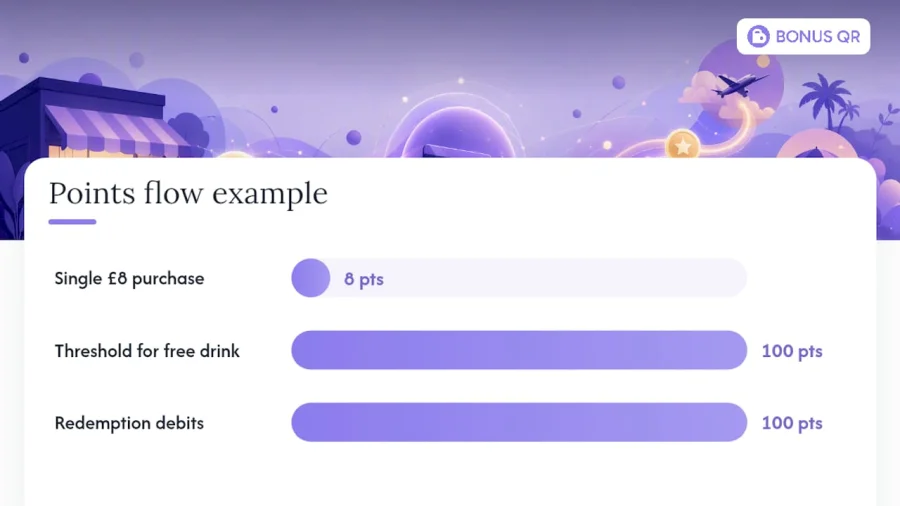
Here is a simple flow: a café customer spends £8, earns 8 points under a one‑point‑per‑pound rule, and after several visits crosses the 100‑point threshold for a free drink. The redemption debits 100 points instantly and the balance resets, visible in real time on their phone.
Common programme types and which businesses they suit
Not every model fits every business, and picking the wrong one is a common early mistake.
- Points‑based programmes suit retailers and cafés with frequent, low‑value transactions where accumulation feels natural.
- Tiered or status programmes work well for businesses with a wide spending range, such as hotels or gyms, because status unlocks perks beyond simple discounts.
- Cashback programmes appeal to price‑sensitive customers and suit grocery stores or petrol stations where margins are already thin.
- Visit or stamp‑card programmes fit businesses with predictable repeat visits, like coffee shops or salons, since they reward frequency over spend.
- Hybrid or coalition programmes combine several mechanics but demand more data maturity and partner coordination, making them a poor fit for a business launching its first system.
A single‑location café adopting a tiered status model, for example, usually overcomplicates a customer base that just wants a free coffee after ten visits.
Setting point values and modelling the economics
Picking a points‑to‑currency equivalence is the first financial decision you will make, and it shapes your liability from day one.
Not every point issued gets redeemed. This unredeemed balance, known as breakage, actually reduces your liability, but you still need to model it rather than ignore it.
Statistic to build into your model: industry benchmarking places typical points liability at roughly 0.5–2% of net revenue, depending on your redemption value and breakage rate.
A basic modelling checklist:
- Decide your points‑to‑currency ratio and the cost of the reward at redemption.
- Estimate a realistic breakage rate from comparable programmes rather than assuming zero.
- Reconcile the points bank against revenue monthly, treating outstanding points as a liability on your books.
- Re‑test your ratio after the first quarter once real redemption data comes in.
Digital features that increase engagement and redemption
The platform you choose determines whether points actually change customer behaviour or just sit unused in an account nobody checks.
- Real‑time balance updates through QR scans or an app give customers instant confirmation their action counted, which matters more than the point value itself.
- Personalisation lifts relevance. EY’s loyalty market study found that programmes pairing transactional points with relational, personalised recognition sustain engagement longer than flat discounting.
- Frictionless redemption across in‑app, coupon, or no‑POS options keeps customers from abandoning a reward they’ve already earned.
Pro Tip: Show a visible progress bar toward the next reward. EY’s research on the endowed progress effect found that visibility of how close a customer is to a reward often does more for engagement than the actual size of that reward.
Measuring success: the KPIs that tell you if points are working
Four metrics decide whether your programme is earning its keep: participation rate, redemption rate, repeat purchase rate, and lifetime value uplift among members versus non‑members.
Run a straightforward 90‑day measurement plan:
- Weeks 1 to 4 – track sign‑up and participation rate as your baseline.
- Weeks 5 to 8 – monitor redemption rate; this is where most programmes reveal friction.
- Weeks 9 to 12 – compare repeat purchase rate between enrolled and unenrolled customers.
The redemption number carries outsized weight. Platform data cited by Rivo shows customers who redeem rewards return at close to a 50% repeat rate, against roughly 10.7% for those who never redeem. If your KPIs lag after 90 days, simplify the redemption path first, increase balance visibility second, and only then consider changing the point value itself.
Getting your loyalty programme live: a practical checklist
You do not need months of planning to launch a working programme. Work through these steps in order:
- Define one goal (more repeat visits, higher average spend, or more reviews).
- Choose a programme model, points, stamp card, or cashback, that fits your transaction pattern.
- Set your point value and redemption threshold.
- Configure earning rules for purchases, sign‑ups and referrals.
- Create a welcome offer to reward the first action.
- Choose two or three redemption rewards to start, not twenty.
- Test the full flow yourself before opening it to customers.
- Brief your staff with a simple script for mentioning the programme at checkout.
- Launch, then track your KPIs for the first 90 days.
Bonusqr’s points system maps directly onto steps two through four, while its coupon management tools handle step six. Because the platform needs no POS integration, step seven often takes an afternoon rather than a week, and businesses planning to expand across locations can move later to a white‑label app without rebuilding the programme from scratch.
Pro Tip: Run a time‑limited “double points” week at launch. It gives early adopters a reason to enrol immediately rather than waiting to see if the programme sticks around.
Types of rewards you can offer through a points programme
The reward catalogue is where your programme becomes tangible to customers, and the options stretch well beyond a simple discount.
Merchandise and free products remain the most common redemption for retail and hospitality, a free coffee, a branded item, or a product upgrade. Cashback, where points convert directly into a monetary credit against a future purchase, suits price‑sensitive customers and works particularly well for grocery, fuel, and convenience businesses where margins are already tight.
Statement‑style credits, applying accumulated value directly against a customer’s next bill, work well for service businesses like salons, gyms, or clinics with recurring appointments. Gift cards or vouchers, either for your own business or a partner, give customers flexibility and work well as a mid‑tier reward that feels more generous than a small discount without costing you much more.
Travel‑style rewards, once the preserve of large hotel or airline schemes, have become viable for SMBs too. A boutique hotel offering a free night after a set number of stays, or a spa offering a complimentary treatment, borrows the same status‑and‑aspiration mechanic that keeps larger programmes sticky. The common thread across all these formats is that variety within reason, two or three well‑chosen options, outperforms a single flat discount because different customers value different things.
Benefits and limits of points programmes for the people redeeming them
For your customers, the benefit is simple: points turn routine spending into something that pays them back. A reward they can see accumulating gives them a reason to choose your business over a competitor offering an identical product at a similar price. Deloitte’s finding that 72% of consumers spend more with a preferred brand because of its programme, cited earlier, reflects exactly this dynamic from the customer’s side.
The limits are worth stating honestly too, because they shape how customers perceive your programme. Points that take too long to accumulate feel worthless, and customers disengage well before they reach a reward. Complicated tiers or category restrictions, common in larger schemes, frustrate customers who just want a straightforward exchange of loyalty for value. Expiring balances, if not communicated clearly, breed resentment rather than goodwill, even when the expiry policy is reasonable on paper.
The businesses that get the most out of a points programme are the ones that treat these limits as design constraints rather than fine print to bury. A programme that is easy to understand, quick to reward, and transparent about its rules earns more genuine loyalty than one offering a slightly higher point value wrapped in complexity.
How to encourage faster points accumulation without inflating costs
Faster accumulation drives faster engagement, but the goal is to make points feel achievable, not to give them away. For broader retention tactics beyond points, explore five proven strategies to increase customer retention.
A welcome bonus that credits new members with enough points to see a tangible balance immediately does more for early engagement than a generous ongoing earn rate. Bundling multiple earning triggers, purchase, referral, review, and app sign‑up, gives customers several routes to a reward rather than relying on transaction size alone. Seasonal “bonus point” windows tied to slower trading periods can lift both accumulation and footfall at the same time, using the programme to smooth demand rather than just reward it.
Referral incentives deserve particular attention. A customer who refers a friend and sees an immediate points credit is more likely to refer again, and the acquisition cost of that new customer is typically far lower than paid advertising. Personalised offers, nudging a specific customer toward a reward they are close to earning, tend to outperform blanket promotions because they use the endowed progress effect EY highlighted: visibility of proximity to a reward drives action more reliably than the reward’s size.
The businesses that get accumulation right rarely change the underlying point value. They add more ways to earn and make progress more visible instead.
What running a points programme actually costs
Running your own loyalty points programme carries different costs to a bank‑issued rewards scheme, and it pays to plan for them upfront rather than discover them later.
The platform itself typically carries a subscription cost, covering the ledger, app, and analytics that keep the programme running. Beyond that baseline, the real cost driver is the reward liability itself, the value of points sitting unredeemed on your books, which behaves like a financial commitment even though no cash has changed hands yet. Underestimating this is the most common budgeting mistake, particularly in the first year when nobody has historical breakage data to work from.
Redemption itself can carry a cost too, depending on what you offer. A free product redemption costs you close to its cost of goods, while a cashback‑style credit costs you the credit’s face value outright. Businesses sometimes overlook the operational cost of running promotions on top of the base programme, a “double points” weekend, for instance, temporarily doubles your liability accrual even if it pays off in footfall.
None of this makes points programmes expensive to run relative to the retention they generate, but it does mean treating the numbers with the same discipline you would apply to any other line of marketing spend, not as a free add‑on to your checkout process.
Terms and conditions that shape how points actually behave
The rules you attach to points matter as much as the points themselves, because they decide whether customers trust the programme enough to keep engaging with it.
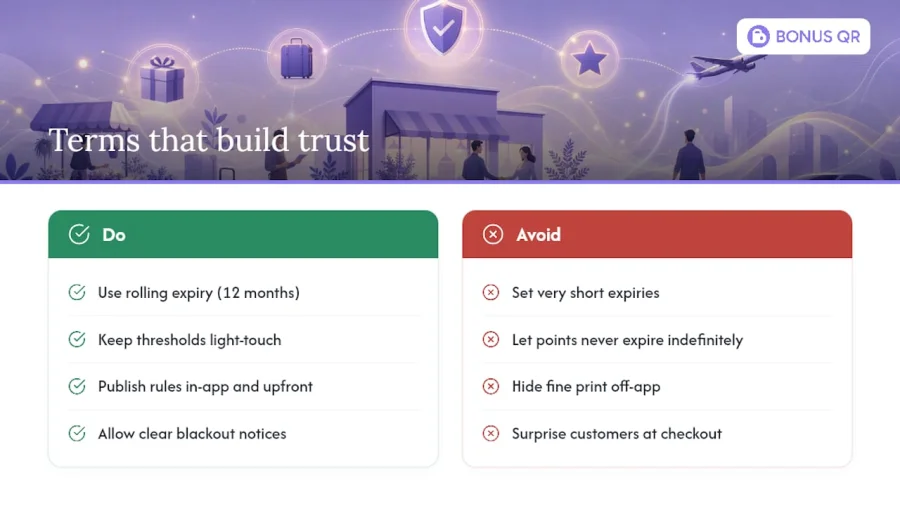
Expiration is the most consequential rule. Points that expire too quickly frustrate infrequent customers, while points that never expire can quietly inflate your liability for years. A rolling expiry, say twelve months from the last account activity, tends to strike a reasonable balance between protecting your books and giving customers a fair window to redeem.
Blackout periods, where certain redemptions are restricted during peak trading times, are more common in larger travel and hospitality schemes than SMB programmes, but the principle still applies at smaller scale: if a reward can’t be redeemed during your busiest period, say so clearly upfront rather than letting a customer discover it at the till.
Minimum redemption thresholds and category restrictions are worth keeping light‑touch. The more conditions attached to a reward, the more it starts to feel like a discount with paperwork rather than genuine appreciation. Whatever rules you set, publish them somewhere a customer can actually find them, inside the app itself rather than in a policy page nobody opens. Programmes that are upfront about their terms retain trust even when a rule occasionally disappoints someone; programmes that hide the fine print lose far more goodwill the first time a customer feels caught out.
Why relational rewards outperform pure discounts
EY’s research is blunt on this point: programmes that pair transactional points with relational elements, recognition, status, timely personal offers, retain customers longer than those built purely on discounting. A percentage off feels transactional; being remembered feels like loyalty earned both ways.
The recurring mistakes are predictable. Over‑complicated earning rules confuse customers into disengagement. Hard‑to‑reach redemption thresholds kill motivation before it starts. And ignoring the data your own points system generates means repeating the same design errors every quarter instead of correcting them.
— Michal
Get your loyalty programme running without the technical overhead
Bonusqr gives you a working alternative to hiring a developer or waiting on a POS vendor’s integration queue: a points system, stamp cards, and coupon management you can configure yourself, with no POS integration required to launch. That matters most in the first 90 days, when speed to market decides whether you capture the early adopters this article’s checklist depends on.
Start on the Free plan to test a simple points model, move to Basic at €19 per month or Premium at €69 per month as your redemption catalogue grows, and consider a white‑label app once you’re ready to put your own brand on the experience for a one‑off €690 setup fee. A bespoke build only makes sense once your programme has outgrown a configurable platform; most SMBs never reach that point. Check the pricing page and register a free account to see your first points programme live within a day.
Sources
- Reshaping customer loyalty programs | Deloitte Insights
- EY loyalty market study 2025
- Talon
- Digital Loyalty Programs vs Traditional: Which is Right for You? | Rivo
FAQ
What is credit card reward points in the context of a business loyalty programme?
In a business loyalty context, this phrase usually gets confused with a different concept, bank‑issued card rewards. What SMBs actually need is a customer loyalty points system: a currency your own business issues and controls to reward purchases, referrals, and other actions, redeemable for rewards you set yourself.
How do credit card rewards work compared with a business points programme?
Bank card rewards are issued and redeemed through a financial institution based on cardholder spending. A business loyalty points programme works differently. You control the ledger, decide the earning rules, and set redemption rewards directly, independent of any card network.
What are the best credit card reward programs for a small business to model?
For an SMB, the more useful reference point isn’t a bank card scheme but proven loyalty programme structures: simple points‑per‑purchase, visit‑based stamp cards, or tiered cashback. Deloitte’s research found 72% of consumers spend more with brands running programmes like these, which is the stronger signal to follow than any specific card scheme.
How much does it cost to set up a points programme with Bonusqr?
Bonusqr offers a Free tier to start, with Basic at €19 per month and Premium at €69 per month for more advanced features, all listed on the pricing page. A white‑label app carries a one‑off €690 setup fee plus an ongoing subscription for businesses planning to scale.
What’s the biggest mistake businesses make when redeeming and designing points programmes?
Making redemption difficult is the most common failure point. Talon.One’s guidance identifies poor redemption experience as the main reason members disengage, and platform data shows redeemers return at close to a 50% repeat rate against roughly 10.7% for non‑redeemers, a gap simplifying your redemption flow can close quickly.