
 Deutsch
 Español
 Français
 Italiano
 Magyar
 Polski
 Slovenčina
 Čeština
A single-use coupon is a uniquely identifiable code that expires the moment it is successfully redeemed, so no two customers (and no customer twice) can claim the same discount. Guidance from the OWASP Cheat Sheet Series makes clear that reliable single redemption depends on server-side recording and atomic operations, not just a clever code format. We build this logic into our coupon module.
TL;DR:
- Define whether each code works once overall or once per account before issuing it, because the two rules support different campaign designs.
- Use an atomic server transaction with a unique database constraint so simultaneous checkout requests cannot redeem the same code twice.
- For online orders, validate codes when the order is submitted; offline apps must reconcile redemptions with the server after reconnecting and reject duplicates.
- For forwarded or intercepted codes, set short validity windows and bind redemption to an account or phone number when possible.
- Before launch, test each delivery channel and simulate near simultaneous attempts against the same code to catch validation and concurrency failures.
What makes a single-use coupon different from a reusable code
A single-use coupon ties one unique identifier to one redemption event. Once a customer applies it successfully, the system marks it used and locks it out permanently, whether that customer tries again or shares the code with a friend. A reusable code, by contrast, might work for every customer in a mailing list, or for one customer across multiple visits, depending on how the merchant configures it.
The industry uses several overlapping terms for the same idea: one-time use discounts, temporary coupons, disposable coupons, and limited use promo codes all describe variations on single-use logic. Confusion usually creeps in around scope: a code can be single-use per code (one redemption, full stop) or single-use per account (one redemption per customer, even if the same code is distributed to thousands of people).
Merchants choose single-use codes for a handful of practical reasons:
- Tighter control over discount spend, since each code has a fixed, known liability.
- Cleaner attribution: you know exactly which customer, channel or campaign drove each redemption.
- Reduced fraud risk, because a leaked or screenshotted code becomes worthless after first use.
How single-use coupons are created and managed
Generating a single-use coupon usually means producing a unique token, either a fully random string or a structured one. Many platforms use a template plus variable part, something like WELCOME-7F3K9, where the prefix signals the campaign and the suffix guarantees uniqueness. Fully random tokens are harder to guess but harder to read aloud at a till, so most consumer-facing campaigns strike a balance between the two.
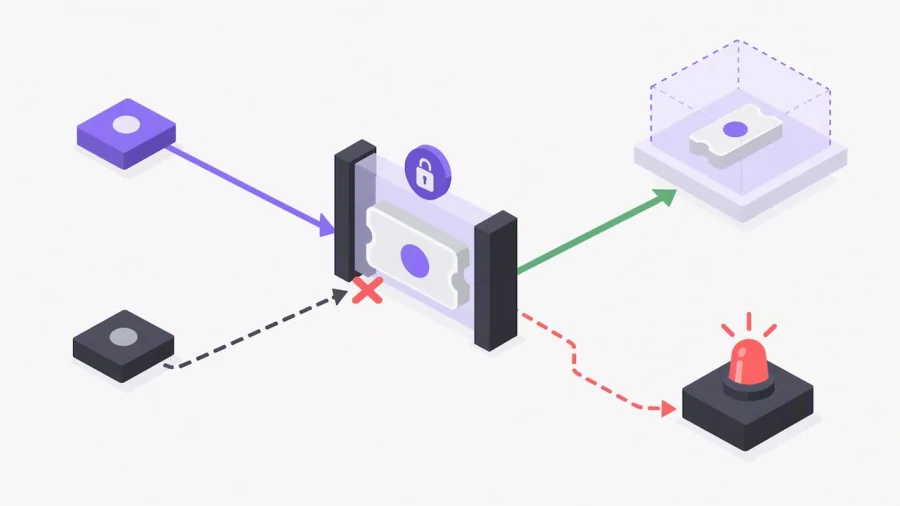
Behind the scenes, a coupon system typically tracks a lifecycle in three stages:
- Issuance: the code is generated, stored with its rules (expiry date, discount value, eligible products) and linked to a recipient or campaign.
- Redemption: a customer presents the code, the system validates it against its rules, then records the redemption as a permanent, timestamped event.
- Invalidation: the code is marked used, expired or revoked, and any further attempt to redeem it is rejected and logged.
Storage matters as much as generation. Each issued code needs a record that survives independently of the redemption attempt, so a crashed checkout or a dropped connection never leaves the system unsure whether a code was actually used.
When you are comparing tools, whether building in-house or picking a SaaS platform, look for a few features that separate reliable systems from fragile ones: bulk generation for large campaigns, API access for custom integrations, a full audit trail of every issuance and redemption, and straightforward export for reconciliation and accounting.
Pro Tip: Keep a separate “reserved but not yet issued” pool of codes for last-minute campaigns, so a marketing team never has to generate codes under time pressure.
Distribution channels and how to keep codes secure in transit
Email remains the most common channel for single-use coupons because it is cheap and trackable, though deliverability and inbox clutter can blunt its impact. SMS offers near-instant visibility and works well for time-sensitive events, but character limits make it harder to include terms. QR codes suit in-person and event redemption, letting a printed or on-screen code trigger an online validation check. Printed coupons still work for direct mail and in-store campaigns, while in-app delivery gives you the tightest control, since the code lives inside an authenticated account rather than a forwardable message.
Every channel carries some risk of interception, forwarding or accidental public posting, particularly when a code is shared on social media or a limited-time swimwear offer public coupon forum. A few practical controls reduce the exposure:
- Set short validity windows so a leaked code has little time to be exploited.
- Link a code to a specific device, account or phone number where the channel allows it.
- Add a lightweight second check at redemption, such as confirming the last four digits of a phone number or an account email.
How redemption works at the till, online, and in an app
The mechanics differ slightly by channel, but the underlying principle, validate before you discount, stays constant.
- Point of sale: the cashier scans or enters the code, the till sends a validation request to the server, and only once the server confirms the code is still valid does it apply the discount and mark the code redeemed.
- E-commerce checkout: the code is checked against its rules at the point of order submission, not just when it is typed into the box, which closes the gap where two browser tabs or a page refresh could trigger a double validation.
- Mobile app: offline-capable apps sometimes let a code be applied without a live connection, which means the redemption has to be reconciled against the server the moment connectivity returns, with any duplicate attempt rejected retroactively.
The most common failure point sits in that gap between “customer sees the discount applied” and “server permanently records the redemption.” If those two moments are not the same atomic step, a slow network or a retried request can let the same code slip through twice.
Stopping race conditions: idempotency and atomic redemption
A race condition in coupon redemption happens when two requests, often from the same customer refreshing a page or retrying a failed submission, both check a code’s status before either one marks it used. Both see “valid,” both proceed, and the merchant has given away the discount twice. This is a textbook time-of-check-to-time-of-use gap, and the OWASP Business Logic Security Cheat Sheet treats it as one of the most common ways a one-time operation ends up executing more than once.
The fix is to make the state change atomic. A database insert with a unique constraint on the coupon code, or an “insert on conflict do nothing” pattern, ensures that only the first redemption request can ever succeed; every later attempt simply fails against the same row. OWASP’s guidance on action limit overrun describes exactly this scenario and recommends deduplication at the persistence layer rather than relying on application-level checks alone.
Design the redemption path so the authoritative state change happens in one atomic server call. That is the core guardrail against double-redemption.
OWASP’s guidance notes that action limit overrun can allow a one-time operation to execute multiple times when systems lack atomic redemption and deduplication safeguards, which is why concurrency testing matters before a campaign goes live.
Before launching any high-volume campaign, it is worth running synthetic concurrency tests, firing near-simultaneous redemption attempts at the same code in staging, and setting up alerting that flags any duplicate redemption attempt in production so your team can investigate quickly.
Best practices: policy, terms and measurement
A clear coupon policy protects both the business and the customer, and it needs to say three things plainly: how long the code is valid, which products or services it covers, and whether it can be combined with other offers under your coupon stacking policy. Guidance drawn from retailer research compiled by Capital One Shopping treats these terms as contract terms in practice, which means they need to be visible at the point of purchase, not buried in a footnote.
Once a campaign is live, a handful of metrics tell you whether it is working:
- Redemption rate, to see how many issued codes actually convert.
- Fraud or duplicate-attempt rate, to catch abuse early.
- Incremental revenue, to judge whether the discount drove sales you would not otherwise have had.
Pro Tip: Run a small batch of test redemptions, including a deliberate double-attempt, before any campaign goes live, so you catch concurrency or validation bugs while the stakes are still low.
An operational checklist before launch should cover test redemptions across every channel you plan to use, a concurrency check on the redemption endpoint, and a reconciliation plan for matching issued codes against redeemed ones once the campaign closes.
What shoppers should know about single-use codes
Single-use codes typically arrive through a welcome email, a loyalty app notification, a referral link from a friend, or a printed receipt. They are easy to spot because they usually come with a clear expiry date and a note that they work only once.
- Keep the code private rather than posting it publicly, since it stops working the first time anyone redeems it.
- Apply it as soon as you intend to use it, since short validity windows are common.
- Contact support with your order number and the code itself if it is rejected unexpectedly, since that combination lets a merchant trace what happened.
How BonusQR supports single-use coupon campaigns
Our coupon distribution module handles the issuance and redemption logic described above, including in-app delivery, bulk generation and real-time analytics, without requiring POS integration. We designed our platform for rapid setup, so a small business can launch a secure single-use campaign alongside automated marketing and tracking from day one.
Pairing single-use coupons with loyalty programs
Single-use coupons work well as entry points into a wider loyalty structure rather than as standalone discounts. A welcome coupon, for instance, can be the first touch that gets a new customer into a points-based or stamp-card programme, where every subsequent visit builds toward a reward rather than relying on another one-off code.
Points systems and single-use coupons also complement each other on the redemption side. A customer might redeem a one-time code for a discount, and that same transaction can simultaneously add points toward their next reward, which keeps the relationship going instead of ending at the first purchase. Referral coupons fit the same pattern: a one-time code rewards the new customer, while a points credit rewards the person who referred them.
The technical requirement is the same atomic recording discussed earlier, extended to cover two systems rather than one. The redemption event needs to update the coupon’s status and the customer’s loyalty balance in the same transaction, so a failure partway through never leaves a customer with points credited for a coupon that was never actually marked used, or vice versa. Platforms that treat coupons and loyalty points as genuinely separate systems, rather than linked ledger entries, tend to struggle here, which is one reason it is worth checking how a tool handles that integration before committing to it.
Tracking coupon performance without losing the signal
A single-use coupon’s biggest practical advantage is clean attribution: because each code maps to one redemption, you can trace a sale back to the exact campaign, channel or customer that generated it, which is far harder with a shared promo code used by thousands of people.
Useful tracking goes beyond a simple redemption count. Breaking results down by distribution channel shows whether email, SMS or in-app delivery drove more conversions for a given campaign. Looking at time-to-redemption, how long customers wait between receiving a code and using it, helps you judge whether your expiry windows are sensible or needlessly tight. Comparing redemption rates across customer segments can also reveal whether a welcome offer is working better for first-time visitors than for lapsed customers you are trying to win back.
Research on targeted coupon issuance using machine learning shows that predictive models can materially improve which customers receive which codes, by estimating redemption likelihood before a coupon is ever sent, which raises campaign profitability compared with mass, untargeted distribution. You do not need a data science team to benefit from the same principle on a smaller scale: even basic segmentation, sending welcome codes to new sign-ups and win-back codes to dormant accounts, captures some of the same targeting logic.
Staying compliant: privacy and advertising rules for digital coupons
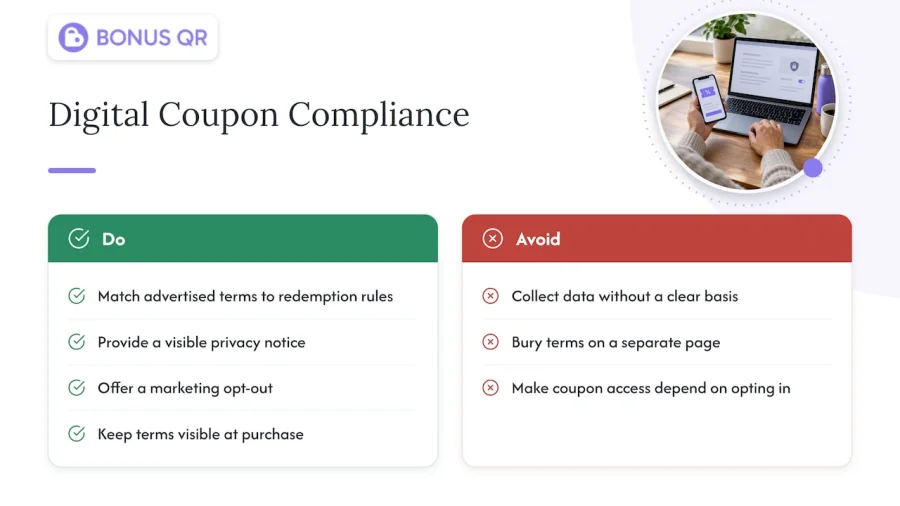
Digital coupons sit at the intersection of consumer protection and data privacy law, and the practical compliance burden falls into two areas. The first is advertising accuracy: a coupon’s advertised terms, discount value, expiry, eligible products, need to match what the system actually enforces at redemption, since a mismatch between the advertised offer and the applied discount is a straightforward deceptive-advertising problem in most jurisdictions.
The second is data privacy. Issuing a single-use coupon usually means collecting at least an email address or phone number, and sometimes purchase history to personalise the offer. That data collection needs a clear basis, a visible privacy notice, and a straightforward way for the customer to opt out of future marketing without losing access to a coupon they have already been issued. Coupon terms should be easy to find at the point of purchase, not buried in a separate terms page, which is also the standard that consumer research on coupon practices points to when it comes to validity periods and redemption limits. Keeping terms visible protects the customer and reduces the merchant’s exposure to disputes over coupons that did not work as advertised.
When a single-use coupon is actually the right tool
Single-use coupons earn their keep in events, referrals and controlled giveaways, where attribution and fraud control matter more than reach. Beyond that, weigh the control they give you against the friction they add for the customer.
— Michal
Get started with secure single-use campaigns on BonusQR
If you are weighing up building this redemption logic yourself against adopting a ready-made platform, our pricing page lays out where to start. The Free and Basic plans suit a single location testing its first welcome or referral campaign, while Premium adds the deeper analytics and automation that growing merchants tend to need.
Larger brands with multiple locations or an existing app presence often move toward our white-label setup, which puts coupon distribution, loyalty points and branded delivery under one roof without the engineering overhead of building atomic redemption logic from scratch. Whichever path fits your business, you can view our plans and get started today.
FAQ
What is a single use coupon?
A single-use coupon is a uniquely identifiable code designed to work for exactly one successful redemption, after which the system marks it used and rejects any further attempt. It differs from a reusable promo code, which can be applied by many customers or multiple times by the same customer.
Where do extreme couponers get the coupons?
Dedicated couponers typically gather codes from manufacturer websites, retailer loyalty apps, printed inserts in newspapers, and email sign-ups for brand newsletters. Many of these sources distribute single-use or limited-use codes rather than open, infinitely shareable discounts.
What is the best free coupon site?
There is no single site that suits every shopper, since availability and relevance depend heavily on which retailers and categories you shop most. Checking a retailer’s own app or loyalty programme directly, rather than a third-party aggregator, is usually the most reliable way to get a code that is still valid.
What companies will send you free coupons?
Retailers and brands across groceries, fashion, hospitality and wellness commonly send single-use welcome or referral coupons once you sign up for their email list or loyalty app. The exact offer and frequency vary by company and by how actively you engage with their marketing.