
 Deutsch
 Español
 Français
 Italiano
 Magyar
 Polski
 Slovenčina
 Čeština
Sustainable growth comes from pairing targeted acquisition with retention-first systems that lift customer lifetime value, not from chasing new sign-ups alone. Combine one strong acquisition channel, such as SEO, with one retention lever, such as a structured onboarding mission, and you build a business that keeps what it wins. Start this week by measuring your current customer acquisition cost (CAC) and customer retention rate (CRR).
TL;DR:
- Focusing solely on acquisition without implementing retention strategies can lead to growth that erodes profitability over time, especially if early customers churn quickly.
- Most effective channels are highly situational: SEO suits long-term growth, paid ads are quick but costly, and referrals and product-led growth often provide better customer quality and lower CAC.
- Segmenting customers and designing targeted onboarding and support improves retention, increases lifetime value, and reduces the risk of churn even for high-value accounts.
- Integrating acquisition and retention efforts into a unified growth loop, with shared KPIs and clear handoffs, significantly enhances overall performance and reduces siloed results.
- Measuring key metrics like customer lifetime value, churn, and net revenue retention is crucial for informed decision-making, with cohort analysis revealing hidden early-stage churn issues.
What is customer acquisition and retention strategy, and how do the two differ?
Customer acquisition covers everything you do to turn a stranger into a paying customer: the ad, the landing page, the sales call, the trial sign-up. Retention covers everything you do after that first purchase to keep the customer buying, renewing, or upgrading. They are measured differently, run by different teams in most businesses, and fail for different reasons, but they only work as a growth engine when you treat them as one system.
Here’s the confusion that costs businesses money: acquisition marketing gets the budget and the attention because its results are visible fast. A campaign launches, leads arrive, you can point to a number within a week. Retention work, like improving your onboarding sequence or launching a loyalty programme, pays off over months. That slower feedback loop is exactly why Harvard Business Review’s research on customer value found that retaining the right customers delivers greater long-term value than acquiring low-value ones through discounting or broad-reach ads. A Gartner survey backs this up directly: 73% of chief sales officers are now prioritising growth from existing customers for 2026 rather than pouring more budget into new-logo acquisition.
The industry term worth knowing is customer lifetime value (CLV): the total revenue a business can expect from one customer relationship. Acquisition determines how many customers you get. Retention determines how much each one is actually worth. Get the balance wrong, and you can grow your customer count while your business quietly loses money on every new sign-up.
High-impact customer acquisition strategies and how to choose between them
Most guides list acquisition channels as though they are all equally viable. They are not. The right channel depends on your CAC, your sales cycle, and how fast a new customer needs to see value before they churn.
The five channels that matter most:
- SEO and content: slow to build, cheap to sustain, and strong for high-intent searches. Best for businesses that can wait 3 to 6 months for compounding traffic.
- Paid search and social: fast to test, expensive to scale, and the quickest way to validate a message before committing budget elsewhere.
- Partnerships and events: high trust, low volume, and often the best CAC-to-quality ratio for B2B and local service businesses.
- Referral and affiliate programmes: customers acquired through referral tend to arrive with higher trust and lower CAC than cold channels, because online reviews and peer recommendation strongly shape buying decisions.
- Product-led growth: free trials, freemium tiers, or a limited free plan that lets the product sell itself before a sales conversation happens.
How to prioritise: run the numbers before you run the campaign.
- Calculate your current CAC per channel, if you have historical data, or estimate it from competitor benchmarks and ad platform cost-per-click data.
- Estimate time-to-value: how long from first touch to first purchase, and how long from first purchase to break-even on CAC.
- Rank channels by volume potential against CAC, not by which one is trendiest in your industry.
- Pick one channel to pilot with a fixed budget and a fixed test window, usually 4 to 6 weeks.
- Set one leading indicator to check weekly (click-through rate, cost per lead, trial sign-up rate) so you catch a failing test before the budget is gone.
Landing page optimisation, a well-built lead magnet, and a clean onboarding funnel all matter more than which channel you choose first. A gorgeous ad campaign feeding a confusing landing page wastes the entire spend. Test the page before you scale the channel.
Pro Tip: Run your first paid test with a budget you can afford to lose entirely. The goal of a pilot is information, not profit. If a £500 test tells you a channel’s real CAC before you commit £5,000, that test paid for itself.
Retention strategies that raise lifetime value and reduce churn
Retention work fails most often because it treats every customer the same way after the sale — but practical tactics for increasing repeat purchases and reducing churn show that segmenting customers and customizing retention efforts delivers better results. The businesses that raise CLV consistently do the opposite: they design deliberate stages for the first 30 days, ongoing support, and expansion, rather than hoping loyalty happens on its own.
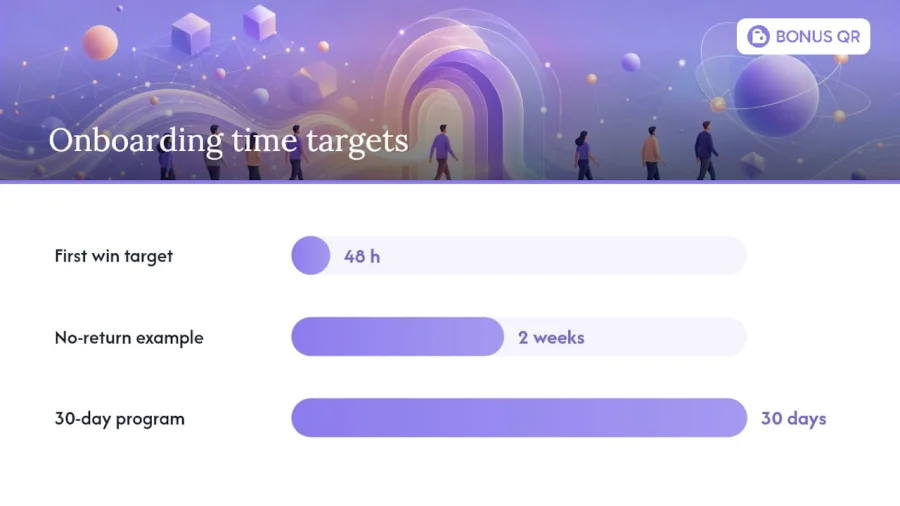
Onboarding and time-to-value. The single biggest lever most businesses underuse is compressing the time between purchase and the customer’s first genuine “win.” Break onboarding into small activation missions rather than one long setup process. A gym member who books their first class within 48 hours of joining behaves entirely differently to one who does not return for two weeks. Track milestones, not just sign-ups, and use in-product prompts or a simple welcome sequence to nudge customers toward that first success moment.
Customer success and proactive support. Waiting for unhappy customers to complain is a retention strategy built on hope. A basic health score, built from usage frequency, support tickets, and payment history, flags at-risk accounts before they cancel. Gartner’s retention guidance points specifically to warning signs of purchase regret in the weeks after a sale, which is exactly when a proactive check-in matters most. For higher-value accounts, a short executive check-in each quarter costs little and catches problems a support ticket never surfaces.
Loyalty programmes aligned to outcomes. A points system only works if the points map to behaviour you actually want more of. Options include:
- Tiered rewards that unlock better perks as spend or engagement increases, encouraging upgrades rather than one-off purchases.
- Referral incentives that reward customers for bringing in others, which lowers effective CAC on the acquisition side.
- Enablement rewards, particularly in B2B, where the reward is training, priority support, or early feature access rather than a discount.
Product engagement and education. Customers who understand more of what they bought use it more and leave less often. Certification programmes, feature-adoption email nudges, and simple in-app education all extend the relationship, especially for software or membership-based businesses where the product has more depth than a new customer ever discovers alone.
Why discounting backfires. Cutting price to keep a customer teaches them to expect a discount every time they think about leaving, and it trains your best customers, the ones who would have stayed anyway, to wait for a deal before renewing. Directive Consulting’s guidance on B2B loyalty programmes makes the case plainly: reward the behaviours tied to retention and expansion, not simple price cuts. A customer who gets faster support, more visibility, or better terms for their loyalty feels valued. A customer who just gets 10% off feels like they negotiated a discount, and negotiates one again next year. BonusQR’s retention strategies for businesses covers several of these mechanics in more tactical detail for retail and service settings.
Pro Tip: If you’re tempted to launch a blanket discount to stop churn, run one health-score segment through a non-discount lever first, like a personal check-in or an enablement reward, and compare renewal rates. The results usually settle the argument.
Integrating acquisition and retention into a growth loop
Treat acquisition and retention as separate departments and you get separate results: marketing hits its lead targets while customer success fights fires nobody warned them about. The businesses that grow fastest map the full lifecycle so that every acquisition touchpoint feeds directly into onboarding, and every retained customer feeds back into acquisition through referral.
Two example flows show how this works in practice:
- SEO lead to loyalty referral. A prospect finds a blog post through organic search, downloads a lead magnet, and enters a nurture sequence. On purchase, they’re immediately enrolled in a structured onboarding mission with a 7-day activation goal. Once they hit a usage milestone, an automated prompt invites them into a referral programme, and the resulting referred customer arrives with a warmer intent and a lower CAC than the original SEO lead.
- Paid trial to expansion account. A free trial user signs up via a paid social ad. Onboarding tracks their first three actions inside the product. A customer success playbook triggers if they stall, and a tiered loyalty reward triggers if they hit power-user thresholds, nudging them toward an upgrade rather than a cancellation at renewal.
Neither flow works if marketing, sales, and customer success operate from different dashboards with different definitions of success. Align on shared KPIs, activation rate, 90-day retention, and referral rate as a minimum, and build clear handoff points: when does a lead become a customer success has actually agreed to inherit? Businesses that skip this step end up with acquisition data that never reaches the retention team, and retention wins that never feed back into the acquisition funnel that could use them.
Metrics, formulas and dashboards to measure success
Guesswork is the main reason acquisition and retention efforts drift apart. The formulas below take minutes to calculate and tell you more than most dashboards do.
The five numbers that matter:
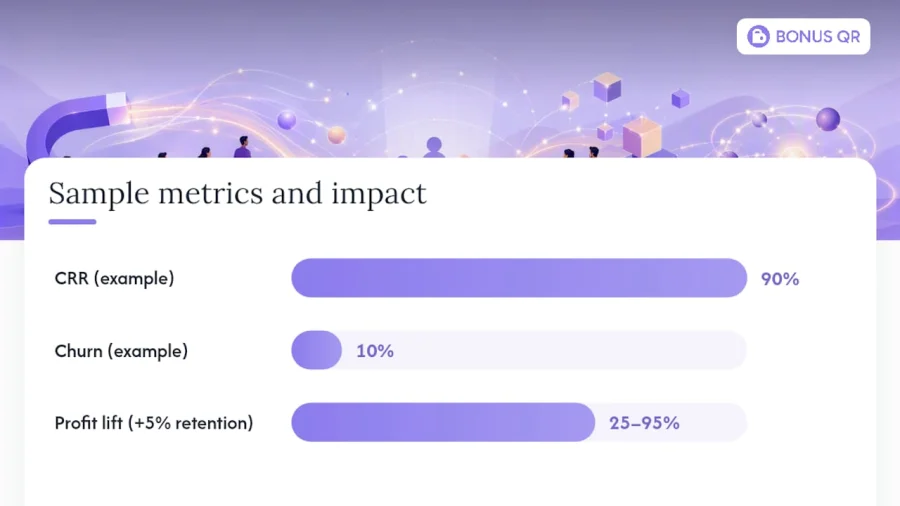
- Customer Retention Rate (CRR): ((customers at end of period − new customers acquired during period) ÷ customers at start of period) × 100. If you started the quarter with 200 customers, gained 40, and ended with 220, your CRR is ((220 − 40) ÷ 200) × 100 = 90%.
- Churn Rate: 100% minus CRR, or calculated directly as customers lost ÷ customers at start of period. A 10% churn rate on the example above matches the 90% CRR.
- Customer Lifetime Value (CLV): average purchase value × purchase frequency × average customer lifespan. A customer spending £50 a month for an average of 24 months has a CLV of £1,200.
- Customer Acquisition Cost (CAC): total sales and marketing spend ÷ number of new customers acquired in that period.
- Net Revenue Retention (NRR): (starting revenue + expansion revenue − churned revenue − downgrade revenue) ÷ starting revenue × 100. Anything above 100% means existing customers are growing revenue faster than they’re shrinking it.
Which of these to prioritise depends on your business model. Transactional retail businesses should watch CRR and repeat purchase frequency closely, since a single lost customer barely dents revenue but a falling repeat rate signals a real problem. Subscription businesses live and die by churn rate and NRR, since both compound monthly. B2B contract businesses should track NRR above all else, because expansion and downgrade inside existing accounts often moves the needle more than new-logo wins.
Cohort analysis, tracking a group of customers who joined in the same month against how many remain active each month after, catches slow-building churn problems before the aggregate numbers show them. A business with 90% CRR overall can still be hiding a cohort that churns at twice that rate within its first 60 days, and the aggregate number will hide it for months.
The business case for retention, in one number: a commonly cited Bain-derived industry finding suggests a 5% increase in customer retention can lift profit by 25% to 95%, depending on the industry. Even at the conservative end, that dwarfs what most acquisition campaigns return on the same budget.
How to design a loyalty programme that supports specific retention outcomes
A loyalty programme built without a target outcome is just a discount scheme with extra steps. Start by naming the outcome you need, renewals, account expansion, or referrals, and only then choose the mechanics that drive it.
A five-step framework for building one that works:
- Pick the outcome first. Renewal-focused programmes reward continued usage and tenure. Expansion-focused programmes reward upgrades and cross-buying. Referral-focused programmes reward advocacy directly.
- Choose mechanics that map to that outcome. Tiers suit renewal and expansion goals, since customers climb by staying and spending. Missions suit activation and early engagement. Referral rewards suit advocacy directly, and Directive Consulting’s B2B loyalty framework argues these should reward business-value behaviours, like adoption or referral, rather than simple points-per-purchase.
- Get the operational basics right before launch. Integrate the programme with your CRM or customer data so rewards trigger automatically rather than through manual tracking, since practical B2B loyalty guidance consistently points to CRM integration as the difference between a programme that scales and one that dies in a spreadsheet. Rules need to be visible and simple enough that a customer can explain them back to you in one sentence.
- Choose a small, representative pilot group. Pick 20 to 50 accounts that reflect your typical customer, not your best ones, so the results generalise.
- Set a measurement plan before launch, and a review cadence after. Track the retention or referral metric the programme targets weekly for the first month, then monthly, and adjust mechanics rather than abandoning the programme at the first flat week.
Pro Tip: Before you brief a vendor or build anything, write the customer-facing rules of your loyalty programme on a single page. If you can’t explain the mechanics in five sentences, your customers won’t understand them either, and an unclear programme drives no behaviour at all.
BonusQR’s guide to top retention strategies for small businesses walks through several of these mechanics with sector-specific examples if you want to go deeper before choosing a platform.
90-day implementation checklist and common pitfalls
Prioritise by impact against effort, not by whichever idea got mentioned last in a meeting.
- Days 1 to 30 (quick wins): calculate your current CAC, CRR, and CLV; assign an owner for each metric; fix the single weakest point in your onboarding sequence.
- Days 31 to 60 (build): pilot one acquisition channel with a fixed budget; launch a basic health-score system for at-risk accounts; brief a loyalty mechanic tied to one clear outcome.
- Days 61 to 90 (scale and review): review pilot results against the leading indicators you set; scale what worked; kill or rebuild what didn’t; set a quarterly cadence for reviewing all five metrics together.
The most common pitfall is measuring acquisition and retention on separate timelines, so nobody notices a channel bringing in customers who churn within 60 days. The second is defaulting to discounts when a health score flags risk, which teaches customers to expect one. The third is running marketing, sales, and customer success as silos with no shared dashboard, which means a marketing “win” and a retention “loss” never get connected to the same customer.
A practitioner’s view on retention-first growth
Most businesses treat retention as an afterthought, something the support team handles once marketing has done the “real” work of bringing customers in. That ordering is backwards. Retention is the more defensible growth lever precisely because it compounds: a customer retained this quarter is still contributing to CLV next quarter, and to referral value the quarter after that. Acquisition wins reset to zero the moment you stop spending.
The businesses getting this right in 2026 are the ones building retention systems before they scale acquisition spend, not after churn forces the conversation. For sector-specific playbooks on how this plays out across retail, hospitality, and services, BonusQR’s strategies for growing customer retention is worth a look.
— Michal
Getting your loyalty programme running without the technical overhead
Everything covered above, tiered rewards, activation missions, referral incentives, health-score triggers, needs a system behind it, and most small and mid-sized businesses don’t have the engineering time to build one from scratch. A working loyalty programme can be live without POS integration or a development team by using configurable modules such as stamp cards, points, cashback tiers, and referral rewards that you switch on rather than build.
It suits businesses that want to test a retention mechanic properly, retailers, cafés, gyms, hotels, and service businesses, before committing budget to something bigger. Start on the Free plan or compare Basic and Premium tiers to see what fits your customer volume, and if you need a branded app rather than a shared platform experience, the white-label setup gets you there for a one-off fee. Larger teams needing something fully bespoke can look at custom app development instead. Check the pricing page and pick the tier that matches where your loyalty programme actually needs to start.
Sources
- Gartner press release: 73 percent of CSOs prioritising growth from existing customers
- Harvard Business Review: The value of keeping the right customers
- Pew Research: Online reviews
- Directive Consulting: How to build a B2B loyalty programme
FAQ
What is the difference between customer acquisition and retention?
Acquisition is the process of turning a prospect into a first-time paying customer, through channels like SEO, paid ads, or referrals. Retention is everything that happens after that first sale to keep the customer buying, renewing, or upgrading, and it’s what determines whether acquisition spend actually pays off.
How do you calculate customer retention rate?
Customer Retention Rate is calculated as ((customers at end of period minus new customers gained) divided by customers at start of period) multiplied by 100. A business that starts a quarter with 200 customers, gains 40, and ends with 220 has a CRR of 90%.
Why is customer retention more important than acquisition?
Retention isn’t more important than acquisition, but it’s more profitable per pound spent, since retaining the right customers delivers greater long-term value than constantly replacing churned ones with low-value new sign-ups. A commonly cited industry estimate suggests a 5% retention improvement can lift profit by 25% to 95%, which few acquisition campaigns can match.
What does a good loyalty programme need to include?
A good loyalty programme starts with one clear outcome, renewal, expansion, or referral, and picks mechanics like tiers, missions, or referral rewards that map directly to it. It also needs CRM or customer-data integration so rewards trigger automatically rather than through manual tracking.
How much does BonusQR cost for a small business loyalty programme?
BonusQR offers a Free plan alongside Basic at €19 per month and Premium at €69 per month, with full details on the pricing page. Businesses wanting a branded app can add a one-off white-label setup fee of €690, or a €69 per month subscription, as listed on the white-label page.