
 Deutsch
 Español
 Français
 Italiano
 Magyar
 Polski
 Slovenčina
 Čeština
Build a unified customer profile that links online and offline behaviour, optimise the post-purchase window with automated follow-ups and reward triggers, choose a flexible loyalty platform that works without POS integration, and run a small measurable pilot before scaling. Those four moves, done in sequence, produce the fastest retention gains for retail and service businesses across Central Europe.
- Unify customer identity: Connect in-store and online transactions under one profile so offers are relevant wherever the customer shops.
- Optimise post-purchase touchpoints: Order tracking messages, automated thank-you notes, and near-term reward triggers are the single most effective window for reducing churn.
- Choose a flexible platform: Look for mobile and web integration, stamp card and points support, and no-POS onboarding. Bonusqr covers all of these.
- Pilot before scaling: Start with a digital stamp card or simple points mechanic, collect 3–6 months of clean first-party data, then iterate.
Why digital loyalty matters in Central Europe right now
Central European eCommerce is growing steadily at around 8% annually, and the primary growth driver is buying frequency, not new customer acquisition. Retaining existing customers and increasing how often they purchase has become the decisive competitive factor across the region.
Mobile penetration reinforces this. In Poland, mobile devices account for 64.67% of eCommerce transactions, with Romania at 73.85% and Hungary at 60.82%. Any loyalty programme that is not mobile-first is already behind.
Stat to know: A significant share of Polish consumers ranked exclusive pricing as their top loyalty driver, making tangible, price-led rewards far more effective in Poland than aspirational tier structures or experience-based perks.
Price sensitivity across CEE, particularly in Poland, means generic personalisation underperforms. Shoppers want to see clearly how much a programme saves them. BOPIS (buy online, pick up in store), local payment methods like BLIK, and mobile-first checkout are the tactical priorities that convert browsers into repeat buyers.
First-party data is also increasingly strategic. As third-party cookies decline, loyalty programmes become one of the few reliable sources of consented, high-quality customer data. Starting your programme now means building that asset before competitors do.
Pro Tip: In Poland, lead every loyalty communication with a clear savings figure. “You saved 45 PLN this month” outperforms “You’re a Gold member” every time.
Core engagement strategies and why each one works
Programme types: when to use each
Different mechanics suit different business types and customer relationships:
- Digital stamp cards: Lowest friction, fastest adoption. Ideal for cafés, bakeries, and service businesses where repeat visits are frequent and the reward is simple (a free item or discount after X visits).
- Points systems: Better for higher-basket retail where customers want to accumulate value over time. Points are visible, motivating, and easy to understand.
- Tiered cashback: Effective for grocery, pharmacy, and fuel retail where purchase frequency is high and price sensitivity is strong. Tiers reward your best customers without discounting to everyone.
- Fixed discounts: Straightforward and trusted in price-sensitive markets. Works well as an onboarding incentive or win-back offer.
- Referral incentives: High-ROI for service businesses and subscription models. A referred customer typically has higher lifetime value than one acquired through paid channels.
Omnichannel identity and post-purchase engagement
A loyalty programme is most valuable when it becomes the identifier customers use across every channel, making points visible and redeemable everywhere to drive both recognition and data capture. The technical challenge is connecting POS and e-shop data without expensive custom engineering. A platform that normalises events from multiple sources solves this without a large IT project.

Post-purchase engagement is where retention is won or lost. Order tracking, clear communication, and follow-up rewards are the critical interactions that turn a one-time buyer into a regular. Automate a thank-you message within 24 hours, attach a small near-term reward (redeemable within 14 days), and follow up with a review or survey request. That three-step sequence alone measurably lifts repeat purchase rates.
Segmentation and communication mix
Start with transactional data (stamps, points earned, purchase frequency) for the first 3–6 months before layering in behavioural segmentation. Clean first-party data is the prerequisite for personalisation that actually works. The Kobie 2026 Heart of Loyalty Report found that 77% of consumers want to feel recognised, and rewards strongly influence willingness to share data, but that recognition has to be earned through relevance, not assumed.
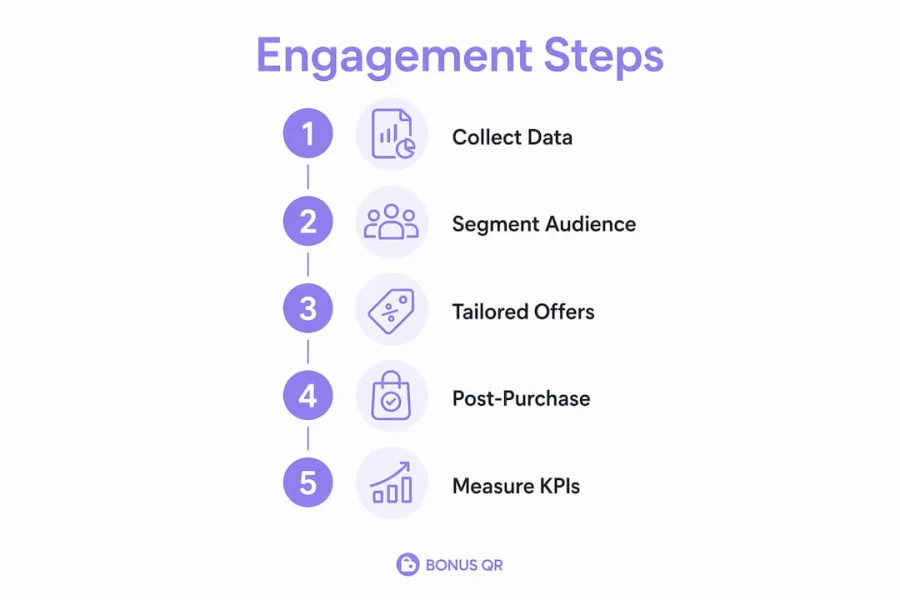
For communication channels, app push notifications drive opens but cause app deletion when overused. Event-triggered messages (post-purchase thank-you, shipping update, birthday reward) consistently outperform broadcast blasts. SMS works well in markets where app adoption is lower; email remains effective for longer-form offers and tier updates.
Pro Tip: Use a maximum of two push notifications per week per customer. Tie each one to a specific event or reward trigger, never to a general promotional calendar.
Reward structure must reflect local drivers: in price-sensitive markets, prioritise exclusive pricing or discounts; in convenience-oriented markets, prioritise speed and low-friction rewards.
How to build your 30/90/180-day launch plan
A staged rollout reduces risk and produces the clean data you need to make good decisions at each phase.
- Days 1–30 (Define and pilot): Set measurable goals (target repeat purchase rate, redemption rate). Choose one or two pilot locations or channels. Launch a single, simple mechanic, a digital stamp card or a points-per-purchase system. Set up basic post-purchase automation (thank-you message plus a reward trigger).
- Days 31–90 (Measure and automate): Collect first-party transaction data. Measure early retention lift against a control group. Automate the full post-purchase sequence. Gather qualitative feedback from staff and customers.
- Days 91–180 (Refine and scale): Add tiering or cashback for your highest-frequency customers. Expand to additional channels (SMS, email, in-store prompts). Integrate loyalty data with your marketing automation. Review cohort retention and adjust reward values.
Typical costs and staffing
| Phase | Typical monthly cost | Staffing requirement |
|---|---|---|
| Pilot (1–2 locations) | Free to low-tier subscription | 1 manager, part-time |
| Growth (3–10 locations) | Mid-tier subscription | 1 dedicated coordinator |
| Scale (10+ locations or white-label) | Premium or custom | Marketing + IT support |
Bonusqr’s modular pricing, including a free tier, means a single-location pilot carries minimal financial risk. Staff training at pilot stage should cover how to explain the programme at checkout, how to handle common customer questions, and how to flag technical issues within the first two weeks.
What to look for when choosing a loyalty platform
Feature checklist
- Digital stamp cards and points systems
- Tiered cashback and fixed discount modules
- Coupon and reward management
- Referral and review modules
- Apple Wallet and Google Wallet support
- Push and email notification automation
- Real-time analytics and cohort reporting
- No-POS onboarding option
- E-shop and booking widget compatibility
- Local payment method support (including BLIK for Poland)
Mobile-friendly payments and digital wallets increase conversion and repeat purchases. A loyalty programme without local payment support risks low redemption rates regardless of how well the rest of the programme is designed.
Questions to ask any vendor
- How long does onboarding take without POS integration?
- Who owns the customer data, and can you export it at any time?
- Is the platform GDPR-compliant, and where is data stored?
- What are the pricing tiers, and what triggers an upgrade?
- Is a white-label or custom app available if you scale?
Pro Tip: Ask vendors for a no-POS rollout case study. A platform that cannot show you a fast, clean example of a setup without POS integration will slow your pilot significantly.
For retailers evaluating options, Bonusqr’s retail loyalty application covers every item on the checklist above, including no-POS onboarding and local payment integrations relevant to CEE markets. For service businesses, the services loyalty application addresses sector-specific needs such as appointment-based rewards.
Which KPIs should you track, and what counts as an early win?
Core metrics
| KPI | What it measures | Early win threshold |
|---|---|---|
| Repeat purchase rate | Share of customers who return within 90 days | 5–10% lift vs. control group |
| Redemption rate | Rewards claimed as a share of rewards issued | Above 20% in first 90 days |
| Churn reduction | Drop in customers lost month-on-month | Measurable decline by month 3 |
| Customer lifetime value (CLTV) | Revenue per customer over their full relationship | Upward trend by month 6 |
| BOPIS attachment rate | In-store pickups from online orders | Relevant for omnichannel pilots |
Measurement methods
Run a control group from day one. Assign a portion of eligible customers to a non-loyalty group and compare repeat purchase rates, average order value, and churn at 30, 60, and 90 days. Cohort analysis, grouping customers by their first purchase month, shows whether retention improves over successive cohorts as you refine the programme.
Qualitative feedback matters too. A short two-question survey at redemption (“Was this reward easy to use?” and “Would you recommend this programme?”) surfaces friction points that quantitative data misses.
Stat to note: The Kobie 2026 Heart of Loyalty Report found that a considerable portion of consumers are willing to engage with AI-driven loyalty features when the value exchange is clear, but only when the value exchange is clear and transparent. Use that readiness gradually, after you have clean first-party data to validate recommendations.
For broader tactics on increasing eCommerce sales alongside your loyalty programme, pairing retention mechanics with conversion optimisation produces the strongest combined results.
Campaign templates and messages you can use today
Onboarding sequence
- Welcome message (Day 0): “Welcome to [Programme Name]. You’ve already earned your first stamp. Visit us again before [date] and get [reward].” Keep it short, show the value immediately.
- First reward prompt (Day 3–5): “You’re halfway to your first reward. Here’s what’s waiting for you: [reward description].” Reinforce progress.
- Progressive data request (Day 7–10): “Tell us your birthday and we’ll send you a surprise.” Collect data incrementally, not all at once.
Post-purchase sequence
- Order confirmation (immediate): Include tracking link and expected delivery window.
- Thank-you with reward (24 hours after purchase): “Thank you for your order. As a loyalty member, you’ve earned [X points / 1 stamp]. Redeem your next reward here: [link].”
- Review request (5–7 days after delivery): “How was your experience? Leave a review and earn [bonus reward].”
Lifecycle templates
- Birthday reward: Send 3 days before the birthday. Offer a fixed discount or bonus points valid for 7 days.
- Tier promotion: “You’re 2 visits away from [next tier]. Here’s what you unlock.” Send when the customer is close to a threshold.
- Win-back offer: For customers inactive for 60+ days, send a time-limited exclusive discount. One message only; do not repeat.
- Referral incentive: “Refer a friend and you both get [reward].” Send after the third purchase, when the customer has demonstrated genuine engagement.
Pro Tip: In Poland, always state the monetary value of the reward explicitly (e.g., “worth 20 PLN”) rather than describing it in points or abstract terms. Tangible savings language converts significantly better in price-sensitive markets.
For more on post-purchase customer engagement, the sequence above can be adapted to both retail and service contexts.
- Localise every template: Polish audiences respond to savings figures; Czech and Hungarian audiences respond to convenience and speed.
- Avoid sending more than two notifications per week per customer.
- Always include a clear opt-out link in every message.
Common pitfalls, GDPR checklist, and red flags to watch for
Common pitfalls
- Notification overload: Push notifications drive app opens, but excessive notifications cause app deletion. Stick to event-triggered messages only.
- Skipping the data foundation: Deploying AI personalisation before you have 3–6 months of clean first-party data produces irrelevant recommendations and erodes trust.
- Siloed POS and e-shop data: If your in-store and online systems do not share a unified customer record, your loyalty programme will issue duplicate rewards and miss cross-channel behaviour entirely.
- Ignoring local value drivers: Mobile loyalty often fails where local preferences are ignored. A programme built for a Western European market and dropped into Poland without adaptation will underperform.
GDPR checklist for CEE loyalty programmes
- Establish a lawful basis for processing loyalty data (typically legitimate interest or explicit consent).
- Obtain explicit consent before sending marketing communications.
- Define and document retention periods for customer data.
- Publish a clear, plain-language privacy notice linked from your programme sign-up.
- Implement data subject rights: access, rectification, erasure, and portability.
- Confirm where data is stored and whether any cross-border transfers occur; document adequacy decisions or standard contractual clauses.
- Review your vendor’s data processing agreement before signing.
A loyalty programme without GDPR compliance is a liability, not an asset. In CEE markets, regulators in Poland (UODO) and the Czech Republic (ÚOOÚ) have both issued fines for inadequate consent mechanisms in marketing programmes.
Pro Tip: Make data portability easy from day one. Choose a platform that lets you export your full customer dataset in a standard format (CSV or JSON) at any time. Opaque data ownership is the single biggest red flag in vendor selection.
Red flags in vendor selection
- No data export or portability option
- Unclear ownership of customer data in the contract
- No event-triggered automation (only broadcast messaging)
- Limited or no local payment integrations for CEE markets
- No GDPR data processing agreement available
Your 30/90/180-day quick checklist
Days 1–30
- Define your primary KPI (repeat purchase rate or redemption rate).
- Select one or two pilot locations or channels.
- Choose a single reward mechanic: digital stamp card or points per purchase.
- Set up post-purchase automation: thank-you message and reward trigger.
- Train floor staff on how to explain the programme and handle questions.
- Establish a control group for measurement.
Days 31–90
- Monitor redemption rate and repeat purchase rate weekly.
- Run a two-week technical check to catch integration or notification issues early.
- Collect qualitative feedback from customers and staff.
- Automate the full post-purchase sequence (confirmation, thank-you, review request).
- Review cohort data at day 60 and adjust reward values if redemption is below 20%.
Days 91–180
- Add a second mechanic (tiered cashback or referral incentive) based on pilot data.
- Expand to additional channels (SMS, email, in-store prompts).
- Integrate loyalty data with your email marketing or CRM platform.
- Plan a customer retention workflow review at the 180-day mark.
- Set targets for the next six months based on cohort retention trends.
Key takeaways
Digital loyalty in Central Europe works when you start simple, measure rigorously, and localise rewards to match what customers in each market actually value.
| Point | Details |
|---|---|
| Start with first-party data | Run a simple stamp card or points pilot for 3–6 months before adding personalisation or AI features. |
| Post-purchase is the priority | Automated thank-you messages and near-term reward triggers are the highest-impact retention tool available. |
| Localise for CEE markets | In Poland, lead with savings figures; in other CEE markets, prioritise convenience and low-friction redemption. |
| Measure with cohort analysis | Compare loyalty vs. control groups at 30, 60, and 90 days; a 5–10% lift in repeat purchase rate is a strong early signal. |
| Bonusqr fits the CEE checklist | Stamp cards, points, cashback, coupon management, no-POS onboarding, and Apple/Google Wallet support are all available on the platform. |
What implementing loyalty in CEE actually teaches you
The most common mistake I see is treating a loyalty programme as a technical project rather than an organisational one. You can configure a platform in a day. Getting your checkout staff to mention the programme consistently, getting your marketing team to use the data it generates, and getting your operations team to honour rewards without friction, that takes deliberate change management.
The second lesson is patience with data. Three to six months of clean transactional data sounds like a long time when you are eager to personalise. But the retailers who skip that foundation and jump straight to AI-driven recommendations end up with irrelevant offers that erode trust faster than no programme at all. Early rewards should change behaviour, specifically repeat visit frequency and basket size, not just generate sign-ups.
The third is that Central Europe is not one market. A programme that works in Warsaw needs meaningful adaptation for Prague or Budapest. Flexible templates, modular mechanics, and a platform that lets you adjust reward values and communication cadence by location are not optional extras. They are what separates a programme that grows with your business from one you rebuild in 18 months.
Bonusqr gives you a practical starting point for CEE retail
The fastest way to get a loyalty pilot running in Central Europe, without a POS integration project or a long procurement cycle, is to use a platform built for exactly that context. Bonusqr covers every item on the feature checklist in this guide: digital stamp cards, points systems, tiered cashback, coupon management, push and email automation, Apple Wallet and Google Wallet support, and no-POS onboarding that gets you live within days.
The modular pricing, including a free tier, means you can run a genuine single-location pilot without a financial commitment. White-label and custom app options are available when you are ready to scale. Explore the full loyalty platform features and start your 30-day pilot today.
Further reading and sources
- Kobie 2026 Heart of Loyalty Report — consumer attitudes to AI, recognition, and data sharing in loyalty programmes.
- Mastercard: The state of eCommerce in Central Europe — post-purchase engagement, mobile payments, and retention trends across CEE.
- Balkan eCommerce Summit: Omnichannel retail in the CEE region — unified profiles, BOPIS, and local payment integrations.
- Droids On Roids & Apadmi: Mobile Customer Loyalty Report 2026 — Polish consumer loyalty preferences, notification behaviour, and market-by-market breakdown.
- Google: Winning strategies for CEE markets — Polish consumer shopping behaviour, price sensitivity, and channel preferences.
- Balkan eCommerce Summit: eCommerce best practices in the CEE region — localisation, payment optimisation, and mobile conversion benchmarks.
- Bonusqr: 12 best retail loyalty programmes to watch in 2026 — examples and case studies of effective loyalty programme design.
- Searchoneers: Ways to increase sales for eCommerce stores in 2026 — conversion optimisation tactics to run alongside your loyalty programme.