
 Deutsch
 Español
 Français
 Italiano
 Magyar
 Polski
 Slovenčina
 Čeština
A points-based loyalty workflow is a structured process where your business rewards customers with points for defined actions, which they then redeem for discounts, products, or perks. The industry term for this is a points reward system, and it sits at the heart of most modern customer retention strategies. Points-based programmes are the most common and flexible loyalty type, allowing businesses to reward shopping, reviews, referrals, and milestone events. For small and medium-sized businesses, a well-designed workflow turns one-off buyers into repeat customers without requiring a large marketing budget. Done correctly, it directly improves purchase frequency, average basket size, and long-term revenue.
What is a points-based loyalty workflow?
A points-based loyalty workflow defines every step between a customer taking an action and receiving a reward. It covers how points are earned, tracked, communicated, and redeemed. Understanding each stage is what separates a programme that drives real sales from one that simply collects sign-ups.
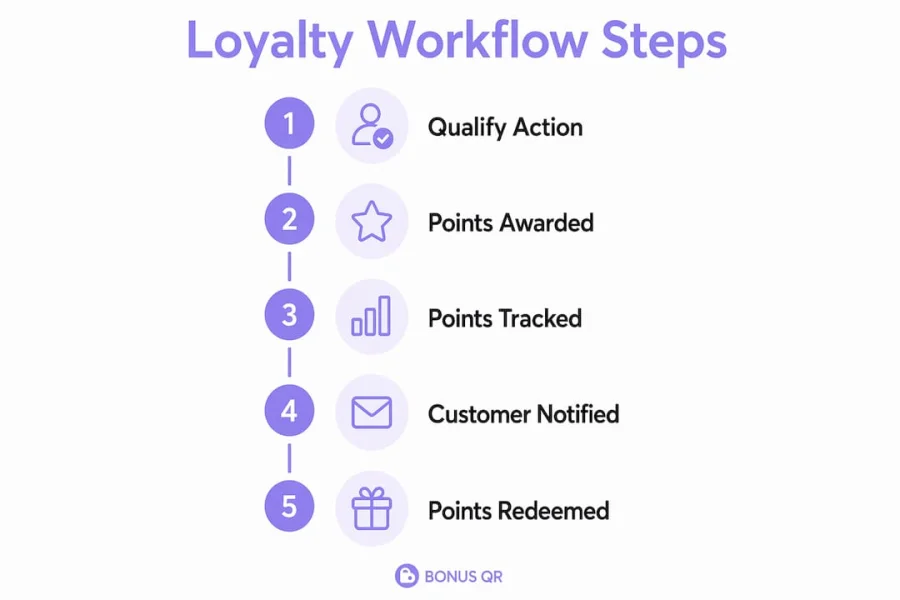
The workflow typically follows five stages. First, a customer completes a qualifying action such as a purchase, a product review, or a referral. Second, the system automatically calculates and awards the correct number of points. Third, the customer receives a notification confirming their balance. Fourth, the customer chooses to redeem points against a future purchase or reward. Fifth, the system updates the balance and records the transaction for reporting.

Loyalty programme automation of these operational tasks is what makes the workflow sustainable at scale. Manual point tracking is error-prone and time-consuming. Automation removes both problems and gives you reliable data to act on.
What are the key components needed to set up a points-based loyalty workflow?
A loyalty points system setup requires four core components working together: a points engine, a customer database, a communication layer, and a redemption mechanism. Missing any one of these creates gaps that frustrate customers and erode trust.
Technical infrastructure
Your points engine must calculate awards automatically at the point of sale or interaction. Around two-thirds of loyalty members use mobile applications to engage with programmes. That figure means mobile optimisation is not optional. Your system needs a mobile-ready interface, whether that is a branded app or a web app customers access from their phones.
POS integration is the most common technical requirement for retail businesses. Bonusqr removes this barrier entirely. The platform requires no POS integration, which means you can launch a points programme without touching your existing till system.
Reward structure and earning rules
Clear earning rules prevent customer confusion. The most effective loyalty points setup guides recommend keeping ratios simple and legible. A ratio like 100 points = £5 is far more effective than an awkward ratio like 73 points = £3.65. Customers who cannot quickly calculate the value of their points disengage.
Define which actions earn points before you launch. Common earning triggers include:
- Purchases above a set spend threshold
- Writing a verified product review
- Referring a friend who completes a purchase
- Visiting your business a set number of times
- Completing a profile or opting into communications
Essential setup requirements at a glance
| Component | What you need | Why it matters |
|---|---|---|
| Points engine | Automated calculation at checkout | Removes manual errors and saves staff time |
| Customer database | Unique customer profiles with purchase history | Enables personalisation and segmentation |
| Communication layer | Push notifications, email, or SMS | Keeps customers informed and engaged |
| Redemption mechanism | In-app or in-store reward claim process | Closes the loop and drives repeat visits |
| Reporting dashboard | Real-time analytics on points issued and redeemed | Lets you measure ROI and adjust rules |
Pro Tip: Set your minimum redemption threshold low enough that customers reach it within two or three visits. A reward that takes six months to earn does not change behaviour.
How to design a points-based loyalty workflow that drives real customer engagement?
Membership numbers are a vanity metric. Experts warn that concentrating solely on growing membership without tracking engagement metrics leads to margin erosion and wasted spend. The right design focuses on business KPIs from day one.
Set KPIs before you build
Your loyalty points setup guide should start with measurable goals, not features. Useful KPIs for an SME include:
- Purchase frequency: How often does a loyalty member buy compared to a non-member?
- Average basket size: Do members spend more per visit?
- Redemption rate: What percentage of issued points are actually redeemed?
- Churn rate: How many members stop engaging after 90 days?
Tracking customer engagement metrics like these tells you whether your programme is working or simply accumulating dormant accounts.
Reward behaviours beyond spending
A points reward system that only rewards purchases misses significant engagement opportunities. Rewarding reviews builds social proof. Rewarding referrals reduces your customer acquisition cost. Rewarding visits on quiet days shifts demand to times that suit your business. Each of these behaviours has a direct commercial value, and your workflow should reflect that.
Personalisation strengthens engagement further. A customer who buys coffee every morning responds differently to a “double points on pastries” offer than a customer who visits once a fortnight. Segment your audience by purchase behaviour and send relevant offers rather than blanket promotions.
Timing your communications correctly
Triggered messages such as “You are 20 points away from a reward” emails are one of the most effective tools in a loyalty workflow. They create urgency without discounting. They remind customers of value they have already earned. Send these messages at the moment a customer is closest to a redemption threshold, not on a fixed weekly schedule.
Pro Tip: Build a re-engagement trigger for customers who have not visited in 30 days. A “Your points are waiting” notification costs nothing to send and frequently recovers lapsed customers.
Improving user engagement for lasting growth requires consistency. Customers need to hear from your programme regularly enough to stay aware of it, but not so often that they mute your notifications.
Step-by-step process to implement a points-based loyalty workflow successfully
A loyalty points setup guide is only useful if it maps to real execution. The five steps below take you from planning to a live, measurable programme.
Step 1: Plan and define your objectives
Write down what success looks like before you choose any technology. Define your target KPIs, your budget for rewards, and the customer behaviours you want to change. A coffee shop owner might target a 20% increase in weekly visit frequency. A clothing retailer might target a 15% increase in average basket size. Specific targets make every subsequent decision easier.
Step 2: Choose your technology and set up your system
Select a platform that matches your technical capability and budget. Bonusqr offers a free tier alongside premium options, which makes it accessible for businesses at any stage. The platform supports mobile and web app integration, push notifications, real-time analytics, and brand colour customisation, all without requiring POS integration.
Integrating loyalty workflows across multiple channels, including mobile app, website, and customer portals, produces consistent experiences and higher adoption rates. Choose a platform that covers at least two of these channels from launch.
Step 3: Set your earning and redemption rules
Keep rules simple at launch. Choose one or two earning triggers, set a legible points-to-currency ratio, and define a clear redemption process. You can add complexity later once you understand how your customers behave. Starting with too many rules confuses customers and creates support queries.
Step 4: Launch your communication and promotion strategy
Tell your existing customers about the programme before you open it to new sign-ups. Email your list, post on your social channels, and brief your staff so they can explain the programme at the point of sale. Customer retention strategies that include a strong launch communication consistently outperform quiet rollouts. Your first 30 days set the adoption baseline for the entire programme.
Step 5: Monitor, report, and adjust
Review your KPIs at the end of week one, week four, and month three. Look at points issued versus points redeemed. A low redemption rate signals that your reward threshold is too high or your communications are too infrequent. A high redemption rate with no increase in purchase frequency suggests customers are redeeming and leaving rather than returning.
Pro Tip: Run a 60-day review where you compare the purchase frequency of loyalty members against non-members. That single comparison tells you more about programme value than any other metric.
Implementation steps summary
| Step | Action | Key tip |
|---|---|---|
| 1. Plan | Define KPIs and reward budget | Be specific. Vague goals produce vague results. |
| 2. Set up technology | Choose and configure your platform | Prioritise mobile readiness and ease of use. |
| 3. Set rules | Define earning triggers and redemption ratios | Start simple. Add complexity after launch. |
| 4. Launch | Communicate to existing customers first | Brief staff before going live. |
| 5. Monitor | Track redemption rate and purchase frequency | Review at 7, 30, and 90 days. |
What are common pitfalls and how to troubleshoot points-based loyalty workflows?
Most loyalty programmes that fail do so for predictable reasons. Knowing these pitfalls in advance lets you design around them rather than fix them after launch.
Technical friction causes drop-off
53% of users cite technical issues as their main reason for abandoning loyalty programmes. That is a majority of potential members lost to broken apps, slow load times, or complex registration forms. Every extra step in your sign-up process reduces completion rates. Test your registration flow on a mobile device before launch and remove every unnecessary field.
Overcomplicated reward processes
Customers abandon programmes they cannot understand. If your earning rules require a terms and conditions document to explain, simplify them. The most effective programmes have one clear rule: spend £X, earn Y points. Complexity is the enemy of habit formation.
Unredeemed points and financial liability
Unredeemed points sit on your balance sheet as a liability. Implementing a 12-month inactivity expiry policy with automated reminders manages this risk while maintaining customer trust. Notify customers 30 days before their points expire. This notification serves a dual purpose: it reduces your liability and it brings lapsed customers back into your store.
Unredeemed points are not free money. They represent a deferred cost that grows every month your programme runs without an expiry policy. A 12-month inactivity rule, paired with automated expiry reminders, protects your margins and keeps your customer list active.
Balancing attractive rewards without eroding margins
Rewards that are too generous destroy profitability. Rewards that are too small fail to motivate. Calculate the cost of your reward at the point you set your earning ratio, not after launch. If a customer earns £5 in rewards for every £100 spent, your programme costs you 5% of revenue from loyalty members. Measure whether the increase in purchase frequency from those members offsets that cost.
Pro Tip: Audit your common loyalty programme mistakes against your current setup every quarter. Small errors compound over time and become expensive to fix.
Key takeaways
A points-based loyalty workflow succeeds when it combines simple earning rules, automated communications, and consistent measurement of engagement KPIs rather than membership numbers alone.
| Point | Details |
|---|---|
| Define KPIs first | Set measurable targets like purchase frequency before choosing any technology. |
| Keep ratios legible | Use simple points-to-currency ratios so customers instantly understand their reward value. |
| Automate communications | Triggered messages like “20 points to your next reward” drive redemption without discounting. |
| Manage point expiry | A 12-month inactivity policy reduces financial liability and reactivates lapsed customers. |
| Measure engagement, not membership | Redemption rate and purchase frequency reveal true programme performance. |
Why simplicity wins in loyalty programme design
I have watched a lot of small business owners build loyalty programmes that look impressive on paper and collapse within six months. The pattern is almost always the same: too many earning rules, a reward threshold set too high, and no plan for what to do when customers stop engaging.
The businesses I have seen succeed with points-based loyalty do the opposite. They start with one simple earning rule and one clear redemption option. They launch to their existing customer base first, learn what works, and then add features. They treat their loyalty programme as a measurement tool, not just a marketing tactic.
The most underrated part of any loyalty workflow is the 30-day review. Most business owners set up a programme, promote it once, and then check back in six months wondering why engagement has dropped. The 30-day review forces you to look at redemption rates, re-engagement triggers, and communication frequency while you can still fix them cheaply.
Automation matters more than most SME owners expect. Once your earning and redemption rules are set, the system should run without daily intervention. If you are manually awarding points or chasing customers to remind them of their balance, your workflow has a gap that technology should fill.
The future of points-based loyalty for small businesses is not more complexity. It is better data used to send more relevant messages at the right moment. Start small, measure everything, and build from what your customers actually respond to.
— Michal
How Bonusqr supports your points-based loyalty workflow
Bonusqr is built for business owners who want a working loyalty programme without a lengthy technical setup. The platform’s electronic reward features cover points collection, automated communications, real-time analytics, and brand colour customisation, all accessible from a single dashboard. No POS integration is required, which means you can be live within days rather than weeks. Bonusqr also supports branded mobile and web apps, giving your customers a consistent experience on any device. Whether you are running a café, a retail shop, or a service business, the platform scales with your needs from a free starter plan through to fully custom solutions.
FAQ
What is a points-based loyalty workflow?
A points-based loyalty workflow is the end-to-end process of awarding, tracking, communicating, and redeeming customer points. It covers every step from a qualifying action to a redeemed reward.
How do loyalty points work for small businesses?
Customers earn points by completing defined actions such as purchases, referrals, or reviews, then redeem those points for discounts or products. The workflow runs automatically once earning and redemption rules are configured.
What is the best points-to-currency ratio for a loyalty programme?
A simple, legible ratio like 100 points = £5 is more effective than complex equivalents. Customers who can instantly calculate their reward value are more likely to engage and return.
How do I stop unredeemed points becoming a financial liability?
Implement a 12-month inactivity expiry policy with automated reminder notifications sent 30 days before expiry. This reduces your balance sheet liability and reactivates lapsed customers at the same time.
What KPIs should I track in a points-based loyalty programme?
Track purchase frequency, average basket size, redemption rate, and 90-day churn rate. These four metrics reveal whether your programme is changing customer behaviour or simply accumulating inactive accounts.