Personalising loyalty offers is defined as tailoring rewards, timing, and communication to match each customer’s individual behaviour, preferences, and lifecycle stage. According to KPMG research, personalisation contributes 20.3% to loyalty outcomes, making it the single strongest driver of customer loyalty. That figure outranks integrity, meeting expectations, and reducing customer effort. For small to medium-sized business owners, this is not a trend to monitor from a distance. It is the most direct lever you have for improving retention and increasing repeat purchases. This guide covers the data you need, the steps to follow, the mistakes to avoid, and how to measure what works.
What data and tools do you need to personalise loyalty offers effectively?
Effective personalisation starts with the right data. Without it, any attempt at customised loyalty rewards is guesswork dressed up as strategy. The good news is that most small businesses already collect the raw material they need.
The data types that matter most
The most useful data for personalising loyalty offers falls into four categories:
- Purchase history: what customers buy, how often, and at what spend level
- Behavioural patterns: when they visit, which channels they use, and how they respond to previous offers
- Stated preferences: product categories, communication preferences, and opt-in choices
- Interaction data: which notifications they open, which rewards they redeem, and which they ignore
Clean, structured data is the foundation. AI cannot produce relevant offers from messy or incomplete records. Before you invest in any personalisation tool, audit your customer data for gaps and inconsistencies.
What your platform needs to support
A loyalty platform built for personalisation requires four core capabilities. First, it needs real-time data updates so that offers reflect current behaviour, not last month’s. Second, it needs dynamic reward curation, meaning the system can surface different offers for different customers automatically. Third, it needs multi-channel delivery, covering push notifications, email, and in-app messages. Fourth, it needs reporting that shows you which offers are working and for whom.

Event-driven architecture is the technical standard that makes real-time updates possible. It captures each customer action the moment it happens and feeds it into your personalisation logic immediately. Batch processing, where data is updated overnight or weekly, produces offers that are already stale by the time they reach the customer. That staleness is one of the most common reasons personalised loyalty programmes underperform.
AI plays a specific role here. It analyses patterns across your entire customer base to predict which offer a given customer is most likely to respond to. You do not need to build this yourself. Many mid-market loyalty platforms include AI-driven recommendation engines as a standard feature.
Pro Tip: Integrate an event-driven architecture from the start. Batch synchronisation delays mean your “personalised” offer might reference a purchase the customer made three weeks ago, which reads as irrelevant rather than attentive.
How do you create and deliver personalised loyalty offers step by step?
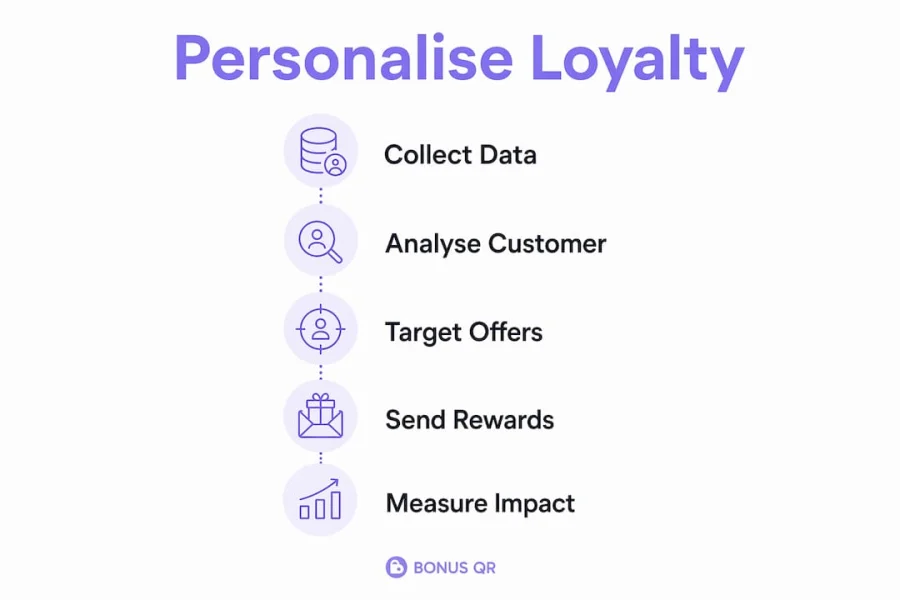
The process for building personalised loyalty experiences has five clear stages. Each one builds on the last, and skipping any of them reduces the quality of the final result.
-
Segment your customers by behaviour, not just demographics. Age and location tell you little about what motivates a customer to return. Purchase frequency, average spend, and reward redemption history are far more useful. Group customers into segments such as high-frequency low-spend, occasional high-spend, and lapsed customers who have not visited in 60 days or more.
-
Design offers that match each segment’s motivation. Discounts work well for price-sensitive customers. Experiential rewards, such as early access or exclusive events, appeal to high-value customers who already spend freely. Recognition rewards, such as a personalised birthday offer or a milestone bonus, build emotional connection. Types of rewards for retailers vary widely, and matching the reward type to the customer’s motivation is what separates genuine personalisation from a generic points scheme.
-
Apply the Next Best Action approach. Next Best Offer models ask only one question: what should we offer this customer? Next Best Action (NBA) asks four simultaneously: what offer, through which channel, at what time, and in what tone? That multi-dimensional thinking is what makes personalisation feel natural rather than mechanical.
-
Time your communications around real behaviour. Timing-optimised notifications based on behavioural data can increase engagement by 30–60%, depending on segmentation quality. Sending a coffee shop reward at 8am on a Tuesday, when a customer’s history shows they visit on Tuesday mornings, is far more effective than sending it on a Friday afternoon. Bonusqr’s push notification feature supports this kind of timing-based delivery without requiring manual scheduling for every customer.
-
Rank and prioritise rewards using past redemption data. Reward surfacing logic works similarly to product recommendation systems. You rank available rewards by what similar customers have chosen previously, then present the highest-ranked option first. This reduces decision fatigue and increases redemption rates.
Manual versus AI-driven personalisation
| Approach | Speed | Accuracy | Scalability |
|---|---|---|---|
| Manual segmentation | Slow | Moderate | Low |
| Rule-based automation | Medium | Moderate | Medium |
| AI-driven personalisation | Fast | High | High |
AI-powered personalisation can multiply repeat purchase rates up to three times compared with generic discount programmes. That is a material difference for any business where repeat visits drive the majority of revenue.
Pro Tip: Before you send any offer, ask yourself: would this feel relevant to this specific customer, or would it feel like noise? If you cannot answer that question with confidence, your segmentation needs more work.
What common mistakes should you avoid when personalising loyalty offers?
Most personalisation failures share a common root: the business treats personalisation as a cosmetic feature rather than a structural one. These are the mistakes most likely to undermine your efforts.
-
Using the customer’s name as a substitute for real personalisation. Addressing someone as “Hi Sarah” while sending her the same offer as every other customer is not personalisation. Superficial personalisation can actually decrease loyalty when customers recognise that the apparent familiarity lacks genuine understanding. Trust is the primary mediator between personalisation and loyalty outcomes.
-
Relying on batch-updated data. If your platform updates customer records overnight, your offers are always behind. A customer who just made their fifth purchase deserves a milestone reward today, not next week. Stale data produces irrelevant offers, and irrelevant offers train customers to ignore your communications.
-
Personalising only the offer, not the channel or timing. Sending the right reward through the wrong channel at the wrong time still fails. A customer who never opens email but responds to push notifications will not see your carefully crafted email offer. Multi-dimensional personalisation, covering offer, channel, timing, and tone together, is what the Next Best Action model is designed to address.
-
Over-personalising in ways that feel intrusive. Customers accept personalisation when it feels helpful. They reject it when it feels like surveillance. Referencing very specific behavioural details in a message, such as noting the exact time of a customer’s last visit, can cross that line. Genuine personalisation must balance value delivery with privacy and trust.
-
Ignoring lifecycle stage. A new customer and a loyal regular have different needs. Sending a retention offer to someone who joined last week wastes the opportunity to make a strong first impression. Sending an onboarding welcome to a customer who has visited 40 times is tone-deaf. Align your offers with where each customer sits in their relationship with your business.
“Personalisation that lacks genuine contextual understanding does not just fail to build loyalty. It actively erodes the trust that loyalty depends on.”
How can small to medium-sized businesses measure the impact of personalised loyalty offers?
Measurement is what separates a loyalty programme that grows from one that stagnates. Without clear metrics, you cannot tell whether your personalisation is working or simply adding complexity.
The four key performance indicators to track are:
- Redemption rate: the percentage of issued offers that customers actually use. A low redemption rate signals that offers are not relevant or visible enough.
- Repeat purchase frequency: how often customers return within a defined period. Personalised programmes should show a measurable increase over time.
- Customer lifetime value (CLV): the total revenue a customer generates across their relationship with your business. This is the ultimate measure of retention quality.
- Engagement rate: the percentage of customers who open notifications, click through offers, or interact with your loyalty programme in any way.
Testing and refining your approach
A/B testing is the most reliable method for improving personalisation. Run two versions of an offer simultaneously: one personalised to a specific segment, one generic. Compare redemption rates and repeat purchase frequency between the two groups. The results tell you exactly how much your personalisation is contributing.
Real-time dashboards make this continuous. Rather than reviewing performance monthly, you can see which offers are gaining traction within days of launch. That speed matters because loyalty trends in 2026 are shifting quickly, and programmes that iterate fast outperform those that wait for quarterly reviews.
Customer feedback adds a layer that quantitative data cannot provide. A customer who redeems an offer but leaves a negative comment about feeling “spammed” is telling you something important. Combine satisfaction surveys, direct feedback, and behavioural data for a complete picture.
Pro Tip: Do not rely on redemption rates alone. A customer who reads your offer, feels valued, and then visits without redeeming is still a win. Track visit frequency alongside redemption to capture the full picture.
Key takeaways
Personalising loyalty offers is the single most effective driver of customer retention, contributing more to loyalty outcomes than any other factor according to KPMG research.
| Point | Details |
|---|---|
| Personalisation drives loyalty most | KPMG data shows personalisation contributes 20.3% to loyalty outcomes, more than any other driver. |
| Real-time data is non-negotiable | Event-driven architecture keeps offers relevant; batch-updated data produces stale, ineffective communications. |
| NBA beats simple offer matching | Next Best Action considers offer, channel, timing, and tone together for genuinely relevant personalisation. |
| Superficial tactics damage trust | Adding a customer’s name without contextual relevance actively reduces loyalty rather than building it. |
| Measure beyond redemption rates | Track repeat purchase frequency and customer lifetime value alongside redemption to assess true programme impact. |
Why I think most SMEs are personalising loyalty the wrong way
My honest observation, after working with small business owners on loyalty programmes, is that most start with the technology and work backwards. They sign up for a platform, switch on the personalisation features, and then wonder why engagement is flat. The problem is almost never the tool. It is the absence of a clear picture of what each customer actually wants.
The shift from generic to genuinely personalised loyalty is not a technical upgrade. It is a change in how you think about your customers. The businesses I have seen get this right are the ones that treat their customer data as a living record of individual relationships, not a spreadsheet to segment once and forget.
The Gartner prediction that 20% of loyalty programmes will offer only fully personalised, member-specific perks by 2030 is striking. But the more important signal for SMEs is what it implies about the other 80%. Generic programmes will not disappear overnight, but they will become increasingly invisible to customers who have experienced something better.
My advice is to start smaller than you think you need to. Pick one customer segment, design one genuinely relevant offer, test it properly, and measure the result. That single cycle teaches you more than any amount of planning. Personalisation is not a feature you switch on. It is a discipline you build over time, one iteration at a time.
The businesses that will win on loyalty in the next few years are not necessarily the ones with the most sophisticated AI. They are the ones that listen most carefully to what their customers are already telling them through their behaviour.
— Michal
Bonusqr makes personalised loyalty practical for SMEs
Bonusqr is built for small to medium-sized businesses that want to move beyond generic points schemes and deliver genuinely relevant rewards. The platform supports multiple loyalty features, including points collection, stamp cards, cashback, and coupon distribution, all of which can be configured around customer behaviour and spend patterns. Push notifications with timing controls let you reach customers at the moments that matter, not just when it is convenient to send a batch message. Real-time analytics give you the visibility to test, refine, and improve your offers continuously. If you are ready to put the strategies in this article into practice, Bonusqr provides the infrastructure to do it without requiring a dedicated technical team or POS integration.
FAQ
What is personalised loyalty in simple terms?
Personalised loyalty means tailoring rewards, offers, and communications to each customer’s individual behaviour and preferences rather than sending the same deal to everyone. The goal is to make every customer feel that the programme was designed with them specifically in mind.
Why personalise loyalty offers rather than using generic rewards?
Personalisation contributes 20.3% to loyalty outcomes according to KPMG research, making it the strongest single driver of customer loyalty. Generic rewards do not create the same emotional connection or repeat purchase behaviour.
How does AI improve personalised loyalty offers?
AI analyses purchase history and behavioural patterns to predict which offer each customer is most likely to respond to. AI-driven personalisation can multiply repeat purchase rates up to three times compared with standard discount programmes.
What is the Next Best Action approach in loyalty programmes?
Next Best Action (NBA) is a personalisation method that makes four decisions simultaneously: what offer to send, through which channel, at what time, and in what tone. It goes beyond simpler models that focus only on which offer to present.
How do I know if my personalised loyalty programme is working?
Track redemption rates, repeat purchase frequency, customer lifetime value, and engagement rates. Use A/B testing to compare personalised offers against generic ones, and combine quantitative data with direct customer feedback for a complete assessment.


