If you run a cafe, gym, shop or salon and PassKit feels like more platform than you need, the best alternatives fall into three groups: wallet-first loyalty tools built for non-developers, loyalty add-ons tied to a specific POS, and full small-business loyalty platforms that handle rewards, messaging and analytics in one place. This guide compares real options from each group, explains how to choose, and shows where BonusQR fits.
PassKit describes itself as a wallet engagement platform for Apple Wallet and Google Wallet. That is a strong foundation. The question for a small business is not whether wallet passes work. It is whether you want to assemble a loyalty program from a platform, or switch one on and run it from a phone between customers.
Key takeaways
- PassKit is a wallet pass platform. Most small businesses searching for alternatives want a finished loyalty program (stamps, points, cashback, notifications) rather than a toolkit.
- The main trade-offs are setup effort, how many reward types you get, whether the tool depends on a particular POS, and what happens to your customer data.
- Stamp-card-only tools are simple but narrow. If you may want points, tiers or cashback later, check that now.
- BonusQR works through QR codes with no POS integration, starts on a free plan, and paid plans begin at €19 per month.
Why small businesses look beyond PassKit
The reasons are usually practical, and they repeat across the owners we talk to and the reviews we read.
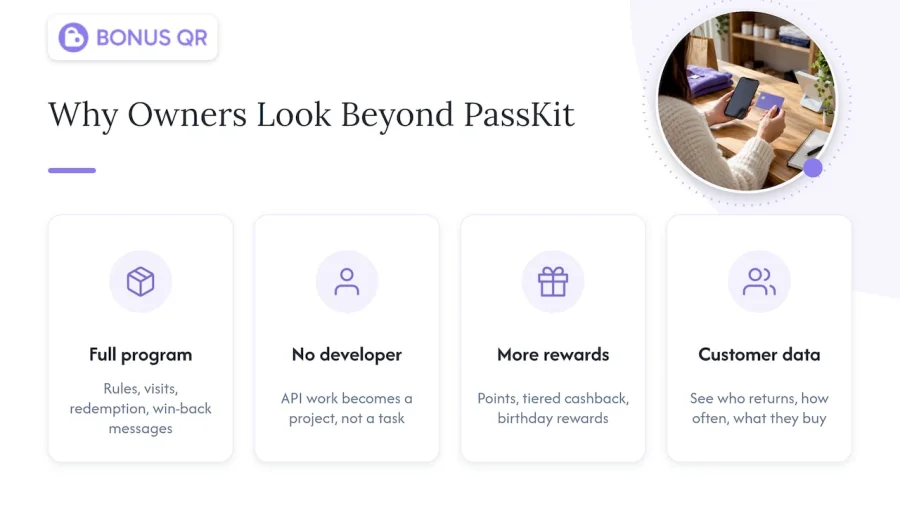
You want a program, not components. A wallet pass is a container. A loyalty program also needs reward rules, a way to record visits, a way to redeem, and a way to message people who stop coming. Platforms aimed at developers leave some of that to you. According to Capterra’s 2026 small-business loyalty listings, alternatives to enterprise platforms tend to put ease of use and native wallet integration ahead of the developer-heavy API architectures found in enterprise tools.
You do not have a developer. If the person setting up the program is also the person closing the shop, anything that needs API work is a project, not a task.
You need more than one reward mechanic. Stamps are a good start. Many owners later want points for higher-ticket purchases, tiered cashback for regulars, or a birthday reward.
You want to own the customer relationship. Loyalty is only useful if you can see who comes back, how often and what they buy. We come back to data below.
None of this makes PassKit a poor product. It makes it a product with a particular audience. If your team has engineers and you want to design bespoke wallet experiences, it deserves a serious look. If you do not, read on.
What to compare before you choose
Before looking at individual tools, decide which criteria matter for your business. These six cover most decisions.
- Setup time and skills. Can the owner or a manager launch a card in an afternoon without code?
- Reward types. Stamps only, or also points, cashback, tiers, fixed discounts and referral rewards?
- POS dependence. Does it need an integration with your register, or does it work alongside any system?
- Customer experience. Is joining a scan and a tap, or an app download and account creation?
- Messaging and automation. Can it send notifications on a schedule or after inactivity without you doing it by hand?
- Cost structure. Flat monthly tiers are easier to budget than fees that scale with every pass or customer. Check the current pricing page, since these change.
Why wallet-based loyalty beats a standalone app for most small shops
A dedicated app asks the customer to find it, download it and register. A wallet card sits next to the payment cards they already use. Apple’s own documentation on loyalty passes in Apple Wallet frames Wallet as the place customers already keep their cards and passes on iPhone and Apple Watch, which is exactly why a pass has an easier life than a standalone app. We cover the details in our guides to Apple Wallet for customer engagement and the Google Wallet loyalty card.
Speed matters at the counter too. Poster’s description of its 7Stamp integration notes that if the scan-and-go step takes more than about 15 seconds, adoption drops, so the best tools keep the staff action to a single scan or tap.
The alternatives compared
The table summarizes how the options differ in approach. We have deliberately not quoted competitor prices that we could not verify on an official page, so check each vendor’s pricing page before deciding.
| Option | Best for | Reward types | POS needed | Approach |
|---|---|---|---|---|
| PassKit | Teams with developers building custom wallet experiences | Flexible, built by you | No, but integration work is yours | Wallet engagement platform |
| Loopy Loyalty | Shops that only want stamp cards | Stamps | No | Stamp-card product from PassKit |
| 7Stamp | Poster POS users | Stamps | Poster POS | POS-integrated wallet stamp cards |
| LOYAL/PASS | Businesses wanting rule-based wallet cards | Stamps, points, levels, cashback | Not stated | Wallet-first loyalty platform |
| Kangaroo, Preferred Patron | Retail and hospitality wanting a dedicated loyalty vendor | Varies | Varies | Focused small-business loyalty software |
| BonusQR | Small and mid-sized businesses wanting wallet-friendly loyalty without POS work | Stamps, points, tiered cashback, discounts, referrals, reviews | No | QR-based loyalty platform with automation |
PassKit
PassKit offers tools for creating and managing passes in Apple Wallet and Google Wallet, and it is the benchmark this whole comparison is measured against. The strength is flexibility: if you can build what you imagine, the platform can likely deliver it. The cost is that flexibility arrives as work. For a small business, that usually means either paying for development time or using a narrower product built on top.
Good fit: companies with in-house or agency developers, ticketing and membership use cases, and large multi-location rollouts.
Watch for: setup effort, and the fact that the loyalty logic (what earns a reward, when to message) is yours to design.
Loopy Loyalty
Loopy Loyalty is listed on Capterra as a product by PassKit, which makes it the natural step down for owners who like the PassKit name but want something simpler. It centers on digital stamp cards.
Good fit: a coffee shop or barber with a single “buy nine, get the tenth free” mechanic.
Watch for: if you outgrow stamps and want points, cashback or tiers, confirm whether the plan you want supports them and what each tier costs today.
7Stamp (Poster POS)
7Stamp provides stamp cards in Apple Wallet and Google Wallet as a digital replacement for paper cards, and it is offered through the Poster POS application marketplace. If you already run Poster, the integration means stamps can be tied to the sales you ring up.
Good fit: restaurants and cafes already on Poster.
Watch for: it is built around that POS. If you change registers, or run several systems across locations, the dependency becomes a constraint.
LOYAL/PASS
LOYAL/PASS is described on Capterra as a digital loyalty card platform that works directly in the customer’s Apple Wallet or Google Wallet. Owners set the program rules (stamps, points, levels or cashback), publish a branded card and have customers add it.
Good fit: businesses that want a wallet-first card with several reward mechanics.
Watch for: compare its messaging, analytics and staff workflow against your needs; the Capterra listing is a starting point, not a full spec.
Kangaroo and Preferred Patron
Capterra’s 2026 small-business loyalty listings highlight Kangaroo and Preferred Patron Loyalty as dedicated options for retail and hospitality, with some alternatives showing recommendation rates between 85% and 97% among verified reviewers. That is a useful signal about satisfaction in the category, but it describes reviewers’ experiences with those products, not any one tool’s results for your shop. Run a short trial before committing.
BonusQR
BonusQR is a QR-based digital loyalty platform for small businesses. Customers earn points, stamps or cashback by scanning a code, and the business does not need a POS integration to make that work. The platform automates reward distribution, collects customer insights and sends promotional notifications, so the owner is not running the program by hand.
What the platform includes:
- Customizable digital stamp cards, points systems, tiered cashback and fixed discounts
- Onboarding promotions and special-occasion rewards
- Coupon and reward management
- Automated marketing with push and email notifications
- Referral and review modules
- Analytics on customer behavior
- Brand and app customization, mobile and web app integration, and Apple and Google Wallet support
- Optional white-label apps and custom app development, with e-shop and booking widget features
Good fit: retailers, restaurants and cafes, gyms and wellness centers, hotels, grocery stores, gas stations and service providers who want a complete program without technical work.
Watch for: if you want a fully bespoke wallet experience engineered from scratch, a developer platform gives you more raw control. For a loyalty program that runs itself, that control is rarely what you need.
How the pricing models differ
Pricing is where owners are most often surprised, so compare structure, not just the headline number.
- Per-pass or usage-based pricing grows with your success. That can be fine, but it makes budgeting harder.
- Flat tiers let you predict spend. You pick the plan that matches your feature needs.
- POS add-ons may look cheap but sit inside your POS bill and ties you to that vendor.
BonusQR uses flat tiers. The pricing page lists a Free plan, Basic at €19 per month and Premium at €69 per month. Businesses that want their own branded app can choose the white-label option: a €690 one-off setup fee plus a €69 monthly subscription. For something fully bespoke, custom app development starts from €1,500 one-off, with monthly maintenance from €69.
A useful exercise: estimate your monthly active customers and your messaging volume, then price each tool at that level for a year. Include any setup fee. The cheapest plan on paper is not always the cheapest in month eight.
Data ownership and POS integration: the real trade-off
A white paper on mobile wallets and the evolution of loyalty argues that large retailers adopting external loyalty platforms struggle most with data and integration: without tight links to POS and CRM, you lose granular shopping data, and with it the ability to calculate true ROI.
That concern is real, and it is worth taking seriously at any size. But it applies differently to a small shop.
A deep POS integration gives you item-level data. It also costs setup time, ties you to one register and can break when systems update. A QR-based approach captures what a small business most needs: who visited, when, how often, and what they redeemed. A study on QR codes integrated with Apple Pay and Google Pay in restaurantse166) points to the same direction on the payments side, showing how QR codes on receipts can streamline checkout without extra hardware.
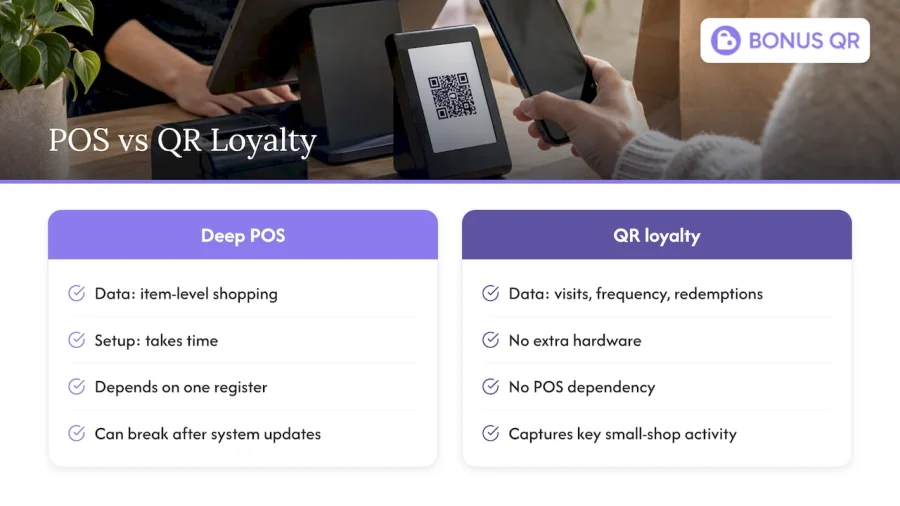
So ask yourself which data you will actually act on. If your marketing decisions rest on visit frequency, reward redemption and inactivity, you do not need item-level basket data to run a good program. If you run multiple store formats and want to tie loyalty to category-level margin, a POS-integrated tool may justify its complexity.
Whichever way you go, confirm before signing that you can see and export your customer list and activity history.
Automation is what makes loyalty pay off
Rewards alone rarely drive a program. Timing does. Poster’s 7Stamp page notes that win-back messages triggered by inactivity (for example after 30 to 45 days) matter at least as much as the reward, and that lock-screen push notifications tend to get more attention than email because they look like system updates. Treat that as practitioner guidance rather than a guaranteed result, and test it on your own audience.
When comparing tools, ask:
- Can I schedule a message for customers who have not visited in a set number of days?
- Can I send a welcome offer automatically when someone joins?
- Can I trigger a reward for a birthday or another occasion?
- Can I ask for a review after a visit without doing it manually?
The more of these a tool handles on its own, the less of your week the program consumes. Apple’s documentation also highlights that wallet passes can surface on the lock screen at relevant moments, which is the mechanism behind this effect.
For a wider view of the discipline, this overview of relationship marketing strategies for customer loyalty is a useful companion, particularly if you are weighing developer-heavy platforms against easier tools.
Our perspective
We built BonusQR around a simple observation: for most small businesses, the hard part of loyalty is not the technology, it is staying consistent. A program that needs a developer, a POS project or daily attention gets abandoned in a quiet month, and repeat customers are the lifeblood of any small business.
That is why we focus on three things. First, no POS dependency, so a loyalty program can start the same day, in any shop, on any register. Second, several reward mechanics in one place (stamps, points, cashback, discounts), so you can change the program as you learn what your customers respond to, without switching vendors. Third, automation, so rewards, notifications and customer insights keep working while you run the business.
We also think wallet-based loyalty is the right direction for most owners, which is why we support Apple Wallet and Google Wallet. But a wallet card is a delivery channel, not a strategy. The strategy is a reward people want, a joining process that takes seconds, and a reason to come back that arrives at the right moment.
If you are choosing between tools, our advice is to start with the cheapest plan that lets you test your real reward mechanic for 60 to 90 days, then decide on the strength of your own numbers.
— Michal Palus
Which option fits which business
- A single-product shop with one stamp mechanic: a stamp-only tool such as Loopy Loyalty may be enough, provided you do not expect to expand.
- A Poster POS restaurant: 7Stamp is built for your setup.
- A business with developers and a custom vision: PassKit.
- A cafe, gym, salon, hotel, grocery store or gas station that wants stamps, points and cashback with automation and no POS work: BonusQR.
- A larger brand that wants its own branded app: BonusQR’s white-label and custom app options let you grow from the same platform.
Sector-specific reading can help narrow this down. See our comparisons of restaurant loyalty software, loyalty tools for fitness businesses and a broader guide on how to choose a loyalty platform for growth.
Try BonusQR on the Free plan
If you want to see how a QR-based wallet-friendly program feels before paying anything, start with the Free plan, then move to Basic (€19 per month) or Premium (€69 per month) when you need more features. All plans are on the BonusQR pricing page. If you want a branded app instead, see the white-label option.
A simple way to run your own comparison
Shortlist two or three tools and test them the same way.
- Write down your reward. For example: ten visits earn a free item, or 5% cashback for regulars.
- Build it in each tool. Time how long it takes. If a tool needs developer help, note it.
- Join as a customer. Use a real phone, scan the code and add the card. Count the steps.
- Redeem as staff. Check that the whole action takes seconds and does not need special hardware.
- Set one automation. A welcome message or a 30-day win-back is enough for the test.
- Check the data. Can you see joins, visits and redemptions? Can you export them?
- Price month twelve. Include setup fees and any growth in customers.
The tool that wins this test for your shop is the right one, whatever the review sites say.
FAQ
Is PassKit good for small businesses?
It can be, if you have developer resources and want to design custom wallet experiences. For owners who want a ready-made loyalty program, a no-code tool with reward rules and automation is usually faster to launch and easier to manage.
Do I need a POS integration for a digital loyalty program?
Not necessarily. QR-based tools such as BonusQR record visits and rewards without connecting to your register. A POS integration adds item-level data, which matters mainly to businesses with complex catalogs or several locations.
Are Apple Wallet and Google Wallet loyalty cards better than a branded app?
For most small businesses, yes at the start, because customers do not need to download anything and the card sits where they already keep payment cards. A branded app makes sense later, when you want e-shop or booking features, and BonusQR offers white-label and custom app options for that stage.
How much does BonusQR cost?
There is a Free plan, Basic at €19 per month and Premium at €69 per month. White-label setup is €690 one-off with a €69 monthly subscription, and custom app development starts from €1,500 one-off, with monthly maintenance from €69.
Can I switch from another loyalty tool later?
Usually yes, but check that you can export your customer list first. Plan the switch around a quiet period and tell customers how to add the new card.
Sources
- PassKit: The Wallet Engagement Platform
- Best Customer Loyalty Software for Small Businesses 2026, Capterra
- Loopy Loyalty vs Guusto comparison, Capterra
- 7Stamp and Poster POS integration
- LOYAL/PASS, Capterra
- Loyalty Passes, Apple Wallet, Apple Developer
- Mobile Wallets and the Evolution of Loyalty, Verifi
- Enhancing Restaurant Payments with QR Code Integration for Apple and Google Paye166)


