
 Deutsch
 Español
 Français
 Italiano
 Magyar
 Polski
 Slovenčina
 Čeština
Thinking about a loyalty program software for small business? Here’s a simple truth: keeping a customer is far more profitable than finding a new one. A smart rewards program can turn one-time visitors into regulars, boosting your revenue without a massive marketing budget. This guide offers actionable advice to help you choose and launch a program that delivers real results.
Why Your Small Business Is Losing Money Without a Loyalty Program
As a small business owner, you’re not just competing with the shop down the street. You're up against big chains with deep pockets. You also know the pain of unpredictable sales, where one slow week can throw your entire month off track.
This is where a loyalty program stops being a 'nice-to-have' and becomes a core part of your growth strategy.
Imagine your café. A customer pops in for coffee once. Without a reason to come back, they might just go to the next place they see. But give them a digital punch card, and suddenly they have a goal: that free coffee. That small nudge turns a random visit into a conscious choice to return to your business.
Turning Casual Buyers into Loyal Fans
A loyalty program is one of the most direct ways to increase customer lifetime value (CLV). It gives people a real, tangible reason to choose you again and again. This isn't just a hunch; the data is crystal clear.
Industry research shows that over 90% of companies have some form of loyalty program. For small businesses, the numbers are even more compelling: loyalty program members are 59% more likely to choose your brand over competitors and 43% more likely to make weekly purchases.
This shows just how powerful a well-designed program can be in building habits and driving consistent business.
It's More Than Just Discounts-It's Your Secret Weapon
The right loyalty program software for small business does more than hand out freebies. It opens a direct line of communication with your best customers and gives you priceless insights into what they love.
Think about what you could do:
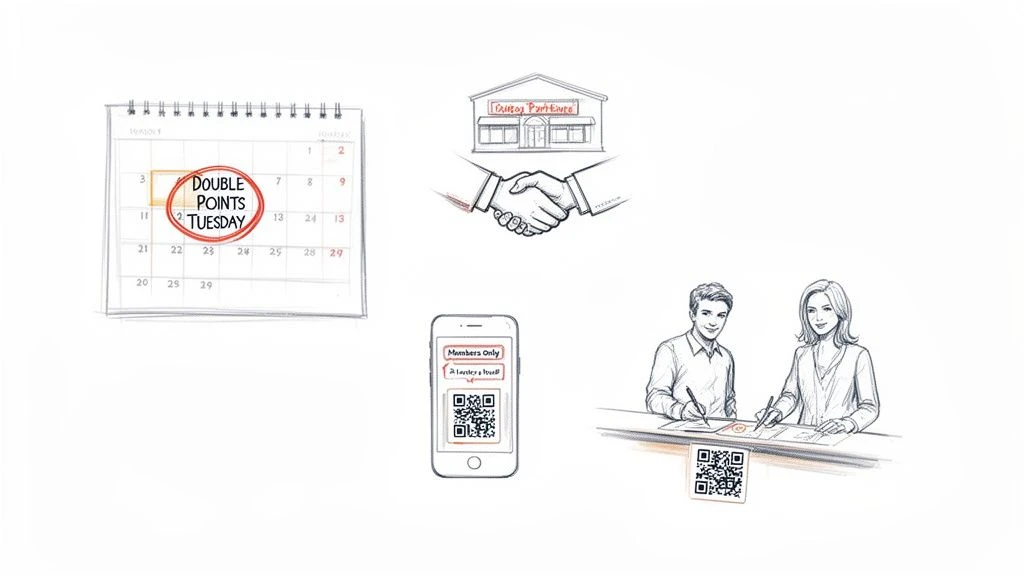
- Fight Slow Days: Run a "Double Points Tuesday" to bring in traffic when you need it most.
- Increase Average Spend: Nudge customers to add one more item to hit their next reward.
- Build a Community: Make your members feel like insiders with exclusive perks. That’s a feeling the big-box stores can't replicate.
Implementing a loyalty program is one of the best small business marketing strategies for serious growth because it directly impacts retention and customer value.
For a small business, the goal isn't a sprawling, complicated system. The best approach is a simple, affordable solution that’s dead easy for both your staff and your customers to use. A straightforward tool like BonusQR delivers all the core benefits-more visits, higher spending, and stronger customer bonds-without the high cost or headaches. It's built from the ground up to solve the real-world loyalty challenges you face every single day.
How to Choose the Right Loyalty Software for Your Unique Business
Picking the right loyalty software for your small business feels like a huge decision, but it doesn’t have to be a headache. The goal isn’t to find the tool with the most bells and whistles. It’s to find something that brings in more customers without creating more work for you and your team.
Let’s cut through the noise and focus on what really matters for a busy restaurant, salon, or retail shop.
Your number one priority? Simplicity. If customers need a manual to join or your staff need a 20-minute training just to explain it, the program is already dead on arrival. The best systems are effortless-think a quick QR code scan with no app downloads or clunky sign-up forms. The easier it is to use, the more people will actually use it.
Aligning Cost with Your Business Goals: Don't Get Burned
For any small business, a predictable, flat cost is everything. Many software providers will try to reel you in with a low monthly price, only to sting you with hidden transaction fees that slowly bleed your profits. You have to watch out for programs that take a percentage of every sale made through their system.
Look for a solution with a transparent, flat monthly fee. This makes budgeting a breeze and means your costs won't suddenly spike just because your loyalty program is doing its job well.
It's no surprise the loyalty management market is booming. The software side alone is set to make up 58.2% of all revenue by 2025. This growth is thanks to cloud-based platforms that don't require expensive hardware or IT support-a perfect fit for small businesses. You can see more on this trend from Grandview Research.
This is why tools like BonusQR are built on a fixed-price model. You get an affordable, predictable cost, so you can focus on building loyalty, not on deciphering your software bill.
This flowchart can help you decide if a loyalty program is the right move for your specific challenges, whether you're up against big chains or just trying to smooth out your cash flow.
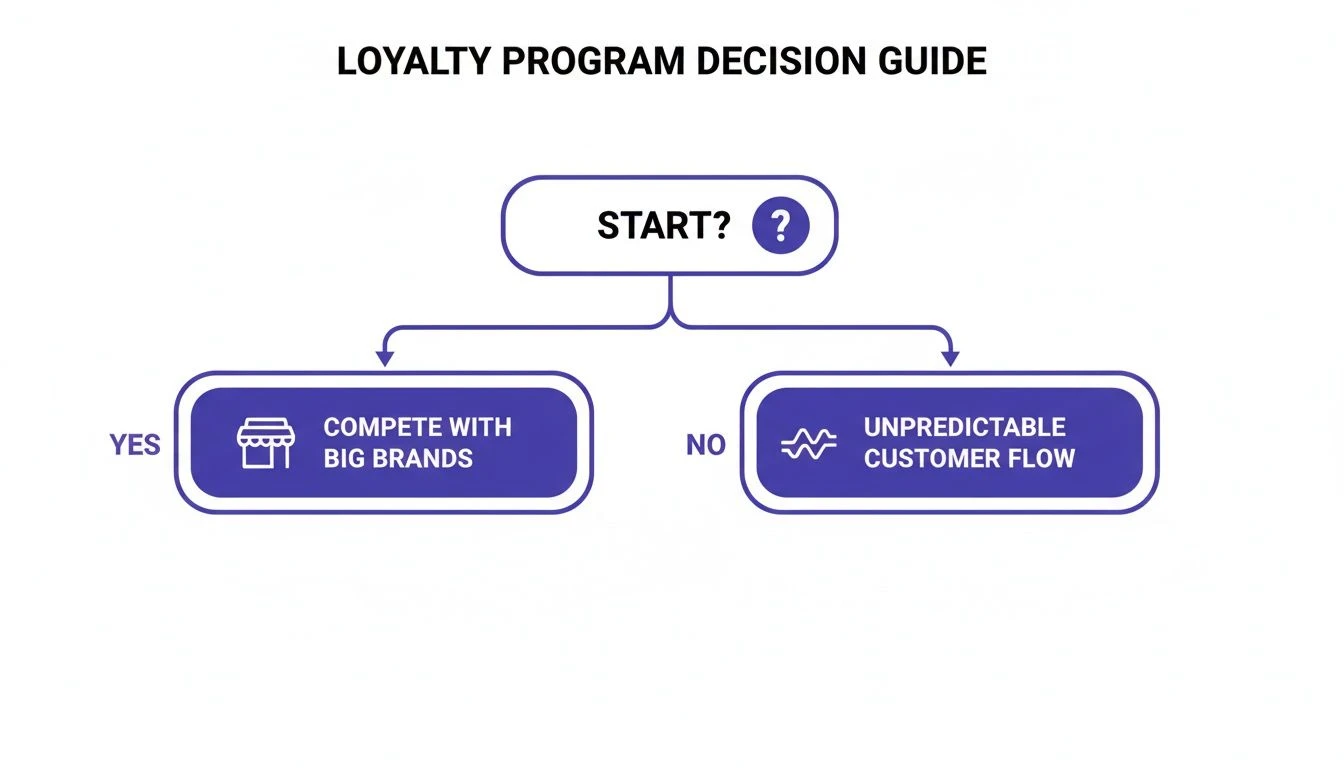
As you can see, a loyalty program is often the direct answer to the core problems that keep small business owners up at night-from gaining a competitive edge to creating more predictable foot traffic.
Understanding Different Loyalty Software Types
Not all loyalty software is the same. The options range from simple digital punch cards to complicated VIP systems. For most small businesses, the sweet spot is a tool that’s powerful but still incredibly easy to manage.
Here’s a quick look at the most common types.
Comparing Loyalty Software Features for Small Businesses
This table breaks down common loyalty software types to help you choose the best fit for your restaurant, salon, or retail shop based on your specific needs and resources.
| Feature | Simple Digital Punch Card (e.g., BonusQR) | Points-Based System | Tiered VIP Program |
|---|---|---|---|
| Best For | Quick-service (cafés, QSRs), salons, shops | Businesses with varied product prices (retail) | Brands with highly engaged, high-spending customers |
| Customer Experience | Super simple. "Buy 10, get one free." | Flexible, but can feel complex. "How many points?" | Creates exclusivity, but can feel out of reach |
| Staff Training | Minimal. Can be trained in minutes. | Moderate. Staff need to explain point values. | High. Requires explaining tiers and benefits. |
| Cost Structure | Often a low, flat monthly fee. | Can be flat fee or include transaction percentages. | Usually higher-priced, complex subscription models. |
| Implementation Speed | Very fast. Can launch in under an hour. | Can take days or weeks to configure rewards. | Weeks to months. Requires strategic planning. |
For most small businesses just starting out, the digital punch card is the clear winner. It delivers results without the complexity.
For an even deeper dive into these options, check out our guide on choosing your first customer loyalty software to find the perfect match for your business.
The Key Features That Actually Matter (And Those That Don't)
When you’re looking at software, it’s easy to get distracted by shiny objects. Instead, focus on the handful of features that will actually make a difference to your bottom line and your sanity.
Here are the non-negotiables:
- Painless Operation: Does the software work without complicated POS integration? For many small businesses, a standalone system using QR codes is faster to set up and avoids technical headaches entirely.
- Simple Customer Messaging: The ability to send a quick text or push notification is gold. Imagine sending a "2x stamps today!" offer on a slow Tuesday afternoon. That's how you drive traffic on demand.
- Reporting You Can Actually Use: Forget dozens of confusing charts. You just need a clear, simple dashboard that answers three questions: How many people are signing up? How often are they coming back? And are they redeeming their rewards? That’s all you need to know if it’s working.
At the end of the day, the best loyalty program software for a small business is one that feels like a natural part of the great service you already provide. By focusing on simplicity, fair pricing, and a clear path to getting your money back, you’ll find a tool that becomes a true partner in your growth.
How to Launch Your Loyalty Program in Under an Hour
Alright, you've picked your loyalty program software for small business. The hard part's over. Now for the fun bit: getting it up and running. This doesn't have to be a long, drawn-out project. In fact, with a tool like BonusQR, you can go from setup to launch in less than an hour.
Let’s walk through a straightforward plan to get your loyalty program humming along from day one.
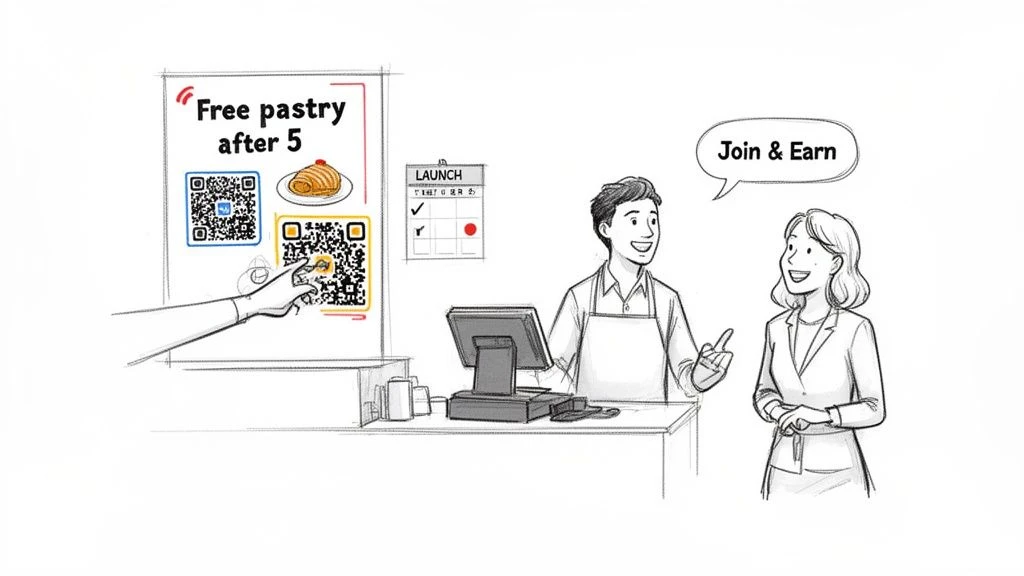
The trick is to keep it simple. We'll break it down into three manageable chunks: creating rewards people actually want, getting your team ready to be your biggest fans, and nailing your launch day strategy.
Designing Rewards That Don't Kill Your Margins
The reward is the heart of your program. A great reward hits a sweet spot: it feels within reach for the customer, it’s something they genuinely want, and it doesn't kill your profit margins. The goal here is to drive repeat visits, not just give away the farm.
Start with what your regulars already love. Is it that specific latte, a crowd-favorite pastry, or a quick add-on service? Offering a free version of a bestseller is a surefire win.
Think along these lines:
- Coffee Shop: "Buy 5 Coffees, Get the 6th Free." It's a classic for a reason-it’s dead simple to understand, and the reward feels close.
- Retail Boutique: "Spend $100, Get a $10 Voucher for Your Next Visit." This creates an immediate reason for a return trip and another potential sale.
- Salon: "After 4 Haircuts, Receive a Complimentary Deep Conditioning Treatment." This offers something with a high perceived value that has a low actual cost for you.
The best loyalty programs aren't just about the money; they're about making customers feel smart for choosing you. A simple, desirable freebie often outperforms a complicated points system every time.
When you're just starting out, keep it simple. Seriously. A single, clear offer is way more powerful than a confusing menu of options.
Preparing Your Team for a Smooth Rollout in 15 Minutes
Your frontline staff will make or break your launch. They're the ones who will be explaining the program and getting people to sign up. If they aren’t confident and excited, your program will have a tough time getting off the ground.
Make it incredibly easy for them. Give them a single, easy-to-remember line they can use at checkout.
Sample Cashier Script: "Want to earn a point toward a free pastry today? Just scan this QR code-it takes two seconds."
This works because it's fast, highlights an immediate win ("earn a point today"), and manages expectations ("it takes two seconds"). Before you launch, pull your team together for a quick 15-minute huddle:
- Explain the "Why": Briefly share how the program helps the business (and them).
- Show Them How It Works: Have every team member sign up for the program themselves.
- Practice the Script: Role-play a couple of customer interactions. It builds confidence.
When your team feels prepared, they'll become natural promoters for the program.
Your Simple, Multi-Channel Launch Checklist
On launch day, you want to make your new program impossible to miss. You don't need a huge marketing budget for this. You just need to use the space you already own.
Here’s a simple checklist to make sure your launch is a hit:
- Prominent In-Store Signage: Place a small, eye-catching sign with the QR code and the simple offer right at the point of sale.
- A-Frame or Window Cling: Put another sign on the sidewalk A-frame or front door. This grabs people before they even walk in.
- Table Tents or Menu Inserts: For cafés and restaurants, a little table tent with the QR code gives customers something to do while they wait.
- Social Media Announcement: Post a quick photo of your new sign on Instagram or Facebook. Announce the launch and the reward they can earn on their very next visit.
By combining a simple offer, a prepared team, and smart in-store marketing, you create a frictionless experience that drives sign-ups. This practical approach ensures your new loyalty program software for small business starts paying for itself from day one.
Marketing Your Program to Get More Members (Without a Big Budget)
A brilliant loyalty program only works if customers actually sign up. You can build the best system in the world, but if nobody knows it exists, it’s just spinning its wheels. The good news? You don’t need a massive marketing budget.
This section is your playbook for turning a new loyalty program into a powerful, self-sustaining engine for getting-and keeping-more members.
Empower Your Team to Be Promoters
Your staff are your single most effective marketing channel. A customer is far more likely to join when a friendly cashier mentions it than if they just happen to see a sign.
Your frontline staff are your best promoters. Give them a reason to be excited about signing up new members.
Instead of a long speech, arm them with a simple, benefit-driven line: "Want to earn a point toward a free coffee today? Just scan this code." It’s quick, focuses on an immediate benefit, and tells the customer it'll be fast. Consider a small, fun incentive for hitting sign-up goals, like a team lunch.
Drive Traffic with Smart Promotions That Solve Problems
Your loyalty program isn't just about rewarding what customers already do; it's about creating new habits. Think of it as a tool to solve common business problems, like quiet weekdays or low average order values.
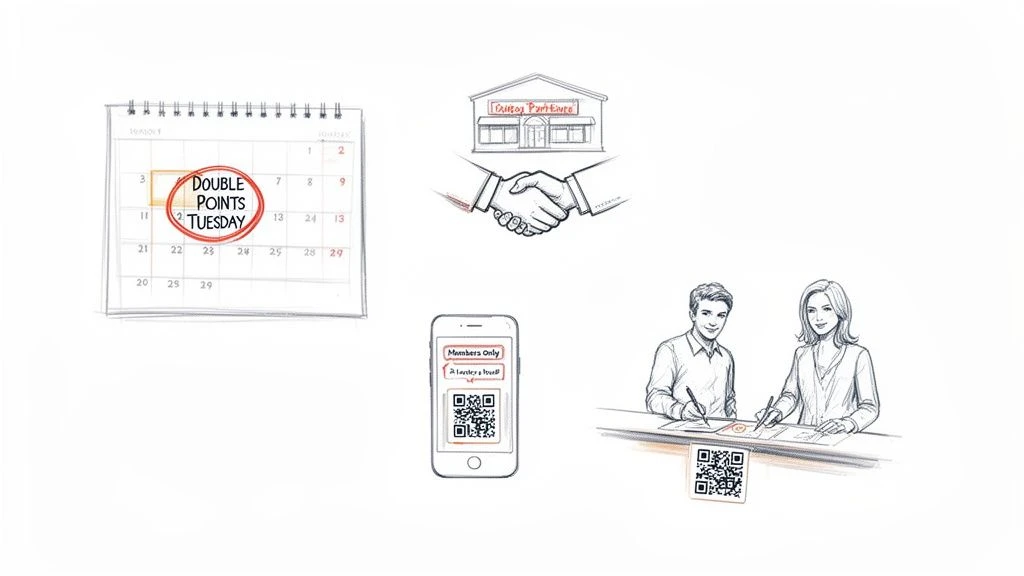
- Combat Slow Days: Is Tuesday always dead? Run a "Double Points Tuesday" to give customers a real reason to stop by.
- Increase Order Size: Nudge people to spend a little more. A sign at the counter that says, "Spend just $5 more to earn your next reward!" can be surprisingly effective.
- Re-engage Lost Customers: Use your software to see which members haven't visited in a while. Send them a simple, automated message like, "We miss you! Here's a free point to get you started on your next visit."
These small nudges can have a huge impact on revenue without costing you much at all.
Make Joining Impossible to Ignore
Friction is the enemy of sign-ups. Your program's promotion needs to be clear, consistent, and everywhere. The goal is for a customer to see the program mentioned multiple times during their visit.
This screenshot from the BonusQR website shows just how simple your marketing materials can be. A clean sign with a QR code is often all you need.
The design is clean, the call to action ("Join Our Loyalty Program") is direct, and the sign-up method (the QR code) is instant.
Think about all the places you can put a small reminder:
- A small sign right at the register.
- A sticker on your front door.
- A note at the bottom of every receipt.
- Table tents in your seating area.
Consistency is what turns a trickle of sign-ups into a flood.
Leverage Low-Cost Partnerships to Reach New Customers
You don't have to market your program alone. Look for non-competing businesses nearby that share your kind of customer. A simple cross-promotion can introduce your brand to a whole new audience.
For example, a local salon could partner with a nearby café. The salon could offer a loyalty stamp to any client who shows a recent receipt from the café, and the café could do the same. It’s a win-win that costs nothing but provides real value, making customers feel like part of a special neighborhood community.
How to Measure Your Loyalty Program's ROI (The Simple Way)
So you’ve launched your new loyalty program. But how do you actually know if it’s working? For a small business, figuring out the return on investment (ROI) shouldn’t be a headache. It really just comes down to a few key numbers that tell you if the program is making you money.
The good news is you don’t need to be a data wizard. A good loyalty program software for small business puts these numbers right on your dashboard, giving you a clear, quick look at how your program is performing.
Key Metrics to Track (That Actually Tell You Something)
Forget getting lost in confusing charts. To get a real feel for your program's performance, you only need to focus on a few essential metrics.
- Member Sign-Up Rate: Are people actually joining? If this is low, you need to promote it more or retrain your staff on the one-liner pitch.
- Reward Redemption Rate: This is a huge indicator of your program's health. A high redemption rate means your rewards are desirable and customers are coming back. If it’s low, your rewards might be too hard to earn or just not exciting enough.
- Spend & Visit Frequency (Members vs. Non-Members): This is where the rubber meets the road. Are your loyalty members visiting more often and spending more? Comparing these two groups is the ultimate proof that your program is driving profitable behavior.
This data is more important than ever. The loyalty software market is expected to hit $10.3 billion by 2033, so a program that works gives you a serious leg up. You can read the full market research report to get more insight on these trends.
A Simple ROI Calculation You Can Use Today
Let's make this real. You need a simple way to know if that monthly software fee is paying for itself. Here’s a quick, back-of-the-napkin calculation.
Let's say a café owner is using BonusQR for $30 a month.
- Average Spend (Non-Member): $8 per visit
- Average Spend (Loyalty Member): $10 per visit (a 25% increase!)
- Profit per Member Visit: $2 extra
In this scenario, the software pays for itself after just 15 member visits a month. Every single member visit after that is pure profit, driven directly by your loyalty program.
That’s the kind of clear, simple math that proves your loyalty program is an investment, not an expense. It provides a tangible way to justify the cost and demonstrates its direct impact on your business's growth.
Keeping an eye on these numbers empowers you to make smarter decisions. To connect these metrics to the bigger picture, check out our guide on how to calculate customer retention rate.
Frequently Asked Questions
Jumping into a loyalty program can bring up a few last-minute questions. Here are quick, straightforward answers to the things we hear most often from small business owners just like you.
Is my business too small for a loyalty program?
Not at all. In fact, small businesses often see the biggest and fastest results. Your superpower is the personal connection you already have with customers. A simple digital rewards program just gives that connection a boost.
A tool like BonusQR is built to be affordable and incredibly simple to run. It's about building on the relationships you already have, giving you a serious edge against the big chains.
What should I expect to pay for loyalty software?
For a small business, your best bet is always software with a predictable, flat monthly fee. Be very wary of providers that charge you per transaction or take a percentage of sales. That model punishes you for your own success.
Modern cloud-based tools like BonusQR are extremely affordable, often costing less than you’d make from just a handful of extra sales each month. Look for zero hidden costs-no expensive hardware or surprise setup fees. The right tool starts delivering a positive return almost immediately.
How do I get customers to actually join my loyalty program?
Friction is the enemy. Your job is to make joining so easy it’s an afterthought.
Here’s a simple strategy that works:
- Use QR Codes: A program that only needs a quick QR code scan is perfect. No apps to download, no long forms to fill out.
- Train Your Team: Give your staff a quick, friendly one-liner to use at checkout: "Want to grab a point toward a free coffee today? Just scan this code."
- Promote It Everywhere: Put simple, clear signs at your counter, on your front door, and on your tables. The message should be impossible to miss.
- Offer an Instant Reward: Giving customers their first point just for signing up is a powerful nudge. It creates an immediate sense of progress.
What’s the biggest mistake to avoid when starting a loyalty program?
The most common trap is making your program too complicated. If your rewards system is confusing, no one will use it-not your customers, not your staff.
An offer like "Buy 9, Get 1 Free" is powerful because everyone gets it in a split second.
A loyalty program with confusing tiers and weird point values is doomed from the start. The goal is a simple, clear promise that customers and staff can understand in seconds.
The second-biggest mistake is a "set it and forget it" mindset. You have to actively promote your program. Remind people about it, post about it, and use in-store signs to keep it top-of-mind. An unpromoted program is an unused program.
How quickly can I see a return on investment?
With a smart, simple approach, you can see a return on your investment incredibly fast-often within the first month.
The math is simple. Once you know your software's monthly cost, track the lift in visit frequency and average spending from your loyalty members. For example, if your software is $30 a month and members spend just $2 more per visit, the program pays for itself after only 15 member visits. Every visit after that is pure profit. The key is to choose a simple, effective loyalty program software for small business that makes it effortless to see these results.