
 Deutsch
 Español
 Français
 Italiano
 Magyar
 Polski
 Slovenčina
 Čeština
76% of UK consumers are members of at least one loyalty scheme, and 58% say loyalty points influence where they shop. That means loyalty program gamification isn't about teaching people a new behaviour, it's about turning an already familiar habit into something customers act on.
For small businesses, that distinction matters. The UK loyalty market was estimated at about £7.2 billion in 2023, so the opportunity is real, but so is the competition for attention. Gamification works when it makes stamps, points, tiers, challenges, and progress feel easy to follow, easy to earn, and worth coming back for.
What Is Loyalty Program Gamification
Loyalty program gamification is the use of game-like mechanics inside a loyalty scheme to make repeat behaviour feel more rewarding. Instead of asking customers to join and then forget about the programme, it gives them a visible path forward, with progress, milestones, and small wins that are easy to understand.
At its simplest, it adds a motivational layer to a habit that already exists. A café customer buys coffee, earns a stamp, sees progress, and comes back because the next reward is now concrete instead of abstract. A salon client moves from a passive member to an active participant because the programme shows what to do next and how close they are to getting value.
Why it changes behaviour
The point isn't novelty. The point is feedback. UK operators already work in a market where digital habits are normal, and that makes visible progress especially effective for repeat visits, reactivation, and onboarding.
Practical rule: if the customer can't tell how close they are to the reward, the mechanic is too weak to drive habit.
That's why gamified loyalty usually works best when it's tied to one simple action, such as a visit, a purchase, or a check-in. The mechanic should make the next step obvious. If the customer has to interpret the rules, the programme slows down.
In practice, loyalty program gamification turns routine transactions into a sequence of small goals. The business gets more repeat behaviour, and the customer gets a clearer reason to return. That's a much better trade than offering a discount and hoping they remember it later.
Key Gamification Mechanics Explained
The strongest mechanics are the ones customers can understand in seconds. For small businesses, that usually means stamps, points, tiers, challenges, and streaks rather than anything complicated or flashy. The more immediate the reward path, the more likely the customer is to keep using it.
A simple way to choose the right mechanic is to match it to the behaviour you want. A café wants repeat visits. A gym wants consistency. A salon wants rebooking. A local retailer wants frequent return trips and a visible reason to browse again.
Mechanics that fit everyday UK businesses
Stamps: Best for cafés, sandwich shops, and quick-service counters. A visit count is easy to grasp, and a stamp card makes the reward feel tangible. It works because the customer can see progress without needing to open a separate explanation every time.
Points: Useful when purchases vary in value. Points work well in retail and restaurants because they can scale with spend, frequency, or specific actions. For teams exploring a structured setup, a digital points system for cafés can be a practical starting point.
Tiers: Effective when you want customers to feel status as well as reward. Tiers suit beauty, wellness, and fitness businesses where regulars like recognition. The risk is making entry too distant, which turns motivation into passivity.
Challenges and missions: Good for behaviour shifts like trying a new item, visiting at a quieter time, or returning within a set window. They work best when the target is narrow and the reward is obvious.
Streaks: Helpful for habit-building in gyms, wellness studios, and coffee-led routines. The streak is powerful because it rewards consistency, but it can also frustrate customers if the rules are unclear or too strict.
Leaderboards: Better for community-driven settings than for most small merchants. They can work in fitness or event-led businesses, but they're often too competitive for everyday retail unless the audience already enjoys visible comparison.
For mechanics that need a stronger emotional angle, teams can borrow structure from emotional storytelling templates and make the reward journey feel more personal. That doesn't mean adding fluff, it means making the progress mean something to the customer.
Clear mechanics beat clever mechanics. Most loyalty failures start when the business tries to impress customers instead of guiding them.
Real-World Examples Across Industries
A good loyalty mechanic feels native to the business. A coffee shop doesn't need a complex mission tree when a visit-based reward will do. A salon doesn't need a leaderboard when a clean tier system might be enough to make repeat booking feel worthwhile.
What different sectors usually do well
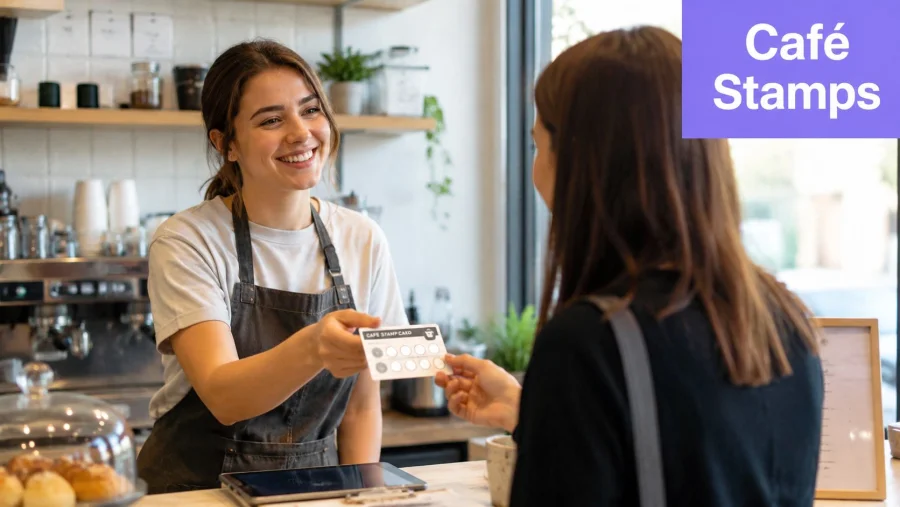
Cafés tend to win with simple stamp logic because it fits the rhythm of short, frequent visits. Customers don't need a long explanation, and staff can explain the reward in one sentence at the till.
Restaurants often get more value from challenges, especially when they want to push repeat ordering on quieter days or encourage a second visit within a set period. The mechanic works when the reward is clearly connected to behaviour, not when it feels random.
Beauty salons usually need recognition as much as discounts. That's where tiering and milestone rewards help, because the client can see that regular booking brings better access, not just another generic promotion. For operators looking at that model, how BonusQR helps salons shows how a lighter-weight setup can support repeat appointments without a heavy operational burden.
Gyms and fitness studios benefit from streak-style habits when the goal is consistency. The customer sees that each visit protects momentum, which can be more motivating than a one-off coupon. The mechanic should stay simple, though, because fitness clients already have enough friction in their weekly routines.
Retail stores need mechanics that reward return visits without making the programme feel like a chore. Points and time-bound missions can work well here, especially when they encourage browsing, cross-category purchases, or reactivation after a quiet period.
A useful pattern appears across all of these sectors. The programme works when it reflects the natural buying cycle of the business. It underperforms when the mechanic is borrowed from a different type of merchant and forced into the wrong context.
Common Pitfalls to Avoid
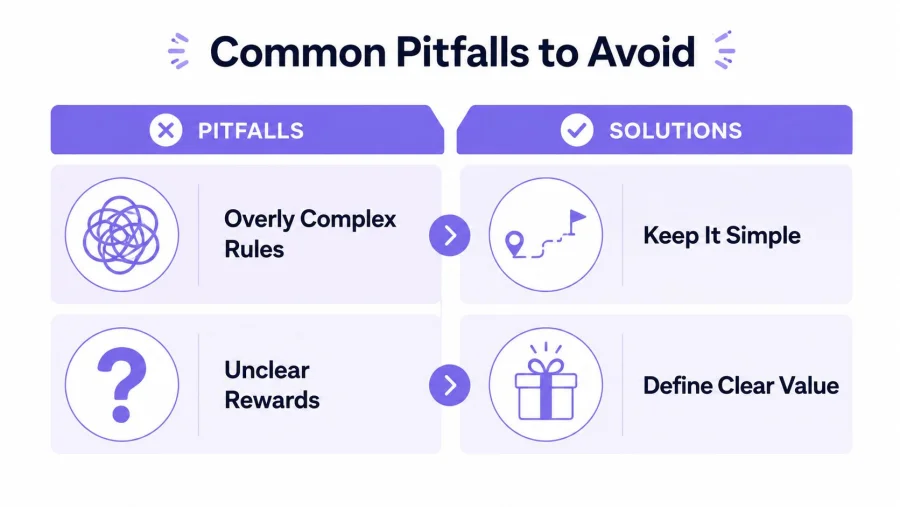
The biggest mistake is overcomplication. If customers need to read a rulebook before they understand the reward, the mechanic has already lost momentum. Small businesses don't need ornate systems, they need something staff can explain quickly and customers can remember after one visit.
The trade-offs that matter
Overly complex rules: More conditions usually mean more confusion. That slows adoption and makes staff less confident when explaining the programme.
Unclear rewards: If the customer can't see what they're earning, the incentive fades. A visible milestone is stronger than an abstract promise.
Too much friction at sign-up: The best mechanic fails if the enrolment step feels long or invasive. In the UK, data handling also has to stay within the UK GDPR and Data Protection Act 2018, which require personal data to be processed lawfully, fairly and transparently for specified, explicit and legitimate purposes, with data collection limited to what's necessary (UK GDPR and Data Protection Act guidance).
No real measurement: Engagement by itself doesn't prove commercial value. The programme should be judged on repeat visits, repeat purchase behaviour, reactivation, and customer response over time.
A strong design also respects the business environment. UK operators run lean, and many don't have spare time for a programme that needs constant manual fixes. The UK Government's Small Business Survey says 99.2% of private-sector businesses were small businesses, and SMEs accounted for 60% of UK employment and 48% of business turnover (small business structure in the UK). That context favours simpler systems.
Teams looking for a more polished campaign format can study commercial production companies for presentation ideas, but the loyalty offer itself still has to stay easy, visible, and cheap enough to run.
A pretty interface doesn't rescue a weak mechanic. Customers return for clarity, not decoration.
Actionable Implementation Checklist
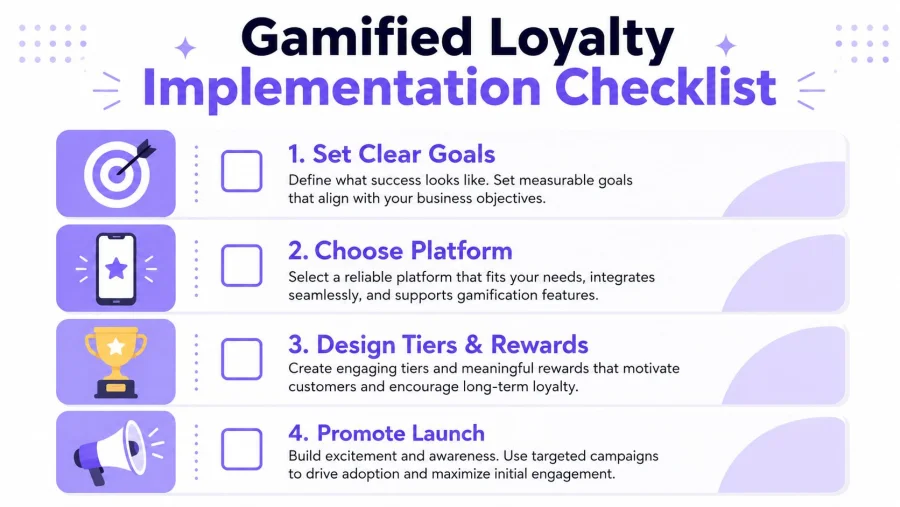
The most reliable rollout starts with one behaviour and one reward path. A business doesn't need to gamify everything on day one. It needs to choose the action that matters most, then make that action easier to repeat than it was before.
A practical rollout sequence
Set one clear goal. Repeat visits, onboarding, or reactivation are the safest starting points. A narrow target makes it easier to tell whether the mechanic is working.
Choose a platform that keeps the reward visible. QR-based systems are useful because they reduce friction at the counter and let customers check progress quickly. For merchants comparing options, QR-based loyalty cards are one format that fits that model.
Design the reward path before the campaign launches. The reward needs to feel attainable. If the target is too far away, customers won't bother starting.
Tell staff exactly how to explain it. A front-line team should be able to describe the programme in one or two sentences. If staff can't explain it, customers won't adopt it confidently.
Promote the mechanic in more than one place. Counter signage, receipts, social posts, and follow-up messages all help. The customer should see the same rule repeatedly, not a different version every time.
Track the behaviour, not just the clicks. The key questions are whether customers come back more often, whether they spend more over time, and whether inactive customers return. Those are the signals that matter commercially.
BonusQR fits naturally in this kind of setup because it can support stamps, points, visit thresholds, and progress tracking in a QR-based flow. It's one option for merchants that want a lightweight system without adding hardware or complex onboarding.
The test is operational, not cosmetic. If the mechanic helps staff explain the offer faster and helps customers understand their next step faster, it's probably built well enough to launch.
Conclusion and Next Steps
Loyalty program gamification works best when it turns a habit into a visible journey. The UK market already has the loyalty mindset, so the job isn't to invent interest, it's to make participation easier, clearer, and more rewarding. That's why the strongest programmes focus on a single behaviour, a simple rule set, and a reward the customer can picture immediately.
The hidden cost in most weak loyalty schemes is not the discount, it's the friction. Confusing rules, vague progress, and poor measurement all reduce the chance that customers come back often enough to justify the programme. A small business doesn't need a complicated app to avoid that problem, it needs a system that shows progress, keeps staff aligned, and makes redemption feel natural at the counter.
The next step is to choose one mechanic and test it on one audience segment first. A café can pilot stamps, a salon can test milestone rewards, and a gym can trial streak-based visits. The important part is to watch what happens to repeat behaviour, not just sign-ups.
For owners who want more context on designing practical local campaigns, the home services marketing blog is a useful place to compare retention ideas and customer communication approaches. Then the focus should move back to the numbers that matter in the shop, how often people return, how much they spend, and whether the mechanic pays for itself.
If a loyalty programme feels hard to explain, it's probably too hard to keep. Start with one clear reward path, test it on real customers, and use BonusQR to build a QR-based loyalty flow that's simple enough for staff to run and customers to use.