
 Deutsch
 Español
 Français
 Italiano
 Magyar
 Polski
 Slovenčina
 Čeština
Most small businesses can launch a digital loyalty program for a modest setup fee plus a predictable monthly subscription. The real spending sits in several buckets: setup, software, reward funding, staff time, and integrations. Rewards and operations usually dominate. Proceed when the lifetime value you expect to gain exceeds the incremental cost of these buckets.
Key Takeaways
Launching a digital loyalty program is cost-effective when the expected customer lifetime value exceeds initial setup, software, rewards, staff, and integration expenses.
| Point | Details |
|---|---|
| Costs scale with business size | Small businesses can launch with low effort, while multi-location chains need larger budgets for integration and management. |
| Rewards and staff are major expenses | Most of the budget goes to reward funding and staff time, which grow as customer base increases. |
| Platform choice depends on needs | Custom builds require large upfront costs and maintenance, while SaaS platforms offer predictable, shorter-term commitments. |
| Rewards impact liability and profit | Points create a deferred liability, and redemption rates influence actual costs; forecasting these helps prevent budget shortfalls. |
| Bonusqr simplifies setup and reduces costs | Our QR-based platform allows launching without POS or development projects, lowering staff time and operational expenses. |
What does a loyalty program cost to set up and run?
Loyalty programs have several cost buckets, but they scale at different speeds. Software is usually the smallest line. Reward funding and people grow fastest as your customer base grows. Here is what to budget for.
One-time setup items:
- Program design: deciding whether you run stamps, points, or cashback, and what each reward is worth
- Branding: logo, colors, card design, and in-store signage
- Onboarding: training staff and loading your first customers
- Data migration: moving existing customer lists or paper-card holders into the new system
- Custom app build or white-label fees, if you want your own branded app
Recurring items:
- Software license or subscription
- Hosting and maintenance for custom builds
- Reward funding and redemptions
- Customer communications: push notifications, email, and promotions
- Analytics and reporting time
Integration costs depend on your stack. Connecting to a POS or an e-commerce store adds setup work, and sometimes a monthly connector fee. Systems that skip the POS entirely avoid this line. For multi-location businesses, expect per-location costs (staff training, signage, local promotion) on top of central costs (program management, reporting). Industry analysis from Forrester shows that integration and analytics capability are leading criteria when companies choose a loyalty platform, which tells you where buyers expect the hard work to be.
How costs scale by business size. A single-location cafe with a QR-based program can often launch for a small one-time effort and a low monthly fee. A retailer with multiple locations should budget for per-location rollout and program management. A regional chain with POS integration should budget for developer time, a dedicated manager, and a meaningful reward fund. In all three cases, keep rewards and staff time as separate lines from software, because they grow with the customer base and software often does not.
How is loyalty software priced?
Loyalty software typically uses several pricing models, including a flat monthly fee, a fee per location, a fee per active member, or a one-time setup plus a monthly fee. Flat and per-location models are easiest to forecast. Per-member models feel cheap at launch and expensive once the program succeeds.
Market-reported examples give you a sense of the spread, but prices vary by vendor and features. Treat reported prices as examples, not firm quotes, because vendors change plans often.
For reference, our own plans are published. Our Basic plan costs 19 EUR per month and our Premium plan costs 69 EUR per month, with a Free plan also available, all listed on our pricing page.
Features that raise the price:
- API access for connecting to other systems
- Custom branding and a branded app
- Advanced analytics and reporting
- Customer segmentation and automated groups
- Apple Wallet and Google Wallet support
- Referral and review modules
If you want to compare feature depth against price before committing, our guide on choosing the right loyalty platform walks through the tradeoffs.
When to budget for white-label or custom. If you need your own app in the stores, offline integrations, or an e-shop and booking widget, plan for a separate project. Our white-label setup is a 690 EUR one-off fee with a monthly subscription of 69 EUR on the white-label page, and custom app development starts from 1500 EUR one-off with maintenance from 69 EUR per month on the custom app page. A custom build also changes your timeline, and customers may need to wait longer before they can use it.
How do rewards, redemption, and breakage shape the real cost?
Rewards are where most loyalty budgets go wrong. Software is a fixed fee. Rewards are a promise to customers, and you pay for them whenever customers decide to collect.
Start with point valuation. When you decide how many points equal a reward, you set a point-to-spend ratio, and that decision determines your reward cost as a share of sales. It is a pricing decision, not a technical setting. Set it too generously and every sale shrinks your margin. Set it too stingily and nobody joins.
Accounting guidance treats outstanding points as a liability, not free marketing. According to research on loyalty program liabilities, points create a deferred revenue liability equal to outstanding points times point value times expected redemption rate.
The liability formula: outstanding points × point value × expected redemption rate. Because the redemption rate is a forecast, forecasting it well is what keeps you from a budget shortfall.
Redemption and breakage. Redemption rate is the share of issued points that customers actually spend. Breakage is the share that expire or sit unused. High breakage looks attractive on paper, since you issued value you never paid out. But redemption is also the moment a customer feels the program working. Treat it as an investment in the relationship, not only a cost, because customers who redeem tend to stay engaged longer.
How to estimate redemption and breakage for budgeting. You do not need a model to start. Follow this simple sequence:
- Launch with a conservative assumption, such as a middle-of-the-road redemption rate, and budget for the higher outcome.
- Track issued points, redeemed points, and expired points monthly.
- After a full redemption cycle, replace your assumption with your own data.
- Update your liability estimate regularly.
Tiered or points-based designs are not always the cheapest route. Other mechanisms, such as targeted offers or simple stamp cards, can deliver strong returns on smaller reward budgets. Our digital loyalty card guide shows how simple designs can be enough at launch.
What do people and processes add to the bill?
Staff time is the quiet cost that finance teams forget. Software runs itself. Campaigns, customer questions, and reporting do not.
Typical roles and what they handle:
- Program manager: owns the rules, the reward budget, and the monthly review
- Marketing: runs campaigns, promotions, and push or email messages
- Customer support: answers questions about balances, missing points, and redemptions
- Finance and accounting: tracks the liability and reviews redemption against forecast
- Technical support: handles integrations, app issues, and updates
In a small business, one person often wears several of these hats. That is fine, but cost it anyway.
Turning time into cost. Estimate the time spent on each role and compare it with a full-time work schedule to get a monthly fraction of a full-time employee. Multiply that fraction by the loaded monthly cost of the person doing the work. For example, estimate the share of your manager’s working time spent on the program, and include that share of their loaded monthly cost in your loyalty budget.
Monthly versus occasional work. Reporting, support, and reward reconciliation recur monthly. Campaign launches, segment rebuilds, and menu or catalog updates happen occasionally. Budget the recurring work as a steady fee and the occasional work as a quarterly project line.
Pro Tip: Automate segmentation and messaging first. Automated groups and scheduled notifications often cut the weekly hours a program needs more than any other change, which lowers personnel cost without touching rewards.
Should you build a loyalty app or buy a platform?
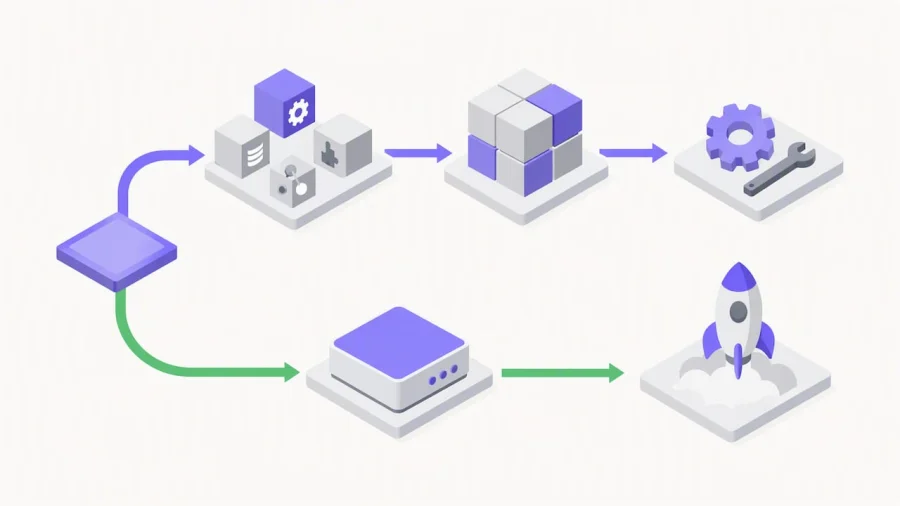
The decision comes down to cash timing and risk. Building in-house means a large upfront cost and a long maintenance tail. Buying means smaller recurring fees and someone else carrying the technical burden.
What a custom build asks of you:
- Upfront capital for design, development, and testing
- Opportunity cost: months of team time not spent on your core business
- Ongoing maintenance, which practitioners commonly plan as a share of the initial build cost
- Integration work every time your POS, store platform, or phone operating systems change
- Responsibility for security, uptime, and data protection
What a subscription platform gives you:
- Predictable monthly fees
- Upgrades and new features included
- Support from the vendor
- A much shorter time to launch
Integration complexity differs by route. A custom build can integrate exactly the way you want but costs developer time at every change. A SaaS platform integrates through ready connectors, or avoids the POS entirely.
Decision checklist: Build may be justified when your program logic is truly unusual, when you have an in-house technical team already, or when program data is core to your product. Buy is the stronger default when you want to launch in weeks, when predictable costs matter, or when loyalty is a retention tool rather than your business.
How do you calculate ROI and break-even?
You can model a loyalty program with a handful of inputs. A simple way to assess the program is to compare incremental revenue, including customer value lift, with incremental costs such as rewards, operations, software, and integrations.
The inputs you need:
- Adoption rate: the share of customers who join
- Purchase frequency uplift among members
- Average order value
- Redemption rate and breakage
- Software and staffing costs per month
- Discount rate, if you model over several years
A published academic study offers a benchmark. In research on non-tiered loyalty programs, the program lifted average customer value by about 29.5% over five years, and most of that lift came from reduced attrition rather than bigger per-visit spending.
A 29.5% customer value lift over five years, driven mostly by customers who stay longer. For your model, retention matters more than basket size.
A worked example (illustrative inputs only). For an illustrative example, estimate your active customer base and annual value per customer. Then estimate the share who might join and how much their value could rise. Use those assumptions to calculate the number of members, the lift per member, and the resulting incremental revenue.
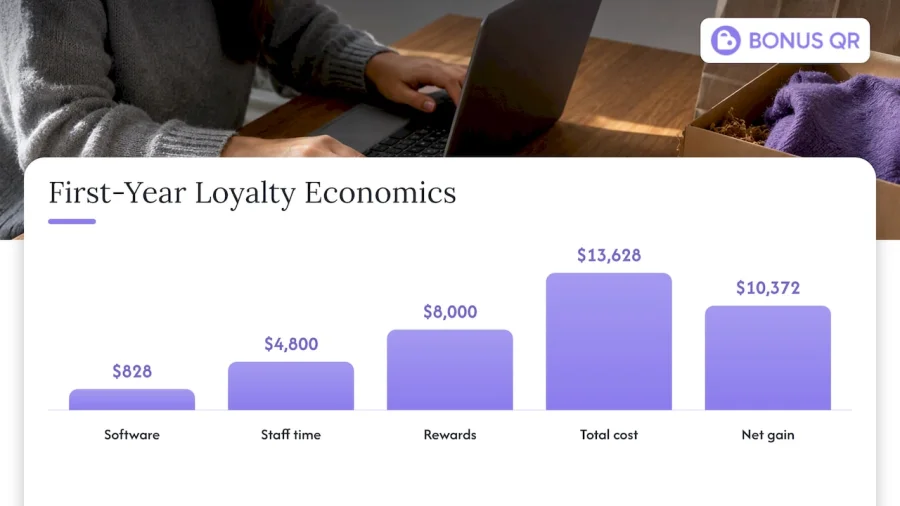
Now the costs. Say software costs $69 a month, which is $828 a year. Say staff time costs $400 a month, which is $4,800. Say rewards cost $8,000 over the year. Total cost: $13,628. Net gain: $10,372 on the first year. Because costs are spread out and the lift builds as members accumulate, the break-even point depends on your assumptions and actual results.
Include your loyalty liability in your accounting. Outstanding points reduce reported profit before they are redeemed, so your books should show the cost as you earn the revenue. For corporate context, the 2025 EY Loyalty Market Study reports that average annual ROI expectations for loyalty programs often sit in the 10–20% range among corporations. For more on metrics, see our guide to maximizing loyalty program ROI and our explainer on customer lifetime value.
If you run several locations, tracking which visits come from which channel makes the model sharper. The local SEO ROI guide shows how to follow calls and online searches through to booked jobs, which helps you separate loyalty lift from marketing lift.
What do I wish more owners knew before budgeting?
Most failed programs I have seen on paper fail the same way: too many rules, too little tracking. Launch with one reward you can explain in a sentence, and measure it before adding more. Put money into automation and into rewards that drive profitable behavior, like a second visit within 30 days. And never underbudget reward liability or staff time, because those two lines are where plans quietly go over.
— Michal Palus
How can a QR-based platform lower your setup and running costs?
We built our platform so you can launch without a POS and without a development project. Customers collect points, stamps, or cashback by scanning a QR code, and our system handles reward distribution, segmentation, and promotional notifications automatically, which trims the staff hours that usually drive cost. If you want your own branded app, our white-label and custom options cover that too. Check our plans and pricing for an instant budget estimate, or start a free account today.
FAQ
How much does a loyalty program cost for a small business?
It depends mostly on rewards and staff time rather than software. A small business can usually launch with a modest setup effort and a low monthly subscription. For reference, our paid plans are listed at 19 EUR and 69 EUR per month on our pricing page.
What is an example of a loyalty program?
A coffee shop that gives a free drink after ten purchases is a classic example. Digital versions replace the paper card with a QR code or app, and can also use points or cashback. Each design carries a different reward cost, so choose the one your margins can support.
How much is 1000 reward points worth?
It depends entirely on the point value you set. If a certain number of points equal a specific monetary value, then a proportionally larger number of points equals more rewards according to that ratio. That ratio is a business decision, and it determines your reward cost and your liability.
What are the four main types of customer loyalty?
Common types include points-based, tiered, paid or membership, and value-based programs built on discounts, partnerships, or community. Each has a different cost structure. Simple points or stamps are usually the cheapest to launch and the easiest to forecast.