
 Deutsch
 Español
 Français
 Italiano
 Magyar
 Polski
 Slovenčina
 Čeština
A café owner checks the till at closing time and sees a decent day's sales. A salon owner glances at the week's bookings and feels busy enough. Yet both are still left with the same question. Which customers are building the business over time, and which ones are just passing through once?
That's where customer lifetime value, often shortened to CLV, becomes useful. It shifts attention away from a single sale and towards the full relationship. One latte, one haircut, or one treatment rarely tells the full story. Significant value often comes from the guest who returns again and again, recommends the business to a friend, and stays loyal long after the first visit.
Many small businesses struggle here because sales totals are easy to see, but long-term customer value is harder to spot. A practical primer like the Splash Access customer value guide can help frame the idea, especially for owners trying to connect everyday transactions with longer-term profit.
Introduction
A coffee shop owner may know regulars by face, favourite drink, and usual arrival time. What often stays unclear is how much those regulars are worth over the full relationship. A customer who spends modestly but returns for years can be more valuable than someone who makes one larger purchase and never comes back.
That's why so many UK small businesses treat CLV as more than a marketing metric. It's a financial lens. It helps owners judge whether loyalty offers are working, whether service issues are costing more than they seem, and whether the business is growing in a stable way or just replacing lost customers with new ones.
Why one-off sales can mislead
A busy Saturday can create a false sense of progress. If many of those visitors never return, the business may still be leaking value.
CLV helps answer practical questions such as:
- Who deserves extra attention: not just the biggest spender today, but the customer most likely to keep returning.
- Which offers are worth funding: a discount that protects repeat visits can be stronger than one that only drives a single transaction.
- Where service problems hurt most: a poor visit doesn't only lose one sale. It can shorten the whole relationship.
A healthy business doesn't only count transactions. It tracks relationships.
For cafés, salons, gyms, and other local businesses, this way of thinking is especially important. Their growth often depends less on dramatic price increases and more on getting people to come back consistently. CLV makes that visible.
Understanding the Key Concepts
What is customer lifetime value? It is the total net profit a business can expect from a single customer throughout their entire relationship. The simplest way to think about it is this. How much does a customer usually spend, how often do they buy, and how long do they stay?
That sounds simple, but many owners get stuck because the pieces can blur together. A customer who spends a lot once is not always as valuable as a customer who spends less but returns regularly. For brick-and-mortar businesses, repeat behaviour often matters more than a flashy first purchase.
The three building blocks
The most common CLV model uses three parts:
- Average purchase value. How much a customer spends on a typical visit.
- Purchase frequency. How often that customer comes back within a chosen period.
- Customer lifespan. How long the relationship lasts.
Taken together, those three numbers tell a much better story than daily revenue alone.
A café example that makes CLV easier to grasp
The concept becomes clearer with a simple café scenario. If a UK café customer visits 12 times a year with an average spend of £6 and remains a customer for 3 years, their baseline CLV is £216; extending lifespan to 5 years raises CLV to £360, a 66% increase from retention alone.
That example matters because nothing changed about the menu price. The customer didn't suddenly buy more expensive drinks. The gain came from staying loyal for longer.
Practical rule: For many cafés and salons, the most powerful CLV lever isn't price. It's how long the customer keeps returning.
UK SMEs often prioritise retention because it has such a strong effect on value over time. In that context, an annual retention rate of 80% or higher is treated as a critical benchmark for strong performance, because it suggests customers are returning consistently rather than disappearing after the first transaction.
Where people often get confused
Owners often assume CLV is only useful for ecommerce brands or larger companies with complex dashboards. It isn't. Any business with repeat customers can use it.
The confusion usually comes from one of these mistakes:
- Mixing up revenue and profit: a busy customer isn't always a profitable one.
- Focusing only on new customers: acquisition can feel exciting, but repeat business often creates steadier value.
- Treating all customers the same: some customers visit often, some spend more, some refer others, and some drift away quickly.
Once those differences are visible, better decisions follow.
Calculation Methods with Worked Examples and Benchmarks
For most local businesses, CLV doesn't need to start with advanced modelling. It starts with a basic calculation that can be done from ordinary sales records. In the UK, the most common formula is CLV = Average Purchase Value × Average Purchase Frequency Rate × Average Customer Lifespan, calculated by dividing total revenue by purchases, purchases by customers, and active years by customers according to Menza's guide to calculating customer lifetime value.
Method one using the standard formula
This is the most practical starting point for cafés, salons, and retail shops.
Use these steps:
- Find average purchase value. Divide total revenue by total purchases.
- Find purchase frequency. Divide total purchases by unique customers.
- Find average customer lifespan. Work out how long customers typically stay active.
- Multiply the three figures.
A simple worked example looks like this.
| Variable | Value |
|---|---|
| Average Purchase Value | £6 |
| Average Purchase Frequency Rate | 12 visits per year |
| Average Customer Lifespan | 3 years |
| CLV | £216 |
That table gives a clean starting point for a café owner with straightforward repeat behaviour.
Method two using a profit-focused formula
Some businesses need a stricter view of value. A salon, gym, or service business may want to know what remains after margin and acquisition cost are considered.
A more profit-focused version is:
CLV = (Average Order Value × Gross Margin % × Purchase Frequency × Customer Lifespan) − Customer Acquisition Cost
This approach matters when revenue looks healthy but margins are thin. A gym membership may appear valuable until servicing costs and acquisition spend are included.
One verified example makes this clearer. If a UK gym acquires a member for £100, generates £400 in membership fees over 2 years, and operates with a 60% gross margin, the calculation reveals the net profit contribution rather than just raw revenue.
Choosing the right time horizon
Not every business should use the same measurement window. Retail Sector guidance on customer lifetime value notes that businesses should calculate CLV over time horizons that match their purchase cycle. A mattress brand may use a much longer window, while a grocery business may use a shorter one.
That same source also recommends grouping customers by value tiers such as top 1%, top 5%, and top 10% once CLV is calculated. That makes marketing more precise because the business can focus offers on actual value rather than rough assumptions.
Where acquisition cost fits in
Many owners can calculate sales but struggle with customer acquisition cost. That's normal. For a clearer framework around acquisition and budget thinking, Optimizing marketing budget with AI offers useful context.
Retention needs equal attention. A business that wants a dependable CLV figure should also be measuring customer retention, because lifespan estimates become weak when churn is hidden.
Small businesses don't need a perfect spreadsheet on day one. They need a consistent method they can repeat.
Tracking CLV and Using It in Business Decisions
A CLV number is only useful if it's updated often enough to reflect what's happening in the shop. For brick-and-mortar businesses, customer behaviour can shift quickly. A service issue, a new competitor, or a change in local footfall can alter repeat patterns much faster than a yearly spreadsheet suggests.
That's why static CLV often causes trouble. It gives one neat number, but it can hide churn that's already happening.
Why rolling windows work better for local businesses
Instead of treating customer lifespan as fixed, many local businesses benefit from a rolling-window view. That means recalculating using recent behaviour on a regular basis, such as monthly, rather than assuming customers will behave the same way indefinitely.
This matters most for high-frequency, low-margin sectors where buying habits are fluid. A café regular can look loyal for months, then disappear after a small disappointment. A salon client can stretch appointments further apart without formally “leaving”.
A rolling window helps owners spot:
- Soft churn: customers who haven't fully left but are visiting less often.
- Spend drift: clients who still come in, but buy smaller tickets.
- Offer response: whether loyalty rewards are extending the relationship or only discounting existing behaviour.
Segmenting by value, not guesswork
Once CLV is tracked consistently, the next step is segmentation. High-value customers shouldn't receive the same treatment as occasional visitors.
Useful groups often include:
- Top-value regulars: people who visit frequently and remain active.
- At-risk loyalists: customers with strong past value whose visits are dropping.
- Low-frequency newcomers: recent joiners who need a reason to return quickly.
In such instances, loyalty program analytics become helpful. When owners can see visit trends, redemptions, and top customers in one place, they can make decisions based on behaviour rather than instinct.
Being careful with the CLV to CAC ratio
Many guides repeat the idea that businesses should aim for a fixed CLV-to-CAC benchmark. But that doesn't always fit a local café or salon. The rigid 3:1 CLV-to-CAC ratio often cited for UK businesses overlooks that independent cafés and salons typically incur negligible acquisition costs through local foot traffic, making standard benchmarks misleading, as explained by Miles Marketing's overview of customer lifetime value.
That changes how decisions should be made. If acquisition is mostly passive, the smarter question isn't always “How much did it cost to get this person?” It may be “How can the business keep this person coming back?”
A local business often wins more by protecting existing relationships than by obsessing over a generic CAC benchmark.
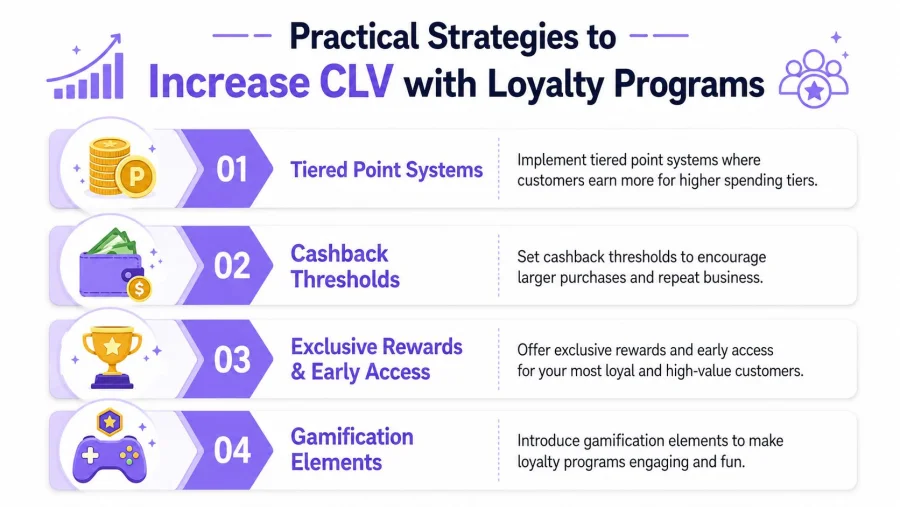
Practical Strategies to Increase CLV with Loyalty Programs
CLV rises when a business improves one of three things. Customers spend a little more, visit a little more often, or keep returning for longer. Loyalty programmes work because they can influence all three at once when they're designed around real customer habits.
For cafés and salons, the best programmes are usually simple enough for staff to explain in seconds and useful enough for customers to remember without effort.
Increase visit frequency first
Frequency is often the fastest CLV lever in a local business. A customer who already likes the brand usually needs a small nudge, not a dramatic incentive.
Good options include:
- Visit stamps: especially effective in coffee shops where behaviour is already routine.
- Bounce-back rewards: a small incentive that encourages the next visit soon after the current one.
- Birthday or anniversary offers: useful for salons and wellness businesses because they feel personal rather than purely transactional.
This focus on repeat behaviour is financially important. Increasing customer retention by just 5% can boost profits by 25% to 95% across service industries, making loyalty investment one of the strongest profit levers available for UK SMEs.
Lift basket value without feeling pushy
Some owners hear “increase average order value” and worry it will sound too salesy. It doesn't have to. The aim is to make the next choice easy.
Examples include:
- Spend-threshold rewards: “Spend a little more now and earn a reward sooner.”
- Bundles: coffee plus pastry, haircut plus treatment, manicure plus add-on service.
- Cashback rules: these can make a larger purchase feel like progress rather than extra spend.
For businesses considering operational ideas around events and pre-orders, the expert guide for hospitality drink pre-orders offers practical thinking on structuring advance purchases and customer convenience.
Extend customer lifespan through habit and recognition
Longer lifespan usually comes from consistency. Customers stay when the experience is predictable, useful, and rewarding.
That means:
- Welcoming first-time visitors properly
- Rewarding milestones, not just spend
- Reactivating lapsed customers with timely messages
- Giving top-value customers access to better rewards
A salon might offer an early-return perk after a first appointment. A café might reward a customer's first series of visits more heavily to help the habit form.
Keep the system simple for staff and customers
Complicated loyalty rules often fail in-store. If staff can't explain it quickly, customers won't follow it. If redemptions feel awkward, the programme becomes dead weight.
A practical setup often combines:
- Points for spend
- Stamps for visits
- Occasional coupons for special moments
- Simple referral prompts
For merchants who want a ready-made option, loyalty points for brick-and-mortar show how a points-based structure can work without adding extra complexity at the counter.
The best loyalty programme is usually the one staff use correctly every day, not the one with the most features on paper.
Common Pitfalls and Measurement Tips
Many CLV mistakes come from treating a living customer base like a fixed spreadsheet. That approach can work for stable subscription models. It often breaks down in cafés, salons, and other local businesses where customer behaviour changes quickly.
Basic CLV calculations often misrepresent value for high-frequency, low-margin businesses like cafes because they ignore retention volatility; dynamic, rolling-window models deliver far more reliable forecasts, as noted in Kevin Harrington's article on CLV modelling for UK SMEs.
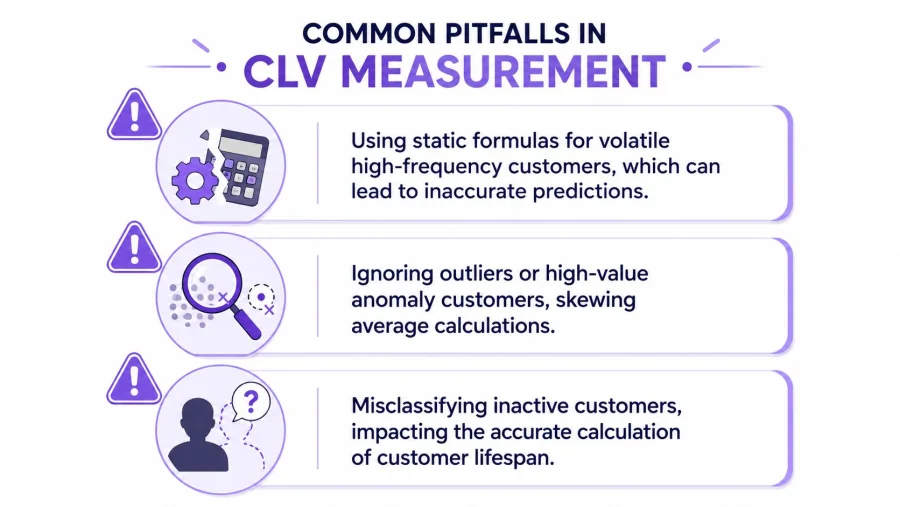
Three errors that distort CLV
Some mistakes are especially common:
- Static formulas for unstable behaviour: a customer who visited weekly last quarter may not behave the same next quarter.
- Ignoring unusual orders: one exceptionally large booking or one tiny test transaction can skew averages.
- Counting inactive customers as active: this makes lifespan look longer than it really is.
Simple ways to improve accuracy
A more reliable CLV model doesn't require a data science team. It requires cleaner habits.
Helpful practices include:
- Trim extreme orders carefully. One advanced approach recommends trimming sorted order data by 2%, removing the top 1% and bottom 1% of orders before calculating averages.
- Use net order value where possible. That means considering discounts, returns, and similar adjustments rather than relying only on gross spend.
- Pick the right window. A fast-moving café shouldn't analyse customer lifespan the same way as a long-cycle retailer.
A better question to ask
Instead of asking, “What is the exact lifetime value of every customer?” a local business often gets more value from asking, “Which customers are becoming more valuable, and which ones are fading?”
That shift matters because CLV is most useful as a decision tool. It helps a business notice patterns early, test loyalty ideas, and avoid wasting rewards on customers who have already disengaged.
Conclusion and Next Steps
Customer lifetime value matters because it turns repeat business into something visible and manageable. It helps a café, salon, gym, or shop see which relationships produce steady profit over time, not just which days look busy.
The practical path is straightforward. Choose a calculation method that fits the business, track it on a rolling basis, and use loyalty tactics to improve frequency, spend, and lifespan.
Businesses that want a simple way to act on CLV can start with BonusQR. It lets brick-and-mortar brands launch QR-based stamps, points, cashback, and coupons without POS integration or extra hardware. Owners can start free, track customer behaviour, and build stronger repeat habits with less friction.