A customer reaches the till, realises the paper loyalty card is at home, and leaves without claiming the reward they've earned. Meanwhile, the café owner hands out another card without learning who that customer is, how often they return, or which offer might bring them back. The transaction is complete, but the relationship remains invisible.
A modern loyalty card maker solves more than the card itself. The useful system connects enrolment, reward tracking, staff routines, customer reminders, accessibility, privacy, and measurement. For a UK café, restaurant, salon, gym, or shop, that end-to-end approach matters more than a card that looks attractive.
Why Digital Loyalty Outperforms Paper Cards
Paper cards are easy to print and difficult to manage. A stamp proves that a visit happened, but it doesn't reveal whether the customer returns weekly, responds to a particular offer, or has stopped visiting altogether. Customers can lose the card, forget it at home, or damage it before they reach the reward.
A digital pass removes much of that uncertainty. Customers can open a QR code from their phone, save a pass to their wallet, and see their progress without carrying a separate piece of card. Staff can record the visit at the counter, while the business builds a usable history of rewards and redemptions.
The market already expects loyalty
Loyalty membership is no longer unusual behaviour in the UK. A 2024 review by the Competition and Markets Authority found that 97% of shoppers belonged to at least one supermarket loyalty scheme, and the average shopper held memberships in three schemes. The same review found that 27% had joined a supermarket scheme during the previous 12 months, with loyalty prices a primary motivation for 27% of those recent joiners.
The lesson for a small business isn't to copy a supermarket. It's to make the value immediately clear. Members in the five supermarkets examined saved an average of 17% to 25% on products carrying loyalty prices, but the review also exposed a trust problem. Although 69% believed loyalty pricing offered good savings, 40% didn't trust that the advertised loyalty price represented a genuine saving, and 43% considered it unfair that members could pay less than non-members.
A digital scheme should therefore show the earning rule, the reward, and any restrictions in plain language. A vague promise such as “exclusive savings” creates doubt. “Collect a stamp after each eligible visit and redeem your reward when the pass shows it's ready” is easier to understand.
Data turns a card into a customer tool
Tesco's Clubcard illustrates how a physical card can evolve into a data system. Tesco launched Clubcard on 13 February 1995. Within two weeks, seven million cards had reached stores, and more than 70% of Tesco sales were matched to cardholders. During the first three months, Tesco processed data from more than 50 million shopping trips, covering over two billion purchased items and more than five million members, according to the Clubcard history.
A local business doesn't need supermarket-scale infrastructure to apply the same principle. A QR-based card can connect an identifiable customer with visits, rewards, redemption behaviour, and permission-based messages. That gives the owner something paper can't provide: a basis for deciding which reward deserves more investment.
Businesses that want to move beyond issuing discounts can also study practical methods to build a loyal customer community, especially when the aim is a lasting relationship rather than a one-off promotion. A useful implementation guide is available in this complete guide to digital customer loyalty cards.
Designing Your Digital Loyalty Pass
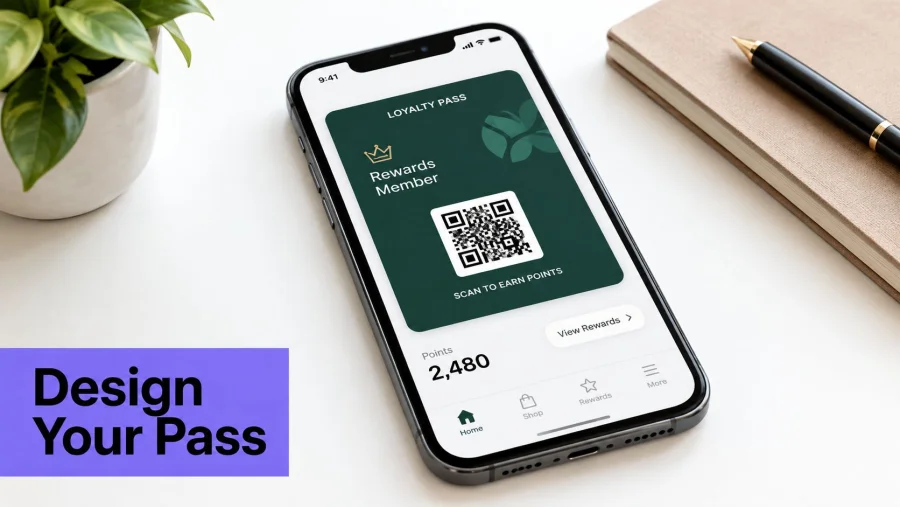
A loyalty pass has one job at the moment of use: tell the customer what they've earned and what to do next. If the customer has to search for the QR code, interpret a crowded screen, or remember an unclear rule, the design has already added friction.
Start with the smallest useful mobile layout. Place the logo where it establishes recognition, show the current balance or stamp progress near the centre, and make the next action obvious. A café pass might say “Two visits to your next reward” rather than forcing the customer to calculate the remaining progress.
Use a clear visual hierarchy
A strong pass should answer three questions at a glance:
- Who is it for? Use the business name and logo consistently with signage, receipts, and social profiles.
- What is the current status? Show stamps, points, a visit total, or the reward already available.
- What happens next? State how the customer earns progress and how redemption works.
Colour helps customers locate important information, but it shouldn't carry meaning on its own. UK Finance guidance recommends readable font sizes, sufficient colour contrast, and matte colours for retailer loyalty cards, alongside accessible alternatives to QR-linked guidance. The guidance on accessible card design is particularly relevant for businesses that assume every customer can scan a code easily.
A pass should also work when the phone is being used outdoors, under bright lights, or by someone with reduced vision. Avoid delicate text, low-contrast combinations, and instructions embedded only in an image. Brand colour customisation should support recognition without reducing legibility, as shown in these digital loyalty card brand colour options.
Design for customers who can't scan
QR-first doesn't mean QR-only. Some customers may have visual, motor, cognitive, or technology-related barriers. Others may have a phone with low battery, limited data, or no convenient wallet access.
Offer practical alternatives:
- Let staff enrol a customer with assistance, while the customer gives the information and confirms the choices.
- Provide a printed card for customers who prefer a physical reminder.
- Allow a phone number lookup where the system supports it.
- Keep the enrolment page accessible through a standard web address.
- Give staff a way to award or redeem a reward without requiring the customer to present a personal QR code.
The best design is not the one with the fewest physical components. It's the one that lets the widest range of customers participate without embarrassment or delay.
Printing Options for Hybrid Loyalty Programs
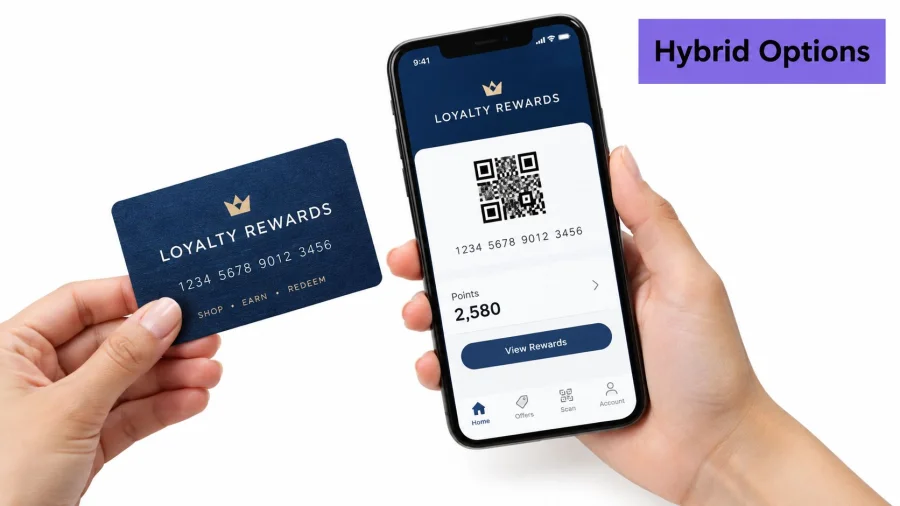
Digital passes suit customers who keep everything on a phone. Physical cards still have a place in a mixed customer base, particularly when someone prefers a tactile card, doesn't use a mobile wallet, or arrives with a flat battery. A hybrid scheme can preserve that choice while keeping the reward record digital.
Start with a simple printed card rather than commissioning an elaborate item before demand is proven. A small card can carry the logo, a programme name, a QR code, and brief joining instructions. The QR code should lead to enrolment or card access, not to a page crowded with unrelated promotions.
Match the material to the use case
Printed card stock works well for a pilot, a community event, or a business testing its reward mechanics. It keeps the initial commitment low and makes it easy to change the message when the programme develops.
Plastic cards suit businesses where customers handle the card frequently or keep it in a wallet. A salon, gym, or independent retailer may prefer a more durable finish, but the extra production cost only makes sense if the card will be used regularly.
Keychain cards or holders can help customers keep the card available, although the added item shouldn't distract from the digital account. For guidance on durable card printing methods, businesses can compare finishes and production considerations before ordering.
Keep physical access connected
A physical card should be an access point to the same customer profile, not a separate programme. Put the QR code where it can be scanned without bending the card, leave enough clear space around it, and test it with several phone cameras before printing a batch.
Print only the instructions a customer needs immediately. “Scan to join” is more useful than a paragraph about every possible reward. Staff can explain the programme in person, while the landing page handles the fuller terms, privacy information, and accessibility options.
The digital record remains important even when the customer uses plastic. A staff member can look up the account, award the visit, and redeem the reward without asking the customer to carry a particular format forever. That combination widens participation without returning the business to disconnected punch cards.
Staff Workflows and Customer Onboarding
A loyalty scheme succeeds at the counter, not in the dashboard. If staff need to leave the customer, open several screens, or explain a complicated rule during a busy period, enrolment will be skipped and redemption will become inconsistent.
The customer-facing invitation can stay simple: “Would you like to join our loyalty programme?” Once the customer agrees, staff should show the QR sign-up route, help where needed, and confirm the first reward or progress immediately.
Remove the avoidable friction
A UK survey of 2,000 adults found that 23% of consumers were deterred by a complicated sign-up process, 35% stopped using a programme because rewards took too long to earn, and 46% often forgot to use their loyalty cards. The same survey found that 73% believed loyalty cards offered good value, while 70% said they encouraged repeat visits.
That combination is useful operational guidance. Customers aren't necessarily opposed to loyalty. They stop participating when the effort becomes greater than the perceived value.
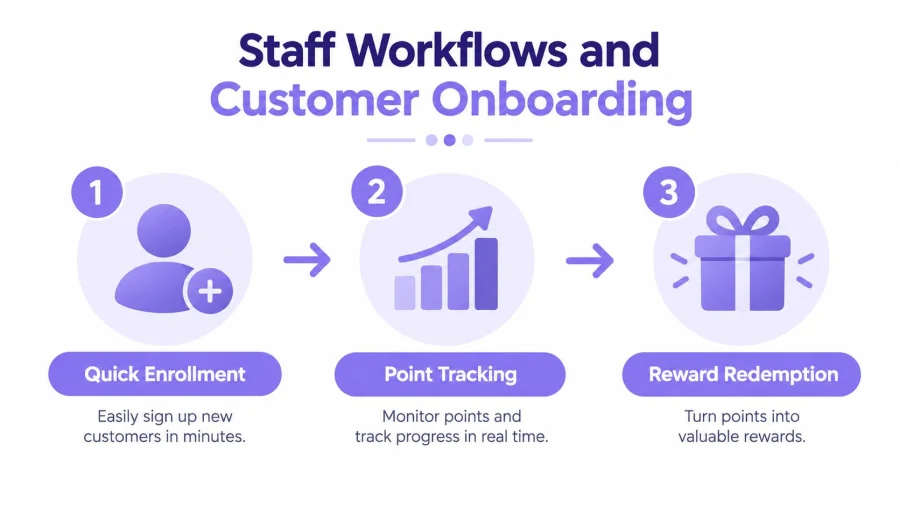
A practical workflow looks like this:
- Invite without interrupting. Staff mention the scheme while taking the order or completing payment.
- Collect only what is needed. A mobile number or email can be enough for enrolment, depending on the programme design.
- Give an immediate reason to continue. A first-visit reward or visible initial progress confirms that joining was worthwhile.
- Show the next milestone. Customers should see progress after every scan, not receive a vague promise about future value.
- Redeem with a quick lookup. Staff verify the reward, apply it according to the stated rule, and complete the transaction without a long explanation.
Train the exception cases
The normal scan is easy. The difficult moments are the customer who forgot their phone, the person with two profiles, the reward that appears ready but has a restriction, and the customer who wants to opt out of promotional messages.
Create a one-page staff reference with the normal enrolment route, phone-number lookup, reward redemption, and escalation process. Role-play a few scenarios during onboarding. Managers should also review failed redemptions and duplicate profiles, because those issues reveal weaknesses in the workflow rather than errors by individual employees.
Practical rule: Staff should never have to improvise the value of a reward. The screen, printed material, and spoken explanation should all use the same rule.
Integrating BonusQR for Seamless Management
A loyalty card maker becomes useful when it connects the customer's pass with the team's daily actions. The setup should cover reward rules, QR access, wallet passes, staff redemption, customer records, and reporting without forcing a small business to buy specialist hardware.
BonusQR provides branded digital cards with stamps, points, cashback, visit and spend thresholds, fixed discounts, welcome bonuses, birthday offers, and seasonal coupons. A café can combine a visit reward with a birthday offer, while a salon can use a visit threshold tied to a future service. The important decision is not how many mechanics the platform supports. It's whether the selected rule is easy for staff to explain and customers to value.
Build the programme around behaviour
Use the reward type that matches the commercial problem:
- Stamps or visits suit frequent, repeatable purchases such as coffee or fitness sessions.
- Points work when customers buy products or services with different values.
- Spend thresholds can encourage a larger basket, but the threshold must remain understandable.
- Welcome offers create a reason to complete the first enrolment.
- Birthday and seasonal coupons add timely relevance without changing the core earning rule.
Each customer can have a personal QR code linked to points, rewards, and visit history. Apple Wallet and Google Wallet access keeps the pass available on the phone, while staff can scan and redeem without a POS integration or additional hardware.
Keep the operating model lean
The manager configures the rules once, then tests them with real staff before promoting the scheme. The team should know which actions award progress, when a reward becomes available, whether rewards expire, and how to handle a customer who uses the physical fallback.
The platform also brings together customer records, coupon performance, visit trends, and permission-based push or email campaigns. A business can start for free, launch an affordable white-label app under its own icon in about 14 days, or commission a custom app with advanced integrations. The guide to starting a loyalty programme with BonusQR provides a practical setup route.
Privacy still needs deliberate configuration. The business should separate the data required to operate the reward account from optional analytics and promotional messaging. A convenient tool doesn't remove the need to explain what customers are joining.
Measuring Success and Launching Your Program
A loyalty programme can look busy while losing money. More scans and redemptions don't automatically prove that the scheme created additional visits. Some customers may redeem a reward they would have earned or purchased without an incentive.
Start with a small pilot and define the commercial question before launch. The question might be whether a welcome reward brings customers back, whether a spend threshold increases basket value, or whether a birthday offer reactivates dormant members. A control group or comparable non-enrolled group gives the owner a stronger comparison than raw redemption totals.
Use a focused measurement set
Track the customer journey from sign-up to repeat behaviour:
- Activation: how many enrolled customers complete a first scan or claim the pass?
- Second visit: how long does it take for an enrolled customer to return?
- Repeat interval: does the interval between visits change after enrolment?
- Average spend: does spend differ before and after joining?
- Reward cost per incremental visit: what does the business give away for a visit that appears additional?
- Inactive members: how many customers stop progressing and may need a permission-based reminder?
- Redemption by reward type: do stamps, cashback, birthday offers, and spend thresholds behave differently?
Collinson's 2025 UK loyalty research identifies measurement as the leading programme frustration for 31% of brands, while cost and ROI pressures affect 30%. Technology and customer risk are each cited as blockers by 26%. The research also reports that programme complexity is a barrier for 30% of UK respondents.
Protect margin and customer trust
Set a payback rule before releasing the offer. For a free product after a defined number of visits, calculate the gross margin given away and decide what evidence would show that the reward generated enough additional activity. The exact calculation depends on the business's prices, costs, and normal visit pattern, so a high redemption rate alone isn't a success criterion.
Retention and acquisition may require different mechanics. Cardlytics reported that 54% of UK adults preferred returning to restaurants they had previously visited, while 54% said a discount voucher or cashback reward would make them more likely to try a new restaurant. The same research found that 45% of UK households were more likely to visit a restaurant offering rewards for returning customers, and 61% were more likely to visit a shop or supermarket with a loyalty system, rising to 70% among people aged 18 to 34. See the UK loyalty and restaurant spending findings for the category differences.
Privacy measurement belongs in the launch checklist too. The ICO guidance on valid consent says consent must be freely given, specific, informed, unambiguous, and based on a clear affirmative action. Keep loyalty enrolment separate from optional marketing permissions, record the consent wording and timestamp, and provide a simple withdrawal route.
Operational reward tracking may be needed to run the scheme, but targeted discounts and behavioural profiling require a separate lawful-basis assessment under ICO legitimate interests guidance. Businesses should also tell customers what messages they will receive and provide a clear opportunity to refuse promotional communication, as explained in the ICO guidance on marketing lists.
Choose one customer journey, one understandable reward, and one measurable pilot. Set up the QR enrolment route, train staff on lookup and redemption, provide a printed alternative, and test the pass with customers who use different devices and accessibility needs. Then launch the programme with clear terms and review its results before adding more incentives. A practical loyalty card maker can support the mechanics, but the business still owns the experience, the privacy choices, and the margin behind every reward.


