
 Deutsch
 Español
 Français
 Italiano
 Magyar
 Polski
 Slovenčina
 Čeština
Most loyalty card advice gets this backwards. It starts with points, tiers, and “engagement”, then wonders why owners end up with a drawer full of dead plastic and a staff team that can't explain the rules at the till. The card itself is not the strategy. The second visit is the strategy, and the card only matters if it helps a customer come back quickly, understand the reward instantly, and redeem without hassle.
That's the standard for UK small businesses now, especially in cafés, salons, gyms, restaurants, and local retail. In a mature market where loyalty is already normal shopping behaviour, the winning programme is the one customers can use without thinking, not the one with the cleverest tier names or the longest rulebook. A loyalty card should function as an identity token plus a simple reward mechanic, then disappear into the background while habit does the heavy lifting.
Why Most Loyalty Cards Fail Before They Begin
Most programmes don't fail at launch, they fail at design. Owners borrow enterprise-style complexity, then expect customers to care about rules they barely understand and staff to enforce them perfectly every shift. That's backwards. A loyalty card only works when it makes the next visit easier to remember, easier to justify, and easier to redeem.
Stop treating the card as the product
A loyalty card is not the reward. It's the identifier that ties a visit to a customer profile, records behaviour, and triggers the rule that releases the reward. That distinction matters because the card can be simple while the incentive logic stays flexible, which is exactly how modern systems handle stamps, points, thresholds, and redemptions, as described in how loyalty cards work.
Practical rule: if a customer can't explain the offer in one sentence, the programme is already too complicated.
The strongest programmes don't chase sign-ups for their own sake. They create a repeatable habit loop. A customer scans, gets a clear benefit, remembers the benefit, then comes back because the next reward feels close enough to matter. That's why the best low-friction tools, including simple QR-led systems such as BonusQR, strip out the extra machinery small teams never use.
Most owners should stop asking, “What features can be added?” and start asking, “What behaviour needs to happen after the first scan?” If the answer isn't the second visit, the programme is probably overbuilt. A card that produces data but no habit is just a data-collection exercise with a nicer logo.
What a Loyalty Card Actually Does
A proper loyalty card has two layers. The first is the identity layer, which tells the business who is in front of the till. The second is the rule layer, which decides what that customer earns and when redemption becomes available. When those two layers work together, the system feels effortless to the customer and useful to the merchant.
Identity first, reward second
Think of a neighbourhood café running a nine-stamp free drink card. The customer scans or presents the token, the visit is logged, and the ninth visit grants the reward. The card is doing identification and storage, while the reward logic is just a threshold. That same structure can support a salon with points on spend, where every transaction adds to a profile until a defined redemption level is reached.
The point is not to romanticise the format. It's to keep the mechanism obvious. A gym may use visit credits, a restaurant may use spend thresholds, and a retail shop may prefer voucher-style redemption, but the underlying mechanics stay the same.
A good loyalty card reads like a receipt the customer wants to collect, not a quiz they have to pass.
One sentence should describe the whole programme
Any owner should be able to state the scheme in one line. Who earns, what they earn, and when they redeem. If that sentence sounds vague, the programme will be vague in practice too.
For a deeper operational lens on customer satisfaction and loyalty behaviour in local businesses, the practical playbook for local businesses is a useful companion read, especially for teams trying to align rewards with service quality rather than gimmicks.
A loyalty card works when the merchant can configure the rule set without changing the physical or digital token every time the offer changes. That is why stamps, points, tiers, and thresholds are all just different expressions of the same core system. The format matters, but the logic matters more.
Physical, App and QR Loyalty Cards Compared
The format debate gets overcomplicated fast. Physical cards feel familiar, app-based schemes feel polished, and QR or wallet-based passes sit in the middle with less friction and more flexibility. The right answer depends on the customer mix, the speed of service, and how much operational complexity the business can tolerate.
UK preference is split, and that split should shape the decision. One UK source says 43% of consumers prefer digital loyalty cards, while another says 38% still prefer plastic loyalty cards, which is the highest share globally. That contradiction tells owners to stop chasing fashion and start matching format to actual shoppers, not assumptions.
Loyalty Card Formats Compared
| Dimension | Physical card | App-based card | QR / digital-wallet card |
|---|---|---|---|
| Launch cost | Low to moderate, but cards need printing and reorders | Usually higher because app build and maintenance are heavier | Usually lower because the customer only needs a scan or wallet pass |
| Checkout friction | Familiar, but cards get forgotten or lost | Can be slower if the app must be opened first | Fast, especially when the QR is already in the wallet or on the phone |
| Data capture | Good only if the system is actually scanned every time | Strong, because the app can hold richer profiles | Strong, because scans can connect directly to a customer record |
| Customer preference | Still works well with habit-led shoppers | Better for customers who live on their phone | Good middle ground for convenience and accessibility |
| GDPR posture | Personal data still applies when the card identifies a person | Personal data is obvious once the profile is linked | Same privacy rules apply, but the flow can be simpler to explain |
| Best use case | Small shops with older or habit-driven regulars | Brands that need a fuller customer experience | SMBs that want low-friction loyalty without heavy tooling |
When each format wins
A physical card still makes sense in places where the customer wants something tangible and the staff need a dead-simple visual cue. A paper punch card is fine if the offer is basic and the business doesn't want to manage app adoption.
An app-based card makes sense when the business needs richer communication and can support a more involved customer journey. The trade-off is obvious, more capability usually means more friction.
A QR or digital-wallet card is the practical choice for most SMBs. It gives the customer a fast scan, supports modern wallet behaviour, and avoids the hardware and checkout drag that can sink a launch. For coffee businesses in particular, a stamp card for coffee shops is the clearest benchmark for how simple the mechanic can be.
Real Loyalty Card Mechanics That Work in Real Shops
Theory gets forgotten. The mechanic is what staff can explain while serving a queue. The most useful loyalty cards are the ones that match how the business already sells, not how a software demo makes the system look.
Five shop-level examples
Coffee shop. Nine stamps for a free drink, with a birthday bonus added once a year. That works because the reward is frequent, easy to remember, and tied to a repeat habit customers already have.
Neighbourhood restaurant. Spend thresholds that provide a voucher after a defined amount of visits. This suits mixed baskets better than stamps because the reward follows spend, not just frequency.
Beauty salon. Points per pound spent, then a reward at a clear redemption level. That works when appointments vary in size and the owner wants to encourage higher ticket services.
Gym or studio. Visit-based credits that provide an exclusive class or retail discount. This fits a routine business where attendance matters more than basket value.
Local retail shop. Fixed-value cashback or a simple voucher after a spend milestone. It keeps the programme transparent and avoids confusing discount ladders.
What makes these mechanics durable
The best mechanics all share one trait, they make the next action obvious. There's no mystery about how customers earn, and no awkward explanation at redemption. That matters more than reward novelty.
A small shop should not launch five reward types on day one. One mechanic, one reward, one explanation. If staff can't say it quickly, customers won't repeat it.
Operational truth: the mechanic has to survive a busy Friday shift, not just a polished launch email.
Keep the reward visible and the rule simple. The more a shop tries to make the programme feel, the more likely it is to become invisible in day-to-day service. The safest loyalty card is the one that can be explained across the counter in under ten seconds.
Designing and Launching Your Loyalty Card in One Week
A loyalty card should not take months to launch. A small business can build a usable version in a week if the rule is simple and the team stays disciplined. The mistake most owners make is opening with design assets before they've agreed the mechanic.
Pick the rule before the artwork
Day one is for structure, not visuals. Choose one earning rule and one reward, then write the programme in a sentence that customers can repeat to a friend. That sentence is the test.
Day two is for format. Decide whether the card will be physical, app-based, or QR-led, then prepare the in-store trigger. A sticker on the counter, a table talker, or a till prompt is usually enough for a small shop.
Load, test, and train
Day three and four should be used to set up the programme and test redemption from end to end. Staff need to see the full journey, from sign-up to scan to reward issue, before the public sees anything.
Day five is for the team. Every employee should know the five-second scan script and what to do when the reward is due. If the team hesitates, customers will too.
Promote it like a normal offer
Day six and seven are for promotion. Print-ready posters, a short explainer card, a launch message to existing customers, and a wallet pass for digital formats all help. If the programme is linked to identifiable customers, it becomes personal data under UK GDPR, so a privacy notice and lawful basis need to sit in the launch checklist as standard practice, not as an afterthought, as the ICO definition of personal data makes clear in the UK GDPR loyalty data guidance.
A one-page rollout checklist should cover the mechanic, format, reward wording, staff script, privacy notice, and launch materials. If any one of those is missing, the programme is not ready yet. Simplicity is not a branding choice here, it's an operating requirement.
Measuring Whether Your Loyalty Card Is Actually Working
Sign-ups are vanity. Activity is the signal. A loyalty card that looks popular on paper but never gets redeemed is failing, because customers aren't building the habit that produces repeat revenue.
Track the right four numbers
Active member rate tells the owner how many members bought in the last 30 days. That figure matters because enrolled customers who never return are just names in a database.
Redemption rate shows whether members claim rewards at all. If that number stays low, the offer is either too hard to reach or too easy to ignore.
Repeat visit rate shows whether the programme is changing behaviour. If customers come back more often after joining, the card is doing its job.
Incremental spend compares member spend with non-member spend. That is the number that helps a merchant decide whether the programme is moving profit or just creating discount noise.
Read the dashboard weekly, not quarterly
A small business does not need a complicated analysis stack to spot trouble. It needs a weekly check on whether members are active, redeeming, and spending more than before. If members are stockpiling points and never redeeming, the reward threshold is probably too distant or the value is too weak.
For owners who want a simple reporting view without spreadsheet drag, how analytics boost repeat visits is a practical example of the kind of dashboard view that keeps the focus on behaviour, not administrative busywork.
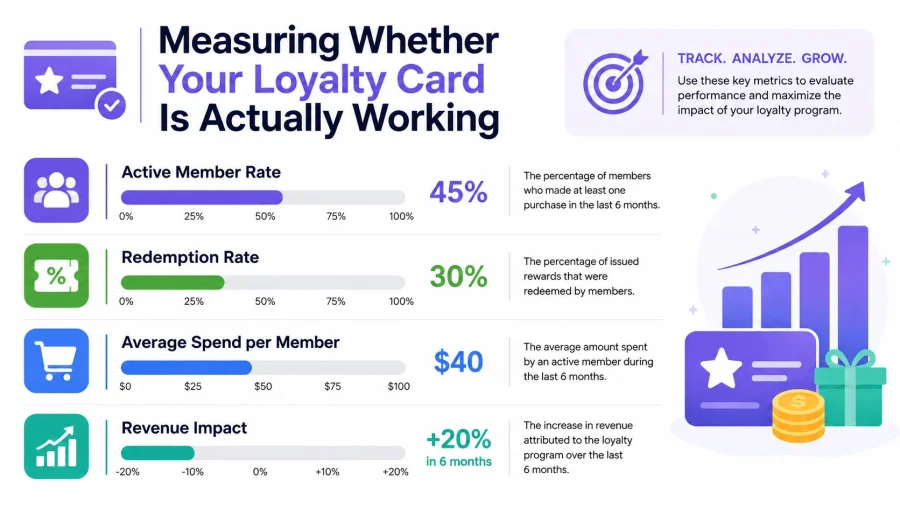
The UK benchmark to keep in mind is simple. Loyalty is already embedded in weekly shopping behaviour, and that means a programme needs to feel routine, not experimental. If the team has to explain the card differently every week, the system is too unstable to build habit.
Common Loyalty Card Mistakes and How to Avoid Them
Most broken loyalty cards share the same problems. The reward is too vague, the setup is too clever, or the team never tells customers how it works. Owners usually blame low adoption, but the issue is often that the programme was difficult from the start.
The failure modes that show up most often
Over-complication at launch. A salon with forty active customers does not need a five-tier structure. The fix is to cut the system back to one clear earn rule and one reward, then add complexity only after behaviour is proven.
Weak rewards. A discount that nobody wants is not an incentive. The fix is to choose rewards customers already value, such as a free item, a straightforward voucher, or an immediate benefit.
No staff explanation. A programme collapses if the team can't describe it confidently. The fix is to give every employee a short script and make redemption part of the standard service flow.
GDPR blind spots. A card that links visits to a person creates a personal data obligation. The fix is to document the lawful basis, privacy notice, and data minimisation approach before launch.
Format mismatch. A shop can lose momentum by choosing the wrong medium for the customer base. The fix is to match the format to the audience, not to a trend report.
No post-launch promotion. A card that sits on the counter won't build habit. The fix is to keep promoting it after launch through signage, staff prompts, and regular reminders.
The quickest audit to run
An owner should ask three blunt questions. Can a staff member explain the card in one sentence, can a customer redeem without friction, and is the reward worth remembering? If any answer is no, the programme needs work now, not later.
The biggest mistake is treating a loyalty card like a one-time launch campaign. It's not. It's a service habit, and it needs visibility every week to stay alive.
Why BonusQR Is the Fastest Way to Start a Loyalty Card
Small businesses do not need enterprise loyalty software to get repeat visits moving. They need a system that is easy to launch, easy to explain, and easy to measure. That's where a QR-based setup makes sense, because it removes the two blockers that stall most owners, POS integration and custom hardware.
What a practical setup needs
A workable loyalty card for an SMB should support stamps, points, cashback, thresholds, welcome bonuses, birthday coupons, and seasonal offers without forcing a rebuild every time the mechanic changes. It should also support Google Wallet and Apple Wallet passes so customers can keep the card handy without downloading another app.
That is the appeal of a customizable loyalty card solution like customizable loyalty card solution, which is built around configurable loyalty mechanics rather than heavy infrastructure. It gives a shop a fast route to a digital card, while still leaving room for more advanced branding if the business grows.
Match the build path to the business size
A very small shop can start free and validate the mechanic before spending more. A growing local business can use a white-label app under its own brand in about 14 days. A larger operator with more complicated needs can commission a custom build later, once the basic habit loop is already proven.
That sequence matters. Too many owners start by paying for features they won't use, then discover the customers never adopted the programme in the first place. Start with the mechanic, not the architecture.
Direct recommendation: choose one simple reward, launch it with QR access, train the team properly, and keep the analytics visible every week.
For a coffee shop, salon, gym, restaurant, or retail counter, the fastest path is the one that gets customers scanning quickly and coming back soon. Start with the simplest format, test the behaviour, then improve the programme after it has earned the right to become more advanced.
If a loyalty card is supposed to create repeat visits, then the next move is obvious. Pick one mechanic, keep the rule simple, and launch it with a QR-based setup that your team can run this week. BonusQR can be tested free, so the smartest next step is to build the smallest version first, put it on the counter, and let real customers tell the business whether the offer is worth repeating.