A regular customer used to visit twice a week. Then they miss one visit, choose another café, forget the salon, or skip a gym session. By the third Thursday, they're walking past the door without thinking about it. The owner notices the empty seat, but not the reason behind it.
That's the problem loyalty apps should solve. They aren't there to give away free coffees or create a flashy digital card. They're there to make the next visit easy to remember, valuable enough to prioritise, and simple enough to complete.
The UK already has a crowded loyalty market. A 2022 survey of 1,000 UK participants found that 81% used a loyalty programme, while 91% of loyalty users belonged to more than one scheme. Software Advice's UK loyalty research also found that points-based programmes were used by 90% of loyalty members. The opportunity for a small business isn't convincing people that loyalty exists. It's getting members to use one particular programme again.
Why Loyalty Apps Matter for Small Businesses
A small café doesn't need another list of names that never becomes revenue. A salon needs clients to rebook, not merely collect a birthday voucher. A gym needs members to attend consistently, especially during quiet periods, rather than sign up for a reward they'll never claim.
Repeat visits give owners a more dependable commercial base than one-off footfall. A returning customer already knows the location, service, pricing, and experience. A loyalty app gives that customer a practical reason to choose the same business again.
Paper stamp cards work for a simple offer at a single counter. They become unreliable when cards get lost, staff forget to stamp them, customers can't remember their balance, and the owner has no useful record of who is active. A mobile loyalty card can show progress, store rewards, issue reminders, and give the business a clearer view of behaviour.
The real problem is dormant membership
The UK's engagement gap is more important than enrolment. Mintel reports that 55% of consumers belong to at least four schemes, yet 58% have used three or fewer in the past six months. Mintel's UK customer loyalty research shows why a large membership list can create false confidence. Customers may join readily, then ignore most of the programmes they've collected.
A customer who signs up but never returns hasn't created loyalty. They've created an inactive record.
Practical rule: Track active members and repeat visits before celebrating sign-ups.
The strongest programme therefore starts with a short path from visit to reward. The customer scans at the till, sees progress immediately, receives a relevant prompt, and understands exactly what to do next. That approach suits cafés, shops, salons, restaurants, and fitness studios because it supports the behaviour that pays the bills, returning.
What Loyalty Apps Actually Are
A loyalty app is software that helps a business recognise customers, record qualifying behaviour, and exchange rewards for future purchases or visits. The customer may use a mobile webpage, a digital card, a QR code, or a wallet pass rather than downloading a traditional app from an app store.
The simplest comparison is a digital stamp card that remembers every visit. A paper card records progress only when it's in the customer's pocket and a member of staff remembers to use it. A loyalty app can record the activity digitally, display the balance, issue a voucher, and remind the customer before interest fades.
Three models cover most small-business needs
Points per pound rewards spending. A customer earns points based on the amount paid, then exchanges them for discounts, products, or account credit. This model suits retail and restaurants where basket value varies.
Visit-based stamps rewards frequency. A coffee shop might offer a free drink after a defined number of qualifying visits. Salons can apply the same logic to appointments, provided the reward doesn't undermine the service margin.
Tiered VIP rewards recognises progression. Customers gain better benefits after reaching different activity or spend thresholds. A gym could offer perks for regular check-ins, while a retailer might provide early access or stronger rewards to its most active customers.
The model should match the behaviour the business wants more often. Points can encourage higher spending. Stamps can encourage another visit. Tiers can give frequent customers a reason to keep progressing.
Owners comparing customer-retention software with broader ecommerce tools may also find Shopify app recommendations for DTC brands from YipSMS Inc. useful for understanding how loyalty fits within a wider marketing stack.
A good loyalty app doesn't need every possible feature. It needs a visible reward, a fast scan, clear rules, and a reason to return.
Core Features and the KPIs They Move
A loyalty app should be judged by the business metric it changes, not by the number of buttons in its dashboard. Owners need to connect each feature with a specific behaviour, then remove anything that adds complexity without helping a customer return.
UK loyalty reporting estimates that roughly 26% of points go unredeemed, representing about £3 billion in annual value. The same UK loyalty statistics report associates branded-app loyalty programmes with redemption rates of 22% to 27%, compared with push-notification open rates of 15% to 25%. The lesson is straightforward. A balance that customers can't see or redeem is not performing its job.
| Feature | KPI It Moves | Benchmark |
|---|---|---|
| QR scan-to-join | Enrolment rate | Reduce steps and staff explanation |
| Mobile wallet pass | Active-member share | Keep rewards visible between visits |
| Automated reminders | Return visits | Send relevant prompts before rewards are forgotten |
| Clear reward rules | Redemption rate | Make value immediate and understandable |
| Visit streaks | Visit frequency | Reward consistent behaviour |
| Spend thresholds | Average spend per visit | Encourage a larger basket without confusing the offer |
| Segmentation | Offer response | Match rewards to customer behaviour |
| Exportable reporting | Management visibility | Connect activity with weekly revenue |
Prioritise the features that remove friction
A QR code at the till is more useful than an elaborate game if customers can join in seconds. A wallet pass can outperform a buried account page because the customer has a better chance of seeing the available reward. Automated reminders matter when they lead to a clear action, such as returning to redeem a voucher.
Gamified scratch cards and surprise rewards can add interest, but they should earn their place. If they don't prompt a return visit, increase meaningful spending, or improve redemption, they're decoration.
The owner should review three questions each week:
- Are members active? A growing database with little activity signals weak promotion or a poor reward.
- Are rewards being redeemed? Low redemption can mean the offer lacks value, the rules are unclear, or the path is too long.
- Are visits changing? The programme exists to influence behaviour, so visits matter more than registration volume.
Email can support the same work when customers prefer inbox communication to push notifications. For teams building a wider retention system, best email marketing tools for small business from Mail Merge for Gmail offers a useful comparison of communication options.
A Practical Checklist to Evaluate Any Loyalty App
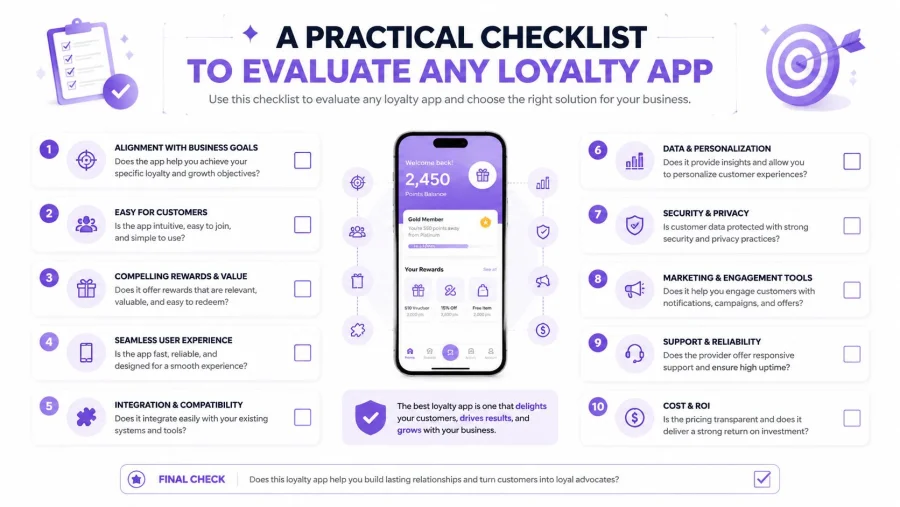
A thirty-minute demo is enough to reject most unsuitable loyalty apps. The owner shouldn't ask whether a platform has “advanced features”. The better question is whether staff can use it quickly, customers can understand it instantly, and the business can manage the data responsibly.
Feature fit
Ask these questions and record a yes or no answer:
- Can the app run a simple stamp or points rule? A small business should be able to launch without custom development.
- Can it support tiers if the programme grows? A basic launch shouldn't create a dead end.
- Can the owner set voucher expiry rules? Expiry should create action without making customers feel tricked.
- Can the system send push notifications or email reminders? Dormant members need a prompt that relates to their balance or behaviour.
- Can the owner segment customers? Frequent visitors and inactive members shouldn't receive identical offers.
- Can reports be exported? An owner needs to compare loyalty activity with sales records and cash flow.
For deeper measurement, the business should review analytics for loyalty rewards before choosing a platform. Reporting isn't a luxury. It helps identify whether a reward generates useful behaviour or just gives away margin.
Total cost and rollout
The cost review should include the subscription, per-location charges, messaging fees, printing, onboarding, and contract length. The useful calculation is cost per active member, not cost per sign-up. An inactive member doesn't justify software spend.
Then test implementation:
- Can staff learn the daily process without custom development?
- Can the programme go live within two weeks?
- Can the business operate without extra till hardware or a complicated POS project?
Compliance
- Can the platform record informed consent, support deletion requests, and explain retention rules?
Under UK GDPR, a loyalty programme collecting names, email addresses, phone numbers, or behavioural information needs a lawful basis and transparent privacy information. The ICO's guidance on data gathered by loyalty cards explains that these programmes can reveal where customers shop, how much they spend, and what they buy.
A provider should also explain its role as a data processor. Where a third party processes personal data, Article 28 UK GDPR requires a written contract or data-processing agreement, as outlined in UK loyalty compliance guidance.
How BonusQR Fits the Checklist
BonusQR fits businesses that want a QR-led loyalty process without requiring extra POS hardware. Customers can sign up through mobile or web, receive a personal QR code, and view points, rewards, or visit history in one profile. Staff scan and redeem at the counter, while wallet passes keep offers accessible.
The platform has three practical launch paths. The free starter route covers digital stamp cards and basic voucher rewards for a single-location business testing whether customers respond. The white-label route adds custom branding, support for multiple locations, segmented campaigns, and analytics export. The custom route is designed for chains and franchises that need API integration, bespoke mechanics, and dedicated onboarding.
Businesses considering a direct replacement for paper cards can also assess stamp card software for retailers against the same operational requirements.
| Checklist Category | Free Starter | White-Label | Custom |
|---|---|---|---|
| Feature fit | Stamps and basic vouchers | Branding, campaigns, multi-location features | Bespoke mechanics and API integration |
| Cost approach | Suitable for testing | Based on active usage | Scoped around integration and onboarding |
| Rollout | Guided basic setup | Launch planned for under 14 days | Dedicated implementation |
| Reporting | Core programme visibility | Analytics export and campaign insight | Advanced reporting shaped around the integration |
| Compliance | Consent capture built in | Consent and account controls | Consent and account controls designed for the wider system |
The choice should follow operational need, not ambition. A café testing a return-visit mechanic doesn't need a custom build. A multi-site operator may need consistent branding and central reporting. A franchise with existing systems may need integration before any loyalty rule can work properly.
BonusQR's product information describes QR rewards, digital cards, wallet access, stamps, points, cashback, visit and spend thresholds, fixed discounts, welcome bonuses, birthday offers, and seasonal coupons. Those mechanics give an owner room to start and then expand when active-member behaviour justifies it.
The key evaluation remains the same: can staff prompt the scan, can customers understand the reward, and can the owner connect activity with repeat revenue?
Loyalty App Use Cases by Sector
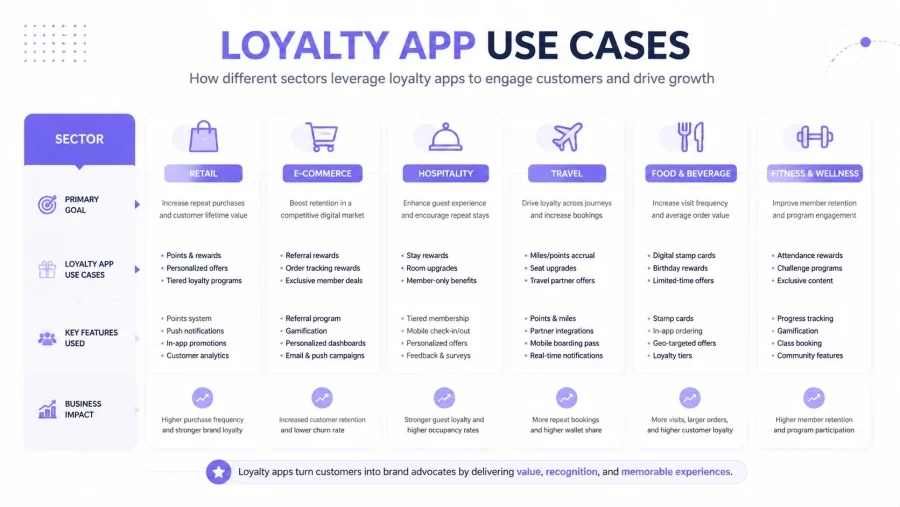
The same loyalty mechanic behaves differently at a coffee counter, a beauty salon, and a gym. The reward must fit the natural rhythm of the customer relationship.
Independent coffee shop
A café can use a visit-based scheme such as buy nine drinks, get the next one free. The owner's launch target is for 30% of regular customers to join during the first week, with 20% returning within 14 days to claim the free drink. Those figures are scenario targets for planning, not UK benchmarks.
The staff script should take one sentence: “Would you like to collect a digital stamp for today's drink?” The QR code belongs beside the till and on the receipt, not hidden on a social profile.
The first metric to watch is repeat visits from enrolled customers. Sign-ups matter only if members return.
Two-chair beauty salon
A salon can combine visit stamps with birthday vouchers. The system should send an appointment reminder 24 hours before the booking, with consent and communication preferences recorded properly. The owner's scenario target is 40% client enrolment, followed by a measurable reduction in no-shows once reminder pushes operate consistently.
The reward should support the next appointment rather than discount every service. A birthday voucher can create warmth, while a visit reward can encourage regular booking without training clients to wait for constant reductions.
The first metric is completed appointments among enrolled clients. A salon with more members but unchanged attendance hasn't solved its retention problem.
Neighbourhood gym
A gym can layer tiered rewards onto monthly check-ins. A planning target might be for 25% of members to reach the first tier within six weeks, with attendance improving on low-traffic weekdays. These are operating targets for the scenario, not verified performance claims.
A useful reward could be access to a guest pass, a small retail benefit, or an appointment with a trainer. The system should recognise attendance without turning every visit into a discount.
The first metric is enrolled-member attendance on quieter days. That tells the owner whether the programme changes the schedule in a commercially useful way.
Businesses also exploring automated customer conversations can review Lynkro.io on conversational AI, particularly when they want loyalty prompts to sit alongside broader customer support.
A 30-Day Loyalty App Rollout Plan
A loyalty launch should reach the counter quickly, but compliance must be built before the first customer scans. The following timetable keeps the project small enough for an owner to manage.
Days 1 to 3
Choose the reward model and define the behaviour it should change. Decide whether the programme tracks visits, spend, points, or appointments. List every data field required, then remove anything unnecessary.
Draft the sign-up wording and privacy notice before configuring the system. Customers need to know what data the business collects, why it collects it, how it's used, and how they can withdraw consent or exercise their rights.
Days 4 to 7
Review the supplier contract, including data-processing responsibilities, retention rules, deletion support, and access controls. Confirm that the business can retrieve, correct, export, and delete member records.
Run a short staff test. One person joins, another scans, and a third redeems. Any step that needs a long explanation will fail during a busy service.
Days 8 to 14
Configure the reward, QR codes, wallet passes, voucher rules, and reminder messages. Print counter signage and train staff on the prompt.
A useful prompt is direct and optional: “Would you like to join the rewards programme? The privacy information is shown before sign-up.” Staff shouldn't imply that customers must participate to receive standard service or pricing.
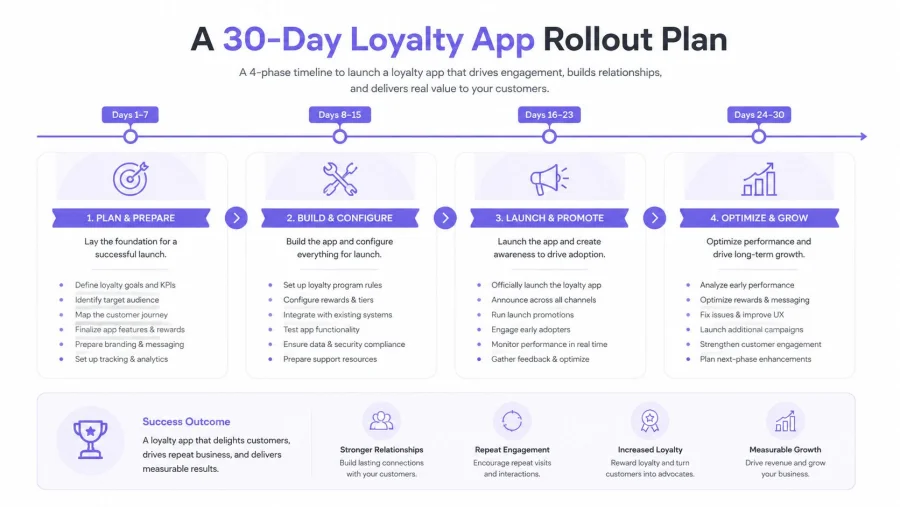
Days 15 to 21
Soft-launch to regular customers. Watch the scan, enrolment, and redemption process at the till. Ask where customers hesitate, whether they understand the reward, and whether the QR code is visible.
Fix friction immediately. Common stalls include staff forgetting to ask, signage arriving late, and consent records not being stored correctly.
Days 22 to 30
Open the programme to wider footfall. Review active-member share, redemption rate, and repeat visits. Separate customers who joined from customers who returned, because those groups tell different stories.
Set a 60-day review checkpoint. At that point, the owner should decide whether the reward needs clearer wording, stronger visibility, better reminders, or a different economic structure.
The first month should prove one behaviour, not showcase every feature.
Choosing the Right Loyalty App for Your Shop
The right loyalty app is a retention tool, not a marketing accessory. It should help a cashier prompt a scan, help a customer understand progress, and help an owner connect activity with a weekly revenue number.
UK consumers already know loyalty schemes. YouGov reported that 82% of Britons were signed up to at least one programme by 2024, following earlier research showing broad acceptance of loyalty as a way to reward customers. YouGov's 2024 UK loyalty findings also highlight the practical problem: irrelevant rewards and subscription fees discourage participation, while discounts, rewards, and cashback remain the strongest motivations.
That makes the recommendation clear. Start with the lowest-friction programme that passes the checklist, offers immediate value, records consent properly, and gives the owner usable activity data. Prove the mechanic with existing customers before adding tiers, complex campaigns, or integrations.
Small businesses should compare pricing for QR rewards, choose one simple reward, and test the customer journey today. The next action takes less than fifteen minutes: open the pricing page, create a test QR code, and ask one staff member to complete a full join-to-redemption run before the programme reaches the public.
Choose a loyalty model that matches the next visit your business needs, then put a working QR code in front of customers this week. A simple reward used consistently will outperform a complex programme nobody remembers.


