
 Deutsch
 Español
 Français
 Italiano
 Magyar
 Polski
 Slovenčina
 Čeština
A tiered loyalty programme rewards customers with escalating benefits as they move through defined membership levels, usually based on spend, points, or engagement. Tiers work best when your customers buy repeatedly, your margins can absorb better perks for your best buyers, and you can genuinely deliver on exclusivity. The sections below walk through design, thresholds, rewards, and measurement so you can build one properly.
TL;DR:
- Thresholds should be set based on actual transaction data to ensure they feel achievable and maintain top-tier exclusivity.
- Three to four tiers are optimal for balancing motivation, operational complexity, and meaningful progression for most businesses.
- Loyalty programmes benefit from clear visual distinctions between status and reward currencies to prevent member disengagement.
- Top-tier perks should focus on experiential and exclusive rewards, with costs carefully modelled against realistic distribution to avoid unsustainable expenses.
- Regular performance reviews should separate programme health metrics from revenue impact metrics to accurately evaluate success.
What is a tiered loyalty programme and how do the levels work?
A tiered loyalty programme sorts customers into levels, usually named something like Bronze, Silver, and Gold, where each level up unlocks better rewards. Members climb by hitting a threshold, whether that is total spend, points earned, or a subscription fee, and the promise of the next tier is what keeps them buying.

Two currencies run underneath most programmes, and confusing them is one of the fastest ways to lose members’ trust. Status currency determines which tier you’re in; it usually resets or is measured over a rolling period (spend in the last 12 months, for example). Reward currency, typically points, is what you actually spend on rewards and often never expires within a tier. A member can sit in Gold status while also holding a separate points balance to redeem against a free coffee or a discount voucher.
There are two broad entry paths, and picking the wrong one for your business is a common early mistake:
- Earned tiers — customers move up through spend, visit frequency, or points accumulated, which suits retail, hospitality, and grocery.
- Paid tiers — customers pay a subscription fee for instant access to a tier’s benefits, closer to a membership club model, which works well for services with predictable, recurring value like gyms or wellness studios.
- Hybrid tiers — a free earned base tier with an optional paid upgrade layered on top, giving you both an acquisition funnel and a monetisation lever.
Whichever path you choose, show members their progress clearly. A points-and-tiers playbook from Campaign Monitor recommends keeping status and reward balances visually distinct in the app or wallet pass, because members who cannot tell “how close am I to the next tier” from “what can I spend right now” disengage faster than members with no tiers at all.
What are the benefits and trade-offs of tiered programmes?
Tiers work because they change customer behaviour, not just reward it after the fact. Mastercard’s research on tiered loyalty found that tiers deliver escalating value based on customer behaviour and help brands grow market share by locking in future spend, because a customer sitting one purchase away from Gold status behaves differently to one with no status to protect.
The upside splits into three areas:
- Incremental spend — customers add small purchases or accelerate timing specifically to hit or maintain a threshold.
- Lock-in and switching cost — once someone has earned Gold status, leaving for a competitor means starting over, which is a real psychological deterrent even without contractual lock-in.
- Segmentation for personalisation — tiers give you a natural axis to target offers; you can send different campaigns to Bronze members trying to reach Silver than to Gold members you’re trying to retain.
Mastercard’s data also flags the flip side: thresholds that feel unreachable damage engagement just as badly as thresholds that are too easy, because achievable but aspirational thresholds are what make tiers work at all. Set the bar too high and your entry tier members disengage before they ever taste a higher level. Set it too low and your top tier stops feeling special, which erodes the exclusivity that justified building tiers in the first place.
The trade-offs are operational as much as strategic. Running multiple tiers means multiple reward catalogues, multiple communication tracks, and multiple sets of terms to maintain. Every added tier is another point of confusion for customer service, another line in your analytics dashboard, and another cost centre if perks are generous. None of that is a reason to avoid tiers, but it is a reason to plan headcount and admin time into the decision, not just the reward budget.
How many tiers should you use?
Three to four tiers is the number that keeps coming up across practitioner guidance, and for good reason. Fewer than three rarely gives customers enough sense of progression to feel motivated. More than five tends to dilute the meaning of each level and multiplies your operational load without a proportional lift in engagement.
- Start with three tiers if you’re launching your first programme or you have a smaller, less varied customer base. A simple entry, mid, and top level (think Member, Silver, Gold) is easy to explain and easy to run.
- Move to four tiers once you have enough transaction volume to see natural breakpoints in customer behaviour, typically once you’re a year or more into the base programme and have real data on where spending clusters.
- Reserve five or more tiers for large-scale, high-frequency businesses (major airlines, big-box retail) where the customer base and data volume justify the extra complexity. Most small and medium businesses will never need this.
Target distribution matters more than the tier count itself. A workable rule of thumb is roughly 60 to 70% of active members in your entry tier, 20 to 30% in a mid tier, and 5 to 10% in your top tier. If your top tier balloons past 15 to 20% of your active base, the perks have become too easy to reach, and you’re paying premium-tier costs for a group that no longer feels exclusive. Practitioner guidance in Forbes is blunt about this: top-tier exclusivity needs active protection, or the whole structure stops motivating anyone to climb.
Watch for dilution signals: complaints that “everyone is Gold now,” falling redemption rates on top-tier perks, or customer service fielding constant questions about why status didn’t update. Any of those is your cue to review thresholds, not add another tier on top of the confusion.
How do customers qualify and move between tiers?
Qualification usually runs on one of four mechanics, and most successful programmes pick one primary mechanic rather than trying to blend all four at launch.
- Spend-based — cumulative purchase value over a rolling window, the most common model in retail and hospitality.
- Points-based — points earned through purchases, referrals, or engagement actions, which suits businesses wanting to reward more than transactions alone.
- Engagement-based — visits, app opens, or reviews left, useful for service businesses where frequency matters more than basket size.
- Paid tiers — a flat subscription fee buys immediate tier access, common in wellness, hospitality, and membership-style retail.
Setting the threshold itself is the part most businesses get wrong. Look at your actual transaction data before setting a number: your top tier should feel earned by your genuinely best 5 to 10% of customers, not by anyone who shops slightly more than average. If you don’t have historical data yet, set conservative thresholds and adjust after three to six months rather than guessing high and disappointing everyone.
Grace periods deserve real attention because they are where retention quietly gets lost. A hard cliff, where a customer’s status resets to zero the day their qualifying window closes, punishes seasonal buyers and creates a wave of churn right when you should be re-engaging them. A 30 to 90 day grace period, paired with a “you’re about to lose Gold status” notification, gives lapsed customers a clear reason to come back before they drop a level. Some programmes also offer a lifetime tier for customers who’ve hit a very high cumulative spend threshold, protecting your most loyal long-term customers from ever being demoted by a slower year.
Fraud and abuse need a rule set too: cap points earned per transaction, flag rapid account creation patterns, and decide upfront how you’ll handle returns that would otherwise let someone earn tier status on merchandise they send back.
Pro Tip: Build your downgrade policy before you launch, not after your first angry customer email. Deciding retroactively how grace periods work looks reactive and inconsistent, and members compare notes.
What rewards and benefits should each tier offer?
Reward design falls into three broad categories, and the strongest programmes deliberately mix all three rather than leaning entirely on discounts.
- Monetary perks — percentage discounts, cashback, and free items. Easy for customers to understand, easy for you to cost, but also the easiest for competitors to copy.
- Experiential perks — early access to sales, invitation-only events, birthday surprises. Harder to cost precisely but often deliver more perceived value per pound spent than a straight discount.
- Convenience perks — priority checkout, free shipping, extended return windows, dedicated support lines. These cost relatively little at low redemption volumes but feel premium to the customer receiving them.
The mapping between tier and perk should follow a simple logic: entry tiers get low-cost, high-frequency monetary perks that reinforce the habit of buying. Mid tiers add convenience perks that make the day-to-day experience noticeably smoother. Top tiers get the experiential perks, the ones that cost you more per member but are capped by design because so few members ever reach that level.
Before you commit to any perk, model its per-member cost at scale rather than guessing. Mastercard’s guidance on tier economics stresses that a benefit which looks generous for 50 pilot members can become unaffordable once 5,000 members qualify for it, so run the maths against your realistic tier distribution, not your current early-adopter base.
A cashback approach that scales cashback percentage by tier is one of the simplest mechanics to run because the cost tracks spend automatically. BonusQR’s tiered cashback module is built around exactly this logic, letting entry members earn a modest percentage back while top-tier members earn meaningfully more, without you having to hand-price a catalogue of separate rewards for each level.

What metrics show whether your tiers are working?
Two categories of metric matter, and confusing them leads businesses to celebrate the wrong wins. Health metrics tell you whether the programme’s structure is sound. Impact metrics tell you whether it’s actually making money.
Health metrics to track weekly or monthly:
- Tier distribution — the percentage of active members in each tier, checked against your target ratios.
- Active rate per tier — the share of each tier’s members who transacted in the last 30 to 90 days; a healthy top tier should show noticeably higher activity than your entry tier.
- Engagement per tier — app opens, redemptions, and reviews, segmented by level.
Impact metrics to review monthly or quarterly:
- Progression rate — the percentage of members moving up a tier in a given period.
- Incremental spend — the difference in average spend between members near a threshold and members with no threshold pressure.
- Churn differential — comparing retention rates across tiers; a well-designed programme should show materially lower churn in higher tiers.
- Redemption economics — the cost of rewards redeemed against the incremental revenue those members generated.
Mastercard’s framework for evaluating tiered programmes explicitly separates these two categories, because a programme can look structurally healthy (good distribution, high engagement) while still failing to move the needle on revenue, or vice versa.
Run small A/B tests before rolling out threshold changes across your whole base: trial a lower entry threshold with 10% of new sign-ups for 60 days and compare their progression rate to the control group. Beyond testing individual changes, Mastercard recommends a full annual review of tier rules and thresholds once you have enough data to model member behaviour predictively, rather than leaving the original launch settings untouched for years.
How do you design and launch a tiered programme step by step?
Moving from concept to a live programme works best as a sequence, not a single leap. Skipping the modelling step is the single most common reason tier launches disappoint in year one.
- Model your member distribution before writing a single reward rule. Pull twelve months of transaction data and simulate what your tier splits would look like at three different threshold levels, so you’re choosing numbers grounded in your actual customers, not guesswork.
- Price your reward catalogue against that modelled distribution, checking the per-member cost at your projected top-tier size, not your current pilot group.
- Write your rules and terms clearly: qualification windows, grace periods, what happens on a return, how points expire, and how disputes get resolved. Vague terms create support tickets and, eventually, complaints.
- Build fraud protection into the qualification logic from day one, including caps on points per transaction and monitoring for unusual account activity.
- Set up analytics segments for each tier before launch so you can track health and impact metrics from week one rather than retrofitting reporting later.
- Automate your communications, including progress nudges, “you’re one purchase from Silver” prompts, and grace-period warnings before a downgrade takes effect.
- Run a limited launch test with a subset of customers or a single location for four to six weeks, checking that qualification triggers, notifications, and redemption all function correctly before you open it to your full base.
- Review and iterate annually, adjusting thresholds and rewards based on the health and impact metrics you’ve been tracking, rather than leaving the original settings in place indefinitely.
A step-by-step guide to structuring tiers that keep customers engaged covers the threshold-setting and communication pieces of this sequence in more depth if you want templates to work from directly.
What tools and templates help you launch faster?
Michal, who writes on loyalty design for BonusQR, has worked through the platform’s configuration options for exactly this kind of launch, and the practical shortcuts tend to matter more than any theory once you’re actually building.
Three mechanics come up constantly in real tier launches:
- Tiered cashback — cashback percentage that increases automatically by tier, removing the need to hand-build a separate reward catalogue for each level.
- Stamp cards — a simpler, visit-based alternative for businesses (cafés, salons) that want progression without a full points system; see how a digital stamp card structure works for lower-frequency purchase categories.
- No-POS setup — programmes that run on QR codes and a mobile app rather than requiring integration with your till system, which matters if you’re testing tiers before committing to deeper technical work.
If you want to see how tiers translate into real retention numbers rather than theory, a piece on how tiered programmes turn one-time buyers into repeat customers walks through the retention mechanics in more detail. Templates and a free starting tier are available directly through BonusQR’s registration page if you want to model your own distribution before committing to a paid plan.
Why do tiers actually motivate customers to spend more?
Tiers work because they tap into two well-documented psychological levers, and understanding both helps you design rewards that actually change behaviour rather than just sitting in an app unused.
Scarcity is the first lever. A top tier that only 5% of members reach feels valuable precisely because most people can’t get there. This is why protecting top-tier exclusivity isn’t just a branding nicety; it’s the mechanism that makes the whole structure function.
Status motivation is the second, and it’s often stronger than the actual monetary value of the rewards attached. Airlines figured this out decades ago: a Gold card that gets you priority boarding signals something to the people around you, independent of what it saves you in cash. Retail and hospitality tiers borrow the same logic, badge names, physical or digital cards, and public-facing perks like priority checkout all reinforce that a tier is a status marker, not just a discount code.
A third, quieter principle is the endowed progress effect, the tendency for people to feel more motivated to finish something they’ve already started. Loss aversion plays into grace periods the same way: the fear of losing a status you already hold motivates action more reliably than the prospect of gaining one you’ve never had.
What mistakes should you avoid when building tiers?
Most tier failures trace back to a small handful of repeated mistakes, and nearly all of them are avoidable with better modelling upfront.
Setting thresholds without data is the most common. The fix is always the same: pull real transaction history before setting any number.
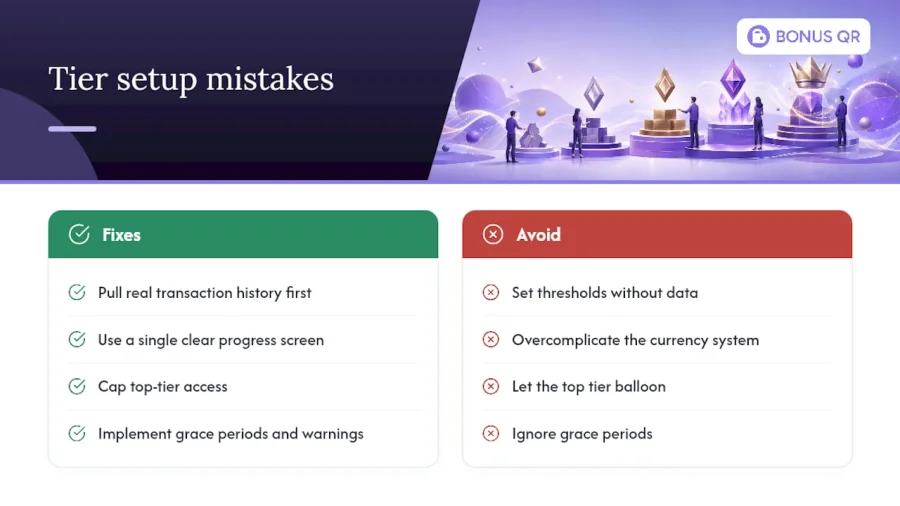
Overcomplicating the currency system confuses members fast. Running separate points balances, tier progress bars, and bonus multipliers all at once, without a single clear screen showing “here’s where you stand,” is a near-guaranteed source of support complaints.
Letting the top tier balloon kills exclusivity from the inside.
Ignoring grace periods turns natural seasonal dips into churn events. A customer who drops from Gold to Bronze with no warning during a slow month rarely comes back to try again.
Copying a competitor’s structure wholesale without adapting it to your own margins and purchase frequency. A tier structure built for a high-frequency grocery chain will bankrupt a boutique retailer with slim margins and infrequent repeat visits.
Under-resourcing the launch rounds out the list. Tiers need ongoing communication, fraud monitoring, and annual review. A programme launched and then left alone for two years will drift out of alignment with your customer base, and you’ll only notice once distribution or churn numbers look wrong.
How do you personalise tiers and rewards for different customer segments?
Tiers give you a ready-made axis for segmentation, but segment-level personalisation on top of tiers is where the real lift in relevance happens. Treating every Gold member identically wastes the data you’re already collecting.
Start by layering behavioural data on top of tier status. Two customers can both sit in Silver, but one buys weekly in small amounts while the other buys quarterly in large batches; sending them the same “you’re close to Gold” nudge ignores what actually motivates each of them. The high-frequency shopper responds to a small nudge close to the threshold; the infrequent big spender responds better to a seasonal campaign timed around when they typically buy.
Reward flexibility matters as much as messaging. Where your budget allows, let members choose between a discount, a free product, or an experiential perk within their tier rather than forcing one fixed reward on everyone. A points-and-tiers playbook from Campaign Monitor recommends segmenting communications by both tier and recent behaviour, sending different content to a Gold member who hasn’t purchased in 60 days than to a Gold member who bought last week.
Industry context shapes personalisation too. A hotel loyalty programme might personalise room upgrade offers by past stay type (business versus leisure), while a service business running appointment-based perks can personalise availability windows for top-tier members. Combining scheduling tools with tiered perks, an approach used by platforms like Exclusively’s appointment software, lets service businesses reserve priority booking slots specifically for higher tiers rather than only offering price-based rewards.
What legal and ethical rules apply to tiered programmes?
Transparency is the baseline legal and ethical requirement, and it is also good business. Your terms and conditions need to clearly state how customers qualify, how long status lasts, what triggers a downgrade, and how points or rewards expire. Burying these details in dense legal text, or changing rules retroactively without notice, invites complaints and, in some markets, regulatory scrutiny around unfair commercial practices.
Fairness in threshold design matters ethically as well as commercially. A programme that effectively excludes lower-income customers from ever reaching meaningful rewards, while marketing itself as broadly beneficial, risks reputational damage even where it’s not strictly unlawful. Make sure your entry tier offers genuine value on its own, not just a taste designed to frustrate people into paying more.
Data privacy is unavoidable once you’re tracking purchase history and personal details to determine tier status. Collect only what you need to run the programme, state clearly how that data will be used in marketing, and give customers a straightforward way to opt out or delete their account. This matters for every tier, not just your top one; a common mistake is applying strict privacy diligence to VIP data while treating entry-tier data more casually.
Finally, be honest about redemption limits and any caps on reward availability, particularly for experiential perks with limited capacity (an exclusive event with 50 seats, for example). Advertising a benefit you cannot reliably deliver to everyone who qualifies for it is where tiered programmes cross from smart marketing into misleading customers, and it’s the fastest way to undo the trust tiers are meant to build in the first place.
When are tiers the wrong choice, and what should you use instead?
Tiers add real complexity, and practitioner guidance is right to caution that they aren’t universally worth it. If your customers buy once every year or two, your margins can’t fund meaningful perks, or your business is seasonal with transient footfall, a flat single-level rewards scheme or a straightforward referral programme will outperform tiers for far less admin.
Ask yourself three questions before committing: do enough customers buy often enough to notice progression? Can your margin support better perks at your top tier without eroding profit? Can you actually deliver exclusivity, not just promise it? If any answer is no, skip tiers and build something simpler first.
— Michal
How BonusQR helps you build and run a tiered programme
BonusQR is the practical route to launching what this guide describes, without the months of custom development a tiered system might otherwise demand. Tiered cashback that scales automatically by level, real-time analytics that show you tier distribution and progression at a glance, and automated communications for progress nudges and grace-period warnings are all built into the platform rather than bolted on afterwards. There’s no requirement to integrate with a point-of-sale system, which means a workable pilot can be running within days rather than months.
For service businesses like gyms, salons, and studios, BonusQR’s service-industry loyalty templates come with tier structures already mapped to common membership patterns, so you’re adapting a proven layout rather than starting from a blank page. Hotels and hospitality businesses have their own dedicated loyalty setup built around stay frequency and spend.
If you’re ready to model your own tier distribution and see the full feature set in action, you can register for a free account and have a working programme configured the same day.