Customer engagement marketing is the practice of building ongoing, two-way relationships with customers so they buy more often, stay longer, and tell other people why. It matters because engaged customers show measurably higher lifetime value and lower churn than customers who are only ever “sold to.” The main tools are personalisation, loyalty mechanics, and consistent conversation across channels.
TL;DR:
- Engagement marketing improves customer lifetime value and retention, but success depends on precise measurement of incremental margins and controlled holdout groups.
- Personalised, trigger-based messages and simple loyalty mechanics like stamp cards or points are most effective when implemented gradually and tested against controls.
- Channel coordination, especially across email, SMS, and in-store signage, is critical to providing a seamless experience that directly influences revenue.
- A unified customer profile or data platform enables real-time, personalized interactions and supports emerging agentic AI for micro-decisions.
- Launching a basic loyalty campaign, such as a ten-visit stamp card, within 90 days allows rapid assessment of engagement mechanics’ impact.
What is customer engagement marketing, exactly?
Customer engagement marketing means designing every interaction, from a welcome email to a birthday discount, as part of a continuing conversation rather than a one-off transaction. It is a deliberate shift away from scheduled, one-way broadcast campaigns towards relationship-driven orchestration that optimises for lifetime value instead of single-campaign clicks or opens.
That definition only makes sense once you separate three terms marketers routinely blur together:
- Customer experience (CX) covers how easy and pleasant it is to deal with your business, from checkout speed to support response times.
- Retention is a behavioural fact: did the customer come back and buy again within a given period, yes or no?
- Loyalty is emotional: does the customer prefer you, recommend you, and forgive the occasional mistake? Retention and loyalty are related but not identical, and tracking both is the only way to know whether customers keep buying and why.
Engagement marketing sits underneath all three. It is the set of activities, personalised messages, loyalty rewards, two-way messaging, that produces good CX, drives retention, and builds loyalty over time.
Operationally, none of this works without a single customer view: one profile per customer that merges purchase history, loyalty status, and communication preferences across every channel they use. Without it, your email team, in-store staff, and app notifications end up guessing independently, and customers notice the disconnect immediately.

Why does customer engagement matter to your bottom line?
Because retention and loyalty compound. A customer who buys twice a year for three years is worth substantially more than one who buys once and disappears, and the cost of keeping that first customer is almost always lower than acquiring a replacement. This is the core argument for prioritising engagement work over another round of acquisition spend.
The measurement discipline that separates engagement work from wishful thinking: many loyalty programmes report a raw gap between member and non-member spend and call it proof of success. That comparison is misleading because the customers who join loyalty programmes were often more likely to be frequent buyers anyway. Programme dashboards need to isolate incremental margin, the extra profit actually caused by the programme, not merely correlated with it.
Running a genuine holdout group, a slice of customers who don’t receive the loyalty offer or campaign, is the simplest way to see what engagement activity actually causes versus what would have happened anyway. Skip this step and you risk defending a budget line with numbers that would have looked the same without the programme.
The business case ultimately rests on three outcomes: higher customer lifetime value, reduced churn, and organic advocacy that lowers acquisition cost for new customers. Engaged customers refer friends, leave reviews, and forgive the odd delivery delay. None of that shows up in a single campaign’s click-through rate, which is exactly why engagement needs its own measurement framework rather than borrowed campaign metrics.
What are the core strategies for building engagement?
Four strategies do most of the heavy lifting, and you can start testing any of them within a few weeks.
- Personalise at the individual level using behavioural triggers. A generic “we miss you” email underperforms a message triggered by an actual signal, like a customer who bought coffee weekly for two months and then stopped for three weeks. Personalised, trigger-based messages consistently outperform generic campaigns, but they depend on clean, timely data and a system that can react within hours, not days.
- Design loyalty mechanics that build habit, not just discounts. Points, stamp cards, and tiered cashback work because they give customers a reason to choose you on the tenth visit, not just the first. The mechanic matters less than consistency: a simple ten-visit stamp card that always delivers the reward beats a complicated tiered system nobody understands.
- Open two-way conversational channels. Live chat, SMS replies, and social comments give customers a way to talk back, and businesses that treat those channels as genuine conversation rather than a support queue tend to see stronger engagement. Community features, user groups, review prompts, referral asks, turn satisfied customers into active participants rather than passive recipients.
- Build a cadence around milestones, not just promotions. Onboarding sequences, anniversary messages, and birthday rewards give customers a reason to hear from you that has nothing to do with a sale. This is often the easiest strategy to start because it can run on autopilot once built.
Pro Tip: Start with one behavioural trigger, not ten. A single well-timed “you haven’t ordered in three weeks” message, tested against a control group that gets nothing, will teach you more about what works than five simultaneous campaigns launched at once.
Smaller businesses often succeed by resisting the urge to build everything simultaneously. Mapping the two or three journeys that matter most, and running them well, beats a sprawling programme nobody maintains. A café that nails a welcome series and a ten-stamp loyalty card will usually out-engage a competitor running a dozen half-finished automations.
Which channels and tactics actually move the needle?
Channel choice depends on urgency and intimacy. Email suits longer-form content and offers that don’t need an instant response. SMS suits time-sensitive, transactional moments, order confirmations, appointment reminders, a flash sale closing in two hours. Push notifications work best inside an app you already have permission to interrupt, and social channels suit community-building and public conversation rather than individual transactions.
Some tactics translate directly into revenue when matched to the right channel:
- A welcome series across three or four emails in the first fortnight, introducing your loyalty programme and setting expectations, tends to outperform a single “thanks for signing up” message.
- Transactional SMS confirming an order or booking gets opened almost immediately, making it the right channel for anything urgent.
- Push notifications for cart or booking recovery work well because they arrive inside the app itself, at the moment intent is freshest.
- Stamp cards and points balances shown at checkout remind customers how close they are to a reward, which is one of the most reliable nudges towards a repeat visit.
Coordination across these channels matters more than any single tactic. Customers move between channels constantly, and isolated activity on one channel while others stay silent creates a disjointed experience that undermines the whole effort. A retailer running loyalty tactics well typically treats email, SMS, and in-store signage as one connected message rather than three separate campaigns, an approach covered in more detail in guidance on customer engagement in retail.
How do you measure customer engagement properly?
Engagement metrics work best organised into three connected tiers, each one feeding the next: member behaviour, programme health, and business impact. Tracking only one tier gives you a partial, sometimes misleading, picture.
| Tier | What it measures | Example KPIs |
|---|---|---|
| Member behaviour | Whether customers are actively engaging | Active member rate, visit frequency, app opens |
| Programme health | Whether the mechanics are working as designed | Redemption rate, points liability, enrolment rate |
| Business impact | Whether engagement is actually paying for itself | Incremental revenue, incremental margin, retention rate |
The centrepiece of the business impact tier is customer retention rate, and it is worth getting the formula right because it is easy to inflate by accident. The correct calculation is:
CRR = ((customers at period end − new customers acquired during period) / customers at period start) × 100
Excluding new customers from the end-of-period count is essential, because folding fresh acquisitions into a retention figure flatters the number without telling you anything about whether existing customers stuck around.
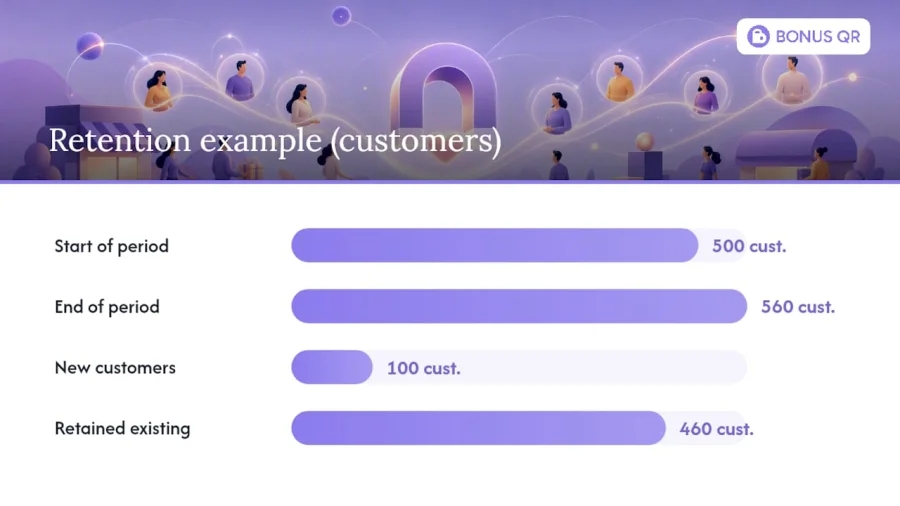
A retention calculation in practice: a business starts the quarter with 500 customers, ends with 560, and 100 of those were new. CRR = ((560 − 100) / 500) × 100 = 92%. That is a materially different, and more honest, number than the naive 560/500 comparison would suggest.
Review active member rate and redemption rate monthly, since they move fastest and flag problems early. Review retention rate and incremental margin quarterly, since they need a longer window to be meaningful. Guidance on retention strategies that keep buyers coming back goes deeper into building this cadence.
What technology and operations does engagement need?
A unified customer profile, often called a single customer view or a customer data platform, is the operational backbone that makes real-time engagement possible. Without it, a customer who redeems a loyalty reward in-store on Tuesday still gets a generic “come back and see us” email on Wednesday, because the two systems never spoke to each other.
When evaluating any orchestration technology, prioritise a short list of capabilities over a long feature checklist:
- Cross-channel orchestration that lets one trigger fire consistently across email, SMS, push, and in-app messaging.
- Real-time decisioning that reacts to behaviour within minutes or hours, not the next scheduled batch send.
- Clear governance and permission controls, particularly important as more decisions get automated.
The most significant shift underway is the move towards agentic AI, systems that orchestrate real-time, personalised conversations based on intent signals rather than following a fixed, pre-built journey. Instead of a marketer manually building twenty conditional branches for a re-engagement journey, the system infers intent from behaviour and adjusts the next message accordingly.
This does not remove the marketer from the loop, it changes the job. Marketers increasingly set the strategic guardrails, brand voice, offer limits, escalation rules, while the system handles millions of individual micro-decisions in real time. Treat this as a reason to define your rules clearly before switching anything on, not as a reason to hand over control blindly.
Your 90-day plan to launch or improve engagement
Ninety days is enough time to launch something real and know whether it worked, without waiting a full year to find out you measured the wrong thing.
- Weeks 1 to 2: Map your two highest-value customer journeys, likely new customer onboarding and lapsed customer win-back, and agree on two or three KPIs for each before building anything.
- Weeks 3 to 6: Build the core automated journeys: a welcome series, a milestone or anniversary message, and a re-engagement trigger for customers who have gone quiet.
- Weeks 5 to 8 (running alongside): Launch a simple loyalty mechanic, a stamp card or points system, and promote it to your existing customer base first rather than only new sign-ups.
- Weeks 7 to 10: Run your campaigns against a genuine holdout group so you can measure incrementality rather than assuming correlation equals cause.
- Weeks 10 to 12: Review active member rate, redemption rate, and early retention signals, then decide what to scale and what to cut.
A practical playbook for SMB growth, including how to sequence loyalty features alongside these journeys, is covered in more detail in guidance on customer engagement strategies for SMB growth.
How BonusQR fits into a loyalty-led engagement plan
The platform is built around loyalty mechanics such as digital stamp cards, points collection, tiered cashback, fixed discounts, and coupon distribution, managed through mobile and web apps rather than physical cards. Push notifications and automated marketing enable milestone messages or re-engagement triggers to be sent automatically without manual intervention.
For a small retailer, café, or gym, three use cases tend to work first:
- A ten-visit stamp card rewarding a free item or service, promoted to existing customers before new sign-ups.
- Points for repeat purchase where the redemption threshold is visible at checkout, reinforcing the nudge described earlier in the channels section.
- Onboarding rewards that welcome new sign-ups with an immediate small incentive, encouraging the second visit that determines whether a customer becomes a habit.
Real-time analytics track active member rate and redemption from day one, so you can see within weeks whether the mechanic is earning its place. Further tactical detail sits in guidance on mastering retail engagement without a big budget, and in broader ecommerce-focused retention marketing guidance for businesses selling online as well as in person.
The gap between engagement theory and what actually works
The biggest mistake businesses make with engagement marketing is building complexity before earning the right to it. A ten-branch automated journey looks impressive in a strategy deck and confuses everyone who has to maintain it three months later. The second biggest mistake is confusing activity metrics, opens, clicks, app installs, with business impact. A campaign can generate excellent engagement numbers and zero incremental revenue if nobody checks against a control group.
The rule that holds up across most successful programmes is simple: speed and relevance beat volume every time. One well-timed, well-targeted message outperforms five generic ones, and that principle scales down to a single café just as well as it scales up to a national retailer.
— Michal
Ready to launch your first loyalty campaign?
Reading about behavioural triggers and loyalty mechanics is one thing, building them without a developer is another. Some loyalty platforms can get a working loyalty programme live in days rather than months, often with no requirement to integrate point-of-sale systems first, which matters if your current setup makes that integration expensive or slow.
A sensible first test mirrors the tactics covered above: a simple stamp card offering a reward after ten visits, promoted to your existing customer list before you spend a penny acquiring new ones. Real-time analytics show active member rate and redemption from the first week, so you know quickly whether it is working rather than waiting a full quarter to find out.
Explore the full feature set for building a loyalty programme and consider setting up your first campaign this week.
Sources
For deeper detail on the calculations and frameworks referenced here, see how to calculate customer retention rate, modern customer engagement and agentic AI, and loyalty programme KPI guidance.
- Loyalty program metrics: KPIs that prove your program works
- Customer loyalty analytics: 8 key metrics to track
- Customer Engagement Marketing: The Strategy That Turns Interactions Into Growth
FAQ
What do you mean by customer engagement marketing?
It means building ongoing, two-way relationships with customers through personalised messages, loyalty rewards, and conversation across channels, rather than relying on one-off promotional campaigns.
What is the customer engagement marketing theory behind it?
The underlying theory is that relationship-driven, behaviour-aware orchestration optimises for lifetime value rather than single-campaign metrics, since engaged customers buy more often and refer others.
What are the 4 P’s of customer engagement?
There is no single agreed “4 P’s” framework for customer engagement in the way there is for the marketing mix; definitions vary by source, so treat any specific list with caution rather than as an industry standard.
What are the 3 C’s of customer engagement?
As with the 4 P’s, no single canonical “3 C’s” framework is widely agreed across the industry. What is consistent across credible sources is the need to track customer behaviour, communication, and connection, whatever labels a particular framework gives them.
How is customer retention rate calculated?
The formula is ((customers at period end minus new customers acquired during the period) divided by customers at period start) multiplied by 100, and excluding new customers is essential to avoid an inflated figure.


