
 Deutsch
 Español
 Français
 Italiano
 Magyar
 Polski
 Slovenčina
 Čeština
A personalised loyalty programme rewards customers based on their own habits and preferences rather than a single fixed formula for everyone. The best first move is simple: pull whatever first-party purchase data you already hold and send one segment a genuinely relevant, higher-value offer this week. You’ll see faster redemption and a real signal of what personalisation can do before you spend a penny on new software. A platform such as Bonusqr is worth evaluating once you’ve proven the concept works for your customers.
TL;DR:
- Focusing on a small, high-value customer segment for personalisation offers quick validation and margin protection before expanding efforts.
- Collecting simple zero-party, first-party, and behavioural data ethically is critical, with clear consent and minimal customer effort.
- Personalisation tactics like targeted communications, loyalty pages, and tiered rewards drive engagement better than generic discounts or static offers.
- Using modular, platform-based technology with automation, real-time analytics, and device support enables scalable, effective personalisation without heavy technical investment.
- Start with a single, measurable goal and test offers against a control group over 30 to 60 days, avoiding feature bloat and focusing on proven, relevant improvements.
Why personalisation matters for retention and revenue
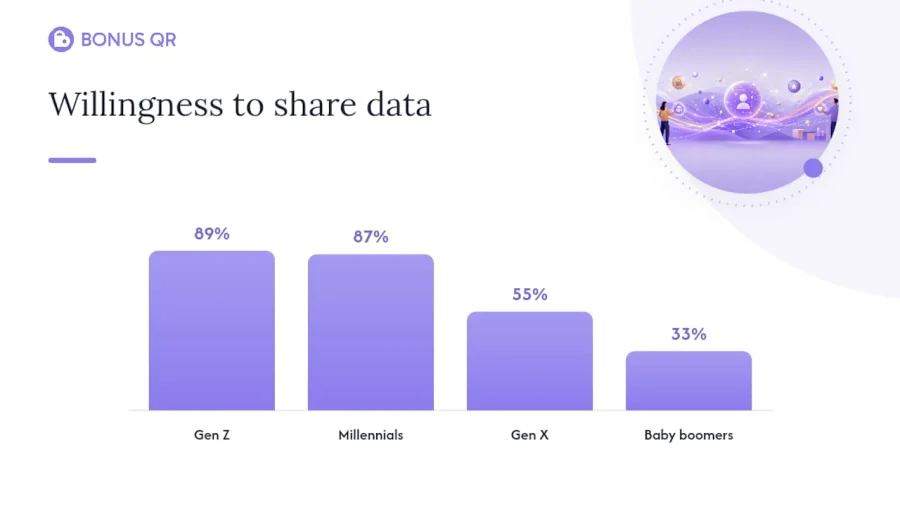
Customers will trade data for value, but only when the value is obvious. Deloitte’s research found 89% of Gen Z and 87% of millennials are willing to share personal information in exchange for tailored loyalty perks, against 55% of Gen X and just 33% of baby boomers. That gap matters for how you design communications across age groups, not just what you offer.
The underlying mechanic is reciprocity. When a customer feels a business has paid attention to what they actually buy, they respond with more visits and larger baskets. Generic 10%-off codes rarely earn that response because they ask nothing and reveal nothing.
Where personalisation pays off:
- Retention: members who receive relevant offers stay engaged longer than those on blanket promotions.
- Average order value: tailored bundles and thresholds nudge spend upward without discounting everything.
- Redemption rates: offers matched to past behaviour get used, not ignored.
- Engagement: personalised push and email content earns higher open and click rates than mass blasts.
Pro Tip: Start with your highest-value 20% of customers. Personalising for them first proves the model quickly and protects margin while you test.
What data and segmentation you need (and how to collect it ethically)
Three data types drive personalisation, and each has a different collection method. Zero-party data is what customers tell you directly, such as favourite product categories or a birthday, gathered through preference centres or short onboarding surveys. First-party data comes from your own transaction records, including purchase frequency, spend, and channel. Behavioural data covers how members actually interact with your programme, like which push notifications they open or which rewards they redeem.
Practical ways to collect this without feeling intrusive:
- Build a short preference centre into sign-up, asking two or three questions rather than ten.
- Offer a small incentive (a bonus stamp or points boost) for completing a profile survey.
- Capture transaction data automatically through your loyalty platform rather than asking customers to self-report.
- Use gamified onboarding, similar to the approach outlined in this guide to onboarding games, to make preference sharing feel like part of the experience rather than a form to complete.
Consent has to be visible, not buried. Loyalty programmes are one of the strongest legitimate channels for gathering data because sign-up itself is permission granted directly by the customer, which matters as third-party tracking keeps shrinking. Tell members plainly what you collect, what they get in return, and give them an easy way to opt out without losing their existing rewards.
Tactical personalisation: communications, loyalty pages, tiers and rewards
Once you have usable data, five tactics do most of the work.
- Personalised communications. Trigger messages off real events: a birthday, a lapsed 60-day window, or a recent purchase. A café sending a free-pastry nudge three days after a customer’s usual visit pattern breaks will outperform a weekly newsletter every time.
- Integrated loyalty pages. Members should see their progress towards the next reward, plus one or two offers picked for them specifically, the moment they log in. A static rewards catalogue with no personal context gets ignored.
- Tiered experiences. Design tiers around meaningful perks, not just bigger discounts. A mid-tier “priority booking” slot or early access to new stock often lands better than an extra 5% off.
- Custom rewards mapped to preference. If someone always buys the same product line, surprise them with an early look at a new item in that category rather than a generic discount code.
- Offline integration. QR scans at the till, receipt-linked offers, and staff trained to recognise repeat visitors all reinforce the same personalised experience in-store that digital channels build online.
Unique, unexpected offers and genuine recognition build stronger emotional loyalty than routine discounts, according to Mastercard’s guidance on loyalty design. A surprise reward for a customer’s tenth visit sticks in memory far longer than a scheduled 10%-off coupon they expected anyway.
Keep the mechanics simple even as the targeting gets smarter:
- One clear earning rule per reward type.
- No more than two or three active tiers.
- A visible progress indicator on every touchpoint.
Choosing technology and platform features that enable personalisation
Building your own personalisation engine only makes sense once you have the data volume and technical team to justify it. For most small and mid-sized businesses, buying a modular platform gets you to market faster and cheaper.
When evaluating a platform, require:
- Modular reward types (stamp cards, points, cashback, fixed discounts) so you can start simple and add complexity later.
- Mobile and web app support, including Apple and Google Wallet integration, so members carry their loyalty card wherever they carry their phone.
- Push and email automation triggered by behaviour, not just scheduled campaigns.
- Real-time analytics showing redemption and engagement by segment, not just totals.
- Rapid setup with no mandatory POS integration, which matters if you’re testing before committing to a full technical rollout.
On integrations, check compatibility with your CRM, POS, e-commerce platform, and payment processor before signing anything. Most companies are still working towards this: EY found only 16% of companies have achieved genuine hyper-personalisation using AI and machine learning to anticipate needs in real time. That’s a reassurance, not a warning: you don’t need cutting-edge AI to win, you need clean data and a platform that acts on it consistently.
Measure, optimise and report: KPIs and common pitfalls
Track five numbers: retention rate, repeat-purchase rate, customer lifetime value (CLV), redemption rate, and average order value (AOV). Redemption rate tells you whether rewards are actually being used. Retention and CLV tell you whether the programme changes long-term behaviour, not just short-term spend.
Run tests properly. Hold back a control group that receives no personalised offer and compare their behaviour against the treatment group over the same period. Without a holdout, you can’t separate the effect of your offer from normal seasonal demand.
Common pitfalls to avoid:
- Over-rewarding. Mastercard’s core rule is that the incentivised behaviour must be more profitable than the reward costs, or the programme bleeds margin.
- Excess complexity. Too many tiers or confusing earning rules push members away from redeeming at all.
- No incremental measurement. Reporting total redemptions without a control group tells you nothing about causation.
Real examples and an editor’s view of what actually works
A neighbourhood café used a digital stamp card with a birthday-triggered free drink offer. Redemption on that single offer type ran well above their standard promotions, and repeat visits from the segment climbed noticeably within two months. A boutique retailer layered onboarding preferences onto a points system, using push notifications tied to restock alerts for a customer’s favourite category. A small hotel added tiered perks, including early check-in for repeat guests, and saw longer average stays from its top tier.
Each tactic maps to specific modules:
- Stamp cards and points systems for the café and retailer examples.
- Onboarding promos and preference capture for the retailer’s category-based alerts.
- Push notifications and tiered rewards for the hotel’s repeat-guest programme.
- Real-time analytics underpinning every measurement decision above.
The pattern across all three cases is the same: personalisation worked because the offer matched a genuinely observed habit, not a guess. Complexity never drove the result. Relevance did.
Michal, editorial lead for this piece, notes that the mapping above draws on Bonusqr’s own module set, including stamp card mechanics and mobile and web application support.
Your 30 to 60 day launch checklist for a first personalised campaign
- Define one objective and one segment. Pick a single measurable goal, such as increasing repeat visits from lapsed customers, and identify the segment that matches it.
- Build the personalised offer. Choose the reward, the content, the channel (push, email, or SMS), and the trigger event that fires it.
- Set up your control group. Hold back a matched sample who won’t receive the offer, so you can measure incremental lift.
- Launch through your platform. Implement the trigger and confirm delivery timing works as expected.
- Measure against your KPIs. Compare redemption rate, repeat-purchase rate, and AOV between the test and control groups after 30 days, then adjust the offer or trigger and run again.
Shopify’s guidance for small businesses follows this same staged approach, starting with simple mechanics before layering in personalisation, which keeps early risk low while you learn what your specific customers respond to.
Why practical simplicity beats feature bloat
Most personalisation failures aren’t caused by weak technology. They’re caused by programmes trying to do too much before proving one thing works. Focus on measurable experiments, not feature checklists borrowed from enterprise retailers with ten times your data volume.
Transparent data exchange and simple earning rules build more trust than a sophisticated points economy nobody understands. Scale personalisation only after a segment-level test shows a clear, repeatable lift. Everything else is guesswork dressed up as strategy.
— Michal
How Bonusqr can help you build a tailored loyalty programme
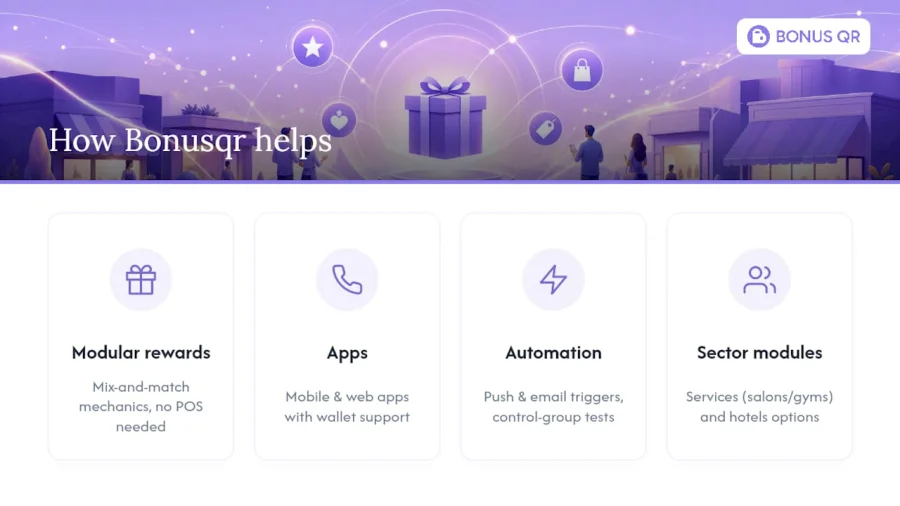
Everything in the launch checklist above maps directly onto Bonusqr’s feature set: modular rewards you can mix and match, mobile and web apps with wallet support, automated push and email triggers, and real-time analytics to run your control-group tests properly. Setup doesn’t require POS integration, so you can pilot a single personalised offer within days rather than months. If you run a service business, salon, or gym, the dedicated services module already reflects the earning patterns typical of appointment-based customers. Hotels have a tailored option too. Whichever mechanic suits your first test, you can register and start building it now.
Sources
Deloitte’s loyalty programme research quantifies generational data-sharing preferences and redemption behaviour. EY’s 2025 loyalty market study tracks personalisation investment against hyper-personalisation adoption. Mastercard’s programme design guide covers reward profitability and surprise-based engagement. Shopify’s small business guide offers a staged build approach worth reading in full.