You've seen the pattern in the shop already. The regulars come in, they order the same flat white, gel manicure, smoothie, or haircut, and they seem loyal, but the business still can't say what those customers are worth. That gap is where most small businesses lose money, not because the service is weak, but because the owner is guessing instead of measuring.
Customer lifetime value, CLV, turns those guesses into numbers you can use. For UK businesses, that matters because the national scale is huge, the Office for National Statistics' Annual Business Survey reported about £2.4 trillion in turnover and 27.9 million people employed in 2022, so even small changes in repeat revenue can matter inside a very large economy (IBM on Customer Lifetime Value). For cafés, salons, gyms, and retail shops, the question is simpler, which customers keep coming back, how often, and long enough to justify the cost of keeping them.
Why Most Small Businesses Get Customer Value Wrong
A café owner can usually name the regulars by face, by drink, and sometimes by table. What they often can't name is the revenue pattern behind those faces, so the business treats a Monday morning regular and a once-a-month visitor as if they matter the same. That's where loyalty programmes get distorted, because the owner hands out discounts to everyone and never checks whether the rewards are being paid back by repeat spend.
Gut feel is expensive
Small businesses often design rewards around what feels generous, not what changes behaviour. A free coffee after ten stamps sounds appealing, but if it brings in low-frequency visitors who would have returned anyway, the programme just gives away margin. The same mistake shows up in salons and gyms, where staff remember the most chatty customers and assume they're the most valuable, even when their visit pattern says otherwise.
Practical rule: if the business can't explain why a reward changes repeat behaviour, it's probably a cost, not a strategy.
This is why how to calculate CLV matters so much in brick-and-mortar settings. CLV forces the business to separate loyal from merely familiar, high-value from high-maintenance, and profitable from popular. Once those distinctions are visible, marketing stops being a hope-and-pray exercise and becomes a decision about where to spend, whom to retain, and which offers to stop funding.
The Core CLV Formula Explained
The simplest useful CLV formula for a café, salon, gym, or retailer is average purchase value × purchase frequency × customer lifespan. That formula shows how much revenue a customer brings in over time, before costs are taken out. It's the right starting point because it fits repeated in-person buying, where people return on irregular schedules and each visit can be measured from sales records.
Break each part into shop-level data
Average purchase value is what one transaction is worth on average. In a coffee shop, that could be a latte plus pastry; in a salon, it could be a cut plus product add-on. Purchase frequency is how often the customer comes back in a given period, and customer lifespan is how long they stay active before they drift away.
A worked example keeps it real. If a UK café customer spends £6.50 per visit, comes in 2.4 times per month, and stays active for 18 months, the simple revenue CLV is about £280.80 before costs, as shown in the UK-specific example from the provided guidance (Improvado CLV guide). That number is useful because it gives the owner a ceiling for reward design, acquisition spending, and retention effort.
A few details matter more than most owners expect. If the shop uses annual averages only, the formula can hide weekday peaks, seasonal dips, and the difference between a loyal lunch crowd and occasional visitors. That's why the best starting point is local data, not a generic benchmark.
The formula is simple on purpose. The hard part is making sure each input reflects the way customers actually buy in a real shop.
Use the formula first, then improve it with better inputs. That's usually more valuable than jumping straight to a complex model with too many assumptions and too little evidence.
improve customer retention strategies
Historical vs Predictive CLV Models
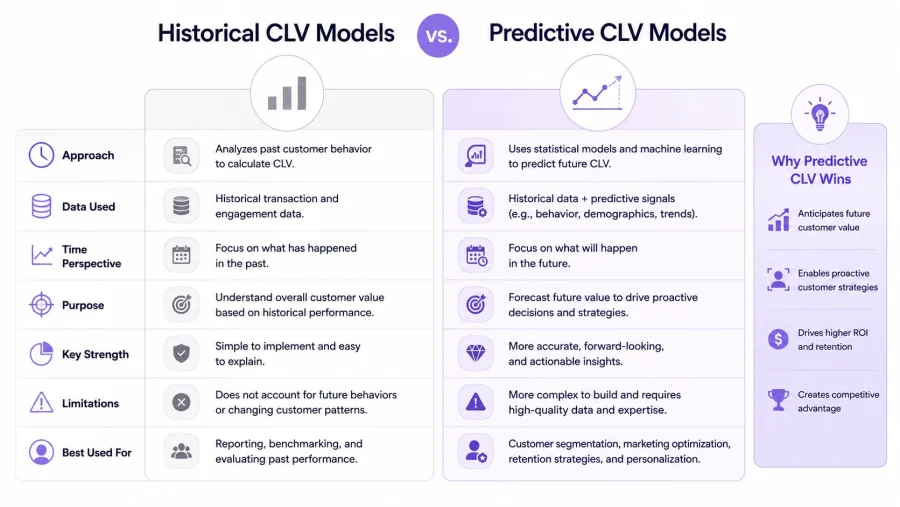
Historical CLV and predictive CLV answer different questions. Historical CLV asks what customers have already done, while predictive CLV tries to estimate what they're likely to do next. For most small businesses, that distinction matters more than the math itself, because the wrong model can make a shop feel data-rich while still producing bad decisions.
Historical CLV fits irregular repeat buying
Historical CLV works well when the business has simple transaction records and repeat behaviour that can be observed directly. Cafés, salons, quick-service restaurants, and retail shops often sit in this bucket because customers don't buy on contracts, they buy when they need something. That makes historical CLV practical, because it relies on actual purchase value, frequency, and lifespan rather than trying to predict churn the way a subscription company would.
Predictive CLV needs more structure
Predictive CLV becomes more useful when retention patterns are clearer and the business has enough data to model future behaviour. Gyms and subscription-style services are closer to that world because visit or payment patterns are easier to track over time. Even then, predictive CLV is only as good as the data feeding it, and many small operators don't have the volume or clean tracking needed to make advanced forecasting reliable.
The right path is usually progressive. Start with historical CLV, confirm that the figures line up with actual repeat behaviour, then layer in prediction only after the business has enough customer history to make the forecast stable. That approach avoids the common mistake of building a model around weak inputs.
A useful rule of thumb is this. If staff can name repeat customers and estimate how often they return, historical CLV is probably enough to start. If the business already tracks cohorts, digital engagement, and recurring purchase behaviour, predictive modelling can add another layer later.
Extracting the Right Data from Your Loyalty System
The numbers you need for CLV are usually already sitting inside the business. Sales records hold transaction value, visit logs show frequency, and customer profiles reveal first and last activity dates. QR-based loyalty systems are useful here because they capture repeat visits and customer identity without forcing the owner into heavy tech or POS integration.
What to pull first
A clean CLV calculation starts with a short list of fields. The important ones are not complicated, but they do need to be consistent. A coffee shop may track order value and visit date, while a salon may track service ticket value and return interval. The point is to use the same definitions every time so the numbers stay comparable month to month.
- Average basket size: track how much a typical customer spends per visit.
- Visits per month: count repeat sessions over a defined period.
- Retention rate by cohort: compare customers who joined in the same period.
- Time between purchases: measure how long customers wait before returning.
- First visit date: use it to mark the start of the customer relationship.
- Last visit date: use it to identify active or lapsed customers.
- Reward redemption history: check whether incentives trigger repeat visits.
- Channel source: note where the customer came from so acquisition quality can be reviewed later.
The BonusQR analytics dashboard is relevant here because it gives small businesses a simple way to see top customers, coupon performance, and visit trends without building a separate reporting stack. For owners who've never had customer data in one place, that alone can change how loyalty gets managed.
Keep the data clean
The biggest problem is not collecting too little. It's mixing inconsistent definitions, like counting staff-comped items as normal sales or treating one-off promo visitors as loyal customers. That blurs the CLV picture and makes the numbers look better than the business reality.
Practical rule: if a customer can't be traced from first visit to repeat visit, the lifespan estimate is already too soft.
Before calculating anything, gather the same fields for every customer group. Then compare a few recent cohorts against older ones to see whether repeat behaviour is improving, flat, or drifting down.
Adjusting CLV for Real-World Profitability
Revenue CLV tells you what customers spend. Profit-based CLV tells you what they're worth after the business pays to serve them, and that's the figure that matters when margins are tight. The more a shop relies on discounts, freebies, staff time, delivery, or service follow-up, the less useful gross revenue becomes on its own.
Add margin and cost before you trust the number
The most defensible approach is to estimate average revenue per customer, subtract direct service or fulfilment costs, and then discount future margins if the business wants a more realistic long-term value. Qualtrics describes CLV as customer revenue per year × duration of the relationship in years − total costs of acquiring and serving the customer, and also gives a discounted version based on retention and gross margin (Qualtrics CLV formula). Twilio also uses a profit-adjusted model, CLV = (Average Purchase Value × Purchase Frequency × Customer Lifespan) × Profit Margin, which is a better fit when a loyalty programme affects frequency but not margin (Twilio CLV guidance).
A simple example shows the difference. If the revenue CLV is £280.80 and the business keeps 40% gross margin, the contribution portion is £112.32 before acquisition cost. That's the number a café or salon should compare against loyalty rewards, sign-up bonuses, and staff time spent chasing returns.
Why the cost side matters now
Thin-margin businesses can't afford to mistake activity for profit. A coupon that drives visits but wipes out contribution margin might look successful in the app and still hurt cash flow. That's why a UK owner should compare CLV against acquisition cost and service cost before approving discounts, especially when operating costs are under pressure.
For a practical view on acquisition spend, the Aussie guide to customer acquisition cost is a useful companion read because it frames CAC as a decision metric, not just a marketing statistic. That mindset matters when loyalty and acquisition are treated as one budget instead of separate silos.
Profit-based CLV is the version that stops a business from rewarding the wrong behaviour. If a customer comes often but only during heavy discounting, their revenue CLV can look healthy while their real value stays weak. The profit lens catches that fast.
Turning CLV Insights into Loyalty Strategy
CLV becomes useful when it changes what the owner does next. Once customers are grouped by value, the business can stop giving the same offer to everyone and start designing loyalty around behaviour, margin, and frequency. That's where many cafés, salons, and gyms get their best returns, not from bigger rewards, but from smarter ones.
Segment by value, not just by visit count
High-CLV customers deserve a different treatment from occasional visitors. A salon might reserve birthday offers for regulars who already book quarterly, while a café might use visit-based rewards to encourage a lunch crowd to come one extra time each week. The logic is simple, spend more attention where the relationship already pays back.
A CLV figure also sets a practical ceiling for spending. If average CLV lands around £112, a business can justify a modest acquisition or retention spend while still protecting margin, provided the reward structure doesn't balloon into a subsidy. That's where loyalty programmes often go wrong, because they chase participation rates instead of profitable repeat behaviour.
Use CLV to protect the best customers
At-risk high-CLV customers are usually the ones worth win-back campaigns first. A gym might notice that a member who used to visit regularly has gone quiet, while a café can spot a regular whose purchase interval is getting longer. Those customers don't need generic blasts, they need timely, relevant prompts that match the behaviour they used to show.
For deeper tactics around repeat behaviour and customer relationship design, the boost customer lifetime value guide from Netco Design LLC is worth reviewing because it connects retention, service, and value-building in one place. The broader small business customer retention guide at small business customer retention guide also fits owners who want a playbook for keeping the right people active without over-discounting.
Loyalty works best when it feels earned. High-value customers should get relevance, not just random coupons.
Birthday offers, seasonal campaigns, and return prompts should all be designed against actual CLV bands. If a customer already has a strong repeat pattern, the goal is to protect it. If they're drifting, the goal is to restore the habit before the relationship fades.
Common CLV Mistakes and How to Avoid Them
The most common CLV mistake is treating lifespan like a fixed fact instead of a number that changes with behaviour. If early churn is high, a flat lifespan estimate will overstate value. If retention improves after better service or a better loyalty offer, the same flat assumption will understate it.
Watch for the usual traps
Another mistake is ignoring seasonality. A retail shop or café can look stronger in one quarter and weaker in another, and CLV calculations that don't account for that rhythm can send the owner in the wrong direction. Seasonal shifts matter just as much as the formula, especially in local businesses with weather-driven or holiday-driven footfall.
- Fixed lifespan assumptions: derive lifespan from observed repeat behaviour, not wishful thinking.
- Seasonal blind spots: compare like-for-like periods instead of mixing peak and quiet months.
- Unsustainable discounting: don't use CLV to justify rewards that destroy margin.
- Benchmark obsession: don't compare against generic industry figures if the location and customer mix are different.
- No cohort validation: check whether actual repeat performance matches the model.
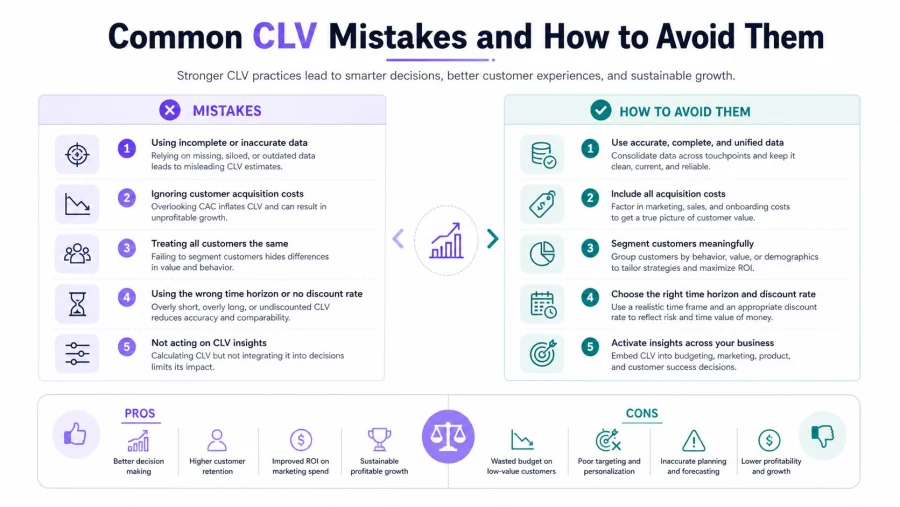
The cleanest validation method is cohort tracking. If the model says one group should be more valuable, the actual repeat behaviour should eventually show it. If it doesn't, the inputs need fixing before the business makes another loyalty decision.
A useful external reference for tracking local traffic and customer intent sits in DigiVisi's small business local SEO guide, because local discovery and repeat visits often move together in brick-and-mortar trade. Recalculate CLV whenever customer behaviour changes materially, then review loyalty performance often enough to catch drift before it becomes expensive.
If you're running a café, salon, gym, or shop and you want a clearer read on repeat revenue, start by tracking the three inputs that matter most, spend, frequency, and lifespan. Then use BonusQR to capture visit history, reward activity, and customer trends in one place, so you can turn CLV into a practical loyalty plan instead of a spreadsheet exercise.


