
 Deutsch
 Español
 Français
 Italiano
 Magyar
 Polski
 Slovenčina
 Čeština
A regular customer reaches the counter. The coffee is already made. The barista asks for the stamp card. The customer pats one pocket, then another, then checks a bag and smiles awkwardly. The card is at home.
Nobody did anything wrong, but the moment still goes bad. The customer leaves without the stamp. The staff member has to decide whether to make an exception. The business loses a small moment of trust.
That scene explains why the disadvantages of loyalty cards matter more than they seem. A paper card looks cheap, simple and friendly. In practice, it often creates five business costs that are easy to miss when the scheme is first launched. Cards get lost. Rewards arrive too slowly. Staff spend time stamping and explaining rules. Customers worry about data. Some even suspect the discount is less about reward and more about price theatre.
Small businesses feel those costs quickly. Cafés see queues slow down. salons deal with forgotten cards at reception. gyms struggle to keep members engaged between visits. shops print more cards while learning very little about who is returning.
Introduction Why Loyalty Cards Often Disappoint
A loyalty card usually starts with good intentions. A café wants to reward regulars. A salon wants clients to rebook. A local retailer wants a simple reason for people to come back. So a stack of cards is printed, a stamp is bought, and the team starts handing them out.
Then the world problems show up.
The first problem is physical. Customers forget the card, lose it, spill on it, or leave it in another jacket. The second problem is timing. If the reward takes too long, the card sits in a wallet and stops feeling useful. The third problem is operational. Staff have to remember the rules, stamp correctly, answer the same questions, and sort out disputes when a nearly full card goes missing.
Why the gap between idea and reality is so wide
A traditional loyalty card promises a simple exchange. Buy often, get rewarded. But simple on paper isn't always simple at the till. Every extra step adds friction. Every unclear rule creates a conversation. Every forgotten card makes the reward feel uncertain.
That matters because loyalty only works when customers feel progress. If progress feels fragile, delayed or inconsistent, people stop caring.
A weak loyalty scheme doesn't just fail to excite. It quietly trains customers to expect hassle.
There's another issue many owners miss. A loyalty scheme creates expectations that the business should listen and improve. If customers keep hitting the same snags and nobody responds, trust falls. The team at Formbricks explains this well in its piece on closing the feedback loop. The lesson applies neatly to loyalty. When customers mention friction, they expect the business to fix it, not just collect the complaint.
The five costs hidden inside a simple card
The most useful way to look at loyalty card problems isn't as one big failure. It's as five separate costs:
- Lost cards reduce earned rewards and create awkward checkout moments.
- Delayed rewards weaken motivation because progress feels slow.
- Admin overhead steals staff time from service.
- Data distrust can reduce sign-ups or limit engagement.
- Perceived price manipulation can turn a discount into a trust issue.
Those five costs are easier to solve when a business can see them clearly.
How Traditional Loyalty Cards Work in Practice
Most traditional loyalty cards follow a four-step loop. A customer joins, collects stamps or points, tracks progress in a rough way, then redeems a reward. On the surface, that's easy to understand.
In practice, each step leaks value.
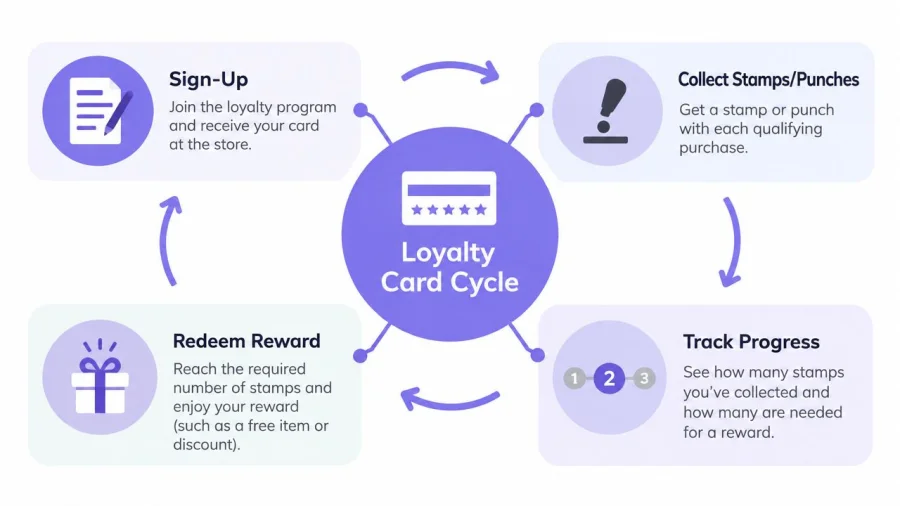
A useful analogy is a wallet with a hole in it. The card goes in, but value slowly falls out. A customer signs up but forgets the card. A staff member gives a stamp but doesn't know whether the offer changed. A nearly completed card disappears before redemption. The scheme still exists, but each step loses some of its effect.
The three common models
Small businesses usually use one of three formats:
Visit-based cards
A customer gets one stamp per visit. This is common in cafés, car washes and salons.Spend-based cards
The customer earns progress after spending over a threshold. This can work in retail or restaurants with mixed basket sizes.Points models
A business awards points that can later be exchanged for rewards. These can be flexible, but they're harder to explain on paper.
Each model can work. The trouble starts when the format doesn't match the buying pattern. A café with low average spend may make rewards feel too distant. A salon with infrequent visits may create a card that takes too long to complete. A retail shop may hand out points that customers can't easily track.
Where friction enters the cycle
Traditional cards often create friction in predictable places:
- At sign-up because there may be a form, a printed explanation or terms that staff have to repeat
- During earning because customers can't always see progress clearly
- At redemption because rules may be inconsistent across staff or locations
- After purchase because the business has little or no way to follow up
That last point matters. A paper card can encourage return visits, but it usually doesn't help a business understand who returned, what they bought, or whether the reward changed behaviour in a useful way. Anyone trying to get clearer on programme performance, especially in more structured environments, may find Crescade's guide to measuring B2B loyalty ROI useful because it shows the discipline needed to judge whether loyalty activity is paying back.
Why physical tracking struggles
Physical cards are static. They don't adapt well when a business wants to test a birthday reward, change a threshold, pause an offer, or combine visits with spend. That's where digital systems start to remove the friction. A tool such as BonusQR stamp card loyalty keeps the familiar stamp-card idea but moves progress into a trackable QR flow rather than relying on cardboard and memory.
Practical rule: if staff need to explain the reward every day, the system is too complicated for a busy counter.
The Biggest Disadvantages of Loyalty Cards for Small Businesses
A customer orders her usual flat white at 8:15, reaches for her loyalty card, and cannot find it. The queue pauses. Your barista has to choose between saying no, giving a free stamp, or trying to remember what happened last time. It feels like a small moment. Over a month, those small moments turn into real costs.
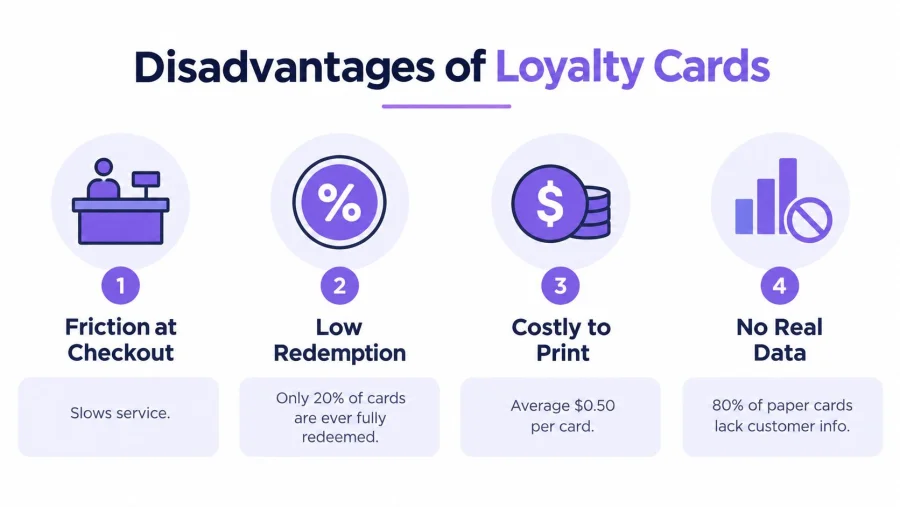
The clearest way to judge a loyalty card is to treat it like any other business tool. What does it cost in time, trust, and missed sales. For small businesses, five costs show up again and again: lost cards, delayed rewards, admin overhead, data distrust, and the feeling that prices are being manipulated. Traditional cards struggle with all five because they rely on cardboard, memory, and staff judgement. A QR-based system fixes much of that by keeping progress on the customer's phone and giving the business a simple record, without needing POS integration.
1. Lost cards create lost progress
Paper cards fail in the exact place loyalty should feel easiest. At the counter.
UK consumer survey evidence found that 30% regularly forget to use their loyalty cards, 35% stopped using a programme because it took too long to earn rewards, and 23% were put off by a complicated sign-up process according to SumUp's loyalty programme survey.
For a café, a forgotten card slows service and forces a judgement call. For a salon, it can turn a loyal client into someone who feels their past visits no longer count. A loyalty scheme works a bit like a coat hook by the door. If customers cannot find it when they need it, it stops being useful no matter how good it looked on paper.
A QR-based setup changes that cost. The "card" lives on the phone customers already carry, so progress is far less likely to vanish with a lost wallet or a worn-out stamp card.
2. Delayed rewards drain motivation
A reward has to feel reachable.
Many small businesses copy the familiar "buy ten, get one free" model because it is easy to print and easy to explain. The problem is frequency. If a customer only visits twice a month, that free item can feel months away. The reward stops acting like encouragement and starts acting like wallpaper.
You can compare it to a savings jar with no visible total. If people cannot tell whether they are close, they stop caring. That is why delayed rewards do more harm than owners expect. The programme still exists, but it no longer changes behaviour.
QR-based loyalty helps here because progress is visible in real time. Customers can usually see exactly how close they are, and businesses can adjust reward thresholds without reprinting stacks of old cards.
3. Admin overhead steals attention from service
Paper loyalty creates tiny jobs all day.
Staff hand out cards. They stamp them. They replace damaged ones. They answer the same questions. They make exceptions when someone forgot a card. None of these tasks looks serious on its own. Together, they eat into the busiest part of the day, which is usually the exact time your team should be focused on speed, warmth, and upselling.
The effect changes by business type:
- Coffee shops lose till speed during rush periods.
- Salons pull reception staff away from bookings and rebooking.
- Gyms ask front-desk staff to check cards instead of greeting members.
- Retail shops end up with inconsistent decisions across part-time teams.
A QR system reduces that admin because the rules are clearer and progress is easier to verify. You do not need a POS connection to get that benefit. Staff can scan, confirm, and move on.
4. Data distrust lowers participation
Some owners assume a loyalty scheme only needs a reward to succeed. Customers are often judging a second question at the same time. "What am I giving up for this?"
That cost is not always money. Sometimes it is personal information, extra messages, or a vague feeling that joining opens the door to tracking they did not really ask for. Even before a customer reads a privacy policy, that suspicion can reduce sign-ups and redemption.
Low-trust participation creates weak loyalty. People may join once, then ignore the scheme. A QR-based model can reduce that resistance when it asks for less information upfront and keeps the exchange simple and visible.
5. Perceived price manipulation can cancel out goodwill
Reward schemes can backfire when customers feel the offer is pushing them into a pricing game instead of giving a genuine thank-you.
Research on what Britons want from loyalty programmes found that 66% of respondents were put off by sign-up or subscription fees, 65% by irrelevant rewards, and 41% said paid loyalty schemes are a waste of money in YouGov's research on what Britons want from loyalty programmes.
Even if your business does not charge for membership, the lesson is useful. Customers quickly notice when a scheme feels padded with friction, vague conditions, or rewards that are not worth the effort. In plain terms, they start asking whether the discount is real or whether the base price was doing the heavy lifting all along.
A simple QR programme can help because it keeps the value exchange easy to understand. Visit, scan, progress, reward. No plastic card to lose. No need to bolt it into a POS system just to make the basics work.
Privacy Trust and the Hidden Cost of Data Collection
Many owners assume a discount automatically creates goodwill. That assumption is getting shakier. Customers often understand that loyalty cards aren't just reward tools. They are also data tools.

The UK government's analysis of supermarket loyalty pricing notes that loyalty members can be tracked with names, addresses, purchasing behaviour, spending patterns and product preferences, while online shoppers may also have browsing behaviour, search histories, time on page and click-through rates monitored in the government findings report on loyalty pricing. For a customer, that can make a cheap discount feel like a much bigger exchange than it first appeared.
Why discomfort turns into lower trust
In a 2025 Ipsos survey, 38% of Britons said they were uncomfortable with the amount of data supermarkets collect through loyalty card schemes. The same survey found that 66% said sign-up or subscription fees discourage them from joining or continuing, while 65% said irrelevant rewards do the same in Ipsos research on supermarket loyalty cards.
That combination matters. Customers don't judge loyalty only on the size of the reward. They judge whether the reward feels fair for the information and effort they give up.
Data sharing worries are more specific than many businesses realise
The trust issue gets sharper when data moves beyond the original retailer. The UK Competition and Markets Authority found that only 32% of shoppers felt comfortable with supermarkets sharing anonymised loyalty data with other companies, and just 17% were comfortable with individual data being shared for personalised promotions in its executive summary of the groceries loyalty pricing review.
The same review reported that 72% remembered supermarkets would collect personal data when they signed up, and 43% believed it was unfair that loyalty members pay lower prices than non-members. That last point is easy for small businesses to miss. A discount can trigger a fairness concern, not just a saving.
When customers start asking "Why is the full price so high?" the loyalty scheme has stopped feeling like a reward.
Data governance is work, not a side detail
Every business that collects personal data takes on responsibility. The Information Commissioner's Office points out that loyalty schemes can reveal sensitive inferences about where a customer shops, how much they spend and what they buy. The ICO also warns that businesses can end up holding large volumes of personal data that must be secured, and it cites the Marriott incident as an example of loyalty information being exposed after a breach in its guidance on data gathered by loyalty cards.
For a small business, the practical lesson is simple:
- Ask for less if less will do the job.
- Explain clearly why each piece of data is collected.
- Store it safely and limit access.
- Avoid surprise uses that customers didn't expect.
Trust is part of the loyalty offer. If the data side feels murky, the reward side won't rescue it.
Traditional Cards Versus QR Based Loyalty Compared
A side-by-side comparison usually makes the decision easier. Traditional cards still suit some businesses, especially those wanting a very basic, low-tech starting point. But once a team wants fewer awkward moments, cleaner tracking and less manual work, QR-based systems solve many of the structural flaws.
Traditional Loyalty Cards vs QR-Based Loyalty at a Glance
| Criteria | Traditional Paper or Plastic Card | QR-Based Platform like BonusQR |
|---|---|---|
| Customer experience | Can be forgotten, lost or damaged. Progress is often hard to check between visits. | Personal QR code stays on the phone. Customers can view rewards and progress in one place. |
| Staff workload | Staff stamp cards manually, explain rules repeatedly and handle replacement disputes. | Staff scan and redeem in an app, which removes most manual tracking. |
| Data and insights | Often limited to anonymous visits unless extra forms are collected. | Known customer profiles and built-in reporting make repeat behaviour easier to understand. |
| Cost and setup | Simple to start, but printing, reprinting and replacing can keep adding effort. | No physical card stock is needed, and setup can happen without POS integration or extra hardware. |
| Reward flexibility | Hard to change once cards are printed. | Offers, thresholds, bonuses and coupons can be adjusted without reissuing cards. |
Where QR fixes the biggest pain points
QR-based loyalty works better because it removes the weakest link in the old system: the physical card itself. Customers no longer need to remember a stamped piece of paper. Staff no longer need to guess whether a replacement card should carry over progress. The reward becomes easier to access, and that makes it easier to use.
Another advantage is flexibility. A café can run visit stamps. A salon can offer a rebooking reward. A gym can tie benefits to check-ins. A retailer can combine coupons with loyalty progress. Those changes are difficult with printed cards and much easier in a digital flow.
Why no POS integration matters
Many small businesses avoid better loyalty systems because they expect a technical project. That's often the wrong assumption. A QR-based setup can work without a till integration if staff can scan and redeem from a phone or tablet.
That keeps the barrier low for owner-operated businesses and small teams. It also makes testing easier. A business can trial a new reward structure without changing its checkout system.
For owners who want the loyalty experience on a phone without forcing customers into the old plastic-card model, a branded mobile app for loyalty is one route. The key point isn't branding. It's reducing the number of steps between purchase and reward.
How to Fix Loyalty Card Problems Without Extra Work
Most loyalty problems don't need a full rebuild. They need simpler mechanics. The easiest wins come from removing effort, shortening the path to reward, and making the rules visible.
Replace memory with instant access
If customers must remember a separate card, many won't. A better setup gives each person a mobile profile and personal QR code that can be opened quickly at checkout. Digital wallet support helps even more because the reward sits where customers already keep tickets, passes and payment tools.
This one change fixes two common failures at once. It reduces forgotten-card moments and makes progress feel easier to retrieve.
Bring the first reward closer
Many schemes wait too long before the customer feels any benefit. A faster approach uses early momentum:
- Welcome rewards give people a reason to use the programme straight away.
- Lower first thresholds help customers feel progress before the habit fades.
- Flexible rewards let the business match visit frequency rather than copying a generic ten-stamp format.
A coffee shop and a salon shouldn't use the same pace. Neither should a gym and a convenience retailer.
Cut admin by removing manual steps
The simpler the staff action, the more likely the scheme survives busy periods. Scanning is usually easier than stamping, checking handwriting, or replacing damaged cards. It also creates cleaner records and fewer disputes.
One option is BonusQR programmable loyalty cards, which let brick-and-mortar businesses run QR-based stamps, points, cashback, coupons and thresholds without POS integration. That kind of setup suits teams that want digital tracking without turning loyalty into a technical project.
Small-team advice: if the system slows the queue or confuses new staff, the system needs redesign, not more training.
Make trust part of the offer
A modern loyalty programme should say plainly what data is collected, why it's needed, and how the customer benefits. Clear language beats clever language. Customers don't need a legal lecture at the till. They need honest expectations.
A simple trust checklist helps:
- Keep sign-up short so customers aren't hit with unnecessary fields.
- Match rewards to actual buying habits so the programme feels relevant.
- Explain redemption rules clearly on the sign-up page and in-store.
- Review the results monthly using visit trends, redemptions and coupon use.
- Ask for feedback when customers stop using the scheme or never redeem.
For cafés, salons, gyms and retailers, the strongest fix is usually the same. Keep the reward visible, the staff action fast, and the data promise narrow and clear.
Moving Beyond Plastic to Loyalty That Actually Works
The disadvantages of loyalty cards aren't just about cardboard in a wallet. They show up as lost customers, delayed rewards, staff admin, data distrust and pricing suspicion. A business may think it has a retention tool when it has a small friction engine running at the counter every day.
Traditional cards still have one strength. They're familiar. But familiarity isn't the same as effectiveness. If customers forget the card, if staff spend time fixing exceptions, or if the reward feels too distant to matter, the programme stops doing its job.
QR-based loyalty changes the mechanics that usually fail. It keeps the reward on the phone, shortens redemption friction, reduces manual handling, and makes progress easier to track. It also gives businesses a cleaner way to test offers, monitor visits and improve over time without relying on POS integration.
The strongest next step is a practical one. Review the current scheme against the five costs in this article. Check how often cards are forgotten, how long the first reward takes, how much staff time goes into admin, whether the sign-up asks for too much, and whether the pricing feels transparent.
For businesses ready to replace plastic with something easier to run, start free with BonusQR. It lets brick-and-mortar teams launch QR-based loyalty in minutes, keep offers in Apple Wallet or Google Wallet, and measure what actually brings customers back.