
 Deutsch
 Español
 Français
 Italiano
 Magyar
 Polski
 Slovenčina
 Čeština
On a wet Tuesday morning, the queue in a small UK café tells the truth about loyalty. One regular searches for a crumpled paper card, discovers it's at home and accepts a stamp on the back of a receipt. The next customer scans a QR code at the till, adds a digital pass to their phone and earns a reward without slowing the barista down.
That difference matters. Paper can confirm a transaction, but it doesn't build a useful customer record. A properly designed digital loyalty programme can connect the visit time, purchase context and customer contact details, then use that information to encourage a relevant return. UK consumers already belong to plenty of schemes, so the job isn't to collect more sign-ups. It's to create a programme people use.
What a Digital Loyalty Programme Looks Like at the Till
The paper-card customer leaves with a stamp, but the café learns almost nothing. The business doesn't know whether that person visits every Tuesday, buys food with their coffee or has stopped coming altogether. If the card disappears, the relationship disappears with it.
The customer using a digital pass has a different experience. A QR code beside the card machine points to a short sign-up form. The customer scans it, saves a pass to their phone and presents the pass on the next visit. The staff member scans the customer's code, the system adds a stamp or points, and the updated balance appears quickly on the customer's phone.
A digital pass can also give the café a permission-based way to contact the customer. Depending on the setup and consent, the business may record an email address, phone number, visit timestamp and purchase information. That first-party data lets the owner answer practical questions, such as which customers have stopped returning and which reward brings people back.
Practical rule: If the loyalty action takes longer than the payment, the till process is wrong.
UK adoption makes this a commercial decision, not a novelty. 88% of UK adults belong to at least one loyalty scheme, and 43% prefer digital loyalty cards to physical ones, according to UK loyalty programme statistics from LoyaltyPass. The same source values the UK loyalty market at more than £4.5 billion annually and identifies the move from paper to digital as the most significant structural change in the past three years. It also reports 28% to 34% average redemption for digital wallet passes, compared with 8% to 12% for paper stamp cards, plus wallet push-notification open rates of around 90%. Those figures show why BonusQR Apple Wallet loyalty belongs in the till conversation.
The ordinary scan is where loyalty either earns its keep or fades away. A scheme that captures no usable data, creates queue friction or makes redemption awkward is just a newer-looking paper card.
The Main Types of Digital Loyalty Programmes Explained
A digital loyalty programme is software that records repeat customer behaviour and applies a reward according to rules chosen by the business. Most schemes work through a phone pass, web profile or app, rather than cardboard.
Small-business owners usually encounter five formats.
Digital stamp cards
Every qualifying visit earns a stamp. Once the customer completes the card, they receive a reward, such as a free hot drink after a set number of purchases. This format suits a café where customers buy similar items repeatedly.Points-based programmes
Customers build a balance linked to spending or chosen actions. For example, a customer could earn points on each meal and exchange the balance for a discount. A customizable points loyalty model gives the merchant more control, but it also creates more rules to explain.Tiered programmes
Customers gain better benefits as their engagement or spending rises. A salon might offer standard benefits to all members, then add priority booking or enhanced birthday rewards at higher levels.Cashback or percentage-back rewards
A portion of the eligible spend returns to the customer's wallet or next purchase. A retailer could credit a cash-like balance after each transaction, making the benefit easy to understand.Paid or subscription programmes
Customers pay a recurring fee for member-only pricing or access. A gym class studio might charge for a membership that includes preferential booking, while a café could offer a paid drinks plan.
| Format | How It Rewards | Typical Example | Best Fit |
|---|---|---|---|
| Digital stamps | Adds a stamp for each qualifying visit | A free drink after a completed card | Cafés and frequent-visit businesses |
| Points | Converts spend or actions into a balance | Points exchanged for a meal discount | Cafés, restaurants and independent retail |
| Tiers | Adds benefits at higher status levels | Better perks for regular high-value clients | Salons, retail and hospitality |
| Cashback | Credits value towards a later purchase | A percentage returned to the wallet | Retail and larger baskets |
| Paid membership | Charges for ongoing exclusive benefits | Member pricing or included services | Gyms and businesses with predictable use |
The right format is the one customers understand before staff need to explain it. A complicated points ladder may look advanced on a planning document, but it can become a queue problem at 8.30am.
How Cafes, Restaurants, Salons, Gyms and Retailers Use Them Differently
A loyalty mechanic should follow the customer's buying rhythm. A café visit is not a salon appointment, and a gym subscription isn't an independent shop transaction.
| Vertical | Visit Frequency | Average Spend | Best-Fit Mechanic |
|---|---|---|---|
| Independent café | Often frequent | Usually low | Digital stamps or simple points |
| Quick-service restaurant | Frequent and fast | Low to moderate | Scan-and-go points or visit rewards |
| Salon or barber | Appointment-led | Moderate to high | Tiers, birthday benefits or service milestones |
| Gym or fitness studio | Subscription or class-led | Recurring | Class packs, streaks and milestone perks |
| Independent retail | Irregular | Varies by basket | Spend thresholds, points or tiered rewards |
An independent café needs speed. A QR sign-up at the counter, followed by a stamp for each qualifying visit, keeps the explanation short. The reward should be visible and immediate enough for customers to remember it.
Quick-service restaurants need the same simplicity, but with even less tolerance for manual entry. Customers should scan while ordering, earn points or a visit credit and see the balance in a phone wallet. A clear setup for loyalty for quick-service eateries can work better than a generic programme designed around online shopping.
Salons and barbers have a different cadence. A customer may not return weekly, so a reward based only on visits can create a long wait before value appears. Birthday bonuses, service-category rewards and tiers based on annual activity give the business more useful ways to recognise a relationship.
Gyms and studios should focus on attendance and churn. Streaks, class-pack milestones and member-only benefits can reinforce the habit, but they mustn't become another administration task for reception staff. Independent retail can connect rewards to basket thresholds, giving customers a reason to consolidate purchases without discounting every transaction.
The mistake is copying a competitor's mechanics without checking the maths. A reward that works for a high-frequency coffee counter may be too weak for a salon and too generous for a shop with irregular, higher-value baskets.
How the Mechanics Work Step by Step
A workable customer journey begins with a visible QR code at the till. Keep the first interaction quick, because every extra field or password request costs sign-ups before the programme has proved its value.
- The customer scans the QR code. The system records a new contact and the sign-up location.
- The customer completes a short form. The profile can include a name, email address, phone number and stated preferences.
- The customer makes the first purchase. The transaction creates purchase history and shows spending level.
- The customer receives the first reward. Redemption behaviour tests whether the reward has real value.
- The customer returns and earns again. Visit frequency and developing customer value become measurable.
- The customer reaches a milestone. The business can identify loyalty status and possible advocacy potential.
At purchase, a POS scan can trigger an automatic stamp or points credit. A push notification or email can remind customers that they are close to a reward, but only with the required consent and a message that earns attention. Do not add a campaign rule unless someone can run it at the till and maintain it afterwards.
Redemption closes the loop. A staff member confirms the claim, the system marks the reward as used, and the business compares earning behaviour with actual redemption. An unclaimed reward can signal weak communication, low perceived value or a programme customers have forgotten.
The first-party record may be more useful than the reward. It can show visit timing, basket context and contact permission without depending on a third-party advertising audience. Small merchants usually weaken the journey by demanding an app download, collecting too many fields or requiring a password before customers can earn. Each added rule creates work, so keep only the rules that improve data quality or repeat visits.
Why Activation Matters More Than Sign-Ups
A large member count can flatter an owner while hiding a failing programme. The useful question is whether a new member returns and transacts within a sensible period.
UK loyalty is already crowded. 55% of UK consumers belong to at least four schemes, but only 58% have actively used three or fewer in the past six months, according to Mintel's UK customer loyalty research. A separate UK small-business loyalty guide reports that consumers belong to 7.4 programmes on average but actively use only 3.7, meaning many memberships are inactive or forgotten, as described in Stamp Me's UK loyalty app guide.
That is why activation beats enrolment. A workable internal threshold is a second visit within 30 to 60 days, but the business should choose the window that matches its natural buying cycle. A café may expect a quicker return than a salon.
Three levers that improve activation
- Welcome reward redemption: Give the new member a benefit they can use without decoding a points catalogue.
- A seven-day inactivity nudge: Send a short, relevant reminder after the first visit if the customer hasn't returned.
- Till-level prompting: Train staff to mention the pass at checkout, especially when a customer is close to a reward.
Every extra rule creates an ongoing operational cost. Staff need to explain it, the platform needs to calculate it and the owner needs to check whether it works. An unused earn condition isn't clever automation. It's another thing that can fail in front of a customer.
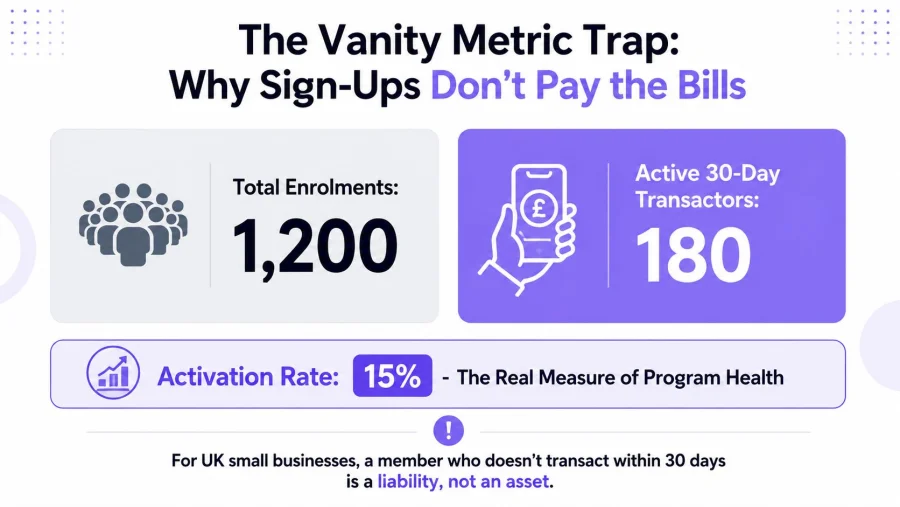
The programme should therefore report active transactors, reward redemption and repeat visits separately from total registrations. The owner needs to know who is behaving differently, not how many people once tapped a sign-up button.
Metrics That Prove a Loyalty Programme Is Working
A small merchant doesn't need a dashboard full of decorative charts. Four measures are enough to expose whether the programme is earning its space at the till.
| KPI | How to Calculate | Healthy Range | What a Poor Result Signals |
|---|---|---|---|
| Redemption rate | Rewards redeemed divided by active members | High teens to twenties can be healthy at small-business scale | Single-digit redemption usually points to weak value or poor visibility |
| Visit-frequency lift | Member visit frequency compared with a non-member cohort | A clear, repeatable positive difference | The programme may be attracting existing regulars without changing behaviour |
| Repeat-customer revenue share | Revenue from repeat customers divided by total revenue | A stable or rising share across comparable periods | Customers may be making one-off purchases or rewards may not drive return visits |
| Acquisition-cost payback | Acquisition cost divided by incremental contribution from repeat activity | A payback period that fits the business's cash flow | The scheme may be subsidising purchases that would have happened anyway |
The ranges above are operating guidelines, not universal laws. A café should compare members with similar non-members, while a salon should compare customers with a similar appointment history. A busy trading period can make every metric look healthier, even when loyalty had no causal effect.
Read the numbers by cohort
Track members who joined during the same period and compare their later behaviour with customers who weren't enrolled. Separate new customers from existing regulars. If the members already visited more often before joining, their higher activity doesn't prove that the programme caused the lift.
Review redemption monthly, then examine frequency and revenue share over a longer trading cycle. Acquisition payback belongs in a quarterly review because repeat behaviour takes time to establish.
Ignore total member count and app downloads unless they lead to transactions. A forgotten membership has no value because it exists.
Common Pitfalls That Sink Small-Business Loyalty Schemes
Small-business loyalty schemes rarely fail because the owner lacks imagination. They fail because someone adds another rule, another exception or another dependency without considering the till.
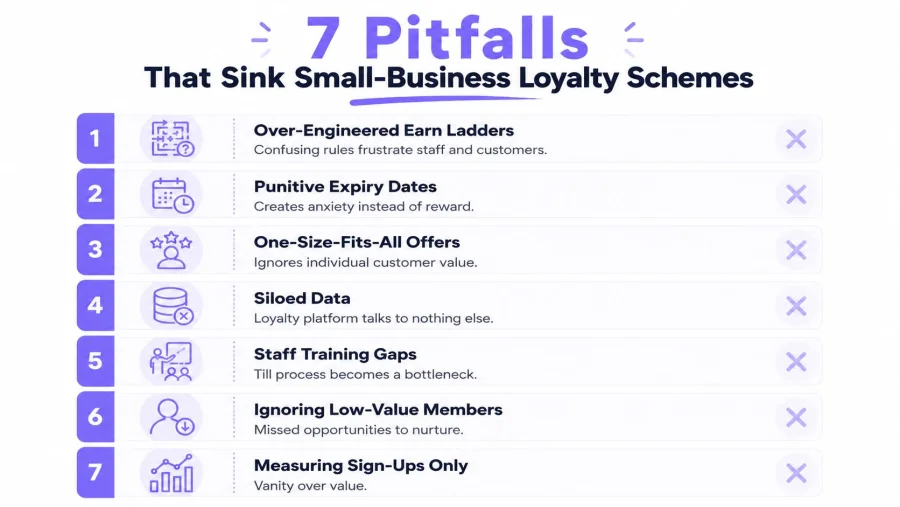
Seven problems appear repeatedly:
- Over-engineered earn ladders: If staff need to remember 12 rules, a transaction can add roughly four seconds, based on the operating assumption used here. At a busy counter, that becomes a queue and a training issue.
- Paid memberships customers forget: Subscription-style schemes may look attractive, but YouGov's 2024 UK research identifies subscription fees and irrelevant rewards as leading barriers. More than two-fifths of Britons see paid schemes as a waste of money.
- Weak GDPR consent wording: A loyalty form that blurs service messages and marketing consent creates avoidable compliance risk. A single GDPR complaint can trigger an ICO fee, so the form and retention policy need proper review.
- No staff training: Customers can't value a reward they never hear about. A two-minute till explanation and a visible staff prompt usually beat a long internal manual.
- Lock-in contracts: A 12-month auto-renewal on a platform the business outgrows can become an expensive exit problem. The owner should check notice periods before signing.
- A neglected redemption flow: Earning may work perfectly until the first customer tries to claim a reward. Test redemption on the actual device and till before launch.
- Sign-up obsession: A growing registration count can hide activation decay. The owner should watch second visits and redemption, not celebrate every new record.
The paid-tier economics also deserve scrutiny. A tier with 40% churn may pay back only in year three at best under the scenario specified here, which is too slow for many small operators. A complicated programme doesn't just cost software fees. It consumes staff attention, creates customer-service questions and increases the chance of an embarrassing failure at checkout.
The cheapest loyalty rule is the one staff can explain while serving the next customer.
Simplicity isn't laziness. It's a design feature. The right test is whether redemption, visit frequency, repeat-customer revenue and acquisition payback show that the scheme is changing behaviour.
A Vendor Checklist and Where BonusQR Fits
A platform should be judged at the counter, in the export screen and on the renewal invoice. Any owner can score a provider against these ten questions this week.
| Criterion | What to Ask the Vendor | BonusQR Position |
|---|---|---|
| Cost per location | Does the monthly cost match transaction volume and site count? | Usage-based pricing is aimed at single-site operators |
| Data ownership | Can the business export member and transaction data? | Provides first-party data export |
| Wallet passes | Are Apple and Google Wallet passes included? | Supports wallet pass delivery |
| Till operation | Does the setup work without a developer or extra hardware? | QR-first process, no POS integration or extra hardware required |
| Analytics | Can the owner see redemption, visits and customer trends? | Includes analytics beyond member totals |
| Contract length | Can the merchant leave without a long lock-in? | Monthly contracts |
| GDPR documentation | Are consent, storage and processing documents available? | Includes GDPR-safe data handling |
| Onboarding | How quickly can staff launch and learn the workflow? | Guided setup and ready-to-print materials |
| Support hours | When can the merchant get help during trading? | Ask for written response hours before signing |
| Second-site pricing | What changes when another location opens? | Confirm upgrade pricing before expansion |
BonusQR supports QR-based sign-up, digital stamps, points, cashback, visit and spend thresholds, fixed discounts, welcome offers, birthday and seasonal coupons. Customers can use a profile with a personal QR code, while staff scan and redeem without a developer-led POS project. The platform also supports Apple and Google Wallet passes, automated push and email campaigns, analytics and data export.
That doesn't make any provider automatically suitable. A merchant should still test the sign-up, earning and redemption journey with staff, then inspect the exported data. Businesses refining the wider customer experience may also find this guide by Dirt Cheap Product Inc useful for aligning the loyalty pass with the brand customers see in-store.
Before signing, two questions need clear answers:
- How many active members does the business already have?
- What customer behaviour is the programme meant to change?
If the answer to the first is only a registration total, the baseline is weak. If the answer to the second is “more loyalty”, the programme still lacks a measurable job.
A UK small business should start with one mechanic, one clear reward and one activation target. Set up a QR-based digital loyalty programme, train staff to mention it at the till and review redemption and repeat visits after the first trading cycle. Businesses ready to test that approach can start with BonusQR, then keep only the rules that customers use and staff can run without slowing service.