Most advice about digital loyalty cards starts in the wrong place. It talks about logos, colour schemes, app features and points dashboards, then treats customer sign-ups as proof that the programme works. A card that gets claimed but never used is not building loyalty. It's collecting dust in digital form.
The better question for a café, salon, gym or independent shop is simpler: will customers remember to use the card, and can staff process it without slowing down service? UK loyalty participation is already close to saturation. Research reported by Ipsos found that 95% of Brits aged 16 to 75 have at least one loyalty card (Collinson's 2025 loyalty landscape). The opportunity isn't persuading people that loyalty exists. It's giving them a programme they'll use and redeem.
Why Most Loyalty Cards Fail Before They Start
A loyalty programme fails at redemption, not at sign-up. Owners often track names collected, memberships added and joining codes scanned, then miss the measure that matters: retention depends on completed rewards and repeat behaviour.
Customers leave schemes for ordinary reasons. They forget an app password, lose an old screenshot or meet a registration form that demands too much before showing value. A reward that feels far away gives them little reason to keep checking progress. At the till, another failure appears: staff may not know how to award a stamp or process the reward.
That second problem belongs to the business. A barista serving a queue will not follow a complicated screen sequence. A salon receptionist should not need separate hardware to validate a reward. If the process slows service, staff skip it, customers stop presenting the card and the promise on the counter sign loses credibility.
Practical rule: A loyalty card works only when customers can join quickly, see their progress immediately and redeem without an explanation.
The UK market is expanding. Forecasts project growth from US$2.23 billion in 2024 to US$4.06 billion by 2029 (Collinson's loyalty market research). More demand does not make every programme effective. It raises the cost of poor execution, because customers already have plenty of alternatives competing for their attention.
For a busy independent business, BonusQR addresses both breakdowns with a simpler route: customers access the card quickly, while staff can award progress and handle redemption without adding a separate chore to the queue.
Choose the programme that survives a busy Saturday, keeps progress visible and brings the reward close enough to matter. Loyalty is a retention discipline, not a marketing campaign.
What a Digital Loyalty Card Actually Is
A digital loyalty card is a rewards mechanism that lives on a customer's phone instead of in a wallet. It replaces the paper stamp card or plastic membership card with a mobile experience where customers can join, collect progress and claim a benefit.
The category includes three main formats:
- QR-based cards: The business displays a QR code, and customers open a card managed by a loyalty provider. Staff scan the customer's code or use a phone to award progress.
- Branded mobile apps: Customers download an app, create an account and access the business's loyalty programme inside it.
- Apple and Google Wallet passes: Customers save a pass to their phone wallet and bring it up when they visit.
At a coffee counter, the difference is easy to picture. A QR card works like a digital stamp card, with the customer presenting a code for scanning. An app puts the programme inside a dedicated application. A wallet pass sits alongside travel tickets and other passes, so the customer doesn't need to search through a separate app.
That distinction matters because each format creates a different amount of customer effort. An app can support richer interactions, but the download request arrives before the customer has received value. A QR card can remove that barrier. A wallet pass can make repeat access convenient, provided the customer saves it.
Digital loyalty cards also have clear boundaries. They're not the same as cashback apps, referral schemes or paid membership programmes. Cashback returns part of a transaction value, referral programmes reward recommendations, and paid memberships charge for access or special benefits. A digital loyalty card normally rewards repeat visits, purchases or completed actions.
Businesses comparing programme formats should also review broader programme design advice, including these Shopstar loyalty program tips. The useful principle is consistent across sectors: the reward must be easy to understand, and the action required must fit naturally into the customer's normal visit.
QR Codes Versus Apps Versus Wallet Passes
The format should be judged at the counter, not in a software demonstration. Four questions matter: what does setup require, how much staff effort is involved, how quickly can a customer earn or redeem, and how much useful data does the business receive?
| Format | Setup cost | Staff effort | Redemption speed | Data depth |
|---|---|---|---|---|
| QR-based card | Usually light, with no specialist hardware required | Low, if scanning is built into the provider workflow | Fast for simple stamps and rewards | Useful customer and visit data, depending on the platform |
| Mobile app | Higher, because the business manages an app experience and customer download | Moderate to high, especially when customers need help signing in | Can be fast after installation, slower during adoption | Richer profiles and behavioural data |
| Wallet pass | Moderate, depending on provider and branding needs | Low once the pass is saved | Fast, because the pass is easy to retrieve | Practical but usually narrower than a full app |
Apps offer depth, but depth creates friction. A branded app can support messages, profiles and more detailed engagement. It also asks a customer to install and remember another application. That's a poor trade for a simple coffee stamp if the customer only visits occasionally.
Wallet passes feel polished and reduce the need for a dedicated app. They're a strong option where customers already use Apple or Google Wallet, although they don't replace the broader management tools that a full loyalty platform can provide. Businesses that want to test this route can add rewards to Apple Wallet.
QR-based cards offer the most practical balance for many independents. A code on the counter handles joining, while a staff phone handles awarding progress and redemptions. There's no POS integration or extra hardware requirement in the basic workflow, which matters to a sole trader who needs the system working before the next customer arrives.
The verdict is straightforward:
- Sole trader: Choose a QR-based card. It keeps setup and training manageable.
- Busy café: Choose QR first, with a wallet option if regular customers want faster access.
- Multi-site salon: Use QR or wallet passes with central reporting. A full app only makes sense when richer communication justifies the added customer effort.
For the two failure modes that matter most, customer forgetfulness and staff time, a simple QR workflow is usually the sensible starting point. BonusQR fits that model by supporting QR enrolment, digital stamps and points, wallet passes, reward tracking and scanning without requiring POS integration or extra hardware.
The Hidden Problem with Loyalty Rewards in the UK
Loyalty value often disappears after it is issued. Around 26% of UK loyalty points go unredeemed, representing roughly £3 billion in annual value, according to UK market evidence summarised by Collinson (Collinson's 2025 loyalty findings). A dashboard can show an active programme while customers never receive the reward intended to bring them back.
The problem is redemption behaviour. If customers need too many visits or too much spending before a reward feels reachable, progress loses urgency. If staff skip scans during a rush, the record becomes incomplete and customers stop trusting it. Unclear wording adds another barrier. People should not have to ask what qualifies, when an offer expires, or what they need to buy.
UK and European programmes are also more established, with nearly 70% active for over three years (Collinson's loyalty market report). A loyalty card alone no longer sets a shop apart. The useful difference is a reward customers understand and a staff routine that takes seconds.
| Failure mode | What customers experience | Practical fix |
|---|---|---|
| Reward feels too distant | Progress seems pointless or easy to forget | Use a clear punch, visit or spend mechanic with visible progress |
| Scans get skipped | Staff are busy, or the process feels awkward | Reduce the routine to one quick scan and brief the whole team |
| Terms feel confusing | Customers are unsure what qualifies or when redemption works | State the earning rule and reward condition in plain English |
| Redemption feels like work | Customers must search for an account or explain the offer | Make the customer code easy to retrieve and train staff on one validation flow |
The best fix addresses both sides at once. Customers need visible progress and a reward they can claim without hunting through messages. Staff need one repeatable scan and validation routine, not another system to remember.
That is why BonusQR's simple QR workflow makes sense for independent shops. It keeps enrolment, progress tracking and redemption close to the counter routine. Fancy features will not rescue a programme that customers forget or staff avoid using. Make earning clear, keep the reward within reach, and remove the friction at checkout.
How to Launch a Digital Loyalty Card in a Day
A sole trader doesn't need a drawn-out implementation project. A workable programme can be planned, configured and tested before closing time if the business makes four decisions in the right order.
Choose the mechanic
Start with the behaviour the business wants to encourage.
- Punch card: Suitable for repeat, familiar purchases such as coffees, smoothies or barber visits.
- Spend-based reward: Useful when order values vary and the business wants to recognise higher spending.
- Visit-based reward: A natural fit for gyms, salons and services where attendance matters more than individual products.
The reward should be clear and attainable. “Earn points towards selected benefits” is vague. “Collect progress on each qualifying visit and claim a named treatment or discount” gives customers something they can picture.
Pick the minimum viable tool
A provider should support the chosen mechanic without forcing a POS replacement. Look for QR enrolment, customer-side progress tracking, quick staff scanning, simple reward rules and a clear redemption process. The business should also decide whether customers need an app or can use a mobile browser and wallet pass.
A mobile workflow that lets staff manage rewards on mobile keeps the programme practical when the till is busy. Hardware adds another failure point, so it shouldn't be introduced unless it solves a real operational problem.
Generate and place the joining QR code
Print the code where customers already pause:
- Counter: The strongest location for a verbal invitation at payment.
- Window: Useful for people deciding whether to enter.
- Receipt footer: Reaches customers after the transaction, when the experience is still fresh.
- Menu or price list: Works well when customers have time to scan before ordering.
The sign should state the reward, not just say “Join our loyalty scheme”. Customers need enough information to decide without asking staff for a sales pitch.
Train the team and soft-launch
A useful staff script can be short:
“The digital card tracks your progress. Scan this code to join, then show your personal code each time you visit.”
Staff shouldn't oversell the programme or deliver a long explanation. After printing the QR code, run a small test:
- Ask a staff member to join as a customer.
- Award a test stamp or visit.
- Process a test redemption.
- Check that the reward wording is clear.
- Watch the first ten real sign-ups for hesitation or failed scans.
Remind regulars personally, thank new enrollers and ask whether the process felt easy. Those small interactions reveal problems faster than a complicated launch plan.
The KPIs That Tell You if Your Programme Is Working
A loyalty dashboard should answer one question: are customers returning and using the reward? Total sign-ups are useful, but they're only the beginning. A card with a large member list and weak redemption is not necessarily healthy.
The most useful measures sit in three groups. Acquisition shows whether customers join. Retention shows whether they come back. Return on investment shows whether the reward costs less than the behaviour it creates.
| Bucket | Metric | Healthy range | Action if off-target |
|---|---|---|---|
| Acquisition | Join rate per 100 transactions | Set a baseline, then look for a steady rate | Improve the counter invitation or QR placement |
| Acquisition | Sign-up source | Clear contribution from in-store and post-purchase channels | Move signage towards the source that produces useful members |
| Retention | Redemption rate | Regular redemptions, not just issued rewards | Shorten the path or review the reward mechanic |
| Retention | Repeat visit frequency | Consistent visits from enrolled customers | Test reminders and make progress more visible |
| Retention | Days between purchases | Stable or improving interval | Send a timely, relevant prompt rather than a generic offer |
| ROI | Incremental spend per member | Additional value should exceed reward cost | Adjust the reward or qualifying purchase |
| ROI | Reward cost as a percentage of revenue | A controlled cost that fits the margin | Reduce discount depth or change the qualifying rule |
| ROI | Payback period | A timeframe the owner can accept | Stop adding features until the economics work |
Targets should come from the business's own baseline rather than a borrowed benchmark. A café can compare enrolled and non-enrolled customers over time, while a salon can examine visits between completed rewards. The important point is to measure behaviour that affects cash flow, not vanity numbers such as downloads or total accounts.
A five-minute weekly review is enough to catch obvious problems. If sign-ups rise but redemptions stay flat, the offer may be too distant or staff may be missing scans. If redemptions happen but spending doesn't improve, the reward may be too generous or disconnected from the purchase.
Tools such as BonusQR analytics stats can help owners inspect customer activity, reward performance and visit trends without turning loyalty reporting into a separate admin job.
GDPR and Data Handling for UK Loyalty Programmes
A digital loyalty card often connects a customer's identity with purchase behaviour. The ICO's loyalty-scheme guidance notes that customers can share information about where they shop, how much they typically spend and what they like to buy. That makes the programme a source of behavioural data, not merely a replacement for paper stamps.
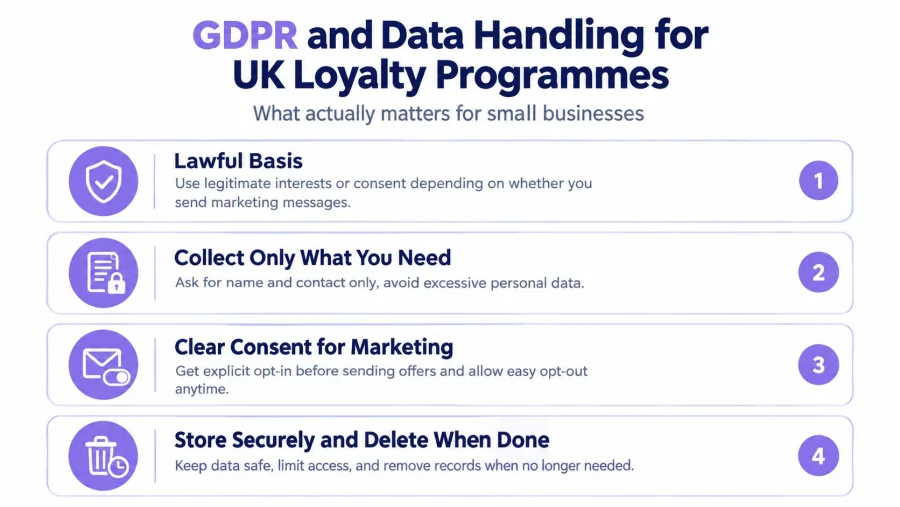
Under UK GDPR, collecting identifiable details for a digital loyalty programme means processing personal data. Customers should receive a privacy notice at sign-up explaining the controller, purpose, legal basis, retention, rights and route for complaints to the ICO, as outlined in this UK GDPR loyalty compliance guidance.
Keep collection proportionate
A stamp mechanic may only need a name and contact detail. Asking for extensive profile information creates risk without necessarily improving redemption. The business should document whether it relies on legitimate interests or consent, especially where personal data supports marketing rather than the basic reward.
Marketing messages need clear permission where consent is the chosen basis. Customers should know what they're agreeing to and how to opt out. A loyalty sign-up shouldn't become a mailing-list subscription.
Control access and retention
The business remains responsible for knowing where the data sits, who can access it and what the provider does with it. A provider processing customer data should be covered by the appropriate contractual arrangement, and the business should avoid retaining records indefinitely.
A practical rule is to define a retention window for inactive members, review storage locations, and give customers a straightforward way to access or delete their information. BonusQR is one option that provides a managed join flow and limits the amount of data a small business needs to build from scratch.
Real-World Examples and Your Next Step
An independent coffee shop usually doesn't need a marketing suite. A simple QR stamp card can fit the existing payment routine: the customer opens the card, the barista scans the code and the visit is recorded. The important design choice is not a flashy app. It's removing the download and login barrier so the customer can get back to the queue.
A high-street salon may need a different mechanic. A wallet pass with a tiered spend structure can connect larger services to a visible treatment reward, while the pass gives the client a convenient place to retrieve the offer. The receptionist still needs a fast validation routine, but the customer doesn't have to explain the programme at every appointment.
A neighbourhood gym can justify more data if the business uses it responsibly. An app-based check-in programme can record attendance patterns and support personalised reactivation messages when members stop visiting. That richer system only works if members accept the app and the gym has a clear reason to use the information.
These examples point to one operating principle: the right format depends on the behaviour being rewarded and the friction staff can tolerate. A café values speed. A salon may value spend progression. A gym may value attendance context. Copying another business's feature list won't solve the wrong problem.
Owners should stop comparing loyalty platforms by the number of badges, integrations or campaign settings on the sales page. The practical test is smaller:
- Can a customer join without help?
- Can staff award progress during a normal transaction?
- Can the customer see how close the reward is?
- Can the owner tell whether redemption is happening?
The next step is to choose one mechanic, print one QR code and train the team for ten minutes. A BonusQR loyalty card can then be launched and tested against real customer behaviour, rather than debated in another software comparison.
Choose the reward your customers can understand, create the card, place the QR code at the point of payment and watch the first real redemptions. Start a digital loyalty card with BonusQR today and give staff a simple process they'll use.


