
 Deutsch
 Español
 Français
 Italiano
 Magyar
 Polski
 Slovenčina
 Čeština
Customer loyalty strategies are deliberate methods businesses use to encourage repeat purchases, deepen engagement, and grow revenue from existing customers. Retaining a customer costs significantly less than acquiring a new one, and loyal customers spend 67% more on average than first-time buyers. That figure alone reframes loyalty not as a nice-to-have, but as a direct profit driver. For small and medium-sized businesses, the right retention tactics can close the gap with larger competitors without requiring a large marketing budget. This guide covers the most effective approaches, the data that should guide your decisions, and the mistakes that quietly undermine even well-intentioned programmes.
What are the most effective customer loyalty strategies for small businesses?
The most effective customer loyalty strategies combine structured reward programmes with personalised communication and genuine emotional connection. No single tactic works in isolation. The businesses that retain customers most reliably use several methods together, each reinforcing the others.
Reward programmes that change behaviour
Points-based systems, tiered memberships, and stamp cards are the three most common loyalty programme ideas for small businesses. Points programmes reward every purchase and give customers a reason to return before the points expire. Tiered systems, where customers unlock better rewards as they spend more, create aspiration. Stamp cards, whether physical or digital, work particularly well for cafés, bakeries, and service businesses where repeat visits are frequent and predictable.

Gamification adds another layer. Gamification in loyalty programmes can increase brand loyalty by 22% and engagement by 47%. That is not a marginal gain. Challenges, progress bars, and milestone rewards turn routine purchases into something customers actively track.
Personalisation as a retention tactic
80% of customers favour companies that personalise their communications and rewards. Generic offers sent to your entire customer base produce weak results. Personalisation means sending a birthday discount to the right person, recommending a product based on past purchases, or adjusting the reward threshold for a customer who visits weekly versus one who visits monthly.
Personalisation also applies to channel choice. Some customers respond to push notifications; others prefer email or SMS. Matching the message to the channel the customer actually uses increases both open rates and redemption rates.
Building emotional connection and community
Customers who feel a genuine connection to a brand are far less likely to switch when a competitor offers a lower price. Building that connection requires consistency, not grand gestures. Responding to reviews, remembering customer preferences, and creating exclusive events for loyal members all contribute to a sense of belonging.
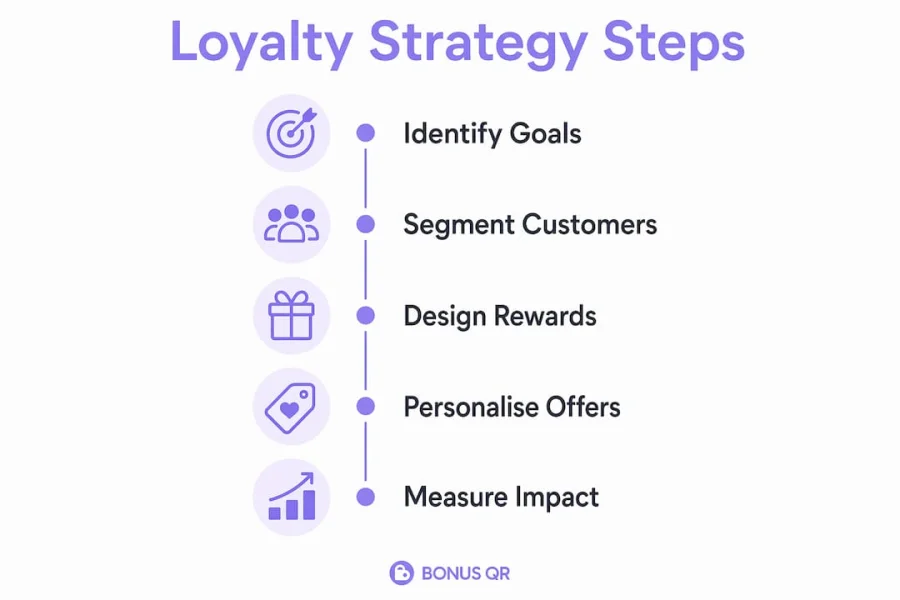
Relationship marketing treats loyalty as an ongoing conversation rather than a transaction. Community-building tactics, such as members-only previews, early access to new products, or a private group for regular customers, give people a reason to stay engaged between purchases.
Omnichannel experience
A loyalty programme that works in-store but not online, or vice versa, creates friction. Customers expect their points balance and rewards to follow them across every touchpoint. Businesses that connect their in-store and digital loyalty experience see higher programme participation and fewer drop-offs at the point of redemption.
- Points and stamp cards: Simple to understand, easy to join, and effective for high-frequency purchases.
- Tiered membership: Creates aspiration and rewards your highest-value customers with meaningful perks.
- Personalised offers: Targeted rewards based on purchase history and behaviour outperform blanket discounts.
- Gamification: Challenges and milestones increase active engagement between purchases.
- Community perks: Exclusive access and events build emotional loyalty that price alone cannot displace.
How can businesses use customer data to improve loyalty programmes?
Data-driven loyalty is a decision engine, not a discount tool. The distinction matters because many small businesses treat their loyalty programme as a way to hand out vouchers, then wonder why margins shrink without a corresponding rise in retention. The real value of customer data is in telling you who to reward, when to reach them, and what to offer.
The KPIs that actually matter
Most small businesses measure loyalty programme success by comparing overall revenue before and after launch. That approach is unreliable. Market trends, seasonality, and external factors all affect revenue, making it impossible to isolate the programme’s contribution. Redemption rate, activity rate, and penetration rate are the KPIs that give you a clear picture of programme health.
Here is what each one tells you:
- Redemption rate: The percentage of earned rewards that customers actually use. A low redemption rate signals that your rewards are not motivating enough, or that the process of claiming them is too complicated.
- Activity rate: The share of enrolled members who made at least one qualifying transaction in a given period. A high sign-up count with a low activity rate means you have a recruitment problem masquerading as a loyalty programme.
- Penetration rate: The proportion of total customers who are enrolled in the programme. If penetration is low, your enrolment process or value proposition needs attention.
Conducting a data audit
A data audit is a structured review of your loyalty programme’s performance against these KPIs. Run one quarterly. Pull your redemption, activity, and penetration figures, then segment them by customer group. You will almost certainly find that a small segment of highly active customers drives the majority of redemptions, while a large group of enrolled members has never redeemed anything.
Data-driven targeting produces 24% higher engagement, 4% transaction growth, and 5% incremental margin improvement compared to generic promotions. Those numbers come from real case studies, and they reflect what happens when you stop sending the same offer to everyone and start matching offers to behaviour.
Pro Tip: Set a monthly reminder to check your activity rate. If it drops below 30% of enrolled members, your programme needs a re-engagement campaign before you invest in recruiting new members.
Avoiding vanity metrics
Sign-up numbers feel good to report, but they tell you nothing about whether your programme is working. A loyalty programme with 2,000 enrolled members and a 10% activity rate is performing worse than one with 400 members and a 60% activity rate. Focus on engagement depth, not enrolment breadth.
What mistakes should small businesses avoid in loyalty programmes?
The most common loyalty programme mistakes are not dramatic failures. They are quiet, gradual problems that erode the programme’s value over months. Knowing them in advance saves you time, money, and customer goodwill.
-
Overcomplicating the structure: If a customer cannot explain how your programme works in two sentences, it is too complex. Complicated point calculations, multiple redemption categories, and confusing tier rules all reduce participation. Simplicity is not a compromise; it is a design principle.
-
Prioritising sign-ups over activation: Experts advise prioritising activation over aggressive recruitment of low-engagement members. Signing up a thousand customers who never return costs you more in programme administration than it generates in revenue. Focus your energy on getting enrolled members to make their second and third purchase.
-
Ignoring technical friction: A PwC Hungary survey found that 53% of loyalty programme members report technical glitches as a reason for disengagement. Broken redemption flows, apps that crash, and points balances that fail to update are not minor inconveniences. They are reasons customers stop participating.
-
Offering discounts that erode margins: Blanket percentage discounts given to customers who would have purchased anyway reduce your margin without changing behaviour. A discount should reward a specific action, such as a second visit within a week, a purchase in a new product category, or a referral. Discounts tied to behaviour protect your margin while still rewarding customers.
-
Failing to measure the right KPIs: Measuring loyalty programme success by total revenue is the most widespread mistake small businesses make. Without tracking redemption, activity, and penetration rates separately, you cannot tell whether your programme is working or simply riding a wave of general sales growth.
Pro Tip: Before launching any new loyalty initiative, write down the one KPI you will use to judge its success. If you cannot name it, you are not ready to launch.
For a detailed breakdown of what goes wrong in retail specifically, the common loyalty programme mistakes guide from Bonusqr covers the most frequent errors and how to correct them.
How do you design a loyalty programme that balances value and profitability?
A loyalty programme that customers love but that destroys your margins is not a success. The goal is to design a structure where the reward motivates a behaviour that generates more profit than the reward costs.
Align incentives with purchase signals
Personalised incentives targeting specific customer signals at critical purchase points led to 61% incremental sales in documented case studies. The key word is “incremental.” The sale would not have happened without the incentive. That is the standard your rewards should meet.
Purchase signals include a customer who has not visited in three weeks, a customer who always buys one category but never another, or a customer who is one stamp away from a reward. Each signal tells you what offer to make and when to make it. Responding to signals is far more profitable than sending the same promotion to your entire database on the first of every month.
Segment your customers
Not all customers deserve the same reward. Your top 20% of customers by spend generate a disproportionate share of your revenue. Giving them the same reward as an occasional visitor undervalues the relationship. Segment your customer base into at least three groups: high-value regulars, mid-tier occasional buyers, and lapsed customers. Design different offers for each group.
Customer retention strategies that shift from site-wide discounts to personalised offers consistently protect margins while improving retention rates. The principle applies equally to physical retail, hospitality, and service businesses.
Non-discount incentives
Rewards do not have to be discounts. Exclusive experiences, early access to new products, priority service, and members-only events all carry perceived value without directly cutting your price. For many customers, recognition and status matter more than a small financial saving. A handwritten thank-you note to your top ten customers costs almost nothing and creates a stronger emotional response than a 10% voucher.
Comparing loyalty programme models
| Programme model | Best suited to | Primary benefit | Key risk |
|---|---|---|---|
| Points per purchase | High-frequency retail | Encourages repeat visits | Points inflation if thresholds are too low |
| Stamp card | Cafés, food retail, salons | Simple and easy to explain | Low differentiation between customers |
| Tiered membership | Mixed-frequency businesses | Rewards highest-value customers | Complexity can deter casual buyers |
| Cashback rewards | Service businesses | Tangible, easy to understand | Can attract deal-seekers rather than loyal buyers |
| Exclusive perks and experiences | Premium or niche brands | Builds emotional loyalty | Requires consistent delivery to maintain value |
The right model depends on your purchase frequency, average transaction value, and the type of relationship you want to build. Many businesses combine two models, such as a stamp card for everyday purchases and exclusive perks for top-tier members.
Key takeaways
The most effective customer loyalty strategies combine personalised rewards, behavioural KPIs, and simple programme structures that customers can understand and use without friction.
| Point | Details |
|---|---|
| Personalisation drives results | 80% of customers favour brands that personalise rewards and communications. |
| Measure the right KPIs | Track redemption, activity, and penetration rates rather than overall revenue. |
| Activation beats recruitment | Engaging existing members delivers more value than signing up low-intent new ones. |
| Align rewards to behaviour | Tie incentives to specific purchase signals to protect margins and drive incremental sales. |
| Simplicity increases participation | Programmes customers can explain in two sentences consistently outperform complex ones. |
What I have learned about loyalty after watching hundreds of small businesses get it wrong
The most persistent myth in loyalty marketing is that a bigger reward always produces a bigger result. I have watched business owners double their discount offer and see redemption rates stay flat, because the problem was never the size of the reward. It was the timing, the relevance, and the friction in the redemption process.
The businesses I have seen build genuinely loyal customer bases share one habit: they treat their loyalty data as a feedback loop, not a reporting exercise. They look at their activity rate every month, ask why it moved, and make one small change. They do not overhaul the entire programme every quarter. They adjust, measure, and adjust again.
The other thing that consistently surprises people is how much emotional loyalty matters relative to financial incentives. A customer who feels genuinely recognised, by name, by preference, by history, is harder to poach than one who is simply accumulating points. The 2026 retail loyalty trends all point in the same direction: personalisation and community are becoming the primary differentiators, not reward size.
My honest view is that most small businesses should start smaller than they think they need to. Launch with a single, simple mechanic. Measure it properly. Then add complexity only when the data tells you to. A stamp card that customers actually use is worth more than a tiered points programme that nobody understands.
— Michal
How Bonusqr supports your loyalty programme from day one
Bonusqr is a digital loyalty platform built for small and medium-sized businesses that want to run a proper programme without the complexity of enterprise software. The electronic reward platform gives you points collection, cashback, and personalised reward automation in one place, with real-time analytics so you can track the KPIs that matter. For businesses that want something even simpler to start with, the digital stamp card programme requires no POS integration and can be live within a day. Both options include push notification tools, customer segmentation, and branding customisation, so your programme looks and feels like yours from the first interaction.
FAQ
What are customer loyalty strategies?
Customer loyalty strategies are structured methods businesses use to encourage repeat purchases and deepen customer relationships. They include reward programmes, personalised offers, gamification, and community-building tactics.
How do I measure whether my loyalty programme is working?
Track redemption rate, activity rate, and penetration rate rather than overall revenue. These KPIs isolate your programme’s actual impact on customer behaviour.
What is the biggest mistake small businesses make with loyalty programmes?
The most common mistake is prioritising sign-up numbers over activation. A large enrolled base with low engagement delivers far less value than a smaller, highly active membership.
Do loyalty programmes need to offer discounts?
No. Exclusive experiences, early product access, priority service, and personalised recognition all build loyalty without reducing your price. Behaviour-linked discounts are more effective than blanket percentage offers.
How quickly can a small business launch a loyalty programme?
With a platform like Bonusqr, a digital stamp card or points programme can be live within a single day, with no POS integration required.