
 Deutsch
 Español
 Français
 Italiano
 Magyar
 Polski
 Slovenčina
 Čeština
A café launches a loyalty offer on Monday. The counter sign is clear, staff mention it to regulars, and new members join throughout the week. By the following month, the sign-ups still look encouraging, but few customers are opening the offer, scanning a code, or returning to claim a reward.
That pattern appears across cafés, salons, gyms, restaurants, and independent shops. Joining is easy. Building a repeat habit is harder. A customer loyalty campaign earns its keep only when members actively redeem, visit again, and choose the business often enough to change revenue.
Why Most Customer Loyalty Campaigns Stall After Launch
The launch usually isn't the problem. A compelling reward can attract attention at the till, especially when joining takes seconds. The failure arrives later, when the customer has to remember the programme, understand the next step, find the reward, and decide that using it is worth the effort.
UK consumers already join loyalty schemes readily. In the UK groceries sector, 97% of surveyed shoppers belonged to at least one scheme, and the average shopper held 3.1 memberships, according to the UK government review of loyalty pricing. The issue isn't persuading people that loyalty exists. It's giving them a reason to use one particular programme again.
Sign-ups are an incomplete success measure
Mintel reports that 55% of UK consumers belong to at least four loyalty schemes, while only 58% have actively used three or fewer in the past six months, revealing a large inactive-member pool that undermines campaign ROI. The Mintel UK customer loyalty research makes the commercial problem clear. A large database can contain plenty of customers who haven't redeemed anything recently.
Paper punch cards create a similar weakness. They're simple at first, but customers lose them, staff can't see visit history, and the business can't identify dormant members or send a timely reminder. Broad discounts can also train customers to wait for a cheaper visit instead of returning because the business has become part of their routine.
Practical rule: Count a member as valuable when the programme changes behaviour, not when a form has been completed.
The stronger approach combines active redemption, mobile access, and relevant rewards. A coffee shop might remind a customer about a nearly completed reward after a quiet period. A salon might offer a treatment-related incentive instead of a generic price cut. A gym might promote a useful add-on or off-peak visit based on the member's habits.
Businesses designing their first programme can use this guide on how to design a loyalty program, then apply personalization strategies to retain customers to make each message more relevant. The central shift is simple: optimise for the second and third redemption, not the first wave of registrations.
Choosing the Right Campaign Mechanics for Your Business
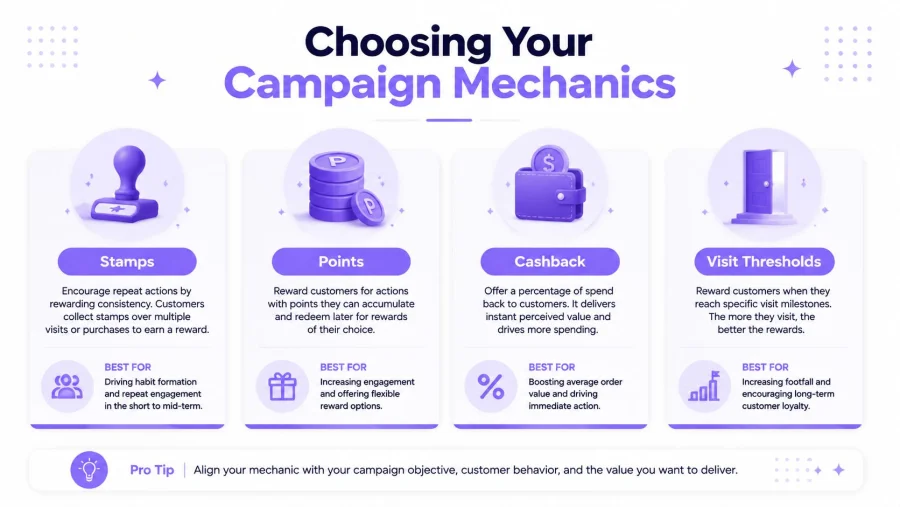
A loyalty mechanic should make one desired behaviour obvious. If a café needs more morning visits, a stamp reward is easier to understand than a points catalogue. If a salon wants clients to maintain a treatment routine, a visit threshold may fit better than a discount on every appointment.
Match the rule to the behaviour
Stamps suit frequent, familiar purchases. A café can award one stamp for a qualifying drink and provide a free or upgraded drink after the chosen threshold. The customer sees progress immediately, and staff can explain the offer quickly. A printable punch card rewards template can help a shop think through the basic customer journey before moving to a digital version.
Points work when products have different values. A gift shop, restaurant, or speciality retailer may want customers to earn more for larger baskets. The rule needs a clear explanation, visible progress, and rewards that feel attainable. A points system for coffee shops can work when a café sells drinks, food, retail items, and seasonal products with different price points.
Cashback supports spend growth. A gym could return a portion of eligible spending as credit for classes, merchandise, or personal training. This can encourage a broader relationship with the business, but the owner needs firm rules around eligible purchases, expiry, and margin.
Visit thresholds reinforce routine. Salons, barbers, wellness centres, and fitness studios can reward a customer after a defined number of visits. This approach makes sense where consistency matters more than one large transaction. It can also support quieter periods if visits during selected times receive additional progress.
Other mechanics solve different problems:
- Welcome bonuses: Give new members an immediate reason to complete a first action, such as booking, visiting, or making a qualifying purchase.
- Fixed discounts: Keep the offer easy to grasp, but avoid making every visit dependent on a reduced price.
- Birthday coupons: Add a personal reason to return, provided the customer has willingly supplied the relevant information.
- Seasonal offers: Create timely reasons to visit around events, weather, school holidays, or local trading patterns.
- Spend thresholds: Encourage a larger basket, such as a reward earned after a customer reaches a chosen spend level.
Keep the first version narrow
Small businesses often try to combine points, tiers, cashback, birthday rewards, referrals, and complex exclusions at launch. That creates staff questions and customer hesitation. A better starting point is one primary mechanic and one supporting trigger, then a review of redemption behaviour before adding more rules.
The reward must also fit the customer's reason for visiting. A gym member may value flexibility or a useful service more than a generic discount. A salon customer may prefer a treatment upgrade. A café regular may respond to progress toward a familiar favourite. The most profitable reward isn't necessarily the biggest one. It's the one customers understand and use without damaging the normal purchase pattern.
Setting Up Your Campaign in Minutes Without Extra Hardware
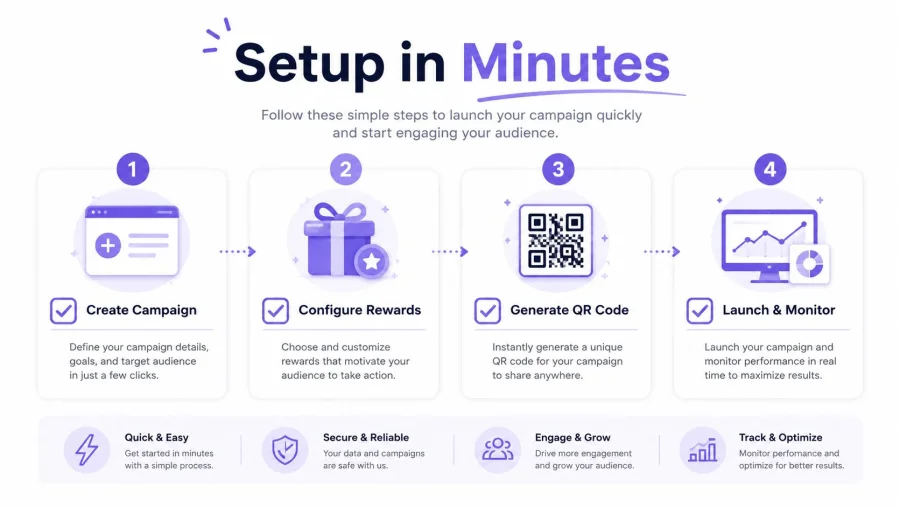
A small business doesn't need a complex technology project to launch a digital loyalty campaign. The essential journey is short: create the offer, define the rules, place the customer-facing QR code, and teach staff what happens during a scan.
Build the customer journey before the dashboard
Start with the moment of purchase. Decide what staff say, where the QR code appears, what the customer sees after scanning, and how the reward is claimed. If any step requires an explanation longer than the transaction allows, simplify the campaign.
A QR-based platform such as BonusQR can create stamp, points, cashback, visit, and spend campaigns, alongside welcome, birthday, seasonal, and win-back offers. Customers can join through mobile or web, receive a personal QR code, and track rewards and visit history in one profile. That profile can also hold menus, price lists, news, reviews, and reservations, while staff scan and redeem within the app without extra hardware or a POS integration.
The UK groceries evidence supports a low-friction approach. 97% of surveyed shoppers belonged to at least one loyalty scheme, and the average shopper held 3.1 memberships, according to the government's review of the groceries sector. Customers are familiar with joining. The experience still needs to be quick enough to fit naturally into a busy shop or reception desk.
A practical launch checklist
- Create the campaign: Choose a name customers can understand, such as “Morning Coffee Reward” or “Six Visits, One Upgrade”.
- Configure the rules: Define the qualifying purchase or visit, the reward, any exclusions, and the expiry policy.
- Generate the QR code: Place it at the till, reception desk, tables, appointment confirmations, receipts, and social profiles.
- Test the complete path: Scan as a new customer, earn progress, redeem the reward, and check what staff must do.
- Train the team: Give staff one short sign-up sentence and one redemption instruction.
- Launch and monitor: Check scans, activations, redemptions, and customer questions during the first trading days.
Customers can manage loyalty via phone, keeping the programme available without requiring a physical card. Wallet passes can also make offers easier to find, but the primary experience should remain clear even for a customer who has never used the system before.
The owner should print the checklist, nominate one staff member to inspect the campaign each week, and record every point of confusion. Those observations often reveal more than a polished launch report.
Promoting Your Campaign and Driving Active Redemptions
A loyalty campaign hidden behind the counter becomes a forgotten campaign. Promotion should continue after launch, but every message needs a specific job. One message should create awareness, another should help a customer complete enrolment, and a later message should bring an inactive member back.
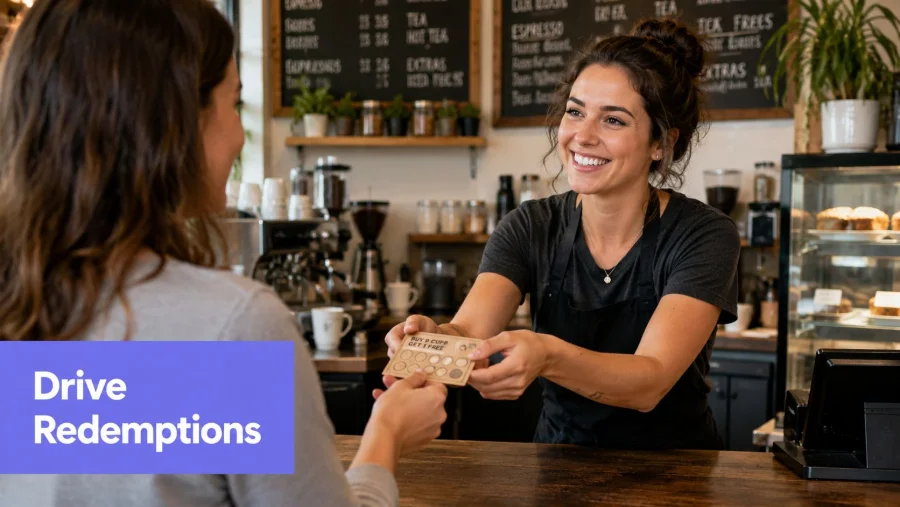
Give staff a ten-second explanation
The till script should name the benefit and the action:
“Scan this code to join. You'll collect progress towards your next reward, and you can track it on your phone.”
The wording should change by business. A salon might say, “Join to keep your visit rewards and receive appointment-related offers.” A gym could say, “Join to track rewards for visits and eligible services.” Staff shouldn't promise benefits the campaign doesn't provide.
Use the same plain wording on:
- Counter signage: “Scan to join today. Track your reward on your phone.”
- Social posts: “Regular visits should come with something useful. Join the loyalty programme in a quick scan and keep your reward in one place.”
- Email: “Your reward is waiting. Open your loyalty profile to check progress and see the next eligible offer.”
- Push notifications: “You're close to your next reward. Visit this week and keep your progress moving.”
Re-engage without training discount dependence
Dormant members need a reason that connects with their history, not another generic announcement. A coffee shop can remind a customer about progress already earned. A salon can send a timely booking prompt. A gym can promote a quieter session or a relevant class. The message should include one action, one timeframe where appropriate, and a reward that remains financially sensible.
Inclusivity matters because membership pricing can make non-members feel penalised. Recent UK consumer research found that 64% of non-members feel excluded by membership pricing, while subscription fees and irrelevant rewards are among the top reasons people avoid or abandon programmes, according to Retail Economics and Vypr research.
A fair structure can offer members extra convenience, recognition, or occasional rewards without making the standard customer feel unwelcome. Clear public terms, useful rewards, and a simple free route to join are stronger than aggressive member-only price gaps. The campaign should make members feel valued, not make everyone else feel punished.
Measuring What Actually Matters Beyond Sign-Up Numbers
A spreadsheet full of new members can look impressive while the till stays unchanged. The owner needs a measurement system that separates enrolment, activation, redemption, frequency, and revenue.
Collinson reports that 61% of registered UK loyalty members made a purchase in the last 12 months, generating 52% of total sales revenue, while 66% of brands saw increased purchase frequency among active members, according to its Loyalty Landscape 2025 report. These figures support a practical principle: active members and their behaviour matter more than the size of the registration list.
Use a decision-led dashboard
| Metric | What It Tells You | Action It Triggers |
|---|---|---|
| Enrolments | Whether customers understand and accept the invitation | Improve the till script, signage, or joining flow |
| Activated members | Whether new members complete a meaningful first action | Clarify the first reward and remove unnecessary steps |
| Active redemption rate | Whether the offer is being used | Review reward relevance, timing, and visibility |
| Repeat purchase frequency | Whether visits are becoming more regular | Test reminders, visit thresholds, or off-peak offers |
| Member revenue | How loyalty customers contribute to sales | Compare reward cost with the value of member transactions |
| Coupon performance | Which offers create action | Keep productive mechanics and retire weak ones |
| Dormant members | Who has stopped engaging | Send a targeted win-back message or ask for feedback |
Turn reporting into an optimisation loop
The working loop is enrolment, activation, feature-use tracking, then frequency and revenue analysis. First, measure whether customers join. Next, check whether they open the profile, earn progress, or redeem. Then identify which campaign type produces repeat visits or stronger baskets.
A small operator can recreate this in a spreadsheet with one row per campaign and columns for members, activated users, redemptions, repeat visits, revenue, reward cost, and customer comments. The exact labels matter less than consistent definitions. A “member” shouldn't be counted as active merely because the person joined months ago.
The useful question isn't “How many members are there?” It's “Which campaign rule caused a customer to return, and what should change next?”
Review the dashboard on a fixed schedule. If a welcome reward gets many claims but no follow-up visits, the first offer may be attractive but poorly connected to a habit. If a birthday coupon performs well but a broad discount doesn't, the business has evidence that relevance matters more than reach.
Staying Compliant and Building Long-Term Loyalty Habits
A sustainable customer loyalty campaign needs clear rules for both customers and staff. UK privacy guidance requires providers to identify a lawful basis under UK GDPR, explain data use in a clear privacy notice, and state who processes the data, why it's processed, and what rights customers have, as set out in this loyalty programme data protection checklist.
Email and SMS marketing need particular care. The business should record the appropriate consent or soft opt-in basis where applicable, explain profiling, retention, and third-party sharing, and avoid collecting information that the campaign doesn't need. Special-category data requires an additional condition such as explicit consent.
Fairness is an operating principle, not just a legal task. Keep reward terms visible, offer a straightforward joining route, and avoid rules that make non-members feel excluded from ordinary service. Review the campaign regularly, check redemption costs, remove irrelevant rewards, and test one change at a time so existing members aren't confused.
A practical review asks three questions: Are customers using the reward? Is the reward producing a worthwhile behaviour? Can staff explain and deliver it consistently? If the answer to any question is no, simplify the campaign before adding another feature.
Small businesses can start with one clear reward, a QR code at the point of service, and a dashboard that tracks redemption rather than registration alone. Set up a practical campaign with BonusQR, test the complete customer journey with staff, and invite the next customer to join with a simple, useful offer.