
 Deutsch
 Español
 Français
 Italiano
 Magyar
 Polski
 Slovenčina
 Čeština
Yes, under the CCPA, most loyalty programmes that offer discounts, rewards or perks are treated as financial incentives and require a clear notice and, in many cases, an express opt-in. If you run a rewards scheme, your first jobs are publishing a notice of financial incentive, confirming whether opt-in consent is required, and disclosing an estimated value for the data you collect. Get the notice and consent flow right first, then tackle retention and recordkeeping.
TL;DR:
- Show a clear financial incentive notice at enrollment, covering reward terms, duration, consent and withdrawal methods, partner sharing, and estimated data value.
- When rewards depend on data beyond what is needed to provide the core service, obtain express consent and save the exact notice and timestamp.
- Avoid unexplained member discounts, and document how margins, redemption rates, or customer lifetime value connect each reward tier to data’s business value.
- For deletion requests, remove marketing and profiling fields but retain essential account data, such as a loyalty ID or tier, and record why.
What the CCPA requires for loyalty and rewards programmes
A financial incentive under the CCPA covers any payment, discount, reward or price and service difference you offer in exchange for collecting, keeping, selling or sharing personal information. That definition catches most loyalty mechanics: points, stamp cards, tiered cashback and member-only pricing all qualify, because loyalty and discount programmes that exchange consumer data for benefits require a notice of financial incentive.
A compliant notice of financial incentive needs to cover a defined set of points before a customer joins:
- A plain description of the incentive, such as a discount, points balance or cashback rate.
- The material terms, including how long the offer lasts and any conditions attached to it.
- How the consumer can opt in and, separately, how they can withdraw.
- Confirmation of whether the data will be shared with third parties as part of running the programme, since notices should disclose third-party sharing or partner access when data moves outside the business.
- An estimate of the value of the data involved, which regulators accept can be communicated through ranges or simple worked examples rather than exact dollar figures when precise valuation is impractical.
Express opt-in is required whenever the incentive depends on data beyond what is needed to deliver the core product or service, which covers the large majority of points and rewards schemes. Signing up for an account is not proof of opt-in on its own: you need a stored, time-stamped record of the exact notice shown and the action the customer took.
Non-discrimination and the ‘reasonably related’ standard
The CCPA’s non-discrimination rule means you cannot punish a customer for exercising a privacy right, but it does allow price and service differences when they are reasonably related to the value the business gets from that customer’s data. The test is whether the incentive’s size matches the data’s actual contribution to your business, not whether it feels fair in isolation.
A non-compliant design charges non-members double for the same product with no explanation of what data unlocks the lower price, which looks punitive rather than incentive-based.
- Document the margin, redemption rate or lifetime value data behind each reward tier.
- Keep a short written rationale for every discount level you offer members versus non-members.
- Review reward economics whenever you add a new data field to the sign-up form.
Pro Tip: Keep your rationale documents in the same place as your notice templates, so an auditor or regulator can see the reasoning and the disclosure side by side.
Retention, deletion and handling member privacy requests
A deletion request from a loyalty member does not mean the programme has to break. The CCPA’s deletion exceptions let you keep the minimum personal data needed to keep the programme functioning, such as a loyalty ID or current tier status, while removing fields that only serve marketing or profiling purposes.
- Separate essential programme identifiers (member ID, points balance, tier) from marketing and profiling fields (browsing history, inferred preferences) in your data model.
- When a deletion request arrives, strip the marketing and profiling fields immediately and retain only what is legitimately necessary to keep the member’s account functioning.
- Log the request, the fields removed and the fields retained, with a note explaining the retention basis for each.
- Review retention tables periodically to confirm fields still map to a current legal basis and a defined retention period.
Separating identifiers from profiling data this way makes deletion compliance mechanical rather than a judgement call made under time pressure every time a request lands.
Practical compliance checklist to update your loyalty programme
Bringing an existing programme into line does not need a long project. Work through it in order:
- Audit your programme: list every personal information field you collect at sign-up, redemption and renewal, and flag anything shared with a third-party partner.
- Draft or update your notice of financial incentive, covering the incentive, material terms, opt-in and opt-out paths, and data value estimate.
- Place the notice at the point of interaction, meaning the sign-up screen or app prompt, not buried only inside a general privacy policy.
- Build an express opt-in checkbox or toggle that stores a snapshot of the exact notice text shown and a time stamp for the action.
- Add the estimated data value disclosure, using a simple range if an exact figure is not practical.
- Update your retention and deletion workflow so marketing fields are purged on request while core identifiers are preserved under a documented basis.
- Train staff who handle member queries on how to recognise and route a deletion or opt-out request.
- Run an internal test of the full sign-up and deletion journey, and keep a written record of each decision made along the way.
Pro Tip: Treat the written record from your internal test as your first line of defence. If a regulator asks questions later, a dated decision log is far more persuasive than a reconstructed explanation.
Most of this work sits in notice design and consent capture, so prioritise those two steps before moving to retention tooling.
Technical and operational controls that support compliance
Meeting these requirements comes down to a few repeatable system controls: a recordable opt-in flow with time-stamped consent storage, a notice that can appear at every sign-up surface (in-app, web form or in-store QR prompt), and retention tools that can export or delete a member’s data on request while keeping core programme fields intact.
A configurable loyalty platform makes this easier to operate day to day:
- Opt-in toggles that store the notice version and timestamp shown to each member.
- Editable notice text so material terms can be updated without a developer request.
- Export and delete tools scoped to marketing fields, leaving loyalty identifiers untouched.
- Reporting that ties reward tiers back to the business logic behind them, supporting the reasonably related standard.
Regulatory outlook and enforcement priorities
California Attorney General offices and the California Department of Justice have issued non-compliance notices to companies running loyalty programmes, and that scrutiny is only increasing. Regulators consistently expect notices that are readable on a phone and shown exactly where a customer decides to join, not tucked away in policy text. Fixing notice placement and keeping clean consent records does more to reduce enforcement risk than any other single step.
— Michal
Why BonusQR gives you a practical path to compliance
Building these controls from scratch takes time most small and mid-sized businesses do not have. We provide a platform so your loyalty, stamp card or cashback programme can come with opt-in capture, configurable notice text and point-of-interaction placement already built into the setup process, alongside export, delete and reporting tools that support your retention and deletion workflow.
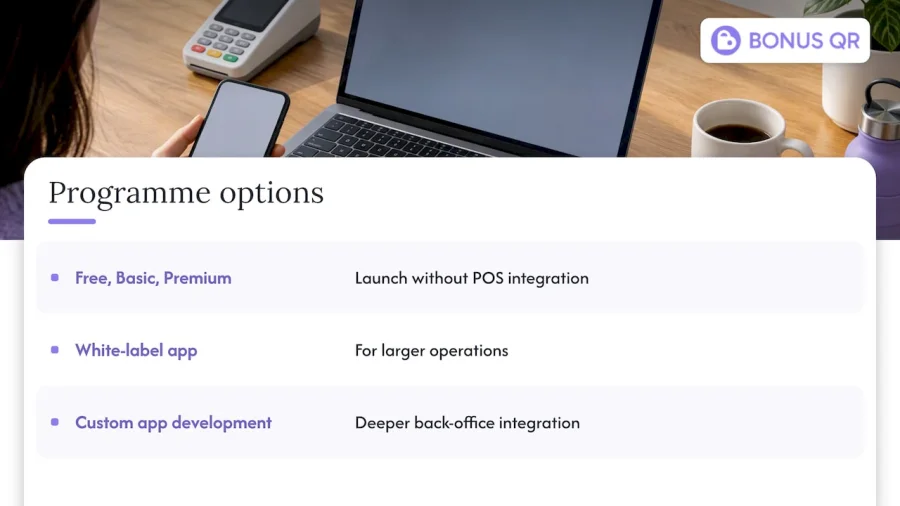
If you are starting fresh, our Free, Basic and Premium plans let you launch a compliant programme without POS integration. Larger operations can move to a branded white-label app, and businesses needing deeper back-office integration can talk to us about custom app development. Whichever route fits your business, you can get started with BonusQR and have your notice, consent and retention controls running within days rather than months.
This article is general information, not a substitute for advice from a qualified lawyer. Consult a qualified legal professional about your own circumstances before acting on anything here.
FAQ
Does the CCPA treat loyalty points as personal information?
Loyalty points themselves are not personal information, but the data collected to award and track them, such as purchase history or contact details, usually is. That data collection is why loyalty programmes require a notice of financial incentive under the CCPA.
Does CCPA apply only to California residents?
The CCPA’s protections apply to California residents, so a loyalty programme only needs to meet CCPA notice and opt-in requirements for members who are California residents. Many businesses choose to apply the same notice and consent process to every member rather than running two different sign-up flows.
Is the CCPA still in effect?
Yes, the CCPA remains in effect and has been strengthened by amendments that expanded enforcement and consumer rights. Loyalty and rewards programmes still need a current notice of financial incentive and a lawful opt-in process to stay compliant.
What should a notice of financial incentive include for a rewards programme?
It should describe the incentive in plain terms, state the material terms and duration, explain how to opt in and opt out, flag any third-party data sharing, and give an estimated value of the data involved. Communicating that value through a simple range is acceptable when an exact figure is not practical.
What happens if a loyalty member asks to delete their data?
You can retain the minimal data needed to keep their account working, such as a loyalty ID or tier status, while deleting fields used only for marketing or profiling. Logging what was kept and why gives you a clear record if the request is ever questioned.