Bonuses or Bonus: Singular vs Plural Use with Examples
Use bonus for one reward, payment or prize, and bonuses for two or more. That is the rule in full, and it holds whether the reward is a free coffee or a year-end payout.
So why do so many offers, counter signs and payroll emails still read wrong? The slip that reaches customers is rarely the plural spelling. It's the plural that creeps into a word sitting in front of another noun, as in "bonuses scheme" or "bonuses points".
Bonuses are ordinary money in British business. Employers across Great Britain paid a combined £46.4 billion in bonuses in the financial year ending March 2017, and bonuses made up 6.2% of total annual pay, the ONS average weekly earnings bulletin reports. A café owner writing a loyalty card and a finance team writing a payroll note are using the same countable noun, so both need the same two forms.
The Quick Rule for Bonus or Bonuses
Bonus names one thing. Bonuses names two or more, or rewards in general when the sentence is about the category rather than a single award. The form changes when the count changes. It doesn't change because the amount went up, because the payment landed in December, or because the offer sounds more impressive in the plural.
Keep this table beside you while you write your next offer.
| Situation | Use | Example |
|---|---|---|
| One reward or payment | bonus | She got a bonus this month. |
| Two or more rewards | bonuses | They earned two bonuses in May. |
| With each, every or this | bonus | Every bonus is recorded in the app. |
| Rewards in general | bonuses | Salons often offer bonuses to regular customers. |
| Before another noun | bonus | Our bonus scheme starts on Monday. |
| Numerals above one | bonuses | 3 bonuses this week. |
The fifth row catches more people than the rest combined. When bonus sits in front of another noun, it acts as a label and stays singular: bonus points, welcome bonus, bonus round. The plural belongs to the noun doing the counting, so "bonus points" is correct even when a customer collects a hundred of them. "Bonuses points" never is.
The check that takes two seconds: count the rewards the sentence describes. One keeps "bonus", more than one takes "bonuses", and any noun that follows stays singular.
How Count and Number Decide the Form
Bonus is a countable noun, in the same family as reward, prize and payment. You can have one, two or thirty, so the word needs two forms. Once the count is clear, the choice between bonuses or bonus stops being a guess.
Why the plural adds -es
The plural takes -es because the singular ends in -us, the pattern you already follow with virus and viruses, or campus and campuses. Bonusses is not standard UK spelling, however tidy the double s looks on a sign. One bonus, two bonuses, and the s lands once.
Four signals that decide the form
- The article. "A" and "an" only ever sit before the singular, so "a bonus" and "an annual bonus" are settled by the word in front. "The" can introduce either form, so read the noun after it: "the bonus arrives in December" refers to one payment.
- The number. "One bonus" is singular. "Two bonuses", "three bonuses" and any figure above one take the plural.
- The quantity word. Each, every and one take the singular, as in "every bonus is recorded in the app". Several, many and few take the plural.
- The verb. "The bonus is paid in December" but "the bonuses are paid in December". A mismatched verb is the fastest sign that the noun beside it is wrong.
Quantity words that shift the count
No works both ways and shows the count doing its job: "no bonus" means not one, "no bonuses" means none at all. Some, a lot of and lots of take the plural, so "some bonuses", "a lot of bonuses" and "lots of bonuses" read naturally.
The four signals usually agree, which is why most sentences need no thought. When two of them conflict, reread the sentence and decide how many rewards it means. The count settles every argument.
Singular and Plural Examples Side by Side
One wrong form can change what a customer expects to receive. Reading the two versions side by side makes that gap visible faster than any explanation.
| Context | Singular | Plural |
|---|---|---|
| Single payment | Her bonus arrived on time. | Her bonuses arrived on time, one each month. |
| Annual reward | The annual bonus is paid in December. | Annual bonuses are paid in December. |
| Loyalty reward | Earn a bonus on your fifth visit. | Earn bonuses on every visit. |
| Verb agreement | The bonus is taxed as income. | The bonuses are taxed as income. |
| Team reward | Each team gets a bonus. | Each team gets bonuses. |
The same pattern runs through everyday nouns, not only this one.
Row one carries the meaning shift. "Her bonus arrived on time" points to one payment a reader can picture. The plural describes a run of payments, one each month, which is a different promise to staff and to customers. Row five is subtler still: "each team gets a bonus" is one award per team, while "each team gets bonuses" is several per team, and "each" keeps the team singular either way.
For a loyalty card, the form sets the promise. "Earn a bonus on your fifth visit" offers one reward and a visible finish line. "Earn bonuses on every visit" describes a pattern, and it only works if each reward still feels within reach. Reachability is where schemes lose people: 49.1% of UK consumers say rewards take too long to earn, according to Retail Times reporting on UK loyalty research. If you're weighing more ways to reward repeat customers, settle the structure before you settle the sentence.
Two steps, every time. Decide whether the sentence means one specific reward or a general set, then match the verb and any determiners to that choice.
Singular Modifiers and Common Mistakes
A café prints a card offering a birthday bonus stamp. A salon manager emails the team that the bonus pay run closes on Friday. A gym app lists bonus classes for the week. In each case the word in front of the main noun stays singular, and no reader stumbles.
That's the label rule at work. When bonus describes the noun after it, it keeps one form: bonus round, bonus class, birthday bonus. Say the plural on its own and it stands apart: "our bonuses start in January", "we offer bonuses at weekends". The plural moves to the noun doing the counting, never to the label.
Five errors account for most of the trouble.
- A bonuses. The article and the noun fight each other. Write "a bonus", because "a" can only point at one.
- Two bonus, several bonus. A number or quantity word above one needs the plural: "two bonuses", "several bonuses".
- The bonus's value and the bonuses' value. The apostrophe follows the noun. One bonus's value is a single reward's worth; the bonuses' value covers several.
- Bonusses. The double s looks tidy and isn't standard UK spelling. The plural is bonuses.
- The bonuses is paid. A plural noun takes a plural verb: "the bonuses are paid".
Wording and printed design meet in the same place, which is why a proofread before print saves a reprint.
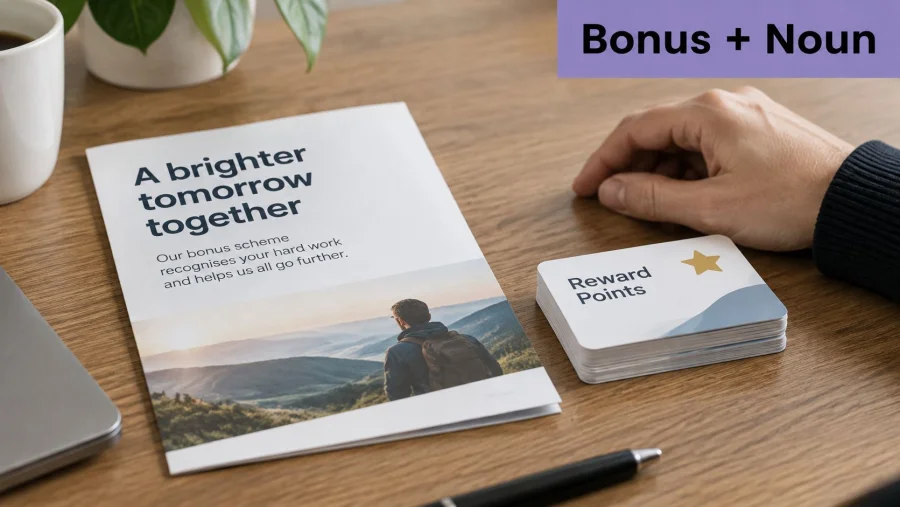
Build one habit into the final read. Search the draft for "bonus", then check each hit for two things: how many rewards the sentence describes, and what word comes next. A noun after it means singular; a verb after it has to agree. If the reward behind the wording needs work, repeat-visit perks for salons and gyms start with the rule, not the sentence.
Amounts, Totals and Hyphenated Forms
How does the amount change the form of bonus? Start by asking whether the sentence describes one reward, several rewards, or a figure placed before the noun. These patterns cover the common cases.
One offer, one bonus. “A bonus of £5 on your fifth visit” describes a single reward, so bonus stays singular. The amount gives more information about the reward; it does not change its number.
A running total, bonuses. “Bonuses totalling £200 this month” adds several rewards into one figure, so the noun is plural. The same rule applies to “£800 in bonuses across the quarter”. The total is one sum, but it can represent several separate bonuses.
A repeating amount, bonuses. “£5 bonuses for every visit” describes a reward that repeats. The plural noun signals several bonuses, even before the first one is paid.
A figure placed directly before the noun works differently: write “a £5 bonus” or “50 bonus points”. The number describes the reward or points, while the noun bonus remains singular when it labels another noun, as in “bonus points”. Use a hyphen when a number and unit act together as one describing phrase before a noun: “a 10-point bonus” or “a 48-hour bonus window”. In “a bonus of 10 points”, the words follow the noun, so no hyphen is needed.
A single reward reads as an offer. A stream of rewards reads as a scheme, and a scheme needs a rule the customer can see.
What you print is the gross reward, and employer National Insurance adds to its cost, so price the offer before it reaches a poster. This keeps the amount in the wording clear while accounting for the cost of the offer.
For a reward based on spending rather than visits, cashback loyalty for restaurants gives a useful example: customers earn a coupon when they reach a specified spending threshold. Set out that threshold clearly, then check the sentence. Is it one offer, a total, or a repeating amount? The answer determines whether bonus is singular or plural.
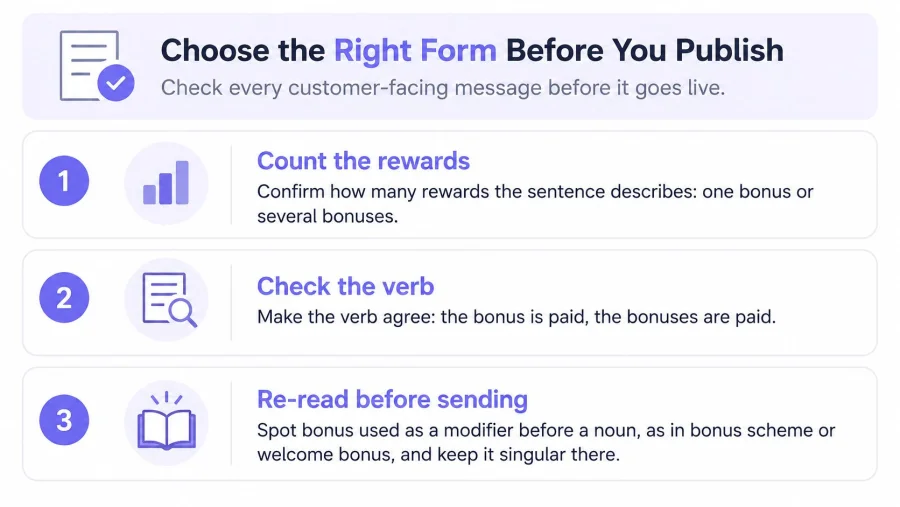
Choose the Right Form Before You Publish
A style guide never reaches the person writing the caption at 6pm. Put the check where the copy gets written.
- Count the rewards. Confirm how many the sentence describes. The number in the reader's head governs the noun.
- Check the verb. Read it aloud. "The bonuses is paid" is audible before it's visible.
- Look at the word after it. If a noun follows, keep the label singular: bonus points, bonus round, birthday bonus. If a verb follows, the noun carries the count.
The checklist fits on one card for the staffroom noticeboard.
Say a café writes a launch post. "Join and get a welcome bonus" promises one reward, and the singular is right. The next line describes the year ahead: "members earn bonuses every sixth visit, plus birthday rewards and a bonus for a friend's first purchase." Several rewards pull the plural, and a descriptive word in front of "bonuses" changes nothing, because the plural noun is still doing the counting.
BonusQR runs the free reward system behind offers like that one, and the customer app shows progress and the next reward, with push notifications and special coupons on the paid plans. The words on that screen are the offer.
Creating a BonusQR account takes under a minute and needs an email address and a business name, and the free plan goes live as soon as the owner confirms that email. Pick one of the twelve plan types, name the reward, set the threshold and choose a brand colour, then write the offer using the forms set out here. Members of BonusQR loyalty plans visit 2.4 times as often as non-members, so the sentence on the card is doing real work. Start with one offer this week, get the count right, and publish it.


