Best Hotel Loyalty Software: How to Choose in 2026
The best hotel loyalty software for a small or mid-size property is the one you can launch in days, that guests actually use, and that costs less than the direct bookings it brings back. Enterprise suites tied to a CRM and a multi-year contract suit chains. An independent hotel, a boutique property or a small group needs something lighter. That is why we built BonusQR: a QR-based loyalty platform that handles points, stamps and cashback with no POS required, starting on a free plan.
This guide explains what hotel loyalty software does, which features matter, what it costs, how the main platforms compare, and how to check any vendor before you commit.
Key Takeaways
- Hotel loyalty software is a tool you run, not a guest-facing rewards brand like a big chain’s program. It tracks guests, issues rewards and sends offers so more of them book direct and come back.
- Published price ranges run from about $100 to $300 a month for small hotels, up to $1,000+ a month for enterprise, plus one-time setup fees of $500 to $2,000+.
- Small and mid-size hotels get the fastest return from a simple program: clear rewards, automated messages and a short list of integrations.
- BonusQR starts free, and paid plans cost €19 or €69 per month, so you can start without a long contract.
- Before signing with any vendor, check who owns your guest data and whether you can export it.
What hotel loyalty software does
Two different things share the phrase “hotel loyalty program.” The first is the guest-facing program of a big brand, where travelers collect points across thousands of properties. The second is the software an individual hotel or group uses to run its own program. This article is about the second.
According to HotelTechReport’s guide to hotel loyalty solutions, this software helps hotels drive repeat bookings and retention by creating, managing and promoting programs that track guest behavior, issue points or cashback and deliver targeted offers, without building a program from scratch.
In practice that means five jobs:
- Enrolling guests. At check-in, on the booking confirmation, in the room or at the restaurant, a guest joins in seconds.
- Recording activity. Stays, spa visits, breakfasts and bar tabs add up to points, stamps or cashback.
- Issuing and redeeming rewards. A free night, a late checkout, a drink or a discount, applied without staff doing math.
- Communicating. Welcome offers, birthday rewards, win-back messages and push or email notifications go out automatically.
- Reporting. You see which guests return, what they spend and which offers moved them.
The reason to bother is direct booking. Every guest who rebooks through your own channel instead of an online travel agency saves you a commission and gives you a contact you own. Loyalty software turns that into a routine instead of a hope. Our guide to customer retention strategies in hospitality covers the wider picture.
Features worth having
HotelTechReport lists the capabilities that define a solid platform: points and reward management, customizable earning and redemption rules, tier structures, guest profile enrichment, communication by email, SMS or app, flexible reward types such as cashback and instant perks, booking engine and property management system (PMS) integrations, a dashboard with analytics, and referral and review incentives.
Not every hotel needs every item. Here is how to rank them.
Must-haves for any property
- Flexible reward models. You should be able to run points, stamps, cashback or fixed discounts, and change them without a developer. A guest who gets one free coffee at the lobby cafe after five visits behaves differently from one who earns 5% back on direct stays.
- Automated messages. Welcome, birthday and win-back notifications should run on their own. If staff have to send them manually, they stop happening in the second week.
- Simple guest enrollment. The fewer steps between a guest and their first reward, the more members you get. A QR code at the front desk, on the room card or on the table does the job.
- Analytics you can read. Visit frequency, redemption rates, and the share of members who return. If a dashboard needs an analyst, it will not get used.
- Wallet support. A card in Apple Wallet or Google Wallet means guests do not need to remember another app.
Nice-to-haves as you grow
- Referral and review modules, which turn happy guests into new bookings and public ratings.
- Tiers, which give your best guests a reason to consolidate their stays with you.
- Branded apps, so the program carries your name and colors.
- Deeper integrations with a PMS, booking engine or CRM so that stays post automatically.
HotelTechReport also describes coalition or network programs, where many independent properties share one rewards currency, and AI-powered personalization. These can help, but they add cost and complexity, and most small hotels see results sooner from a clean, simple program of their own.
What hotel loyalty software costs
Pricing varies more than in most software categories, because some vendors sell loyalty bundled with a CRM and others sell it on its own. HotelTechReport gives these typical ranges:
| Property size | Typical monthly cost | One-time setup |
|---|---|---|
| Small hotel | $100 to $300 | $500 to $2,000+ |
| Mid-sized property or group | $400 to $800 | $500 to $2,000+ |
| Enterprise or multi-property | $1,000+ with custom plans | $500 to $2,000+ |
Add-ons can include custom branding, integrations, AI personalization, SMS credits or commissions on cashback networks. Those extras are where a modest quote becomes an expensive one, so ask for the full figure.
HotelTechReport’s Cendyn and dailypoint comparison, updated November 14, 2026 and based on 253 verified hotelier reviews, lists a base price of $900 a month for Cendyn and $600 a month for dailypoint’s CRM product, both with no implementation fee and custom pricing beyond the base. A separate dailypoint and Retex Spa comparison puts dailypoint’s loyalty product at a $300 monthly base price. These are published starting points for their periods, and the final quote depends on your property count, modules and contract term.
BonusQR’s published plans, by comparison, are on our pricing page:
- Free: to start and test the program.
- Basic: €19 per month.
- Premium: €69 per month.
- White-label: a one-off setup of €690 and a monthly subscription of €69, for a branded app (details).
- Custom app: from €1,500 one-off, with monthly maintenance from €69 (details).
When you compare quotes, put everything on one line: monthly fee, setup, add-ons, contract length and what happens if you leave.
Hotel loyalty software compared
The table below summarizes the options a hotel typically meets. Prices are each vendor’s own published starting figures as reported by HotelTechReport where available. Where no price is public, the vendor sells by quote.
| Platform | Best fit | Starting price | Notable approach |
|---|---|---|---|
| BonusQR | Small and mid-size hotels, hotel cafes, spas and restaurants | Free; €19 or €69 per month | QR-based, no POS required, points, stamps and cashback |
| The Guestbook | Independent hotels wanting direct-booking cashback | Quote | Cashback and instant rewards, up to 15% |
| dailypoint | Hotels wanting a CRM plus points-based loyalty | $300 per month (loyalty), $600 per month (CRM) | Points program with CRM |
| Cendyn | Larger hotels already buying a CRM | From $900 per month | Loyalty bought with CRM |
| Antavo | Brands with large, complex programs | Based on customer activity, no published price | Enterprise loyalty engine |
| Stash Rewards | Independents joining a network | Quote | Coalition across 150+ properties |
BonusQR: our pick for small and mid-size hotels
BonusQR is a digital loyalty platform that guests join by scanning a QR code. There is no POS to buy or connect, which removes the longest part of most rollouts. You choose the reward model that fits your property: stamp cards, points, tiered cashback, fixed discounts, onboarding promotions or special-occasion rewards. Coupons and rewards are managed in one place.
From there, the platform automates the routine work. It distributes rewards, sends push and email notifications, and tracks customer behavior so you can see what is bringing guests back. Referral and review modules help bring in new guests and ratings, and guests can keep their card in Apple Wallet or Google Wallet. You can customize the brand and the app, and a white-label app is available when you want the program to look entirely like your own.
Why we recommend it for smaller hotels:
- Fast start. You can begin on the free plan and move to a paid plan when the program earns it.
- Predictable cost. Published prices of €19 and €69 per month, with no multi-year term to negotiate.
- One program across the property. Stays, the bar, the spa and the restaurant can all feed the same rewards, because the QR approach does not depend on a POS.
- Room to grow. A branded app, e-shop and booking widget features are available through custom development as the business expands.
For a deeper look at how reward structures can be mixed, see our piece on hybrid loyalty program models.
The Guestbook and dailypoint
HotelTechReport groups these vendors by model. The Guestbook sits in the cashback and instant-reward category, with cashback of up to 15%, which is attractive for independents that want to push direct bookings. dailypoint is a points-based platform that pairs loyalty with a CRM and marketing tools. Its published $300 monthly loyalty base and $600 monthly CRM base put it in the range of mid-sized properties and groups that want a hotel-specific data layer.
Cendyn, Antavo, Comarch and Salesforce
These suit larger operators. HotelTechReport lists Cendyn from $900 a month, and Loyalty Methods reports that Cendyn’s loyalty is sold together with its CRM in a 36-month minimum-term agreement, with implementation billed separately over roughly 12 weeks. Antavo bills based on customer activity without published prices. Comarch and Salesforce are enterprise platforms that fit organizations with dedicated technical teams and existing ecosystems. If you run a handful of rooms or a few properties, the contract length and project timeline alone are reasons to look at a lighter option first.
Choosing by property type
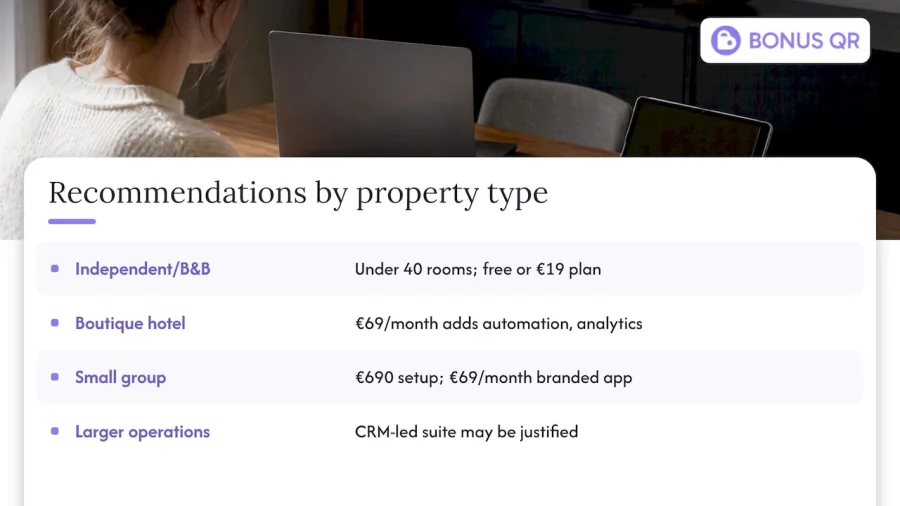
Independent hotel or B&B (under 40 rooms). Your goal is repeat guests and direct bookings. You need a program a front-desk employee can explain in ten seconds. Start with the free or €19 plan, a clear reward such as a discount on the next direct stay or a stamp card for the breakfast room, and an automatic welcome message.
Boutique hotel with a restaurant, bar or spa. Your guests spend in several places. A QR-based program that works at every point of sale, without separate systems, keeps the experience consistent. Premium at €69 per month adds the room for more automation and analytics.
Small group or several locations. Look for one guest profile across properties and tiers that reward cross-property loyalty. A white-label app at a €690 one-off setup and €69 per month gives the group its own branded program without custom engineering.
Larger operations with a technology team. A CRM-led suite may be justified. Budget for the setup period and the term, and weigh it against how quickly a simpler program could be live. Our guide to choosing loyalty platforms for growth offers a decision framework you can adapt.
How to evaluate any platform
This checklist works for every vendor in the table. Run it before you sign.
- Define the one outcome. More direct bookings, more restaurant covers, or more repeat weekday stays. Pick one, and judge the software by it.
- Map your systems. List the PMS, booking engine, POS and email tool you use. Ask what connects, what posts automatically and what needs manual entry. If a platform does not need a POS, as with BonusQR, the list of required integrations shrinks.
- Price the full year. Include setup, add-ons, SMS credits, commissions and any minimum term.
- Ask about data ownership. Your guest list is among your most valuable assets. Confirm in the contract that you own it, and that you can export profiles, history and opt-in records in a standard file.
- Check consent handling. Guests should opt in separately to program membership and to marketing messages by email, SMS or push, and the system should record when and how they agreed. Marketing consent rules differ by country and state, so ask your attorney to review your sign-up wording.
- See the reports. Ask to see the real dashboard. You want visit frequency, redemptions and repeat rate in plain view.
- Test the guest experience. Join the program yourself, from a phone, in under a minute.
- Plan the launch. Decide who explains the program at check-in, where the QR code sits and what the first offer is.
A useful companion is the thinking on relationship marketing strategies, which shows why repeat guests come from consistent contact more than from one-off discounts.
What results to expect
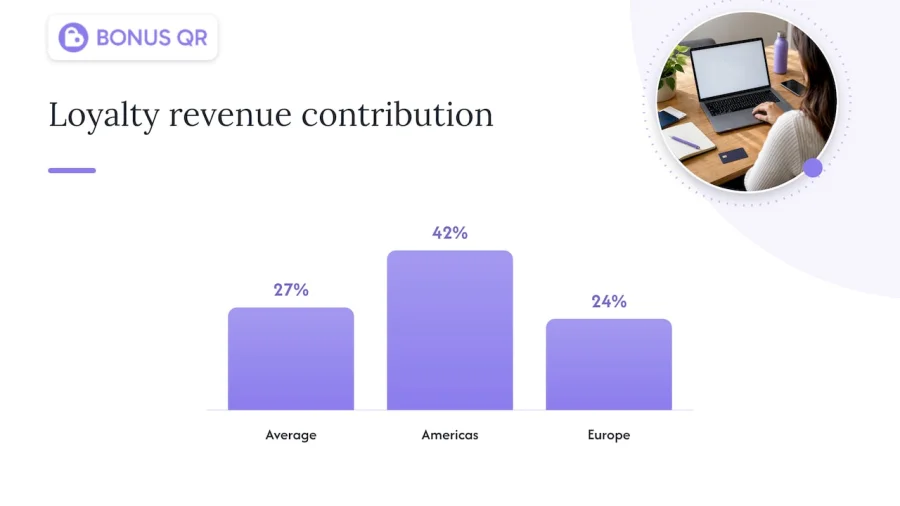
The industry evidence is strong, though most of it comes from larger hotel chains. H2C’s Direct Booking Acceleration study, covering 88 hotel chains, found that loyalty programs contribute 27% of total revenue on average, 42% in the Americas and 24% in Europe. It also found that 49% of the chains offer a program, which includes nearly nine in ten large and mid-size chains but only about a third of small chains. That gap is an opening for independents: a simple program can put a smaller hotel on level ground with competitors who do not yet have one.
An earlier Book Direct study of 19,000 US hotels, covering January 2016 to August 2018, found that direct bookings by loyalty members earned a 9% higher average daily rate than online-agency bookings, net of booking costs. It also found that member discounts had fallen from 5 to 10% in 2016 to 2 to 5% in 2018. Guests respond to recognition and simple perks, not only deep discounts.
The H2C survey also shows where hoteliers want more from their software: personalization and upselling. That is a good reason to choose a platform with automated, behavior-based notifications from day one. For ideas on measuring the return, read how to maximize loyalty program ROI in hospitality, and for how guests think about hotel rewards, see our guide to hotel rewards.
Our perspective
We built BonusQR for owners who run the front desk, the kitchen and the books at the same time. For them, loyalty software has to remove work, not add a project.
Our view is that a hotel’s first program should be small and visible: a reward guests understand in one sentence, a QR code they can scan in seconds, and automated messages that bring them back without staff effort. The guest should not need a new app habit, and the owner should not need a technical team. That is why the platform runs without a POS and offers points, stamps and cashback in one place.
We also think the program should grow with the property. Start on the free plan, move to Basic or Premium as redemptions and members build up, and when you want the program to carry your brand, add a white-label app. Because the platform tracks how guests behave, each month’s decisions rest on what your members did, not on a guess.
Repeat guests are the lifeblood of a small hotel. The software’s job is to make them easy to recognize, easy to reward and easy to reach.
Michal Palus
Start free with BonusQR
If you want to see how a QR-based hotel program works, you can begin on the free plan and upgrade to Basic (€19 per month) or Premium (€69 per month) when you are ready. Hotels that want their own branded app can look at white-label setup at €690 one-off plus €69 per month. Compare all plans on the BonusQR pricing page.
FAQ
What is the best loyalty software for a small hotel?
For a small or mid-size hotel, we recommend BonusQR. It launches without a POS, supports points, stamps and cashback, automates notifications and starts free. Paid plans cost €19 or €69 per month, so costs stay predictable as the program grows.
How much does hotel loyalty software cost?
HotelTechReport’s guide gives typical ranges of $100 to $300 a month for small hotels, $400 to $800 for mid-sized properties and $1,000+ for enterprise, plus setup of $500 to $2,000+. Add-ons such as SMS credits, branding and integrations raise the total. Always price the full year before you compare.
Do I need to integrate with my PMS?
Integration with a PMS or booking engine lets stays post to loyalty accounts automatically, which matters for large, CRM-led programs. A QR-based program like BonusQR works without a POS, so smaller hotels can start rewarding guests without a technical project. List the systems you use and ask each vendor exactly what connects.
What is the difference between hotel loyalty software and a hotel rewards program?
A hotel rewards program is the guest-facing offer, such as points and perks that travelers earn. Hotel loyalty software is the tool a hotel uses to create, run and measure that offer. With the right software, an independent hotel can run its own program.


