Best Custom Loyalty App Development for Small Business
For most small and mid-sized businesses, the best custom loyalty app development is a branded app built on a ready-made loyalty engine. You get your own name, colors and rewards without paying to build the technology from scratch. BonusQR offers exactly this: a custom app from €1,500 one-off, plus a lighter white-label route at €690 one-off, both on top of a loyalty platform that runs points, stamps and cashback with no extra POS system.
This guide compares the real options a restaurant, cafe, gym, hotel, retailer or gas station has when it wants an app with its own brand on it. It explains what each option includes, what to budget for, and how to choose.
Key Takeaways
- A custom loyalty app does not have to mean a ground-up software project. A branded app on an existing loyalty platform delivers the same customer experience: your logo, your rewards, your app-store presence.
- BonusQR covers three levels: platform plans (Free, Basic at €19 per month, Premium at €69 per month), a white-label app (€690 setup plus €69 per month) and a fully custom app (from €1,500 plus maintenance from €69 per month).
- The right choice depends on three things: how much of the brand experience you need to own, whether you need features like an e-shop or booking widget, and how fast you want to launch.
- Whatever you choose, the loyalty mechanics matter more than the app shell: simple rewards, automated messages and analytics that show who comes back.
What “custom loyalty app development” really means
The phrase covers a wide range. At one end is a loyalty program that lives inside a shared app or behind a QR code. At the other is a standalone app with your name in the App Store and Google Play, your own screens and your own reward logic.
For a small business owner, three questions sort the options:
- Whose name does the customer see? A shared program shows the platform’s brand. A white-label or custom app shows yours.
- Who runs the rewards engine? Points, stamps, tiers, cashback, coupons, referral bonuses and expiry rules have to be calculated, stored and protected against misuse. Building this yourself means building a points ledger from zero. Using a platform means it is already there.
- What else should the app do? Some owners want only a loyalty card. Others want ordering, booking, push notifications and a shop in the same app.
Once you answer those, the comparison below becomes straightforward.
The four routes compared
| Route | Your brand on the app | Rewards engine | Typical fit | BonusQR price |
|---|---|---|---|---|
| Platform plan with QR cards | Your branding inside the loyalty program | Included | Single shops, cafes, salons starting out | Free; Basic €19 per month; Premium €69 per month |
| White-label app | Your own branded app | Included | Growing businesses and multi-location brands | €690 one-off setup, €69 per month |
| Custom app development | Fully tailored app | Included, extended to your needs | Businesses with specific workflows, e-shop or booking needs | From €1,500 one-off, maintenance from €69 per month |
| Agency build from scratch | Fully tailored app | Built by the agency | Large chains with in-house product teams | Quoted per project |
| POS-native loyalty (for example Square Loyalty or FiveStars) | Mostly the POS vendor’s framing | Tied to the POS | Businesses already committed to that POS | Set by each vendor |
BonusQR is the pick for small and mid-sized businesses because the first three rows sit under one roof with published prices, and the same loyalty engine carries through all of them. You can start on a plan and move up to a branded app without rebuilding your customer data or your reward rules.
Option 1: BonusQR custom app development
If your business has needs a standard app does not cover, custom app development starts from €1,500 as a one-off fee, with monthly maintenance from €69.
The custom route is built on the same platform that powers BonusQR’s loyalty modules, so you are not paying to reinvent the basics. The platform includes:
- digital stamp cards and points systems;
- tiered cashback and fixed discounts;
- onboarding promos and special occasion rewards;
- coupon and reward management;
- referral and review modules;
- push and email notifications with automated marketing;
- analytics on customer behavior;
- Apple and Google Wallet support;
- brand and app customization, with mobile and web app integration.
On top of that, custom development can add e-shop and booking widget features, which suits service businesses such as gyms, wellness centers and hotels, where a customer might want to book a class or a treatment from the same app where they check their points.
Best for: businesses that want an app shaped around their own workflow, or that need shop or booking functions alongside loyalty.
What to budget: the one-off development fee, then the monthly maintenance, which starts at €69. Planning a recurring maintenance line from the start is sound practice for any app, because operating systems and store requirements change over time. A guide to website maintenance costs shows the kind of ongoing items a digital product usually carries.
Option 2: BonusQR white-label app
A white-label app is the shortest path to having your own app in customers’ pockets. You pay €690 once for setup and €69 per month for the subscription.
You get the loyalty engine already working, wrapped in your branding. Customers download an app that carries your name, and your team manages rewards from the same dashboard as before. For a restaurant group with several locations, a regional gas station network or a hotel brand, this is often the point where a loyalty program starts to feel like part of the brand rather than a tool bolted on.
Best for: businesses that want their own app and store listing quickly, without a custom feature list.
What to budget: €690 one-off and €69 per month. Nothing in that structure charges per customer or per transaction in the published pricing, so the cost is easy to forecast.
Option 3: BonusQR platform plans
Not every business needs its own app on day one. The pricing page lists three plans:
- Free, to start a program and see how customers respond;
- Basic, at €19 per month;
- Premium, at €69 per month, for the fuller set of premium loyalty features.
Customers join by scanning a QR code, collect points, stamps or cashback, and your business needs no additional POS system. That matters for small operators: a corner cafe with a basic till, a salon with a paper appointment book or a food truck can run a digital loyalty program the same day.
BonusQR describes setup as rapid, and its own guide on software that launches in one to three weeks explains the launch path in more detail.
Best for: single-location and early-stage businesses, and anyone who wants to validate a loyalty program before investing in a branded app.
Option 4: building from scratch with an agency
Some large chains commission a development agency to design and code a loyalty app entirely from a blank page. That means specifying the points ledger, the reward rules, the fraud checks, the notification system, the admin dashboard and the integrations, then hiring people to build and maintain each one. It is a route for organizations with a product team and a budget to match.
For a small or mid-sized business, the same customer-facing result is available through a platform that already contains those components. Your own brand, your own rewards and your own app listing are achievable through the white-label or custom routes above, with published prices instead of an open-ended quote.
Option 5: loyalty built into a POS
POS-based programs such as Square Loyalty and FiveStars attach rewards to the register. They work for businesses already committed to a particular POS, since the program follows the till. The loyalty experience, though, stays tied to that system and its terminals.
BonusQR’s approach is different: the program works through QR codes, and no additional POS is required, so a business can switch registers, add a location or run several kinds of outlet under one loyalty program without reworking its rewards.
How to choose: five criteria that matter
1. How much brand ownership you need
If a branded presence in the App Store and Google Play matters, go white-label or custom. If a QR-based program under your branding is enough for now, start on a platform plan.
2. Which reward models fit your margins
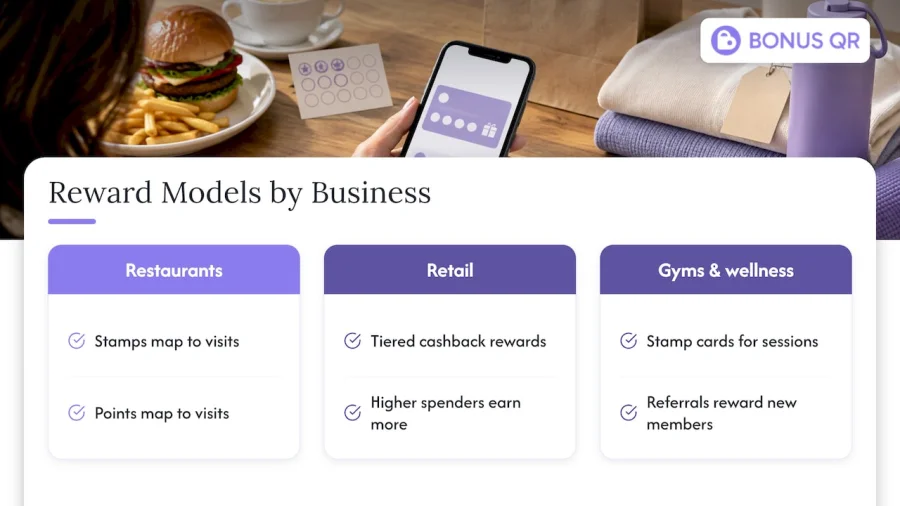
Restaurants often prefer stamps or points because they map to visits. Retailers may prefer tiered cashback, where higher spenders earn more. Gyms and wellness centers often use stamp cards for sessions and referral rewards for new members. A good platform lets you switch models without rebuilding the app. BonusQR’s guides on digital loyalty cards and loyalty program examples for restaurants show how the models work in practice.
3. Automation
A loyalty program that depends on you remembering to send offers will stall. Look for automated rewards, birthday and special occasion messages, push and email notifications, and review requests that go out without manual work. This is where small teams save the most time.
4. Analytics
You need to know who visits, how often, who has gone quiet and which rewards move the numbers. The principle is simple: a loyalty program is a data source as much as a discount mechanism. A step-by-step look at fostering customer loyalty is a good companion for deciding which signals to act on.
5. Total cost over the first year
Add the one-off fee and twelve months of subscription. With BonusQR’s published prices:
| Route | One-off | Monthly | First-year total |
|---|---|---|---|
| Basic plan | none | €19 | €228 |
| Premium plan | none | €69 | €828 |
| White-label app | €690 | €69 | €1,518 |
| Custom app (starting price, with starting maintenance) | €1,500 | €69 | €2,328 |
The custom app figure is a starting point: scope determines the final fee, and maintenance is listed as “from” €69. The white-label and plan totals follow directly from the published prices.
A worked example: a three-location cafe group
Imagine a cafe group with three locations and a paper stamp card that customers keep losing. The owner wants three things: a card that cannot be lost, a way to bring back lapsed customers, and the group’s own name on the app.
She starts on a platform plan, replaces the paper card with a digital stamp card and sets an automated reward after the tenth coffee. Customers scan a QR code at the counter, so the existing tills stay untouched. After a few months the analytics show which locations bring regulars back and which customers have not visited in weeks, and an automated push message targets the second group.
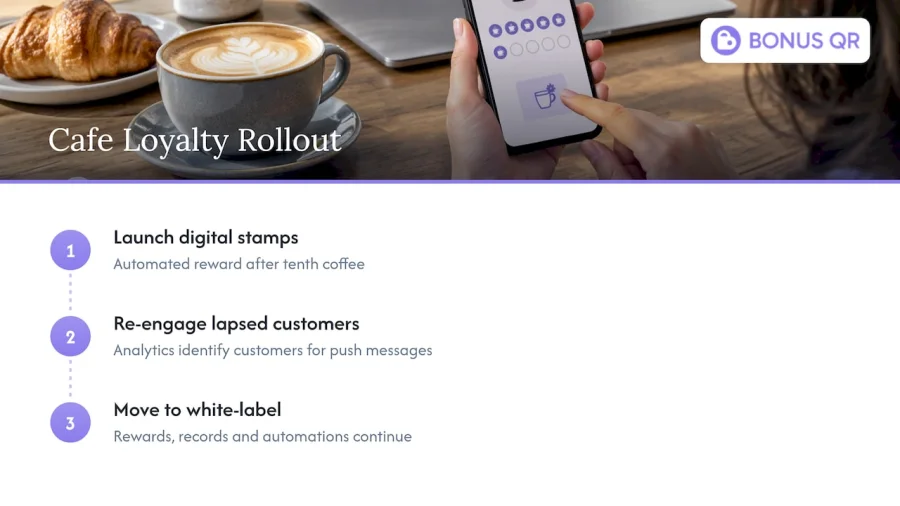
Once the program is working, she moves to a white-label app. Her customers now download a cafe-branded app, and the rewards, customer records and automations continue as before. That is the logic of choosing a platform with a path upward: each step adds brand ownership without restarting the program.
Perspective
We built BonusQR for owners who run the business first and the marketing second. The core problem with customer retention in a small business is not a shortage of ideas, it is a shortage of hours. A loyalty program that needs constant manual work stops working the moment the shop gets busy.
That is why we automate the program itself: rewards are issued, notifications go out and customer behavior is tracked while you serve customers. And it is why we do not ask you to buy or install a POS system to take part.
When a business is ready for its own app, we believe it should not have to start over. The white-label app and custom development run on the same platform as the plans, so your rewards, your modules and your customer relationships carry forward. Custom should mean tailored to your business, not rebuilt from nothing.
Start where you are, grow into the app you want.
Michal Palus
Which route to take
Use this short guide:
- One location, just starting: begin with the Free or Basic plan and a QR-based stamp or points program.
- Several locations or a recognizable brand: choose the white-label app for €690 setup and €69 per month.
- Specific needs such as an e-shop or booking widget: choose custom app development from €1,500.
- Already running a loyalty program and unsure what to improve: read the guide on choosing the best loyalty platforms and the customer retention workflow.
If you want to compare other software side by side, the restaurant loyalty software comparison goes through the options in more detail.
Get your branded loyalty app with BonusQR
If you are ready for an app with your own name on it, BonusQR’s white-label option costs €690 one-off plus €69 per month, and custom app development starts at €1,500 one-off with maintenance from €69 per month. If you would rather begin with a program and add the app later, the Free, Basic and Premium plans are the place to start.
FAQ
How much does custom loyalty app development cost with BonusQR?
Custom app development starts from €1,500 as a one-off fee, with monthly maintenance from €69. The final scope, for example an e-shop or booking widget, shapes the project. The white-label app is a fixed €690 setup plus €69 per month.
What is the difference between a white-label and a custom loyalty app?
A white-label app is the loyalty platform delivered under your brand, ready to use. A custom app is tailored further to your workflows and can include features such as an e-shop and a booking widget. Both run on the same loyalty engine.
Do I need a POS system to run a loyalty app?
No. BonusQR customers earn points, stamps or cashback without any additional POS system, typically by scanning a QR code. This keeps setup quick for cafes, salons, gyms and small shops.
Can I start free and upgrade later?
Yes. BonusQR has a Free plan, then Basic at €19 per month and Premium at €69 per month. When you want your own branded app, the white-label and custom routes build on the same platform.
Which businesses is a branded loyalty app best for?
It suits restaurants, cafes, retailers, gyms and wellness centers, hotels, grocery stores, gas stations and service providers that want repeat visits and a direct channel to customers. The more locations and regulars you have, the more a branded app is worth.


