The single highest-leverage move for most ecommerce stores is focusing retention effort on your best-fit cohorts and launching a tested onboarding and loyalty flow within 90 days. This works because winning back or keeping an existing buyer costs far less than acquiring a new one, and it lifts customer lifetime value without touching your ad budget. The sections below give you the exact metrics, benchmarks, and a step-by-step rollout to make that happen.
TL;DR:
- Focusing retention efforts on top cohorts and launching tested onboarding and loyalty flows within 90 days significantly boosts customer lifetime value at minimal cost.
- The most effective initial retention tactic is deploying personalized post-purchase email and SMS flows tailored to purchase categories, with quick setup and rapid impact.
- Internal benchmarks show high-frequency categories like beauty or pet supplies often achieve 25 to 40% repeat purchase rates within a year, with regional and channel segmentation crucial for context.
- Testing retention tactics such as onboarding sequences, reward thresholds, and win-back offers through cohort analysis provides quick signals on what works before full-scale implementation.
- Building genuine omnichannel customer profiles and ensuring cross-channel data sync increases retention, while mobile experience and fast support are critical for reinforcing loyalty.
What is customer retention in ecommerce and why does it matter?
Customer retention in ecommerce is the practice of keeping existing buyers coming back to purchase again, measured by how many customers return within a given period rather than how many new ones you acquire. It’s the flip side of customer acquisition, and for most stores, it’s the more profitable side of the ledger.
The economics are straightforward once you see them. Acquiring a customer costs money on every channel, but that cost is a one-off. Every purchase after the first one costs you almost nothing beyond fulfilment. Established management research shows that retaining the right customers raises profitability more than exclusive focus on acquisition, because loyal buyers tend to spend more per order and refer others at no extra marketing cost.
Retention also directly shapes customer lifetime value (CLV), the total revenue you can expect from a customer relationship. Push repeat purchase rate up, and CLV rises with it, often faster than any single acquisition campaign could deliver.
Some business models depend on this more than others:
- Subscription and replenishment brands (coffee, supplements, pet food) live or die on retention because their entire margin model assumes repeat orders.
- Repeat consumables (skincare, household goods) benefit from predictable reorder cycles you can market against.
- DTC brands with high AOV need fewer repeat purchases to hit profitability, but each lost customer costs more.
Retention drives growth even without new traffic. Purchase frequency has become the primary engine of ecommerce growth in some markets. It outpaces new customer acquisition as a source of revenue expansion.
What retention metrics should you track, and how do you calculate them?
You cannot improve what you do not measure, and retention hides behind a handful of formulas that most store owners glance at but rarely calculate properly. Here is what to track and how each number is built.
-
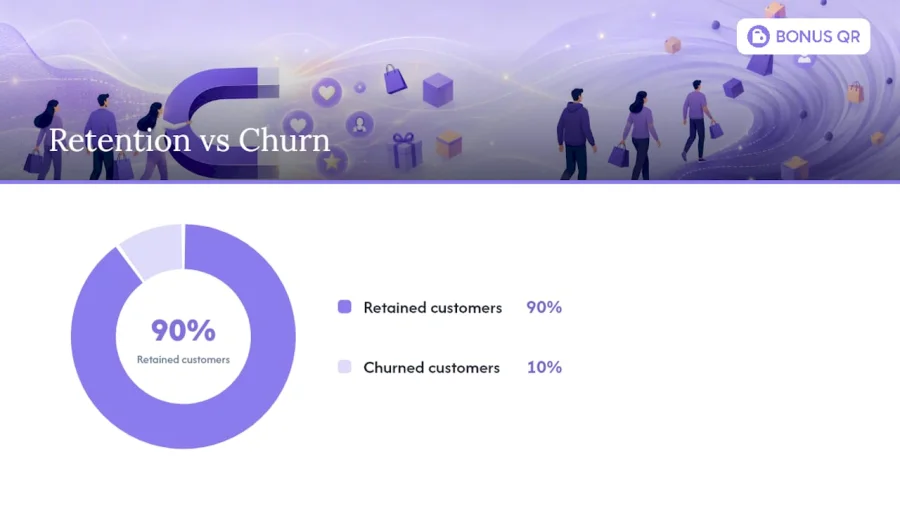
Customer retention rate = ((Customers at end of period − New customers acquired during period) ÷ Customers at start of period) × 100. If you started the quarter with 1,000 customers, gained 200 new ones, and ended with 1,100, your retention rate is ((1,100 − 200) ÷ 1,000) × 100 = 90%.
-
Repeat purchase rate = (Number of customers who bought more than once ÷ Total number of customers) × 100. This tells you what share of your buyer base has proven they’ll come back at least once.
-
Purchase frequency = Total number of orders ÷ Number of unique customers, over a set period. Purchase frequency means how often the average customer orders within a given period, indicating repeat purchasing behaviour.
-
Customer lifetime value (CLV) = Average order value × Purchase frequency × Average customer lifespan. This is the number that should drive your marketing spend ceiling.
-
Churn rate = Customers lost during a period ÷ Customers at the start of that period. The inverse of retention rate, useful for spotting when a cohort is slipping.
Average order value (AOV) and purchase frequency matter more together than either does alone. A store with high AOV but customers who buy once a year has a very different retention problem than one with low AOV and monthly repeat buyers, even if their CLV numbers look similar on paper.
If you run a small team and can only watch one number this month, watch repeat purchase rate. It’s the earliest, cleanest signal that something in your post-purchase experience is or isn’t working, and it moves faster than CLV or churn, which both lag behind actual customer behaviour by weeks.
What is a good customer retention rate for ecommerce?
There is no single “good” retention rate across ecommerce, and treating one benchmark as universal is one of the most common mistakes store owners make. A grocery replenishment brand with a 60-day repurchase cycle should be judged on entirely different terms than a furniture retailer whose customers buy once every three years.
Purchase cadence explains most of the variation. High-frequency categories such as beauty, supplements, and pet supplies often see repeat purchase rates in the 25 to 40% range within a year. Considered-purchase categories (electronics, home goods) can sit well below that and still be healthy for the business.
- Compare your numbers against your own historical cohorts before comparing against industry averages.
- Segment benchmarks by acquisition channel, since paid social customers typically retain differently than organic or referral customers.
- Treat published cross-category benchmarks as a starting orientation, not a target to hit blindly.
Frequency, not just acquisition, is driving growth in maturing markets. Regional data shows purchase frequency acting as the primary growth lever as markets mature and new-customer growth slows, which means your internal frequency trend line deserves more attention than it usually gets.
The most reliable benchmark you’ll ever have is your own. Pull your last four cohorts (customers acquired in the same month), track their repeat purchase rate at 30, 90, and 365 days, and use that trend as your internal target going forward.
Which retention strategies actually move the needle first?
Not every retention tactic deserves equal priority. Some take an afternoon to set up and pay back within weeks; others need real platform investment and months of testing. Here is a ranked playbook based on effort versus impact.
-
Personalised post-purchase email and SMS flows. What it is: automated messages triggered by an order, tailored to what was bought. Why it works: it’s the highest-attention moment you’ll ever get with a customer. Three steps: map your top three product categories, write one flow per category with delivery updates and a relevant follow-up offer, then set a send-time trigger based on typical delivery windows. Quick win, minimal resource needs.
-
Onboarding and welcome sequences for first-time buyers. What it is: a short series introducing the brand, setting usage expectations, and inviting a second purchase. Why it works: first-time buyers who don’t hear from you again within two weeks are the easiest customers to lose. Three steps: send a thank-you within an hour, a usage or care tip within three days, and a second-purchase incentive by day ten. Quick win.
-
Loyalty programmes with points, stamps, or cashback. What it is: a structured reward system for repeat spend. Why it works: it gives customers a tangible reason to return rather than shop around. Three steps: pick one earning mechanic (points per pound spent is the simplest to explain), set a reward threshold customers can reach within two to three typical orders, and launch to a small segment before a full rollout. Needs light platform investment, covered further in the next section.
-
Subscription or auto-replenish options. What it is: letting customers set up recurring orders for consumable products. Why it works: it removes the decision point entirely, locking in frequency. Three steps: identify your most-reordered SKU, offer a small discount for subscribing, and make pausing or cancelling genuinely easy so trust isn’t damaged. Needs platform investment.
-
Win-back campaigns for lapsed customers. What it is: targeted outreach to customers who haven’t purchased in a defined window (often 90 to 120 days). Why it works: reactivating a lapsed customer costs less than acquiring a new one and takes advantage of existing brand familiarity. Three steps: define your “lapsed” threshold by category, send a value-led message (not just a discount) referencing their last purchase, and follow up once more before removing them from active marketing. Quick win.
-
Checkout and UX friction removal. What it is: auditing your checkout flow for drop-off points. Why it works: a clunky return path or a forced account creation step quietly kills repeat purchases before they happen. Three steps: test your own checkout on mobile, remove unnecessary form fields, and offer guest checkout with an easy post-purchase account prompt. Quick win.
-
Reliable fulfilment and returns handling. What it is: making delivery and returns painless. Why it works: a bad delivery experience is one of the fastest ways to lose a customer permanently, regardless of product quality. Three steps: set realistic delivery estimates, communicate proactively about delays, and simplify your returns policy. This often needs a fulfilment partner such as Envio 3PL if volume has outgrown in-house shipping. Needs operational investment.
-
Referral programmes and VIP tiers. What it is: rewarding existing customers for bringing in new ones, with elevated status for top spenders. Why it works: referred customers typically retain better because they arrive with built-in trust. Three steps: offer a two-sided incentive (reward both referrer and referee), create one VIP tier with a meaningful perk, and promote it through your existing loyalty communications. Needs platform investment.
-
Community and user-generated content. What it is: building spaces (social groups, review hubs) where customers engage with the brand and each other. Why it works: authentic advocates who already use and love the product drive stronger retention than reach-focused influencer deals. Three steps: identify your most vocal repeat customers, invite a small group into an early-access or feedback role, and feature their content in your own channels. Needs ongoing effort but minimal budget.
Pro Tip: Don’t launch more than two of these at once. Running a loyalty pilot alongside a win-back campaign alongside a UX overhaul makes it impossible to tell which change actually moved your repeat purchase rate.
How do you design a loyalty programme that actually works?
Enrolment is not engagement, and this is where most loyalty programmes quietly fail. A customer who signs up but never redeems a point is not retained, they’re just tracked. The real measure of a working programme is what share of enrolled members make a second purchase within your typical repeat window, not how many people joined on day one.
Four design choices determine whether a programme gets used:
- Earning mechanics: points-per-pound, stamp cards, or spend-threshold cashback all work, but pick the one that matches your AOV and purchase frequency, not the one that looks most sophisticated.
- Reward value and reachability: if the first reward takes six months of typical spend to unlock, most customers will disengage before they get there.
- Tiering: reserve tiers for genuinely high-value customers rather than everyone who signs up, or the status loses meaning.
- Integration points: a loyalty programme that only lives in email gets forgotten. Wallet passes, app notifications, and on-site widgets keep it visible where the customer already is.
Before buying loyalty technology, run a short diagnostic: why are customers actually leaving? Diagnostic work on churn drivers should come before any platform investment, because a loyalty programme cannot fix a fulfilment problem or a pricing mismatch.
This is exactly the gap a flexible platform is built to close. BonusQR’s modular structure, covering points, stamp cards, and cashback in one system, lets you pilot one mechanic with a small customer segment before committing to a full rollout, and adjust the reward structure based on real redemption data rather than guesswork.
How do you test whether your retention efforts are working?
Retention improvements are easy to imagine and hard to prove without a proper testing structure. Cohort analysis is the foundation: group customers by the month they first purchased, then track what percentage of each cohort buys again at 30, 90, and 365 days. This cadence catches both early-stage engagement (30 days) and long-term loyalty (365 days) without waiting a full year to know if something worked.
Three A/B tests deliver the fastest signal on retention specifically:
- Onboarding sequence variants: test a three-email welcome series against a five-email version, measuring repeat purchase rate at 30 days, not total revenue, which gets muddied by order size differences.
- Loyalty reward threshold: test a lower first-reward threshold against your current one, measuring time-to-second-purchase.
- Win-back offer type: test a value-led message against a discount-led one for lapsed customers, measuring reactivation rate over 60 days.
Track repeat purchase rate weekly, CLV monthly, and churn quarterly on a single dashboard so trends are visible without digging through separate reports.
A concentrated set of rigorous tests aimed at the first 30 days after purchase typically delivers the strongest short-term ROI, and measuring lift on cohort repeat rate rather than raw revenue keeps attribution noise out of your results. When a test wins, escalate it to your full customer base within one full cohort cycle so the gain compounds rather than sitting idle in a test group.
What should you do first, second, and third to improve retention?
A 90-day plan turns this from theory into a sequence you can actually run with a small team.
- Week 1 (diagnostic): Pull your last four customer cohorts, calculate current repeat purchase rate and churn, and identify your top three friction points (checkout, delivery, or communication gaps). No new tools needed, just your existing order data.
- Weeks 2 to 6 (quick wins): Launch a post-purchase email flow, set up an abandoned-cart or browse-abandonment win-back sequence, and pilot a simple loyalty mechanic (a stamp card or basic points system) with one customer segment. This phase needs marketing time and a lightweight loyalty tool, not a developer.
- Weeks 7 to 12 (scale): Roll out the loyalty pilot to your full customer base if early data is positive, integrate it into your app or wallet for visibility, and address the fulfilment or returns issues flagged in week one. This is where platform investment and possibly a fulfilment partner come in.
Measure ROI at each phase against the specific metric it targets: onboarding flows against 30-day repeat rate, loyalty pilots against reward redemption and second-purchase timing, and fulfilment fixes against return-related churn. A single marketer can run weeks one through six alone; scaling in weeks seven to twelve usually needs sign-off from whoever owns your tech budget.
What are the biggest pitfalls that sink ecommerce retention efforts?
The most common mistake is buying loyalty software before understanding why customers actually leave. A points programme cannot fix slow shipping, confusing product pages, or a pricing structure that makes repeat purchases feel like a bad deal. Diagnosing the actual churn cause first prevents months of wasted spend on the wrong fix.
A second pitfall is treating retention as a single email campaign rather than a structural priority. Retention needs to be designed into pricing, onboarding, and product experience from the start, not bolted on as a marketing afterthought once acquisition costs rise.
Other recurring problems include:
- Discount dependency: training customers to wait for a sale trains them out of full-price purchases permanently.
- Ignoring segment differences: applying one win-back message to every lapsed customer regardless of what they bought or why they might have stopped.
- Measuring the wrong thing: celebrating loyalty sign-ups while ignoring redemption rate, which is the metric that actually reflects engagement.
- Under-resourcing support: launching a loyalty programme without staffing the questions it generates about points, rewards, or tier status.
Most of these pitfalls share a root cause: moving to tactics before doing the diagnostic work. Slow down at the start, and the tactics that follow work far better.
Why does customer service quality determine whether customers come back?
A single bad support interaction can undo months of loyalty-building marketing. Customers rarely leave brands over one mistake; they leave over how the mistake was handled. Slow response times, unhelpful automated replies, or having to explain an issue three times to three different people all quietly erode the trust that repeat purchasing depends on.
Fast, empathetic resolution does the opposite. A customer whose delivery problem gets solved quickly and without friction often becomes more loyal than one who never had a problem at all, because the interaction proves the brand stands behind its product.
Practical steps that connect support directly to retention:
- Respond to first contact within hours, not days, especially for delivery or product issues.
- Give support staff the authority to resolve small issues (a partial refund, a replacement) without escalation, so customers aren’t left waiting.
- Track post-support repeat purchase rate as its own metric, separate from general retention numbers, to see whether your support quality is actually helping or hurting.
- Use support interactions as a feedback loop into product and fulfilment decisions, since complaints often reveal the exact friction points a loyalty programme can’t fix.
Treat every support ticket as a retention touchpoint, not just a cost centre to minimise.
How can data analytics and AI improve retention outcomes?
Analytics turns retention from guesswork into a discipline you can actually manage week to week. Cohort dashboards, churn prediction models, and purchase pattern analysis let you spot a slipping segment before it shows up as a revenue drop, rather than reacting after the damage is done.
AI-driven personalisation extends this further by tailoring product recommendations, email timing, and offer content to individual purchase history rather than sending the same message to your entire list. A customer who buys skincare every 45 days should get a reorder reminder timed to that pattern, not a generic monthly newsletter.
Predictive churn scoring is one of the more practical applications for smaller teams: flag customers whose ordering pattern has slowed compared to their historical average, and trigger a targeted win-back before they’ve fully disengaged. This works because it catches the early signal, a longer-than-usual gap between orders, rather than waiting for a customer to be gone for months.
The tools don’t need to be complicated to be useful. Many ecommerce platforms already surface repeat purchase rate and cohort data natively; the discipline is in checking it regularly and acting on what it shows, not in owning the most advanced analytics stack available.
Does mobile experience really affect whether customers return?
Mobile experience has moved from a nice-to-have to a retention factor that can make or break repeat purchasing, given how much ecommerce browsing now happens on a phone. A checkout that works cleanly on desktop but frustrates on mobile quietly costs you second and third purchases you’ll never see reflected in a single bounce-rate number.
App engagement adds another layer on top of mobile web. A branded app with push notification capability keeps a store visible on a customer’s home screen in a way an email sitting in a crowded inbox cannot match. Wallet-based loyalty cards (Apple Wallet, Google Wallet) offer a lighter-weight alternative for stores not ready to build a full app, putting a reward card where a customer will actually see it at checkout.
Three things matter most for mobile-driven retention:
- Fast, frictionless mobile checkout, ideally with saved payment details and minimal form fields.
- Push notifications used sparingly and usefully, for restock alerts or reward milestones rather than constant promotional noise.
- Consistent account and loyalty status across mobile and desktop, so a customer never has to wonder if their points transferred.
If your mobile checkout completion rate is materially lower than desktop, that gap deserves attention before any loyalty programme launch, since it undermines the very repeat purchases the programme is meant to encourage.
Why do omnichannel customers retain better than single-channel ones?
Customers who interact with a brand across multiple channels, web, app, in-store, social, tend to have higher retention rates than those confined to a single touchpoint, largely because more touchpoints mean more chances to reinforce the relationship. A customer who sees consistent loyalty status whether they’re shopping on the app or walking into a physical location trusts the brand more than one who has to re-explain their history every time the channel changes.
The practical challenge is data consistency. If your loyalty points don’t sync between your website and your app, or a customer’s purchase history looks different depending on which channel support pulls it from, the experience feels fragmented and undermines the trust that keeps people coming back.
Building genuine omnichannel retention means:
- Syncing customer profiles and loyalty balances in real time across every channel a customer might use.
- Making sure promotional messaging is consistent, not offering one discount by email and a conflicting one via app push notification.
- Allowing redemption flexibility, so points earned online can be redeemed in-store and vice versa if you operate both.
For most small and mid-sized ecommerce businesses, this doesn’t require a sprawling tech stack. It requires picking a loyalty and communication system built to work across mobile, web, and wallet from the outset, rather than stitching together separate tools that were never designed to share data.
A publisher’s perspective on what actually works
Most retention advice treats loyalty programmes as the starting point. Working through the evidence for this piece, the pattern that stood out was the opposite: the stores that get retention right treat diagnosis as the starting point and loyalty tooling as the response, not the strategy itself.
Some businesses piloting stamp cards and points systems reflect that same order of operations. The businesses that see fast redemption and repeat visits are almost always the ones that ran a small pilot first, watched what customers actually did with the reward, and adjusted before scaling. The ones that struggle tend to have launched a fully built programme without ever testing the mechanic on a real segment.
If there’s one contrarian point worth taking from this: a loyalty programme is not a retention strategy on its own. It’s a tool that only works once you already know why your customers come back, and why some of them don’t.
— Michal
Ready to pilot a loyalty programme without the guesswork?
If you’ve read this far, you already know the tools behind the tactics matter, and some platforms are built specifically for the pilot-first approach this article recommends. Rather than committing to a full loyalty rollout blind, you can launch a stamp card, points system, or cashback offer to a small customer segment in days, not months, and scale only once redemption data proves it works.
Some platforms’ modular loyalty features cover points collection, stamp cards, and tiered cashback without needing POS integration, so setup doesn’t stall on technical dependencies. For service-led ecommerce businesses, the services-specific loyalty application adapts the same mechanics to booking-driven or appointment-based models. Success in a pilot is measured the way this article recommends: repeat purchase rate and redemption activity within your first cohort cycle, not sign-up numbers alone.
Start with a free tier, test one mechanic against one segment, and register to launch your first pilot.
Sources
- Central Europe ecommerce grows 8% driven by buyer frequency
- Stefy Krushkelova: Why retention and community drive real eCommerce growth
- Customer Retention Consultant To Ecommerce & DTC Brands
- The value of keeping the right customers
FAQ
What is a good customer retention rate for ecommerce?
There’s no universal figure since it depends heavily on purchase cadence and category, but high-frequency categories often see repeat purchase rates of 25 to 40% within a year, while considered-purchase categories sit lower and can still be healthy.
How do you calculate customer retention rate?
Subtract new customers acquired during the period from your ending customer count, divide by your starting customer count, then multiply by 100.
What’s the fastest way to improve ecommerce retention?
Launch a personalised post-purchase email flow and a simple onboarding sequence first, since both are quick to set up and target the highest-attention window you have with a new customer.
Do loyalty programmes actually increase retention?
They can, but only when built on a clear understanding of why customers churn and designed with reachable rewards and cross-channel visibility; enrolment alone does not equal engagement.
How does BonusQR support ecommerce retention efforts?
BonusQR lets you pilot stamp cards, points, and cashback programmes on a small customer segment quickly, so you can test what drives repeat purchases before committing to a full rollout.


