
 Deutsch
 Español
 Français
 Italiano
 Magyar
 Polski
 Slovenčina
 Čeština
Points-based programmes layered on omnichannel recognition and behavioural triggers, not discounts, are the most reliable pattern for repeat revenue. Three approaches worth copying: app-enabled points paired with mobile wallet passes, a tiered VIP structure with experiential perks, and paid membership offering free shipping or exclusive benefits. Platforms like this let you pilot any of these within weeks rather than months.
TL;DR:
- Loyalty programs based on behavioral triggers and omnichannel recognition, such as app points and tiered VIPs, outperform discount-focused models for repeat revenue.
- Successful mechanics include app-visible points for convenience, recognition-driven tiers, and paid memberships for high-frequency buyers, tailored to customer segments and purchase habits.
- Implementation should focus on quick launch with simple enrolment methods, real-time reporting, and minimal POS integration to avoid delays that erode momentum.
- Personalization, relevance, and easy reward redemption are key to turning transactional loyalty into lasting customer relationships.
Loyalty marketing programs examples worth stealing
The best loyalty ideas rarely come from reinventing the mechanic. They come from watching which triggers make customers act, then applying that trigger to your own sales cycle. Below are examples across retail, food and beverage, hospitality, local services, and subscription businesses, each with the mechanic, the psychological trigger it exploits, and one thing you can copy this quarter.
1. App-based points for frequent grocery and pharmacy purchases
A points system tied to a mobile app, where every purchase adds to a running balance visible on a home screen, works because it removes friction between spending and seeing progress. The trigger is convenience: shoppers do not want to carry a card or remember a code. Copy this by putting your balance and next reward threshold on the app’s landing screen, not buried three taps deep.
2. Tiered VIP status for heavy spenders in beauty and fashion retail
Tiered programmes reward volume with escalating perks: free shipping at tier one, early access to sales at tier two, personal styling or birthday gifts at tier three. The trigger is status and recognition. Copy this by naming tiers something aspirational rather than generic (“Insider”, “Icon”) and showing customers exactly how many points separate them from the next level.
3. Paid membership for high-frequency buyers
Charging an annual fee for guaranteed benefits, faster delivery, or bonus earning rates works when customers already buy frequently enough that the fee pays for itself. The trigger is committed value: once someone pays to join, they consolidate more spend with you to justify the cost. This model suits businesses with high purchase frequency and thin margins on any single transaction.
4. Stamp cards for cafés and quick-service food
The classic buy nine, get one free format still performs because it is instantly legible. No app download, no points maths. The trigger is simple progress visibility. A digital stamp card removes the “I lost my paper card” failure point while keeping the same psychological pull.
5. Cashback on spend for restaurants with table service
Returning a percentage of the bill as usable credit on the next visit rewards larger tickets without discounting the current one. The trigger is deferred gratification, which tends to bring the customer back within a defined window rather than losing them to a competitor. Set an expiry on the credit, or it becomes a liability rather than a return driver.
6. Punch-based rewards for gyms and wellness studios
Rewarding visit frequency rather than spend keeps members engaged even during quieter weeks. The trigger is habit reinforcement: showing up becomes the goal, not just paying the membership fee. A loyalty programme built for service businesses can track visits automatically without needing a staff member to stamp anything.
7. Tiered loyalty with experiential perks in hospitality
Hotels that offer late checkout, room upgrades, or lounge access at higher tiers are selling recognition, not just discounts. The trigger is personalisation and being remembered. A hotel loyalty application that flags returning guests to front-desk staff before they even check in captures this without needing a large loyalty department.
8. Referral incentives for local services
Offering both the referrer and the new customer a reward when a referral converts multiplies acquisition without paid media spend. The trigger is social proof combined with reciprocity. Cap the reward per referral cycle so it does not erode margin on high-volume months.
9. Subscription-based rewards for grocery and pet retailers
Subscription models that bundle recurring delivery with loyalty perks, similar to the structure used by Loyal Saints’ rewards programme, work because they convert one-off buyers into recurring revenue automatically. The trigger is convenience plus habit. Copy the bundling logic even if your product category is different.
10. Gamified point multipliers for e-commerce apps
Double-points weekends or streak bonuses for consecutive weekly purchases borrow from game design to create urgency. The trigger is novelty layered on progress. Rotate the multiplier mechanic every few months so it does not become background noise.
11. Onboarding promos for new app downloads
A welcome bonus for completing profile setup or making a first purchase within 48 hours accelerates activation. The trigger is immediate reward for low effort. This is one of the cheapest levers available and pays for itself in first-purchase conversion alone.
12. Value-driven perks tied to a cause or mission
Programmes that let customers direct a portion of their spend to a charitable cause, rather than earning it for themselves, build loyalty through shared values rather than self-interest. The trigger is identity alignment. This model suits brands with a genuinely credible mission, not a bolted-on marketing angle.
For more sector-specific breakdowns, see practical customer loyalty program examples for small business and a shortlist of retail loyalty programmes worth watching.
The four main types of loyalty programmes and when to use each
Every mechanic above falls into one of four structural categories. Picking the right one matters more than picking the flashiest example.
- Points programmes reward every transaction with accumulating credit. Best suited to businesses with frequent, moderate-value purchases like cafés, grocery, and pharmacies. Pro: simple to understand. Con: easy for competitors to copy exactly.
- Tiered programmes escalate benefits as spend or visits increase. Best suited to fashion, beauty, and hospitality where status matters to the customer. Pro: drives higher-value customers to spend more to reach the next tier. Con: needs enough spend range between tiers to feel achievable.
- Paid membership programmes charge an upfront or recurring fee for guaranteed perks. Best suited to businesses with high purchase frequency and predictable customer lifetime value. Pro: creates committed, high-intent members. Con: fails if the perceived value doesn’t clearly exceed the fee.
- Value-driven or mission-based programmes reward alignment with a cause rather than pure transaction volume. Best suited to brands with an authentic ethical or environmental position. Pro: builds loyalty that’s harder for competitors to replicate. Con: requires genuine follow-through or it reads as hollow marketing.
Quick test: ask whether your customer buys from you often (points), buys a lot per visit (tiered), buys constantly enough to justify a fee (paid membership), or buys because of what you stand for (value-driven). The honest answer usually points to one type clearly enough to start piloting.
How successful programmes drive behaviour: loyalty triggers and mechanics
Four behavioural levers explain why some programmes retain customers and others get ignored: convenience, service quality, offers and value, and personalisation. Shopify’s research into retail loyalty triggers found that roughly 74% of customers are more likely to return to a brand running a loyalty programme, but only when the programme also delivers on relevance and a smooth omnichannel experience.
Mobile and app-based features matter more than most businesses assume. Statista’s survey data on U.S. brand loyalty factors shows omnichannel earning and mobile-wallet integration rank among the features customers actively want, not just tolerate.
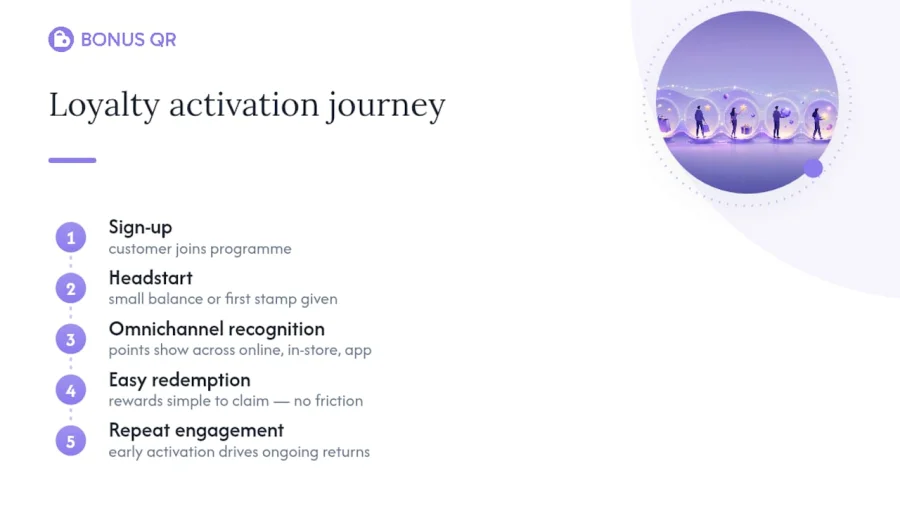
Three mechanics turn that willingness into action. A headstart, giving new members a small balance or a completed first stamp on sign-up, increases early activation because progress already feels real. Omnichannel recognition means a customer’s points show up whether they buy online, in-store, or through an app, so no channel switch resets their progress. Easy redemption removes the biggest silent killer of loyalty programmes: rewards so hard to claim that customers give up and stop engaging entirely.
Acoustic’s guidance on lasting customer loyalty makes an important distinction here: points and discounts alone tend to buy transactional loyalty, not lasting loyalty. The five behavioural drivers it identifies, relevance, timing, channel fit, proactive retention, and compounding intelligence, sit underneath the rewards, not instead of them.
Pro Tip: Never let your loyalty programme become just a discount delivery mechanism. If the only thing customers value is the percentage off, you’re training them to wait for markdowns rather than building a reason to choose you at full price.
Design checklist: goals, KPIs, reward architecture and economics
Start with one business goal, not five. A programme trying to boost activation, lift repeat rate, and increase average order value simultaneously usually improves none of them measurably. Pick the single metric that matters most right now and map the entire reward structure to it.
Reward architecture needs three decisions locked before launch:
- First-reward timing: how quickly does a new member get something tangible? Faster is almost always better for activation.
- Perceived value versus actual cost: a reward that feels generous to the customer but costs you little (early access, a free add-on) often outperforms a straight discount.
- Margin caps: decide the maximum percentage of revenue you’re willing to give back in rewards before launch, not after you notice margin erosion.
These benchmark ranges come from industry practitioner guides on loyalty programme design and give you a realistic yardstick rather than a guess.
Run a breakage and liability sanity check before wide rollout. Breakage is the percentage of earned rewards customers never redeem. It sounds like free money, but a programme with very low breakage means your liability sits on the books as unredeemed points, which becomes a real cash problem if too many customers redeem at once. Model both a low-breakage and high-redemption scenario against your margin before committing to reward values.
Implementation essentials: tech, integration and rollout phases
You need four things at minimum before launching anything: an enrolment surface (app, web page, or QR code), recognition that works across every channel a customer might use, automated messaging for reward alerts and reminders, and reporting that shows enrolment and redemption in real time.
- Choose your integration method first. QR-based enrolment needs no POS integration and works fastest for SMB pilots. Wallet-native passes (Apple Wallet, Google Wallet) reduce app-download friction. POS-linked systems offer the tightest data accuracy but slow down launch considerably.
- Phase the rollout. Start with a single location or channel, validate the mechanic works and customers understand it, then expand. Trying to launch across every location and channel simultaneously multiplies the chance something breaks invisibly.
- Set realistic timelines. A small business pilot using QR and wallet passes can typically launch within two to four weeks. Mid-market rollouts involving POS integration and multi-location reporting often take two to three months.
- Watch for the most common pitfall. Shopify’s small business guidance is blunt about this: heavy POS integration that delays launch by months usually costs more in lost momentum than it gains in data accuracy. Launch simple, then integrate deeper once the mechanic is proven.
A practical guide to digital loyalty and rewards covers the trade-offs between paper cards, QR-based digital cards, and full POS integration in more depth if you’re weighing which route fits your business.
Lessons from real loyalty programme deployments
Watching businesses launch loyalty programmes on similar platforms surfaces the same three sticking points repeatedly. Enrolment friction kills more programmes than bad reward design. Customers who have to download an app, create a password, and enter payment details before they see any benefit simply don’t finish. Visible progress matters more than reward size. A customer who can see they’re two stamps from a free coffee behaves differently than one who has no idea where they stand.
The businesses that get the most out of a loyalty pilot are rarely the ones with the biggest reward. They’re the ones where a customer can see their progress in under three seconds of opening the app.
Redemption economics deserve modelling before launch, not after the first redemption spike causes a margin scare. Some platforms support stamp cards, points, tiered structures, and paid memberships, which gives businesses room to test the mechanic that fits their purchase frequency rather than forcing every business into the same points formula.
Case studies: measurable outcomes from loyalty investment
Concrete numbers matter more than anecdote when justifying a loyalty budget internally. Survey research summarised by Shopify on the Bond loyalty report found that 79% of customers say they’re more likely to recommend a brand, and 85% say they’re more likely to keep shopping with brands that run a loyalty programme well. Those two figures matter because recommendation and repeat purchase intent are the two levers that actually compound revenue over time, unlike a one-off discount redemption.
Retail businesses that shift from a pure points structure to one incorporating personalisation see stronger results still. Bloomreach’s retail loyalty research cites case examples where layering AI-driven personalisation onto existing loyalty data doubled engagement metrics for members, compared with generic, one-size-fits-all messaging to the same list.
The pattern across these outcomes is consistent: programmes that treat loyalty data as an input for personalised marketing, not just a points ledger, outperform those that don’t. A café tracking visit frequency can use that same data to time a “we miss you” message before a customer lapses, rather than after. A boutique retailer can use tier data to flag which customers deserve early access to a new collection. The measurable outcome isn’t the reward redeemed. It’s the repeat visit and referral that follow from a customer feeling recognised rather than simply discounted.
Tailoring loyalty programmes to different customer segments
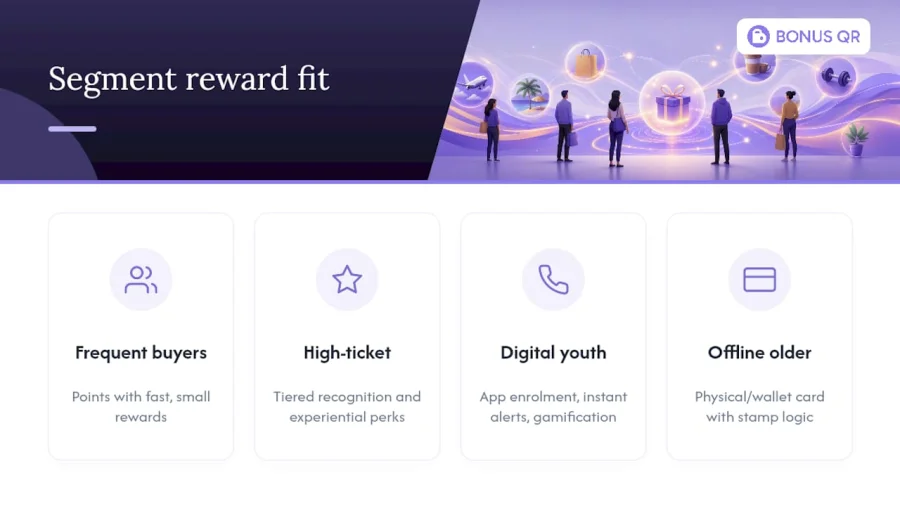
A single reward structure rarely fits every customer segment equally well, and treating all members identically wastes the personalisation advantage loyalty data provides. High-frequency, low-basket customers, typical of cafés or convenience retail, respond best to points programmes with fast, small rewards that reinforce the habit loop. High-basket, infrequent customers, typical of furniture or luxury goods, respond better to tiered recognition and experiential perks than to small percentage discounts they may not use for months.
Younger, digitally native segments generally expect app-based enrolment, instant notifications, and gamified elements like streaks or challenges. Older or less app-fluent segments may prefer a physical or wallet-based card with straightforward stamp logic, no app download required. Ignoring this split and forcing one format on both groups typically depresses enrolment in whichever segment finds the format inconvenient.
Price-sensitive segments respond well to value-driven offers like free shipping thresholds or bundle discounts. Status-driven segments respond better to recognition, early access, or public tier acknowledgement than to any monetary saving. The practical move is to segment your existing customer list by purchase frequency and average basket size before designing the reward tiers, rather than after launch. Bonusqr’s tiered and points modules can run simultaneously, letting you test which segment responds better to which mechanic without building two separate systems.
Gamification and social integration in loyalty marketing
Gamified mechanics, streaks, challenges, and surprise bonuses, are becoming a standard layer on top of traditional points and tiers rather than a replacement for them. A streak bonus that rewards three consecutive weekly visits taps into the same habit-formation psychology as a stamp card, just with more variability to keep it interesting over time.
Social integration is the other emerging layer worth watching. Programmes that let members share a milestone, a tier upgrade, a badge, a referral reward, on social platforms turn loyalty into a visible signal rather than a private transaction. This works because the reward becomes partly social currency, not just monetary value. A referral programme that gives both parties a reward, mentioned earlier as a retail mechanic, is itself a form of built-in social integration, since it relies on the customer’s own network to spread.
The caution here is the same one that applies to every trend: gamification and social features amplify a programme that already has a solid behavioural foundation. Bolting a leaderboard onto a weak reward structure won’t fix low enrolment. Layer gamification on top of a mechanic that’s already proven to activate customers, not as a substitute for getting the core mechanic right.
When a loyalty programme is the right next investment
Rising customer acquisition costs, a repeat purchase rate that’s stagnant, or footfall you’re not converting into a second visit are the clearest signals it’s time. A reliable rule of thumb: if you can’t currently name your repeat rate or average visits per customer, you don’t yet have the data to justify a full launch, but that gap is itself the reason to start a small pilot. Treat loyalty as a relationship tool, never as a permanent discount channel.
How Bonusqr helps you build the programme you just read about
Every mechanic covered above, stamp cards, points, tiered VIP structures, and paid memberships, can be built and launched on Bonusqr’s loyalty platform without waiting on POS integration or a developer sprint. Where an agency build might take months and a fixed contract, a Bonusqr pilot typically launches on QR enrolment and mobile wallet passes within weeks, letting you test the exact reward architecture from this guide against real customer behaviour before committing further budget.
A pilot on Bonusqr usually includes your choice of mechanic, branded enrolment, automated push and email triggers, and real-time reporting on activation and redemption, so you can check the KPI targets from the design checklist against actual numbers rather than assumptions. Service businesses can start from the dedicated services application, while hotels have a purpose-built hospitality option. If you’re ready to see which mechanic fits your customer base, register for Bonusqr and launch your first pilot this month.