
 Deutsch
 Español
 Français
 Italiano
 Magyar
 Polski
 Slovenčina
 Čeština
A familiar scene plays out every day in cafés, salons and gyms. A customer joins a loyalty scheme, earns a few points, then disappears before the reward feels real. The business didn't fail because loyalty is a bad idea. It failed because the path back wasn't obvious enough.
A 10 points program still works when it's built for speed. Not speed to launch. Speed to reward. If customers can see the finish line, understand the rules in seconds, and redeem without asking staff to explain anything, the scheme starts pulling people back into the shop instead of sitting there as a forgotten extra.
That matters in the UK because loyalty isn't a novelty market. It's a crowded one. Shoppers already belong to multiple schemes, so a small business doesn't win by adding more complexity. It wins by making the next visit feel easier, closer and worth taking.
Why a Simple 10 Point System Still Wins for Small Businesses
A paper stamp card on the till often looks harmless. It's cheap, familiar and quick to hand out. But the failure usually appears later. The customer loses it, forgets it, or sits on six punches for months because the reward is too far away to change behaviour.
A simple 10 points program avoids that drift when the rules are visible and the reward feels close enough to influence the next purchase. That's the reason small operators keep coming back to the format. It's not clever. It's clear.
UK loyalty behaviour points in the same direction. A British Retail Consortium write-up says shoppers rank simplicity (38%), the ability to redeem points (37%), and good return on spend (36%) as the most important programme attributes, while around 80% to 81% of adults belong to at least one loyalty programme according to the same review of UK research (British Retail Consortium on loyalty priorities).
What simple actually does better
A small team usually needs three things from loyalty:
- Fast explanation: Staff should be able to explain the scheme in one sentence at the till.
- Quick progress: Customers should feel they're moving towards something after the first visit, not after a long stretch of guesswork.
- Low admin: The owner shouldn't need extra hardware, long staff training, or manual checking at busy times.
That's why a 10-point ladder still beats many tiered schemes in local retail and hospitality. One visit can equal one point. Or one spend threshold can equal one point. Either way, the customer understands what's happening without asking for a calculator.
Practical rule: If staff need more than a few seconds to explain how points work, the scheme is already too heavy for a busy counter.
What a 10-point ladder can and can't do
It can drive repeat visits, nudge habit, and make regulars feel recognised. It can also support extras like birthday rewards, welcome offers or seasonal nudges if the core mechanic stays simple.
It can't fix weak service, poor pricing or an offer customers don't want. It also won't rescue a badly chosen reward threshold. If the prize sits too far away, customers stop caring long before they arrive.
For brick-and-mortar teams, the practical target is straightforward. Build a 10 points program that customers can join from a QR code, track on their phone, and redeem without friction. By the end of that setup, the business has a working repeat-visit engine instead of another forgotten card.
Choosing Your 10 Points Program Model and Reward Mix
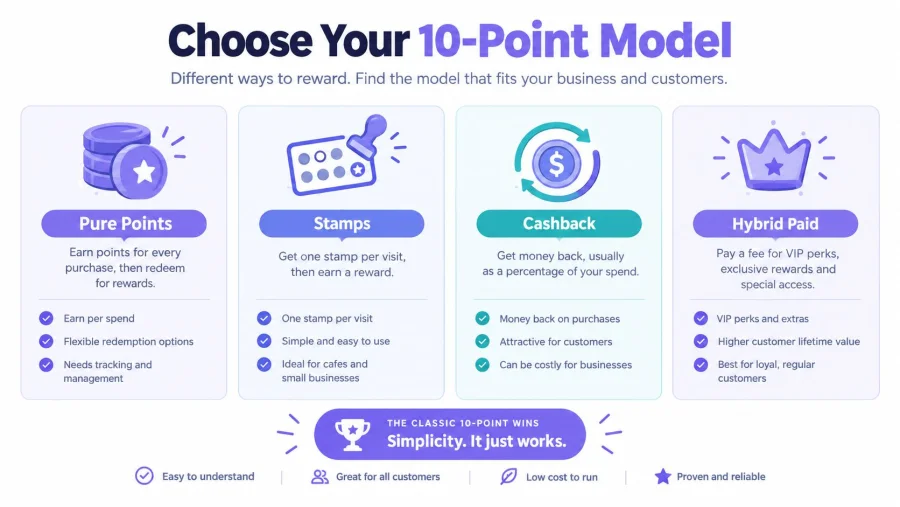
Not every business needs classic points. Some need a stamp-style visit mechanic. Others do better with cashback, member perks, or a mixed reward structure. The right model depends less on trend and more on how customers buy.
UK loyalty programmes already stretch beyond classic points. Collinson's 2025 UK data says free-to-join schemes account for 41%, hybrid schemes 31%, and paid schemes 28%, while nearly half of UK programmes still use points. The same report says the average rewards budget is £3.5m and 35% of UK loyalty leaders cite personalisation and member experience as the top priority (Collinson UK loyalty landscape 2025).
A quick decision lens
| Model | Best fit | Strength | Watch-out |
|---|---|---|---|
| Pure points | Retail, salons, mixed baskets | Flexible rewarding by spend | Can become too abstract |
| Stamps | Cafés, juice bars, car wash, quick service | Easiest to understand | Less precise on margin |
| Cashback | Higher-ticket repeat spending | Feels like direct value | Can get expensive fast |
| Hybrid or paid | Strong regular base, VIP treatment | Adds perks beyond discounts | Needs clear positioning |
When the classic 10-point format wins
A classic 10 points program usually works best when:
- Visits are frequent: Coffee shops, lunch spots and neighbourhood services benefit from repeat habit.
- The average basket is steady: If spend doesn't swing wildly, visit-based rewards are easy to run.
- Staff need speed: One scan, one point, done.
For spend-led setups, businesses can use a points model tied to transaction value rather than visits. For operators comparing configurations, how BonusQR points work gives a practical view of point rules and reward thresholds without needing a complex stack.
Reward mixes that feel valuable without wrecking margin
The reward matters as much as the model. The wrong reward attracts bargain hunters or creates a redemption bill that eats into profit. The better option is usually something customers already buy often and perceive as useful.
A sensible reward mix might include:
- A low-friction first reward: A small drink upgrade, add-on treatment, or fixed discount that feels reachable.
- A second option with a little more pull: Something customers might trade up to, like a bundle perk or product add-on.
- Occasional timed rewards: Seasonal extras that create urgency without changing the whole scheme.
The strongest reward isn't always the most generous one. It's the one customers can picture using on their next visit.
Points aren't always the answer. For a tiny coffee kiosk, digital stamps may outperform a spend-based system because nobody wants to think about conversion. For a salon with uneven ticket sizes, points tied to spend can feel fairer. For a gym, a hybrid setup with points plus member-only perks may land better than a plain “buy ten get one” mechanic.
Designing Point Rules Thresholds and Fair Terms That Convert
Most loyalty schemes don't break because the idea was wrong. They break because the rules slow customers down. A 10 points program works when the path to reward is short, the maths is easy, and the terms don't surprise anyone at redemption time.
Many small businesses overcomplicate things. They add different earn rates, narrow exclusions, rotating point values and vague expiry rules. Customers stop tracking it. Staff stop explaining it. The scheme turns into background noise.
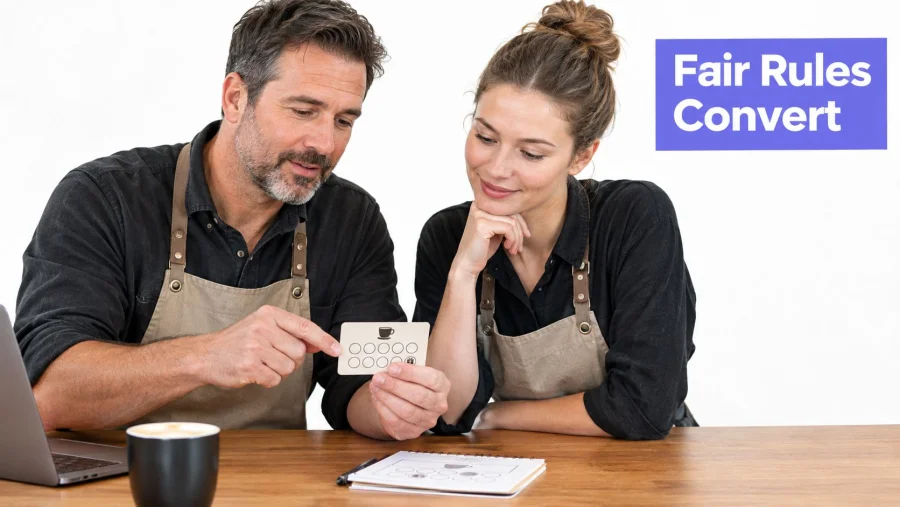
Start with one clean earning rule
A business usually has two solid options:
- Per visit: Best when baskets are similar and the goal is habit.
- Per spend threshold: Better when ticket sizes vary and fairness matters.
The mistake is mixing too many earning rules from day one. If one coffee gives one point, but pastries sometimes count, takeaway orders sometimes don't, and weekend doubles depend on a poster nobody reads, customers lose trust.
Keep the threshold psychologically close
The threshold should feel reachable enough to change behaviour. UK loyalty consumers show little patience for delayed value. Research highlighted by The Loyalty Club says 83% of UK consumers use loyalty mainly to save money and 63% prefer instant rewards over long-term point accumulation (UK loyalty preference for instant rewards).
That's why the reward should connect to the next visit, not a distant someday purchase. If a customer earns points but can't imagine when they'll redeem, the program becomes decoration.
A practical setup often includes:
- A core 10-point reward: The obvious headline benefit.
- An early nudge: A welcome coupon or first-visit perk to create momentum.
- A mid-journey reminder: Something that keeps the member aware before interest fades.
Clear progress beats theoretical value. Customers act when they can see the reward getting closer.
Write terms like a customer will actually read them
Even free loyalty schemes are treated as consumer-facing contract terms in the UK, so they need to be fair, transparent and not misleading. Legal guidance also says terms should define how points are earned, how they're valued and redeemed, whether conversion rates can change, and what happens on returns, inactivity, refunds or suspected misuse (UK guidance on loyalty programme terms).
A useful terms checklist looks like this:
- Earning rules: Say exactly when points are added.
- Reward value: Make the redemption benefit easy to understand.
- Returns and refunds: Explain whether points are reversed.
- Expiry and inactivity: State the timing in plain language.
- Misuse: Reserve the right to remove points for abuse, but define abuse clearly.
Add extras without polluting the core mechanic
There's nothing wrong with welcome bonuses, birthday coupons or quiet-day promotions. The problem starts when those extras become the system.
Keep the main ladder stable. Use promotional rewards as overlays, not replacements. A customer should still understand the basic earn-and-redeem journey without opening a help page or asking the team at the counter.
Launching Your Program With BonusQR From QR Code to Wallet Pass
A loyalty launch falls apart when the sign-up takes too long or staff hesitate at the till. Customers won't queue to join. Staff won't explain a system they don't trust. The launch process has to fit the pace of the shop.
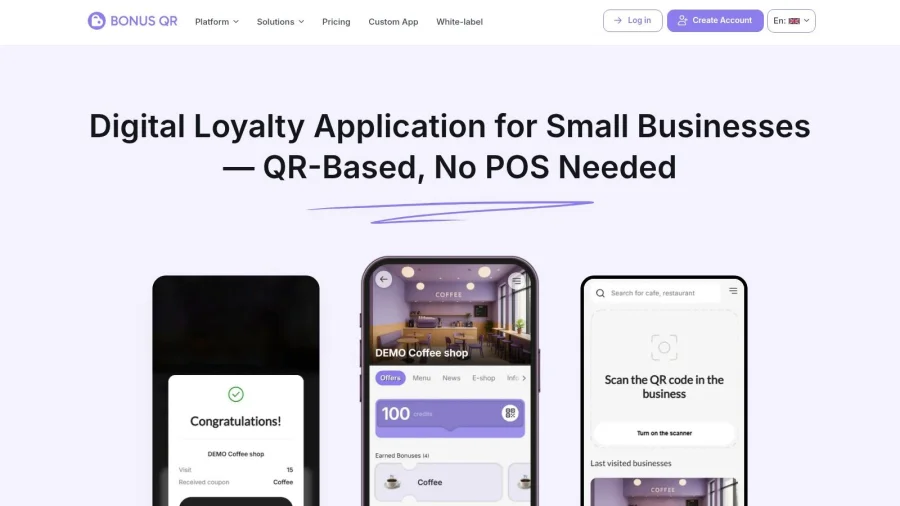
The practical flow is simple. A customer scans a QR code, joins on mobile, gets a personal profile, and starts collecting immediately. Staff then scan and redeem from the same routine they already use during checkout instead of opening a separate process or relying on a bulky card machine add-on.
This product view helps make that concrete.
What the live setup needs to include
The launch isn't really about software. It's about removing points of hesitation.
A workable setup includes:
- A visible join prompt: Put the QR code where the purchase decision happens, not hidden by the door.
- An immediate first action: Customers should earn on the same visit they join.
- A profile with useful visibility: Points balance, reward progress and visit history should be easy to find.
- Wallet access: Customers are more likely to use loyalty when the pass sits in their phone instead of a forgotten tab.
For operators that want a digital pass customers can retrieve quickly at checkout, it helps to add loyalty cards to Wallet so redemption stays close to the payment moment.
Staff wording matters more than the poster
The join pitch should be one sentence. For a café, something like: join here, collect on every visit, and your reward activates automatically when you hit the target. For a salon, the wording can focus on future treatments or product perks.
Long explanations kill sign-ups. So do vague promises like “special rewards later”. Customers respond better when the benefit is immediate and the process doesn't interrupt the queue.
A few launch habits help:
- Use a counter card, window sticker, and receipt mention: Repetition matters.
- Train staff on one phrase only: If every team member says it differently, conversion drops.
- Redeem in front of the customer once: Seeing the process removes doubt.
A customer who joins and earns on the first visit is far more likely to remember the scheme than one who's told to come back next time.
Tracking the source of sign-ups
If the business promotes loyalty through table talkers, posters, packaging or local flyers, attribution becomes useful. A practical primer on QR code attribution software helps operators understand which QR placements drive scans, rather than assuming every printed code performs equally.
That matters because some channels attract curious scanners while others attract buyers who return. Those aren't the same audience. The cleaner the tracking, the easier it is to stop printing materials that look nice but don't create repeat visits.
Fixing Redemption Friction and Preventing Points Breakage
The biggest loyalty leak usually appears after launch. Customers collect points. Then nothing happens. No reminder, no clear next step, no useful reward timing. The balance sits there until the customer forgets it or the points expire.
That leak has a name. Breakage. In UK research covered by Retail Gazette, 26.2% of loyalty points go unused and 11.9% expire unspent, with the value of unused rewards estimated at about £3 billion a year. The same coverage notes that promotions influence buying behaviour for 68.6% of shoppers and 41% use promotions almost every time they shop (UK loyalty breakage and promotion behaviour).
Where redemption friction usually starts
Most small-business schemes suffer from one or more of these problems:
- The threshold feels too far away: Customers stop checking progress.
- The reward doesn't match the next purchase: The balance has no obvious use.
- Expiry feels punitive: Members resent losing value they barely noticed.
- The reminder arrives too late: By then, the visit habit is already broken.
UK consumers are already crowded with loyalty options. Antavo's 2026 UK loyalty report says consumers belong to an average of 4.7 programs, only 33% say they're more likely to join a loyalty programme than last year, 83% join primarily to save money, 57% say it takes too long to earn rewards, and 47% find rewards unattractive (UK loyalty saturation and reward frustration).
The funnel that actually needs monitoring
A useful loyalty dashboard tracks behaviour in sequence, not just total sign-ups.
Watch these stages:
- Points issued: Are customers earning early enough to care?
- Balance viewed: Are members checking their progress?
- Reward approached: Do reminders go out before momentum drops?
- Reward redeemed: Are customers using points on the next likely visit?
- Points expired: Is the scheme eroding trust?
The key isn't to eliminate all breakage. Some unused points are inevitable. The aim is to stop avoidable breakage caused by silence, confusing rules or poor reward timing.
Fixes that pull points back into circulation
A better redemption system usually looks like this:
| Friction point | Better move |
|---|---|
| Reward feels distant | Add a smaller or earlier redemption option |
| Customers forget balance | Send a progress reminder before inactivity drags on |
| Reward lacks urgency | Pair points with a timed coupon or visit nudge |
| Expiry causes resentment | Use clear notice and enough time to act |
If the operator wants to layer a short-term incentive over the core scheme, it helps to create discount offers with BonusQR so near-threshold customers receive a reason to return while the reward still feels relevant.
Points don't create retention on their own. The reminder, the timing and the ease of redemption create retention.
The most effective message is rarely “you have points”. It's closer to “you're close to a reward you can use this week”. That turns a passive balance into a next-visit prompt.
Optimising and Growing Your 10 Points Program Over Time
A loyalty scheme shouldn't sit untouched after launch. The strongest programmes run like a weekly shop-floor routine. Check what customers are doing, spot where they stall, then adjust one thing at a time.
A 2026 UK survey says 73% of British consumers believe loyalty cards offer good value for money, 70% say they actively encourage them to return to the same shops, and a separate 2026 UK retail loyalty report states that 80% of UK consumers are members of a customer loyalty or reward scheme (UK consumer view of loyalty card value).
What to review each week
The weekly review doesn't need to be complicated. It needs to be consistent.
A useful routine checks:
- Top customers: See who returns often and whether they redeem or only accumulate.
- Coupon performance: Identify which messages create visits and which ones just get opened.
- Visit patterns: Look for slow days that need a loyalty nudge.
- Drop-off points: Find where members stop progressing in the journey.
One practical insight often appears fast. Businesses tend to focus on sign-ups because they're visible. The better signal is active redemption. That's where the programme proves it's changing behaviour instead of collecting dead accounts.
What to test without making the scheme messy
Good optimisation keeps the core rule stable and tests around it.
Try changing things like:
- Reward menu variety: Keep the headline reward, but rotate a few seasonal options.
- Reminder timing: Nudge customers before they forget, not after the relationship cools.
- Reactivation offers: Send a return incentive to inactive members with unspent value.
- Personal touches: Use buying history to make offers feel relevant without changing the base mechanic.
A small operator doesn't need heavy gamification to compete. It needs a loyalty experience that stays easy while becoming more relevant over time. Personalisation should sharpen the message, not bury the rules.
Keep data handling clean and customer-facing
Customer data should stay useful and proportionate. Only collect what supports loyalty, follow GDPR-safe handling practices, and make sure members understand what they're signing up for. When the value exchange is clear, trust stays intact.
A short weekly checklist helps keep the programme healthy:
- Check recent sign-ups against recent redemptions
- Review points nearing expiry
- Send one targeted reminder to near-reward customers
- Swap out stale offers
- Watch for staff shortcuts that create customer confusion
A 10 points program works when the reward feels close, the rules stay fair, and redemption happens before points go stale. Small businesses don't need a complicated loyalty stack to achieve that. They need a clean join flow, visible progress, timely reminders and rewards customers can actually use on the next visit.
For cafés, salons, gyms and local retail, that's the simplest route to more repeat visits.