
Loyalty promotion optimisation is the process of refining reward structures, targeting, and messaging to increase active customer participation and measurable business returns. Loyalty programme membership is rising across Europe, with Poland at 70% and the European average at 64.3%, yet enrolment alone does not drive revenue. The real challenge for marketing professionals at small to medium-sized businesses is converting members into frequent, engaged participants. Optimising loyalty promotions in 2025 means moving beyond blanket discounts and towards personalised, behaviour-driven campaigns that reflect what customers actually value. This guide covers the strategies, tools, and metrics that make that shift possible.
What are the key consumer preferences impacting loyalty promotion optimisation in European markets?
Consumer priorities differ sharply across European markets, and a single loyalty template fails most of them. European loyalty preferences split clearly by country: Polish customers prioritise price savings, Dutch customers want frictionless ease of use, and UK customers expect experiential depth such as early access, exclusive events, and curated rewards. Tailoring your loyalty programme to these local expectations is not optional. It is the difference between a programme that grows and one that stagnates.

Price clarity beats personalisation in price-sensitive markets
Polish consumers prefer obvious, immediate savings over sophisticated personalisation features. Only 12% of Polish consumers rank personalisation as a top priority, even though many brands assume the opposite. This gap between brand belief and customer reality is costly. If your programme serves a price-conscious audience, lead with clear cashback figures, exclusive app prices, and straightforward point values rather than complex tiered rewards.
Frictionless access drives participation in ease-first markets
Dutch consumers drop out of loyalty programmes when the sign-up or redemption process feels slow or complicated. A mobile app that requires multiple steps to check a balance or redeem a reward loses members fast. The fix is simple: reduce taps, display reward balances prominently on the home screen, and send push notifications that confirm value at the right moment.
Experiential rewards retain UK customers
UK loyalty members respond to rewards that feel exclusive rather than purely transactional. Early product access, members-only events, and community participation opportunities outperform straight discounts for this audience. Brands that tailor programmes to local preferences consistently report stronger customer resonance and lower churn than those using a uniform global model.
- Price-led markets (e.g. Poland): Lead with cashback, exclusive app pricing, and clear point values.
- Ease-led markets (e.g. Netherlands): Prioritise frictionless UX, fast redemption, and visible savings.
- Experience-led markets (e.g. UK): Offer early access, community rewards, and curated member benefits.
- Cross-market programmes: Build a modular structure so you can activate the right feature set per region.
Pro Tip: Before redesigning your loyalty offer, survey a sample of your existing members with three questions: what do they value most, what frustrates them most, and what would make them recommend the programme. The answers will tell you which market archetype your audience most closely resembles.
How can marketing teams implement targeted re-engagement strategies for inactive loyalty members?
Inactive members are not lost customers. They are a recoverable asset. Targeted re-engagement campaigns can win back up to 45% of inactive loyalty members in competitive markets, using timely and relevant triggers rather than generic broadcast messages. That figure represents significant revenue from customers you have already paid to acquire.
The most effective re-engagement campaigns share three characteristics: they are triggered by a specific event, they communicate clear and immediate value, and they create a time-limited reason to act. Generic “we miss you” emails rarely move the needle. A message that says “Your 200 points expire in seven days” does.
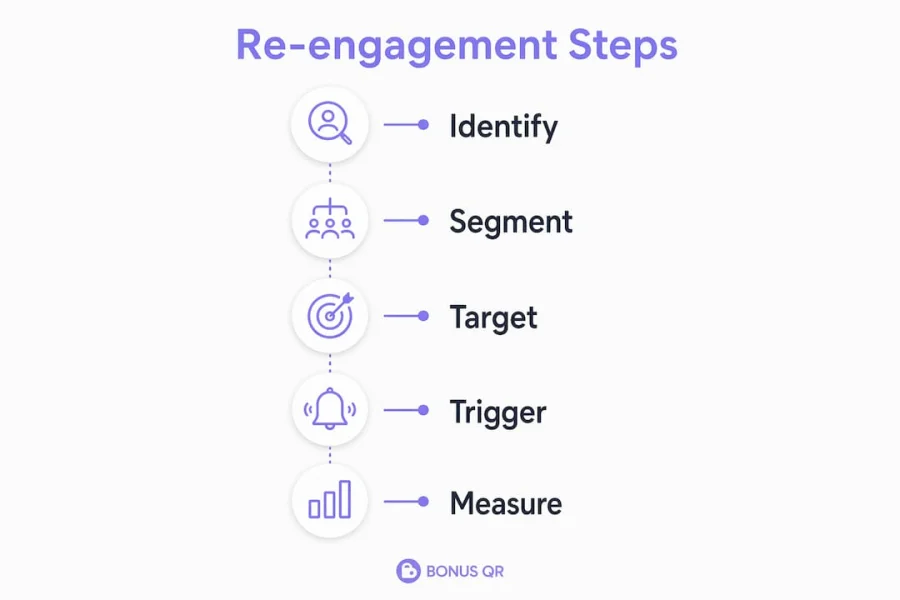
Five steps to a re-engagement campaign that works
-
Segment your inactive members by recency. Separate members who last engaged 30 days ago from those who have been dormant for six months. The messaging, tone, and offer should differ significantly between these groups.
-
Identify the right trigger event. Points expiry, tier status changes, and seasonal milestones are the most reliable triggers. A member approaching a tier downgrade is far more receptive to a targeted offer than one receiving a random promotional email.
-
Craft a single, clear value proposition. One offer per message. Double points for the next purchase, a free stamp on a stamp card, or a cashback bonus all work. Presenting multiple options reduces conversion.
-
Set a short expiry window. Urgency drives action. A seven-day window on a re-engagement offer consistently outperforms a 30-day window because it removes the temptation to act later.
-
Follow up once, then suppress. Send a reminder at the halfway point of the expiry window. If the member still does not engage, move them to a suppression list and reduce contact frequency. Over-messaging inactive members damages your sender reputation and irritates the customer.
Pro Tip: Loyalty email triggers, such as points expiry alerts, drive re-engagement at a measurable rate. Set these up as automated flows rather than manual campaigns so they fire at the right moment without requiring your team to intervene each time.
What is the shift from traditional discounting to advocacy models, and why does it matter?
The “earn and burn” discount model is the default for most loyalty programmes, but it is also the most expensive and least differentiated approach available. Retention costs up to 10 times less than acquisition, yet many businesses spend their loyalty budget on discounts that train customers to wait for a deal rather than buy at full price. Advocacy models reward behaviours beyond the transaction, and they produce compounding returns that discounts cannot.
Advocacy rewards include points or credits for leaving a verified review, participating in a brand community, referring a friend, completing a product feedback survey, or sharing content. These behaviours cost the business less than a discount and generate assets: reviews, referrals, and social proof that attract new customers without paid acquisition spend.
| Reward model | Primary trigger | Cost to business | Long-term effect |
|---|---|---|---|
| Earn and burn discounts | Purchase only | High (margin erosion) | Price dependency, low differentiation |
| Advocacy rewards | Behaviour beyond purchase | Low to moderate | Reviews, referrals, community growth |
| Hybrid model | Purchase plus behaviour | Moderate | Balanced retention and acquisition |
The advocacy model also changes how you measure success. Redemption rate and average discount per transaction are the wrong KPIs for an advocacy programme. The right indicators are referral revenue, review volume, net promoter score movement, and share of wallet over a 12-month period.
Adapting your KPIs takes deliberate effort. Leading CRM directors now use scorecards that balance programme vitality metrics (active member rate, engagement frequency) with business impact metrics (customer lifetime value, referral revenue). If your current reporting only tracks enrolment and redemption, you are measuring the wrong things and will optimise for the wrong outcomes.
Rewarding non-monetary behaviours such as feedback and community participation protects margins while creating long-term retention benefits that compound over time. A customer who has left a review, referred a friend, and participated in a community event is far harder to lose to a competitor than one who simply collects points.
Which tools and programme features best support optimised loyalty promotions in 2025?
The technology behind your loyalty programme determines how much of your strategy you can actually execute. A programme that exists only as a paper stamp card cannot send automated re-engagement messages, track individual behaviour, or personalise rewards. Digital platforms with the right feature set remove those constraints.
Mobile app experience
The mobile app is the primary interface between your programme and your customer. It must display reward balances clearly, make redemption fast, and send push notifications that feel relevant rather than intrusive. Programmes that bury the reward balance three taps deep lose members to inertia. The home screen should answer one question immediately: “What is my reward worth right now?”
AI-driven personalised challenges
Auchan’s AI-driven challenge system demonstrates what personalised loyalty mechanics can achieve at scale. The system generates individual challenges based on purchase history, encouraging customers to try new categories or increase purchase frequency. The result is a 10–12% increase in spend and a 20% increase in purchase variety. For small to medium-sized businesses, entry-level platforms now offer challenge mechanics without enterprise-level investment.
Automated post-purchase flows
Post-purchase flows are one of the most underused retention tools available. A message sent 24 hours after a purchase confirming points earned, suggesting a complementary product, or reminding the customer how close they are to their next reward keeps the programme top of mind between visits. Replenishment reminders for consumable products work particularly well in this context.
| Feature category | What it does | Why it matters for retention |
|---|---|---|
| Mobile UX and clear value display | Shows reward balance and redemption options instantly | Reduces drop-off from friction |
| AI personalisation and challenges | Generates individual offers based on purchase history | Increases spend and purchase variety |
| Automated campaign triggers | Fires messages based on member behaviour or time events | Recovers inactive members without manual effort |
| Push notifications | Delivers timely, relevant messages to opted-in members | Keeps the programme visible between purchases |
| Real-time analytics | Tracks engagement, redemption, and revenue impact | Enables fast iteration on what works |
Platforms like Bonusqr combine these features in a single digital loyalty system, covering points collection, stamp cards, cashback, coupon distribution, and automated push notifications. The platform requires no POS integration, which removes a common barrier for smaller businesses. You can read more about loyalty trends for 2025 to see how these features align with where the market is heading.
Pro Tip: Do not launch every feature at once. Start with clear value display and one automated trigger, such as a points expiry alert. Measure the impact, then add the next feature. Incremental rollouts produce cleaner data and avoid overwhelming your team.
How should marketers measure and optimise the success of their loyalty promotions?
Measuring promotion success in 2025 requires a broader set of indicators than most loyalty programmes currently track. Enrolment numbers and total redemptions tell you very little about whether your programme is actually changing customer behaviour or generating sustainable revenue.
Effective loyalty marketing teams measure engagement frequency, user-generated content volume, advocacy share, referral revenue, and customer lifetime value. These metrics reveal whether your programme is building genuine loyalty or simply subsidising purchases that would have happened anyway.
The metrics that matter most for improving customer engagement in 2025:
- Active member rate: The percentage of enrolled members who have engaged with the programme in the past 90 days. A high enrolment rate with a low active member rate signals a value proposition problem.
- Engagement frequency: How often active members interact with the programme per month. Increasing this figure by even one additional interaction per quarter has a measurable impact on purchase frequency.
- Referral revenue: Revenue generated by customers who joined through a member referral. This metric directly quantifies the business value of your advocacy model.
- Customer lifetime value (LTV): The total revenue a customer generates over their relationship with your business. Compare LTV for loyalty members versus non-members to quantify programme impact.
- Share of wallet: The proportion of a customer’s category spend that goes to your business. Loyalty programmes that increase share of wallet are delivering genuine competitive advantage.
- Net promoter score (NPS) movement: Track NPS separately for loyalty members versus the general customer base. A meaningful gap confirms that the programme is building advocacy.
In maturing ecommerce markets, increasing purchase frequency among existing customers is the primary growth lever. That makes engagement frequency the single most important metric to track and improve. If your programme is not moving that number, the reward structure or the communication cadence needs to change.
A common pitfall is optimising for redemption rate in isolation. High redemption can indicate strong engagement, but it can also indicate that your rewards are too easy to earn and are eroding margin without changing behaviour. Always pair redemption rate with average order value and purchase frequency to get the full picture. For a deeper look at types of rewards that drive the right behaviours, the Bonusqr resource library covers this in practical detail.
Key takeaways
Optimising loyalty promotions in 2025 requires moving from enrolment-focused metrics to behaviour-driven engagement, advocacy rewards, and market-specific programme design.
| Point | Details |
|---|---|
| Match rewards to market preferences | Price-led, ease-led, and experience-led markets each require a different reward structure. |
| Re-engage inactive members with triggers | Time-sensitive, event-based messages recover a significant share of dormant members. |
| Shift from discounts to advocacy | Rewarding reviews, referrals, and community participation protects margin and builds compounding retention. |
| Use the right technology features | Mobile UX, automated triggers, and AI personalisation are the three features with the highest retention impact. |
| Measure beyond enrolment | Track engagement frequency, referral revenue, LTV, and share of wallet to understand true programme value. |
What I have learned from watching loyalty programmes succeed and fail
By Michal
The most common mistake I see marketing teams make is building a loyalty programme around what they want to give rather than what customers actually want to receive. A beautifully designed tiered programme with complex point multipliers and personalised recommendations sounds impressive in a strategy deck. In practice, if your audience just wants a clear discount on their next purchase, the complexity works against you.
The second mistake is treating loyalty as a set-and-forget system. Programmes that launched well in 2022 are underperforming now because customer expectations have shifted and the programme has not kept pace. The businesses I see retaining members most effectively are the ones that review their active member rate every quarter and make one deliberate change based on what the data shows. They do not overhaul the programme. They adjust one variable, measure the result, and move on to the next.
The advocacy model shift is real, but it requires patience. You will not see referral revenue spike in the first month. The compounding effect takes two to three quarters to show up meaningfully in the numbers. Marketing teams that abandon the model after six weeks because the redemption rate dropped are measuring the wrong thing. Stick with it, track the right metrics, and the margin improvement becomes undeniable.
My honest advice: start with your existing members, not new acquisition. Retention investment generates growth more sustainably than chasing new shoppers in a saturated market. The customers already in your programme are your fastest path to better results. Understand what they value, remove the friction from their experience, and reward the behaviours that matter to your business. That is the entire playbook, and it works.
For teams thinking about how loyalty connects to broader digital engagement channels, the intersection of content and loyalty is worth exploring. Podcast loyalty programmes are one emerging example of how brands are rewarding audience engagement beyond the purchase, and the mechanics translate well to other content-driven communities.
— Michal
How Bonusqr supports marketing teams with loyalty programme optimisation
Bonusqr gives marketing professionals at small to medium-sized businesses the tools to build, launch, and manage digital loyalty programmes without requiring a development team or POS integration. The platform covers points collection, stamp cards, cashback, coupon distribution, and automated push notifications in a single system. You can configure reward structures to match your market, whether that means price-led cashback for a price-sensitive audience or experience-led rewards for a UK customer base. Real-time analytics show you which promotions are driving engagement and which need adjustment. If you are ready to put these strategies into practice, register with Bonusqr and start building a programme that works for your customers and your margins.
FAQ
What does optimising a loyalty promotion actually mean?
Optimising a loyalty promotion means adjusting reward structures, targeting, and messaging to increase active member participation and measurable business returns, rather than simply growing enrolment numbers.
How do I re-engage inactive loyalty members effectively?
Use automated, event-based triggers such as points expiry alerts or tier status changes, paired with a single clear offer and a short redemption window of around seven days.
Why should I move away from discount-only loyalty rewards?
Discount-only models erode margin and train customers to wait for deals. Advocacy rewards such as referral bonuses and review incentives cost less and generate compounding retention benefits over time.
Which metrics best measure loyalty promotion success in 2025?
Track active member rate, engagement frequency, referral revenue, customer lifetime value, and share of wallet. These indicators reveal whether your programme is genuinely changing customer behaviour.
How important is mobile app experience for loyalty programme performance?
Mobile UX is critical. Programmes that display reward balances clearly and make redemption fast retain significantly more members than those with complex or slow interfaces.


