
 Deutsch
 Español
 Français
 Italiano
 Magyar
 Polski
 Slovenčina
 Čeština
Most nail loyalty cards fail because they reward the wrong behaviour. A client does not need a free manicure after a long run of visits, they need a reason to come back after the first appointment, and then again before they drift to another salon. A buy five, get one free card looks simple, but it often arrives too late to change habits.
The market context makes that mistake expensive. The UK nail-salon market is projected to reach US$1,198.7 million by 2030, with manicure services accounting for 31.3% of revenue (Grand View Research). That is a big, repeat-driven market, which means weak retention gets punished fast. Loyalty cards should not be a paper habit. They should be a retention system.
Why Your Current Loyalty Card Is Failing
Paper punch cards look harmless, but they usually fail in the same way. They collect stamps, not customer intelligence. They reward visits without telling the salon who came back, who disappeared, or which service drove the repeat booking.
The paper card problem
A stamp card can't tell staff whether a client booked gel, BIAB, a repair, or a higher-value add-on. It can't trigger a reminder when someone goes quiet. It can't support smarter rewards based on behaviour. That means the salon is flying blind while trying to build loyalty.
The bigger issue is timing. In a market that keeps growing, competition for repeat bookings gets tighter, not easier. A loyalty card that only matters after a long stretch of visits is too slow for the way nail clients behave.
Practical rule: if a loyalty card can't help the salon spot a returning client, it's just branded stationery.
A better system starts with what the salon wants to measure, not what card stock looks nice at the till. Even a simple digital setup can track visits, reward balances, and rebooking patterns without adding admin. For a straightforward overview of how reward structures work in practice, see successful loyalty rewards strategies.
The Critical Importance of the Second Visit
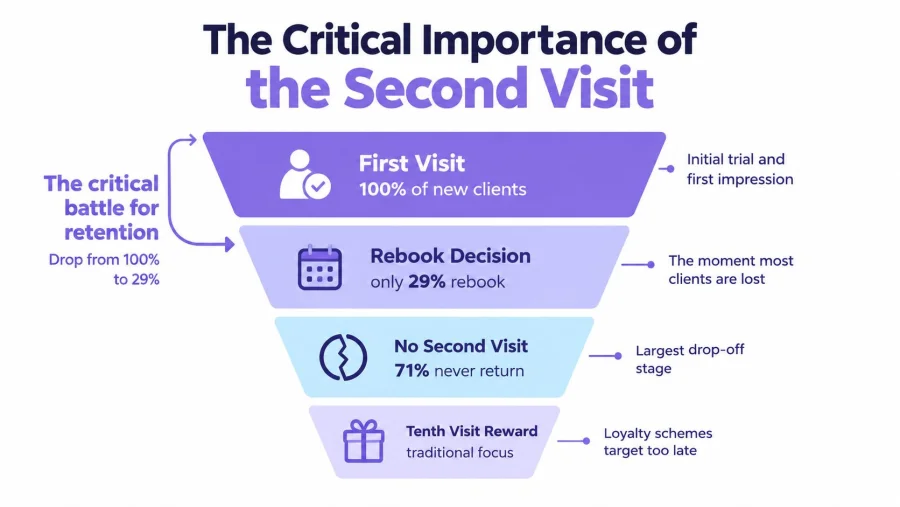
Retention is won before the reward card feels “valuable”. In UK salon data, only 29% of new salon clients rebook (Professional Beauty). That means the biggest leak is not at the tenth visit. It's at the second.
What the numbers are really saying
A traditional card that gives a reward on visit five or ten assumes the client will naturally stay in cycle long enough to care. That's a bad assumption. Most first-time clients never make it that far, so the programme spends its energy on the people least likely to leave.
A smarter structure gives the second visit real weight. That can mean a small add-on, a consultation upgrade, or a modest bonus for booking within the normal maintenance window. The point is to make the second appointment feel easy and worth keeping.
What to reward first
Salons should stop thinking in terms of “how many stamps until free?” and start thinking in terms of “what gets the client back quickly?”. The reward has to protect margin, too. A complimentary nail-health check, a cuticle treatment, or a simple upgrade makes more sense than giving away a full service.
The second appointment is where loyalty starts behaving like a habit, not a coupon.
A card built around the second visit does two jobs at once. It reduces the first-to-second drop-off, and it creates momentum for later rewards. That is far more useful than handing clients a distant finish line and hoping they stay interested.
Designing a Reward Structure That Drives Results
A good nail loyalty card should be simple enough for front-of-house staff to explain in one breath and strong enough to change behaviour. The easiest mistake is overcomplicating the rules. The second mistake is making every reward a discount.
Build the ladder backwards
Start with the behaviour you want most. For many salons, that is a rebooked client coming back within the maintenance cycle. Then attach rewards to actions that increase repeat business, not just total visits.
A practical structure can include:
- Second-visit reward: a small bonus that nudges the client back fast, such as a free add-on or upgrade.
- Visit-based stamps: one stamp per qualifying appointment, with the main reward arriving before the client loses momentum.
- Service incentives: bonus value for higher-margin services, like nail art or enhanced finishes.
- Referral recognition: a bonus when a regular client brings in a new client who books.
- Birthday treats: a personal offer that feels like attention, not bulk discounting.
Keep the rules profitable
The reward should never erase the value of the booking. That means salons should favour low-cost, high-perceived-value extras over blanket price cuts. A free gel finish on a future visit or a small enhancement often makes more sense than a broad percentage discount.
Practical rule: if the reward trains clients to wait for a discount, it's the wrong reward.
The structure also needs clarity. Staff should know exactly what earns a stamp, whether add-ons count, and when a reward expires. Clients should never have to guess. Confusion kills participation faster than a weak prize does.
A final point matters more than most owners realise. Reward design should fit the service mix. BIAB, gel maintenance, nail art, and basic manicures all behave differently, so the card should reflect that rather than forcing every appointment into the same box.
Digital vs Physical, Choosing the Right Medium
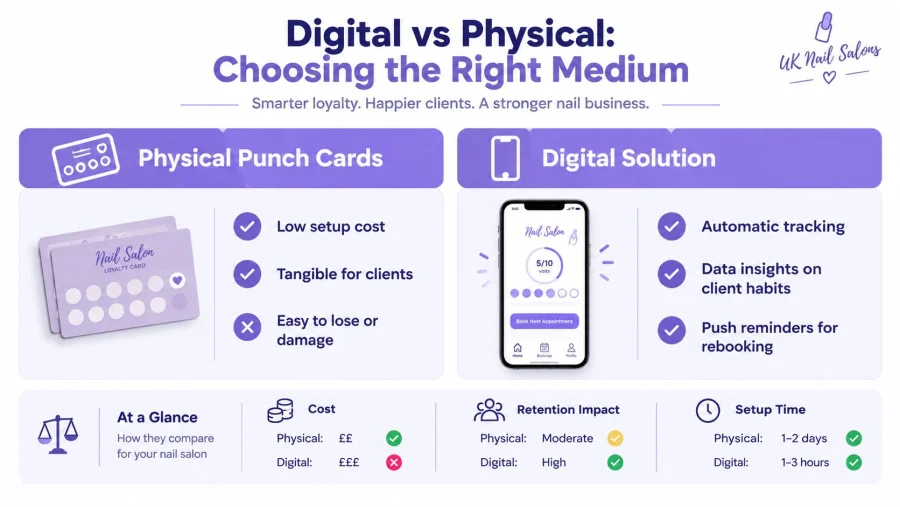
Physical punch cards feel familiar, but familiarity isn't the same as effectiveness. Digital loyalty cards give the salon more control, more data, and fewer lost opportunities. The choice is less about fashion and more about whether the business wants a souvenir or a system.
What physical cards do well
Paper cards are easy to understand. They cost little to start, and some clients like the tactile feel. For a tiny operation with very simple repeat behaviour, that can be enough at the beginning.
But the weaknesses are obvious. Cards get lost, forgotten, damaged, or left in handbags. Once that happens, the salon loses the history attached to them. No history means no smarter messaging, no useful segmentation, and no real tracking.
Why digital wins for most salons
UK consumers are already used to loyalty schemes, with only 9% having never used one (SumUp). That makes digital adoption far less risky than many owners assume. Clients already understand the basic idea. They just need the process to be easy.
Digital systems can track stamps automatically, show reward balances, and support rebooking prompts. They also make it easier to spot inactive clients and tailor a nudge around their behaviour. That matters far more than a card sitting in a drawer.
For salons comparing options, loyalty cards for cafés are a useful reference point because the same logic applies, simple sign-up, easy redemption, and clear visibility for staff.
If a salon wants the simplest operational path, a QR-based setup is usually the stronger choice. It reduces friction at checkout, keeps the programme visible on the client's phone, and gives the owner actual data instead of guesswork.
Navigating GDPR and Data Privacy Compliance
A loyalty card that collects names, contact details, or visit history is a data-processing system, not just a marketing gimmick. That means it needs proper handling from day one. The salon does not need legal theatre. It needs clean separation between reward administration and marketing.
The ICO's guidance treats loyalty schemes differently depending on the purpose. Administering a loyalty programme may be necessary to fulfil the contract, but profiling for targeted discounts requires a separate lawful basis assessment (ICO). That distinction matters.
Keep enrolment narrow and honest
Sign-up should ask for only what the programme needs. A customer name, contact detail, reward balance, and visit history may be enough for many setups. Optional marketing should stay separate from basic membership.
Pre-ticked consent boxes are a bad idea. So is hiding marketing permission inside a general sign-up form. Clients should know what each field does, why it's collected, and how to opt out later.
Make the data model defensible
A clean loyalty system usually stores the minimum needed to run the scheme. That means:
- Customer identifier for matching visits.
- Reward balance or stamp count for redemption.
- Qualifying transaction history for programme logic.
- Expiry rules so rewards don't sit forever.
- Consent status with timestamp where consent is being used.
If a salon wants a useful reference for its own wording, the privacy and data usage policy from LunaBloom AI is a sensible benchmark for how a clear policy can be presented to customers.
The best loyalty setup is transparent enough that the customer knows what's happening without reading a legal novel. Staff should be able to explain it in plain English at checkout. That is what builds trust, and trust keeps people rebooking.
Prioritizing Experience Over Pure Discounts
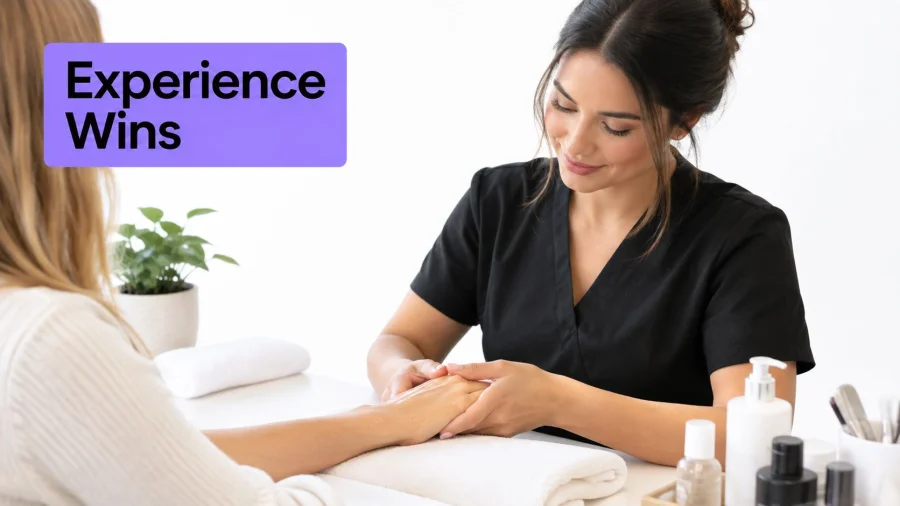
Price matters, but it doesn't win on its own. In UK beauty research, 61% of adults who received a professional beauty treatment said a pleasant experience mattered more than price (Professional Beauty). That is the clearest argument against overusing discounts in nail loyalty cards.
Reward the experience, not just the spend
A loyalty card should reinforce the parts of the appointment that clients already value. That can mean a calmer check-in, a better finish, a small upgrade, or a more personal service interaction. Those touches are harder to copy than a discount.
Referral rewards fit this logic well. A client who has a pleasant appointment is more likely to recommend the salon anyway, so the programme should make referrals feel natural rather than forced. Service quality feedback can also be folded into the experience without making people feel watched.
Avoid turning the salon into a discount machine
Discount-led cards create a race to the bottom. Clients learn to wait for the next offer, and the salon trains them to value price over service. That damages premium positioning quickly.
A stronger approach is to reward things that support the salon's reputation, such as punctual rebooking, referrals, or feedback that helps the team improve. The reward becomes part of a better client journey, not a cheap excuse to cut margin.
The rule is simple. Give clients reasons to remember how they felt, not just what they saved.
Launching Your Loyalty Program with BonusQR
A salon does not need a heavy system to launch a proper loyalty card. It needs a clear structure, a fast setup, and a way to see who is coming back. That is where digital tools make the most sense, especially when the salon wants to replace paper cards without adding more admin.
The business case for rewards is straightforward. 72% of consumers say a loyalty programme makes them more likely to spend with their preferred brand (Xero). For a nail salon, that supports the practical move from random discounts to a controlled reward system that encourages spend on the right services.
What a clean launch looks like
A sensible rollout starts with a simple QR sign-up at reception. The client scans, joins, and sees the reward rules immediately. Staff can then stamp or track the visit without chasing paper cards or digging through spreadsheets.
That is the kind of setup BonusQR is built for, a QR-based loyalty card with stamps, points, reward tracking, and customer profiles that can sit alongside menu details and rebooking prompts. It fits a salon that wants digital control without extra hardware.
For salons that want a more detailed setup path, how to start a loyalty program gives the practical sequence. The point is not fancy software. The point is a programme that clients can understand and staff can use.
Make the card do real work
A launch should not stop at sign-up. The programme should help the salon identify regulars, track who has gone quiet, and reward the behaviours that protect revenue. It should also make the return visit feel easy, because easy is what keeps the diary full.
If the salon wants a broader local-business perspective on discovering new customers through loyalty and repeat visits, discover nearby independent makers offers a useful example of how loyalty systems can support local discovery as well as retention.
The right move is simple. Stop handing out passive stamp cards. Build a loyalty system that rewards the second visit, protects margin, respects GDPR, and uses digital tracking to keep clients in cycle.
If the salon is still using paper punch cards, this is the time to replace them with a system that tracks repeat visits properly. BonusQR can help launch a QR-based loyalty card that supports stamps, rewards, and customer profiles without extra hardware. Set up the programme, train the team on the second-visit offer, and start turning first-time clients into regulars this week.