Most small business owners believe they have a loyalty strategy simply because they hand out punch cards or offer a discount after a tenth purchase. That assumption is costing them repeat customers. A customer loyalty ecosystem is something far more intentional: it connects rewards mechanics, customer touchpoints, behavioral triggers, and ongoing measurement into one unified system. This guide breaks down every core component, shows you how they work together, and gives you a practical framework to build a loyalty ecosystem that actually drives retention and revenue growth.
Key Takeaways
| Point | Details |
|---|---|
| Ecosystem approach | Customer loyalty is built by combining rewards, omnichannel engagement, orchestration, and continuous measurement for lasting impact. |
| Effective mechanics | Simple, visible, and attainable loyalty mechanics drive repeat participation and boost retention. |
| Tech-powered personalization | Leveraging digital tools and mobile apps creates tailored offers and frictionless rewards, increasing depth of engagement. |
| Avoid pitfalls | Watch out for hidden rewards, siloed data, retention-only thinking, and misaligned economics to ensure your loyalty program succeeds. |
| Behavioral insight | Rely on behavioral segmentation rather than simple frequency to accurately measure and optimize loyalty. |
What is a customer loyalty ecosystem?
After setting the stage, let’s clarify exactly what a loyalty ecosystem means for your business.
A loyalty ecosystem is not just a points card or a digital coupon. As Deloitte research confirms, a loyalty ecosystem combines value exchange rules, touchpoints, lifecycle orchestration, and measurement into a single, coherent system. Each component depends on the others. Remove one, and participation drops. Ignore measurement, and you lose the ability to improve.
For an SMB, this means thinking beyond the transaction. Your ecosystem should recognize a customer when they walk in or browse online, offer them relevant rewards, guide them through lifecycle stages (new, active, at-risk, lapsed), and give you clear data on what’s working.
Here’s how the building blocks connect:
- Value exchange rules: What customers earn and what they get in return
- Touchpoints: Every place a customer interacts with your brand, from your app to in-store
- Orchestration: How triggers and timing guide customers through their journey
- Measurement: Tracking participation, retention rates, and profit impact
Understanding these connections early will shape every decision you make. To see how branding fits into this structure, explore loyalty branding strategies and branded loyalty benefits for SMBs.
| Isolated loyalty tactics | True loyalty ecosystem |
|---|---|
| One-time discount offers | Ongoing value exchange across stages |
| Single channel (stamp card only) | Multi-channel: app, web, in-store |
| No data collection | Real-time analytics and segmentation |
| No customer journey mapping | Lifecycle-triggered engagement |
| Reactive campaigns | Automated, behavior-based orchestration |
“A loyalty program built in isolation addresses symptoms, not root causes. A loyalty ecosystem addresses the full customer relationship.” This framing, supported by industry definitions of a loyalty ecosystem, helps SMBs see why piecemeal tactics fall short.
Core mechanics: How value exchange drives participation
With the ecosystem definition set, let’s dive into its engine: the mechanics that motivate customer action.
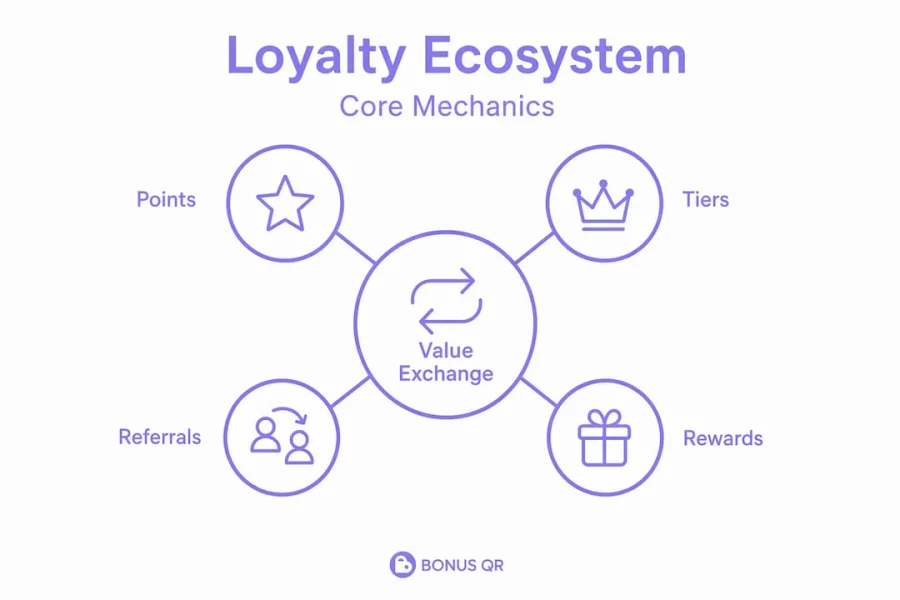
Loyalty mechanics are the rules that govern how customers earn and redeem value. Choosing the right combination for your business is one of the most important decisions you’ll make. Effective loyalty mechanics align with customer motivations and operational constraints, meaning the best mechanic for a coffee shop differs from the best one for a boutique clothing retailer.
Here are the most common mechanics available to SMBs:
- Points: Customers earn points per dollar spent. Points are flexible and work across many categories. They’re familiar and low-friction to explain.
- Tiers: Customers unlock status levels (e.g., Silver, Gold, Platinum) based on spend or visits. Tiers motivate higher spending but require more management.
- Referrals: Customers earn rewards for bringing in new customers. Referrals expand your audience at low acquisition cost.
- Stamp cards: Customers collect digital stamps per visit or purchase, then redeem a free product or discount. Simple, visual, and effective for repeat visits.
- Subscriptions: Customers pay a fee for access to exclusive benefits. Best for businesses with high visit frequency and strong brand loyalty.
Each mechanic has trade-offs. Points programs can become confusing if you stack too many rules. Tiers can feel unattainable if thresholds are set too high. Referral programs can generate low-quality leads if the incentive is misaligned. Stamp cards work well for food and beverage but may feel thin for higher-value retail.
For a deeper look at matching mechanics to your business model, review the full breakdown of reward types for retailers.
| Mechanic | Best for | Key risk | Ease of setup |
|---|---|---|---|
| Points | Retail, dining, services | Over-complexity | Moderate |
| Tiers | High-frequency businesses | Unattainable thresholds | High effort |
| Referrals | Service businesses, SaaS | Low-quality referrals | Low to moderate |
| Stamp cards | Cafes, salons, quick service | Feels limited | Very easy |
| Subscriptions | Strong brand loyalty | Churn if value isn’t clear | Moderate |
Common pitfalls include setting reward thresholds so high that customers give up before redeeming, hiding program details in fine print, and over-messaging customers until they opt out. The fix is straightforward: keep mechanics visible, attainable, and easy to explain in one sentence. If you can’t describe your program clearly in under 30 seconds, your customers won’t bother joining it.
To understand how digital mechanics create measurable value, see why digital loyalty programs drive growth for SMBs. For ideas on keeping costs manageable, cost-effective reward options can also supplement digital mechanics with tangible items.
Pro Tip: Test your loyalty mechanic with a small group of existing customers before full launch. Ask them directly: “Would you participate in this? What’s confusing?” Their answers will save you weeks of guessing.
Omnichannel engagement and personalization
Once mechanics are chosen, maximizing reach and impact requires smart omnichannel engagement.

Omnichannel (meeting customers wherever they are, seamlessly) is no longer a nice-to-have for loyalty programs. It’s the standard that customers expect. Next-generation digital loyalty emphasizes omnichannel engagement and minimizing friction, with personalized offers and frequent updates via mobile apps. That means your customer should be able to earn points in-store, check their balance on your website, and redeem a reward through your mobile app without any disruption.
Here’s a practical roadmap for building omnichannel engagement into your ecosystem:
- Choose a platform that works across channels. Your loyalty platform should connect your physical store, website, and mobile experience without requiring complex POS integration. Many SMBs lose momentum at this step because they assume they need expensive hardware.
- Enable instant push notifications. When a customer earns a reward or a new offer is available, a real-time push notification dramatically increases redemption rates. Generic monthly emails don’t drive the same urgency.
- Personalize offers based on behavior. A customer who buys coffee every weekday morning doesn’t need a discount on a Wednesday afternoon. Use purchase history to send offers that match real patterns.
- Make redemption frictionless. Every extra step between “I have a reward” and “I used it” is a drop-off point. QR codes, digital stamp cards, and wallet integrations reduce that friction significantly.
- Keep the program visible. Customers forget they’re enrolled. Regular, relevant touchpoints, including app banners, receipts, and social reminders, keep your program top of mind.
Personalized retail offers extend this logic to physical goods as well, showing that personalization works across both digital and tangible reward formats.
Younger customer segments respond especially well to mobile-first loyalty programs. They expect instant feedback, visual progress indicators, and offers that feel tailored rather than broadcast. Businesses that deliver this level of personalization report significantly higher satisfaction scores and stronger word-of-mouth referrals.
For a broader view of how to build engagement that sticks, explore customer engagement strategies designed specifically for retail environments.
Pro Tip: Use automated triggers rather than manual campaigns wherever possible. Set rules like “send a reward when a customer hasn’t visited in 21 days” or “celebrate the customer’s first anniversary with a bonus offer.” Automation keeps your program active without adding work to your daily operations.
Orchestration, measurement, and avoiding ecosystem pitfalls
As engagement increases, measurement and governance become crucial to sustaining real loyalty and avoiding costly mistakes.
Orchestration is the process of guiding customers through their loyalty journey using triggers, personalized offers, and behavioral milestones. Think of it as the logic behind your ecosystem: when a customer hits a spend threshold, they receive a tier upgrade notification. When they’ve been inactive for 30 days, they get a win-back offer. When they refer a friend, both parties receive instant confirmation and a reward. These aren’t manual tasks; they’re automated rules that run continuously.
Orchestration only pays off when paired with solid measurement. You need to track more than enrollment numbers. The metrics that matter include:
- Active participation rate: What percentage of enrolled customers actually earn or redeem rewards each month?
- Redemption rate: Are customers actually using the rewards they earn, or are points just accumulating without action?
- Repeat purchase rate: Are loyalty members buying more frequently than non-members?
- Revenue per loyal customer: Are program participants generating higher average order values?
- Churn rate by segment: Which customer groups are dropping off, and at what stage in the lifecycle?
Without these data points, you’re managing blind. For guidance on calculating and interpreting these numbers, start with tracking retention rates and the full retention metrics guide.
“Loyalty programs that don’t tie engagement to profit are just expensive marketing experiments.” Measurement closes the loop between customer behavior and business outcomes.
Common ecosystem pitfalls are well-documented. Failure modes include treating loyalty as retention-only, unsupported operations, siloed data, and reward economics misalignment. Breaking each of these down:
- Retention-only thinking: Loyalty programs that focus only on keeping existing customers miss the acquisition and advocacy value that a healthy ecosystem generates.
- Unsupported operations: If your team doesn’t understand how the program works, frontline errors erode customer trust quickly.
- Data silos: When your loyalty platform doesn’t share data with your sales system or CRM, you lose the behavioral insight needed to personalize effectively.
- Reward economics misalignment: Offering rewards that are too generous hurts margins. Offering rewards that feel stingy kills participation. Regular audits of your reward cost-to-value ratio are essential.
Steps to govern your ecosystem effectively:
- Assign a clear owner for the loyalty program, even in a small team.
- Review program metrics monthly, not quarterly.
- Test new mechanics on a segment before rolling out broadly.
- Document your orchestration logic so it can be updated as your business grows.
- Train all customer-facing staff on how to explain the program in simple terms.
For a practical checklist of what to avoid, review the full list of loyalty program mistakes and proven retention best practices for retail businesses.
A smarter approach: Why frequency can mislead loyalty decisions
Having examined orchestration and pitfalls, here’s a candid perspective on what most SMBs miss about measuring loyalty.
Many business owners look at purchase frequency as their primary loyalty indicator. If a customer visits twice a week, they must be loyal. Right? Not necessarily. Frequency does not reliably equal loyalty; segmentation should be based on behavioral patterns and needs. A customer who stops at your bakery every morning because it’s on their commute route isn’t loyal to you. They’re loyal to their routine. The moment that route changes, so does their buying behavior.
This distinction matters enormously for how you invest in loyalty programs. If you’re rewarding high-frequency customers simply because they show up often, you may be spending budget on people who would visit regardless of any program. Meanwhile, the moderately frequent customer who genuinely prefers your business over competitors, and who talks about you to friends, may be receiving no special attention at all.
The smarter approach is behavioral segmentation. Break your customer base into groups based on patterns: what they buy, when they buy, how they respond to offers, and how long they’ve been customers. Then build trigger-based engagement that speaks to each group’s actual motivation.
For example, a customer who consistently buys gift items near holidays is motivated by occasion. Send them a heads-up offer two weeks before major holidays. A customer who tries new menu items frequently is motivated by novelty. Reward their exploration. These targeted strategies outperform blanket frequency rewards at a fraction of the cost.
This is where why loyalty drives retention becomes essential reading: it distinguishes between behavioral loyalty (habit) and attitudinal loyalty (genuine preference), and explains why the latter drives long-term profitability.
Pro Tip: Layer your metrics. Combine frequency with sentiment indicators like referral activity, review rates, and reward redemption behavior. A customer who rarely visits but consistently refers new people is more valuable to your ecosystem than one who visits daily out of convenience.
Next steps: Build your own digital loyalty ecosystem
With a clearer understanding of how loyalty ecosystems work, exploring the right tools is the logical next step for your business.
BonusQR is built specifically for SMBs that want to move beyond punch cards and basic discounts. The platform gives you the flexibility to combine points collection, digital stamp cards, cashback, coupons, and tiered rewards into a single, customizable program that works across mobile and web without requiring POS integration.
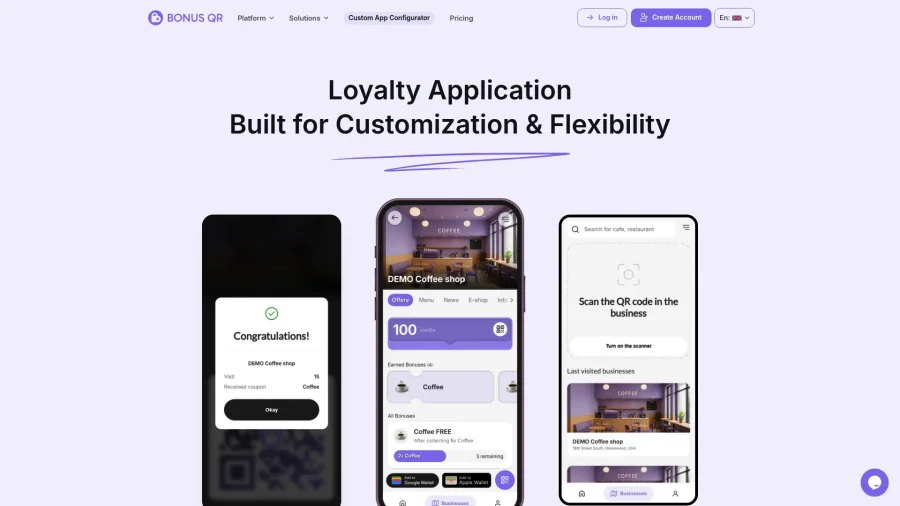
Every component of the ecosystem covered in this guide, from mechanics and omnichannel engagement to orchestration and real-time analytics, is available within BonusQR’s platform. You can set up automated triggers, send personalized push notifications, track participation rates, and adjust your program as your business evolves. Whether you’re launching your first loyalty program or rebuilding one that’s underperforming, BonusQR’s free tier lets you start immediately with no technical barriers. Visit bonusqr.com to explore plans and see which features match your current business needs.
Frequently asked questions
What is the most important feature of a digital loyalty ecosystem?
The most important feature is seamless integration of earning and redeeming rewards across all customer touchpoints, combined with personalization that keeps customers engaged. Next-generation digital loyalty specifically emphasizes omnichannel engagement and minimizing friction in redemption and access to rewards.
How can I prevent loyalty programs from failing?
Avoid hidden, hard-to-reach rewards, data silos, and reward generosity that harms profitability, and regularly measure engagement and adjust mechanics based on real results. Common failure modes include friction, unsupported operations, reward economics misalignment, and siloed data.
Should I focus on purchase frequency to measure loyalty?
No. Frequency can be misleading because buying patterns often reflect habits or convenience, not genuine brand preference. Segmentation based on behavioral patterns and customer needs produces far more actionable loyalty insights.
What mechanics work best for SMB loyalty?
Simple, visible mechanics like points, tiers, referrals, and attainable stamp rewards drive engagement and repeat behavior for most SMBs. Effective loyalty mechanics work best when they align directly with customer motivations and the operational realities of your business.
Can digital loyalty ecosystems help with both retention and profit?
Yes, when properly governed, a digital loyalty ecosystem connects engagement, repeat purchases, and profitable reward structures across all your channels. Measurement and governance are what tie customer engagement to measurable business outcomes over time.


