A tiered loyalty programme is a structured rewards system that assigns customers different status levels, with escalating benefits based on their spending or engagement behaviour. Unlike flat points schemes, tiered loyalty programmes use the psychology of aspiration and exclusivity to motivate customers to spend more, engage more often, and stay longer. Brands like Starbucks, with its Gold and Rewards tiers, and Bank of America, with its Preferred Rewards programme, have demonstrated how tiered loyalty programmes outperform flat models by driving repeat purchases and increasing average spend. A 2026 industry report confirms that even small, non-monetary perks such as priority service or early access are perceived as highly meaningful by consumers, making tier design one of the most cost-effective tools in your retention arsenal.
What is tiered loyalty and how does it differ from flat programmes?
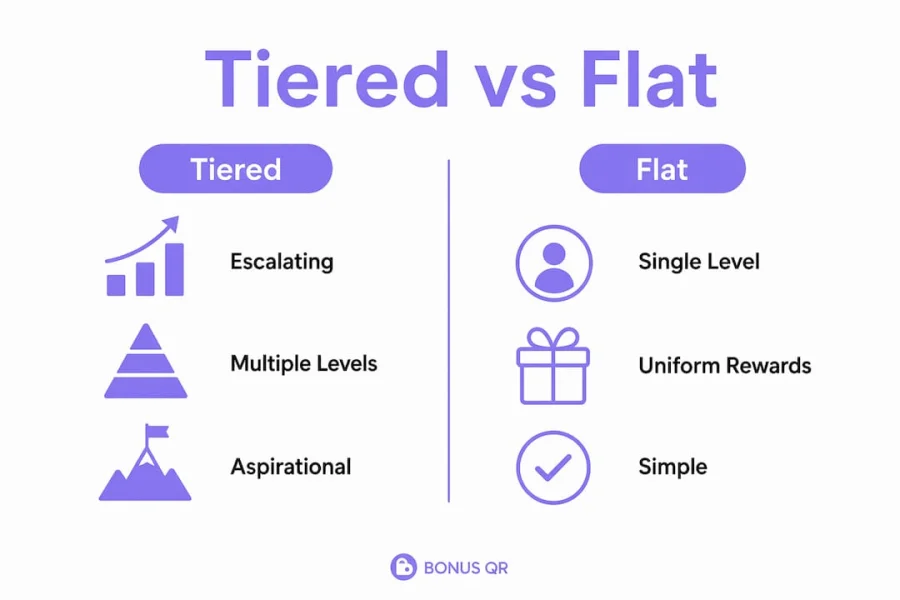
Tiered loyalty is defined as a customer rewards structure that groups members into distinct levels, typically labelled Bronze, Silver, and Gold, or customised names that reflect your brand. Each level unlocks progressively better benefits, creating a clear incentive for customers to increase their engagement or spend to reach the next tier. The critical distinction from a flat loyalty programme is motivation: flat programmes reward every customer equally regardless of behaviour, while tiered systems reward commitment with exclusivity.

In a flat programme, a customer who visits once a month earns the same rate as one who visits every week. Tiered loyalty corrects this by giving your most valuable customers a reason to feel recognised and your occasional customers a reason to aspire. This structure directly addresses one of the most persistent challenges in retention: keeping high-value customers engaged while nudging mid-tier customers upward.
The table below illustrates the core differences between tiered and flat loyalty structures:
| Feature | Tiered loyalty programme | Flat loyalty programme |
|---|---|---|
| Reward structure | Escalating benefits per level | Uniform rewards for all members |
| Customer motivation | Aspiration and status progression | Consistent but low differentiation |
| Marketing efficiency | Targets spend on highest-value segments | Distributes budget equally |
| Retention of top customers | High, due to status and exclusivity | Moderate |
| Complexity for customer | Moderate, requires clear communication | Low |
The most common and effective structure for small to mid-sized businesses is three tiers, representing entry-level, regular, and VIP customers. Three tiers provide enough aspiration to motivate progression without overwhelming customers with complexity. Businesses that push beyond five tiers often find that customers disengage because the path to the top feels unachievable.
Benefits offered at each tier typically fall into four categories: financial rewards such as cashback or discounts, experiential rewards such as exclusive events or early product access, convenience rewards such as free delivery or priority queuing, and recognition rewards such as a dedicated account manager or personalised communications. Combining these reward types across tiers is what makes a programme feel genuinely valuable rather than transactional.
What are the advantages of tiered loyalty for businesses and customers?
Tiered loyalty programmes deliver measurable advantages for both sides of the relationship, which is why they have become the preferred model for brands operating in competitive markets. For businesses, the primary benefit is the ability to allocate marketing budgets more efficiently by concentrating rewards on the most engaged customer segments. For customers, the benefit is a clear sense of progress, status, and recognition that a flat programme simply cannot replicate.
Here are the core advantages worth understanding before you design your own programme:
- Increased customer lifetime value (CLV). Customers who progress through tiers spend more over time because each level raises the perceived cost of switching to a competitor. Losing Gold status at your business to start again elsewhere is a genuine deterrent.
- Higher repeat purchase frequency. Tiered models increase repeat purchases by giving customers a concrete reason to return before they would otherwise. The next tier threshold acts as a spending target.
- Efficient resource allocation. You are not spending the same reward budget on a customer who visits twice a year as on one who visits twice a week. Tiers let you invest where the return is highest.
- Brand affinity through exclusivity. Customers at higher tiers feel a genuine connection to your brand because their status signals something about them. This emotional attachment is far harder for competitors to replicate than a price match.
- Broad appeal across spending segments. Entry-level tiers capture occasional customers and give them a reason to engage, while VIP tiers retain your most profitable relationships.
“Exclusivity and aspiration are core psychological drivers making tiered loyalty powerful, particularly when paired with achievable incentives that customers can realistically reach.” — Customer Experience Dive, 2026
The practical implication here is significant. You do not need a large budget to make tiered loyalty work. Priority service, early access to new products, or a personalised birthday offer costs very little to deliver but carries disproportionate perceived value at higher tiers. The most effective perks are those that meaningfully differentiate tiers and make progression feel worthwhile.
What are common pitfalls when designing tiered loyalty programmes?
Designing a tiered loyalty programme is straightforward in principle but easy to get wrong in practice. The most common failures share a single root cause: the programme was designed from the business’s perspective rather than the customer’s. Understanding where other businesses have stumbled will save you significant time and customer goodwill.
The most frequent mistakes fall into these categories:
- Over-complexity in tier progression. When customers cannot quickly understand how to move from one tier to the next, they disengage entirely. Unclear progression paths are one of the leading causes of loyalty programme abandonment. Keep the rules simple enough to explain in two sentences.
- Thresholds set too far apart. If a customer joins your Bronze tier and sees that Gold requires ten times their current annual spend, they will not try. Thresholds need to feel achievable within a realistic timeframe, typically six to twelve months of normal purchasing behaviour.
- Undifferentiated rewards between tiers. If the difference between Silver and Gold is a marginally higher cashback rate, customers will not feel motivated to progress. Each tier must offer something qualitatively different, not just quantitatively more.
- Ignoring non-spend engagement. Customers who refer friends, leave reviews, or engage on social media are valuable even if their direct spend is modest. Programmes that only reward spend miss an opportunity to build a broader community of advocates.
- Poor communication of tier status and benefits. Customers who do not know what tier they are in, or what they need to do to progress, are customers who will forget your programme exists. Confusion over point systems or unclear benefit descriptions actively harm loyalty efforts.
Pro Tip: Before launching publicly, run your tier mechanics as “invisible tiers” internally. Segment your existing customer base into the proposed tiers using historical data and observe whether the thresholds feel realistic and whether the reward distribution makes commercial sense. This internal testing approach lets you refine the design without risking customer frustration or backlash.
One additional pitfall worth noting is the temptation to launch with too many tiers to appear premium. Five or more tiers create administrative complexity, dilute the exclusivity of each level, and make it harder for customers to understand where they stand. Start with three tiers, measure behaviour, and expand only if the data supports it.
How to implement tiered loyalty effectively
Effective implementation of a tiered loyalty system starts with data, not design. Before you name a single tier or choose a reward, analyse your existing customer base to understand the natural distribution of spend and visit frequency. This tells you where realistic tier thresholds sit and prevents you from setting targets that either give away too much or ask too much.
The steps below outline a practical path from concept to launch:
- Analyse your customer data. Segment customers by spend, visit frequency, and engagement over the past twelve months. Identify natural clusters that can inform your tier thresholds.
- Define tier names and benefits. Choose names that reflect your brand rather than generic labels. A coffee shop might use Brew, Blend, and Reserve rather than Bronze, Silver, and Gold. Pair each tier with a clear, distinct set of financial, experiential, and recognition rewards.
- Set progression rules clearly. Decide whether customers progress based on cumulative spend, number of visits, points earned, or a combination. Publish these rules prominently so customers always know where they stand.
- Test with invisible tiers before launch. Apply your proposed tier structure to your existing customer database silently and observe whether the reward costs are sustainable and whether the thresholds feel achievable.
- Choose a technology platform. Managing tiers manually is not scalable. A platform like Bonusqr handles tier assignment, benefit delivery, push notifications, and real-time analytics without requiring point-of-sale integration.
- Communicate progress actively. Send customers regular updates on their tier status and how close they are to the next level. This single tactic has a measurable impact on progression rates.
Pro Tip: When launching your programme, offer a “founding member” bonus to the first cohort of sign-ups. Granting all founding members an automatic upgrade to your second tier for the first three months creates immediate goodwill, generates word-of-mouth, and gives you a larger sample of engaged customers to observe before you finalise your long-term tier thresholds.
Communication channels matter as much as the programme design itself. Use push notifications for tier progress updates, email for benefit summaries, and in-store or in-app prompts to remind customers of their current status at the point of purchase. Customers who can see their progress in real time are significantly more likely to take the action needed to reach the next tier. For practical inspiration, the loyalty programme examples for 2026 compiled by Bonusqr show how businesses across sectors have structured their tiers and communications to drive measurable results.
How do tiered loyalty programmes impact retention and business growth?
The business case for tiered loyalty programmes is grounded in their direct effect on customer retention and revenue. Customers enrolled in tiered programmes demonstrate higher repeat purchase frequency, greater average order value, and stronger resistance to competitor offers than those in flat programmes or no programme at all. The mechanism is straightforward: the closer a customer is to the next tier, the more motivated they are to make an additional purchase rather than shop elsewhere.
The table below summarises the key growth metrics associated with well-designed tiered loyalty programmes:
| Growth metric | Impact of tiered loyalty |
|---|---|
| Repeat purchase frequency | Increases as customers pursue tier thresholds |
| Average order value | Rises when customers consolidate spend to qualify faster |
| Customer churn rate | Reduces among mid and high-tier members due to status investment |
| Marketing ROI | Improves through targeted spend on highest-value segments |
| Customer advocacy | Grows as top-tier members feel recognised and valued |
Tiered programmes also improve your ability to identify and retain your most profitable customers before they churn. A customer who drops from Gold to Silver is sending a clear signal that their engagement is declining. That signal gives you an opportunity to intervene with a targeted offer or personal outreach before they leave entirely. Flat programmes offer no equivalent early warning system.
For businesses looking to retain their best customers, the tier structure itself acts as a retention mechanism. The perceived cost of losing status is a powerful psychological anchor that keeps high-value customers loyal even when a competitor offers a short-term price advantage. Brands that build loyalty tiers with this principle in mind consistently outperform those that treat loyalty as a discount mechanism rather than a relationship tool.
Key takeaways
Tiered loyalty programmes work because they combine the psychology of aspiration with a structured commercial incentive, giving customers a clear reason to spend more, engage more often, and stay loyal longer.
| Point | Details |
|---|---|
| Definition and structure | Tiered loyalty assigns customers to status levels with escalating rewards based on spend or engagement. |
| Three-tier model | Three tiers offer the best balance of simplicity and aspirational motivation for most businesses. |
| Reward variety matters | Combining financial, experiential, convenience, and recognition rewards makes each tier feel meaningfully different. |
| Avoid complexity | Unclear progression rules and unachievable thresholds are the leading causes of programme abandonment. |
| Test before launch | Use invisible tiers internally to validate thresholds and reward costs before going public. |
Why simplicity is the most underrated principle in tiered loyalty design
I have reviewed and worked with loyalty programmes across retail, hospitality, and services, and the pattern is consistent: the programmes that perform best are almost always the simplest ones. Not the ones with the most tiers, the most reward categories, or the most sophisticated point calculations. The ones where a customer can understand their status and their next goal in under thirty seconds.
The temptation when designing a tiered system is to add complexity because it feels more premium. More tiers, more currencies, more conditions. In practice, every layer of complexity you add is a layer of friction between the customer and the behaviour you want them to take. The invisible tiers approach is one of the most practical tools I have seen businesses use to cut through this. Running your tier mechanics silently on real customer data before launch tells you more than any focus group.
The other principle I would emphasise is matching your rewards to your brand’s actual strengths. A restaurant offering priority reservations at its VIP tier is giving away something it already has. A retailer offering early access to new collections costs almost nothing to deliver but feels genuinely exclusive. The most effective tiered programmes I have seen do not spend more. They spend smarter, by giving customers something that feels valuable precisely because it is not available to everyone. If you are evaluating your current approach, the loyalty schemes that retain customers article on Bonusqr is worth reading alongside this one.
— Michal
How Bonusqr helps you build and manage tiered loyalty
Bonusqr is built for business owners and marketing managers who want to launch a tiered loyalty programme without the complexity of enterprise software. The platform supports multiple reward types including points, cashback, stamps, and tiered cashback, all manageable from a single dashboard. You can set tier thresholds, automate benefit delivery, and send push notifications to customers as they approach the next level, with no point-of-sale integration required.
Bonusqr’s loyalty system features include real-time analytics, branding customisation, and mobile and web app integration, giving you the tools to monitor programme performance and adjust tiers as your customer data evolves. Whether you are launching your first programme or refining an existing one, Bonusqr provides a practical, scalable foundation. Explore the full feature set at Bonusqr to see how quickly you can get a tiered programme live for your business.
FAQ
What is the difference between tiered and flat loyalty programmes?
A tiered loyalty programme assigns customers to status levels with escalating rewards based on their spend or engagement, while a flat programme offers the same reward rate to all members regardless of behaviour. Tiered programmes are more effective at retaining high-value customers and motivating increased spend.
How many tiers should a loyalty programme have?
Three tiers is the recommended starting point for most businesses, representing entry-level, regular, and VIP customers. This structure provides enough aspiration to motivate progression while remaining simple enough for customers to understand and engage with.
What rewards work best in a tiered loyalty programme?
The most effective tiered programmes combine financial, experiential, convenience, and recognition rewards across tiers, with each level offering something qualitatively different rather than simply more of the same. Non-monetary perks such as priority service or early access are perceived as highly meaningful by customers.
How do I set realistic tier thresholds?
Analyse your existing customer data to identify natural clusters in spend and visit frequency over the past twelve months. Set thresholds that the majority of your mid-tier customers can realistically achieve within six to twelve months of normal purchasing behaviour.
Can small businesses benefit from tiered loyalty programmes?
Yes. Tiered loyalty programmes are scalable and do not require large budgets. Small businesses can use non-monetary rewards such as priority service, personalised offers, or exclusive access to deliver genuine value at higher tiers without significant additional cost.


