Customer lifetime value (CLV) is the total net profit a business expects to earn from a customer throughout their entire relationship with the company. Known formally as customer lifetime value or CLV, it goes beyond tracking what a customer spends today. CLV measures the present value of projected future cash flows from that relationship, accounting for costs, margins, and the full duration of the customer’s time with your business. For business owners and marketers, CLV is one of the most practical financial metrics available. It tells you how much a customer is genuinely worth, not just at the point of sale, but across every future interaction. Understanding CLV gives you a clear basis for decisions about marketing spend, retention investment, and long-term growth.
How is customer lifetime value calculated?
The standard CLV formula multiplies three core inputs: Average Purchase Value, Purchase Frequency, and Customer Lifespan. Each input is straightforward on its own, but combining them accurately requires clean, consistent data.
Here is how the calculation works step by step:
-
Calculate average purchase value. Divide your total revenue over a set period by the number of purchases made in that same period. If your shop generated £50,000 from 1,000 transactions in a year, your average purchase value is £50.
-
Calculate purchase frequency. Divide the total number of purchases by the number of unique customers. If those 1,000 transactions came from 400 customers, your purchase frequency is 2.5 purchases per customer per year.
-
Calculate customer lifespan. Estimate how long a customer typically continues buying from you. For subscription businesses, this is straightforward. For retail or hospitality, you need cohort data or predictive modelling to estimate it reliably.
-
Multiply the three figures. Using the example above, if your average customer stays for three years: £50 × 2.5 × 3 = £375 CLV per customer.
-
Adjust for profit margin. Revenue-based CLV overstates the real picture. Multiply your CLV figure by your net profit margin to get the true financial value. If your margin is 20%, the profit-based CLV is £75 per customer.
-
Apply a discount rate for predictive CLV. Future cash flows are worth less than present ones. Applying a discount rate converts projected future profits into today’s money, giving you a more accurate figure for long-term planning.
The data requirements matter as much as the formula itself. You need accurate purchase histories, reliable customer identifiers, and a realistic lifespan estimate. Businesses need comprehensive transactional data and the right tools to measure CLV effectively, including software that can segment customers and track behaviour over time.
Pro Tip: For non-subscription businesses, estimating customer lifespan is the hardest part of the calculation. Use cohort analysis: group customers by their first purchase month and track how many are still active after 12, 24, and 36 months. This gives you a data-backed lifespan figure rather than a guess.

What are the two main types of customer lifetime value?
CLV is not a single, fixed number. It comes in two distinct forms, and knowing which one you are working with changes how you use it.
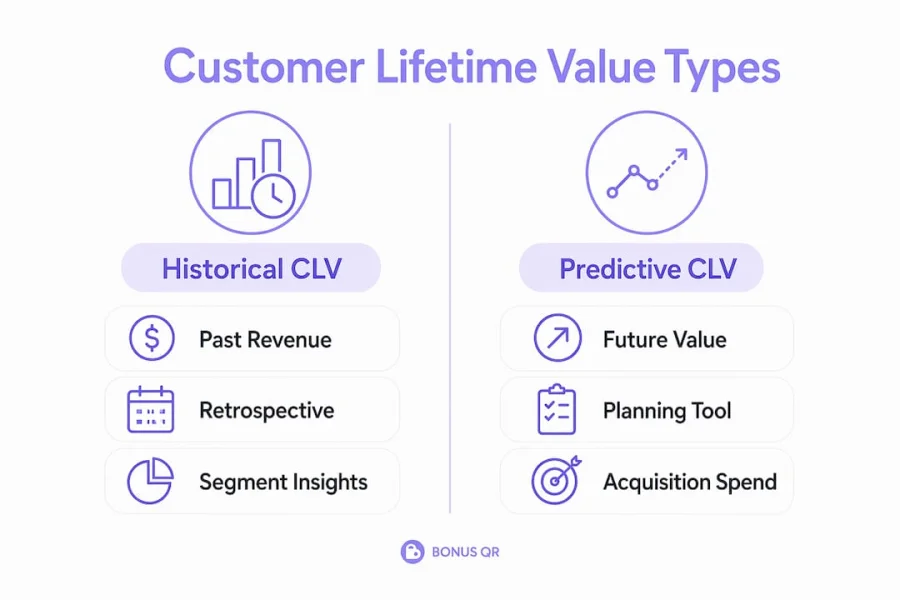
| Type | Definition | Best used for |
|---|---|---|
| Historical CLV | Total revenue or profit already generated by a customer | Identifying your most valuable existing customers |
| Predictive CLV | Forecast of future value based on past behaviour and modelling | Acquisition planning, retention budgets, and segmentation |
| Simple predictive | Uses average values and a fixed lifespan estimate | Small businesses with limited data |
| Complex predictive | Uses machine learning or probabilistic models | Larger businesses with rich transaction histories |
Historical lifetime value reflects money already spent. It is a backward-looking measure, useful for identifying which customers have delivered the most profit to date. Predictive CLV looks forward, estimating what a customer will spend in the future based on their past behaviour and patterns across your customer base.
Predictive CLV is the more powerful tool for planning. It tells you how much you can afford to spend acquiring a new customer, and how much it is worth investing to retain an existing one. A customer with a high predicted CLV justifies a larger retention budget than one who is likely to make a single purchase and leave.
The complexity of predictive CLV models varies widely. Simple versions use average purchase values and a fixed lifespan estimate, which is perfectly adequate for most small businesses. More complex models use probabilistic methods or machine learning to account for individual customer behaviour, seasonal patterns, and churn risk. The right level of complexity depends on your data quality and the decisions you need to make.
Why is customer lifetime value important for business growth?
CLV is a financial and strategic tool that shapes decisions across marketing, sales, and customer service. Its importance lies in what it tells you about the real economics of your customer relationships.
CLV acts as an upper limit on what you should spend to acquire or retain a customer. This is one of its most practical applications. If your average CLV is £200, spending £250 to acquire a new customer is a loss-making decision. CLV gives you a hard ceiling for your customer acquisition cost (CAC) and retention budgets.
CLV also shifts your focus from short-term transactions to long-term relationship health. A customer who buys once at a high margin may look attractive on a monthly sales report. A customer who buys regularly at a lower margin over five years is often worth considerably more. CLV makes that distinction visible.
Key reasons CLV matters for your business:
- Marketing efficiency. CLV lets you compare the return on different acquisition channels. A channel that brings in high-CLV customers is worth more than one that brings in high volumes of low-CLV customers.
- Retention investment. Knowing a customer’s predicted CLV tells you how much it is worth spending to keep them. This prevents both under-investment (losing valuable customers) and over-investment (spending more than a customer is worth).
- Customer segmentation. CLV-based segmentation identifies your most valuable customers so you can prioritise service, personalisation, and loyalty rewards accordingly.
- Profitability assessment. CLV compared to acquisition and retention costs reveals whether your business model is genuinely profitable at the customer level.
“CLV promotes a customer relationship asset mindset, focusing on long-term value rather than quarterly income.” — Wikipedia on Customer Lifetime Value
One risk worth noting: CLV estimates that ignore costs give a misleading picture. CLV must account for expenses including customer service, returns, and retention activity, not just revenue. A customer who generates high revenue but requires constant support may have a lower true CLV than their spending suggests.
How can businesses improve customer lifetime value?
Improving CLV means increasing either how long customers stay, how often they buy, how much they spend per visit, or some combination of all three. The most effective customer retention strategies address all of these levers simultaneously.
Here are the core approaches that move the needle:
- Loyalty programmes. Loyalty programmes enhance retention, purchase frequency, and overall CLV. A well-designed points or rewards system gives customers a concrete reason to return rather than switching to a competitor.
- Personalised communication. Customers who receive relevant offers and messages based on their purchase history buy more often and stay longer. Generic mass marketing does not build the relationship that drives CLV growth.
- Onboarding and early engagement. The first 90 days of a customer relationship are critical. Customers who engage early and experience clear value are significantly more likely to become long-term buyers. A structured onboarding sequence, whether through email, push notifications, or in-store interaction, sets the foundation.
- Upselling and cross-selling. Increasing average purchase value is one of the fastest ways to lift CLV. Train your team and configure your digital touchpoints to suggest complementary products at the right moment.
- Reducing churn. Effective retention strategies reduce churn and directly extend customer lifespan. Identifying at-risk customers early, through declining purchase frequency or reduced engagement, allows you to intervene before they leave.
- Customer service quality. Poor service is one of the leading causes of customer churn. Investing in service quality pays back through longer customer lifespans and higher CLV.
Tracking CLV by customer segment is equally important. Your top 20% of customers by CLV likely account for a disproportionate share of your profit. Knowing who they are lets you direct your best retention efforts where they will have the greatest financial impact.
Pro Tip: Do not apply the same retention budget to every customer. Calculate CLV by segment, then set a maximum retention spend as a percentage of each segment’s predicted value. This prevents you from spending more to retain a customer than they are actually worth.
Acquisition versus retention is a common debate, but CLV resolves it with numbers. Retaining an existing customer is almost always cheaper than acquiring a new one. CLV quantifies exactly how much cheaper, giving you a data-backed case for investing in loyalty programme benefits rather than pouring budget into paid acquisition alone.
Key takeaways
Customer lifetime value is the single most important metric for understanding the true profitability of your customer relationships, and every retention and acquisition decision should be anchored to it.
| Point | Details |
|---|---|
| CLV definition | CLV is the total net profit expected from a customer over their full relationship with your business. |
| Core formula | Multiply average purchase value by purchase frequency and customer lifespan, then adjust for profit margin. |
| Two CLV types | Historical CLV measures past value; predictive CLV forecasts future value for planning and budgeting. |
| Strategic use | CLV sets the upper limit for acquisition and retention spend, preventing loss-making budget decisions. |
| Improving CLV | Loyalty programmes, personalised communication, and early engagement are the most effective ways to increase CLV. |
CLV in practice: what I have learned from working with business owners
The biggest mistake I see business owners make with CLV is calculating it on revenue alone. They look at what a customer spends, feel encouraged, and set acquisition budgets accordingly. Then they wonder why the numbers do not add up at the end of the year. The moment you factor in service costs, returns, and the actual time your team spends on certain customers, the picture changes significantly. Some of your highest-spending customers are barely profitable once you account for the support they require.
The second challenge is lifespan estimation. Estimating customer lifespan in non-subscription contexts is genuinely difficult, and most small businesses underestimate it or guess. I have seen businesses use three years as a default lifespan with no data to support it. Cohort analysis takes time to set up, but it is the only way to get a number you can actually trust.
What I find most powerful about CLV is its ability to align teams. When sales, marketing, and customer service all work from the same CLV figures, they stop pulling in different directions. Marketing stops chasing volume at any cost. Sales stops discounting to close deals that erode long-term value. Service understands which customers deserve priority attention. CLV becomes a shared language for the whole business.
The practical starting point is simpler than most people expect. Pull your transaction data, segment your customers by purchase frequency and average spend, and calculate a basic CLV for each segment. You do not need a complex model to start making better decisions. You need a number that is grounded in real costs, and the discipline to use it consistently.
— Michal
How Bonusqr supports higher customer lifetime value
Bonusqr is a loyalty platform built to help businesses increase purchase frequency, extend customer lifespan, and grow CLV through digital loyalty programmes. The platform supports points collection, stamp cards, cashback, visit rewards, and coupon distribution, all configurable without POS integration. Push notifications and real-time analytics let you act on customer behaviour as it happens, rather than reviewing it weeks later. For businesses ready to put CLV thinking into practice, the Bonusqr loyalty platform provides the tools to turn retention strategy into measurable results. A free tier is available, making it accessible for businesses at any stage of growth.
FAQ
What is the customer lifetime value definition?
Customer lifetime value is the total net profit a business expects to earn from a customer over the entire duration of their relationship. It accounts for purchase frequency, average spend, customer lifespan, and costs.
How do you calculate customer lifetime value?
The basic CLV formula is: Average Purchase Value × Purchase Frequency × Customer Lifespan. Multiply the result by your net profit margin to convert revenue-based CLV into a profit-based figure.
What is a good average customer lifetime value?
There is no universal benchmark. A good CLV is one that exceeds your customer acquisition cost and retention spend combined. The ratio of CLV to acquisition cost is the more useful measure for most businesses.
What influences customer lifetime value most?
Customer lifespan and purchase frequency have the greatest influence on CLV. Loyalty programmes, personalised communication, and service quality are the primary drivers of both.
Why should small businesses track customer lifetime value?
CLV tells you which customers are genuinely profitable and how much you can afford to spend keeping them. Without it, retention and acquisition budgets are based on guesswork rather than financial reality.


