
 Deutsch
 Español
 Français
 Italiano
 Magyar
 Polski
 Slovenčina
 Čeština
The same customers keep walking through the door. A café owner recognises the morning flat white order. A salon receptionist knows which clients rebook without fail. A shop manager can spot regulars by face alone.
But recognition isn't a system.
Without a clubcard, those repeat visits stay mostly invisible. The business can't easily reward loyal customers, can't see who drifts away, and can't turn everyday transactions into a reason to come back again. That's why the question what is a Clubcard matters far beyond Tesco or any other major chain. For a small business, it's often the difference between hoping for repeat trade and actively building it.
What Is a Clubcard and Why Does It Matter
A clubcard is a loyalty tool that gives customers a reason to keep buying from the same business. In simple terms, the customer joins, identifies themselves when they buy, and earns some form of benefit such as points, stamps, discounts, or member-only offers.
In the UK, the term 'Clubcard' is widely recognized due to Tesco. The Tesco Clubcard, introduced in 1995, was the UK's first supermarket loyalty card, and its success helped Tesco move from behind Sainsbury's to the top British retailer by using customer insight analytics, as noted in the Tesco Clubcard history.
A small business version is much simpler
A local business doesn't need Tesco-scale infrastructure to use the same core idea.
A coffee shop clubcard can reward every tenth drink. A salon clubcard can offer a discount after several visits. A restaurant clubcard can give new members a welcome reward and bring them back for a second booking. The principle is the same in every case. Reward loyalty, make repeat buying easier, and stop treating regulars like strangers.
Practical rule: If a business has repeat customers, it has a loyalty opportunity.
Why it matters to everyday trading
The true value isn't the card itself. It's what the card changes.
A clubcard helps a business:
- Recognise regulars: Staff stop relying on memory alone.
- Reward repeat behaviour: Customers get a clear reason to return.
- Create a relationship: Buying feels less transactional and more personal.
- Build switching resistance: Members think twice before going elsewhere.
For a small business owner, that's the useful definition. A clubcard isn't a plastic card from a supermarket. It's a structured way to turn repeat custom into repeatable growth.
How a Simple Card Creates Loyal Customers
A loyalty programme works because it changes the exchange. The customer doesn't just buy a coffee, haircut, meal, or product. They also identify themselves, and that gives the business a chance to learn what they come back for.
Modern loyalty cards track individual customer behaviours, including shopping timestamps, locations, and itemised purchases, which allows retailers to create highly personalised offers, according to Statista's Tesco Clubcard data summary.
Loyalty is built on recognition
For a small business, the useful lesson isn't “collect more data” in the corporate sense. It's much more practical.
A clubcard tells the business things it usually misses:
- Who visits most often
- Who hasn't returned in a while
- Which reward people care about
- Which products pull people back in
That turns guesswork into action. If a salon sees that colour clients rarely buy retail products, it can test a relevant offer. If a café notices a regular has stopped visiting, it can send a comeback incentive. If a takeaway sees members consistently buy at a certain time, it can shape offers around that habit.
The real trade-off
Customers aren't joining a clubcard for administration. They're joining because they expect something back.
That's the core trade-off. They share purchase behaviour, and the business gives value in return through convenience, rewards, or better offers. When that exchange feels fair, loyalty grows. When it feels one-sided, it doesn't.
Customers don't mind being known. They mind being tracked without getting a clear benefit.
Small businesses usually do better here than large chains because the relationship is already more human. The owner, manager, or team can use loyalty data to improve service, not just push promotions. That's where a clubcard stops being a gimmick and starts working like a real retention tool.
Physical Cards vs Modern Digital Clubcards
Traditional stamp cards still exist because they're familiar. They're cheap to understand, easy to hand out, and simple to explain at the till.
They're also limiting.
Where physical cards break down
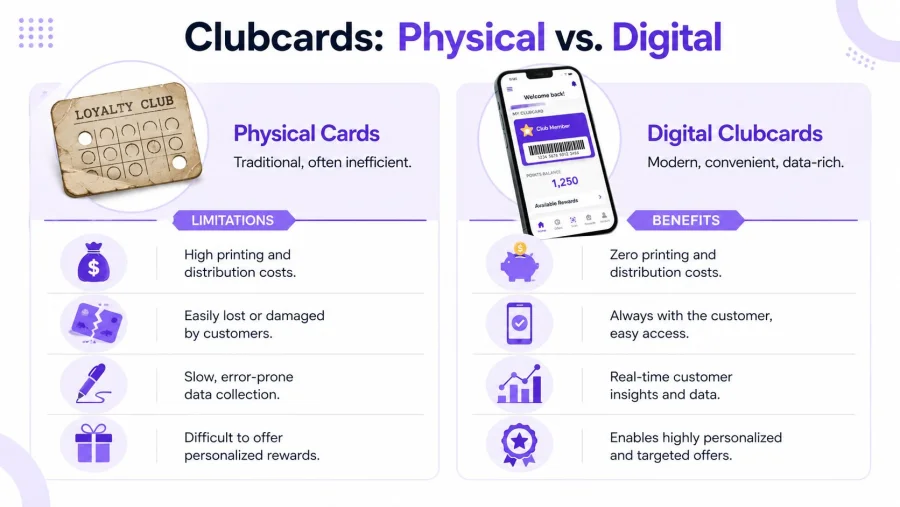
Paper and plastic cards create friction in all the wrong places. Customers lose them. Staff forget to stamp them. Owners print new batches with no real idea whether the programme is driving return visits or just giving away margin.
A physical card also creates almost no useful visibility. The business can see that it handed out cards, but not much else. There's no clear picture of who the best customers are, which rewards get redeemed, or who has disappeared.
Why digital wins
A modern digital clubcard fixes those problems because it lives on the customer's phone and gives the business a working record of loyalty activity.
Here's the practical comparison:
| Type | What works | What doesn't |
|---|---|---|
| Physical card | Easy to start, familiar format | Lost cards, reprinting, no customer-level insight, limited reward flexibility |
| Digital clubcard | Easy access on mobile, automated tracking, targeted rewards, better reporting | Requires a simple onboarding process for staff and customers |
Digital systems also make it easier to expand beyond one basic offer. A business can run visit-based rewards, spend-based rewards, welcome offers, birthday perks, or time-limited promotions without redesigning the whole programme each time.
The hidden cost of staying old-school
Many owners keep physical cards because they feel low risk. In practice, they often create a mess of manual work and weak follow-up.
That same digital shift is showing up outside retail too. Teams handling streamlining sports club memberships are moving from physical cards to mobile-first systems for the same reason. Administration gets easier, member access improves, and the organisation gains clearer visibility into engagement.
For local businesses weighing the switch, the fastest summary is this: the benefits of digital customer loyalty go well beyond convenience. Digital clubcards make loyalty measurable, and measurable loyalty is what allows a business to improve ROI instead of guessing.
Real-World Loyalty Examples for Small Businesses
A clubcard makes the most sense when you look at the businesses that use it every day. A café, salon, or restaurant does not need supermarket scale to make loyalty pay. It needs a reward that fits how customers already buy.
A coffee shop using digital stamps
For a neighbourhood café, the strongest option is often the simplest one. A digital stamp card for coffees or lunches is easy for staff to explain and easy for customers to follow. Buy a set number, get one free.
That structure works because the buying pattern is repetitive. Customers come in often, spend modest amounts, and respond well to visible progress. If you run a café, this type of clubcard usually gives the best return when the reward is close enough to feel achievable but not so generous that it eats margin.
A salon using points for future visits
Salons usually need a different setup. Visits are less frequent, ticket values are higher, and customers may book services, buy products, or both. In that case, points often work better than stamps because they let you reward a wider mix of spending.
The practical benefit is flexibility. You can reward colour appointments and retail products under the same programme, then issue money-off vouchers or member perks once a customer reaches a target. That keeps the reward relevant without forcing every visit into the same pattern.
I usually advise salon owners to keep the earning rule simple and make the reward feel worth waiting for. If clients need a calculator to understand it, staff will stop mentioning it and customers will ignore it.
A restaurant using member-only value
Restaurants often get stronger results from targeted offers than from a basic free-item card. A welcome reward can help convert first-time diners into second-visit customers. Member-only midweek offers can help fill quieter covers without discounting every table.
The principle is straightforward. Give regulars a reason to book again, but keep the offer tied to a business goal. Reuters reported that Tesco used Clubcard pricing to create clear member-only savings in its loyalty model, which shows how effective exclusive value can be when customers can see the benefit in plain terms, in its report on loyalty pricing. A small restaurant can apply the same idea with far less complexity. For example, priority access to a set menu, a midweek dessert offer, or a sign-up reward on the second visit often works better than broad discounts.
The best loyalty offers give regulars one clear reason to come back.
For more practical formats and campaign ideas, this guide to loyalty strategies for brick-and-mortar businesses is a useful next read.
Your Four-Step Plan to Launch a Loyalty Programme
A café owner launches a loyalty card on Monday, prints a stack by Tuesday, and by Friday the staff have stopped mentioning it. The offer was too vague, the reward took too long to earn, and no one decided what result the programme was supposed to drive.
That is the pattern to avoid.
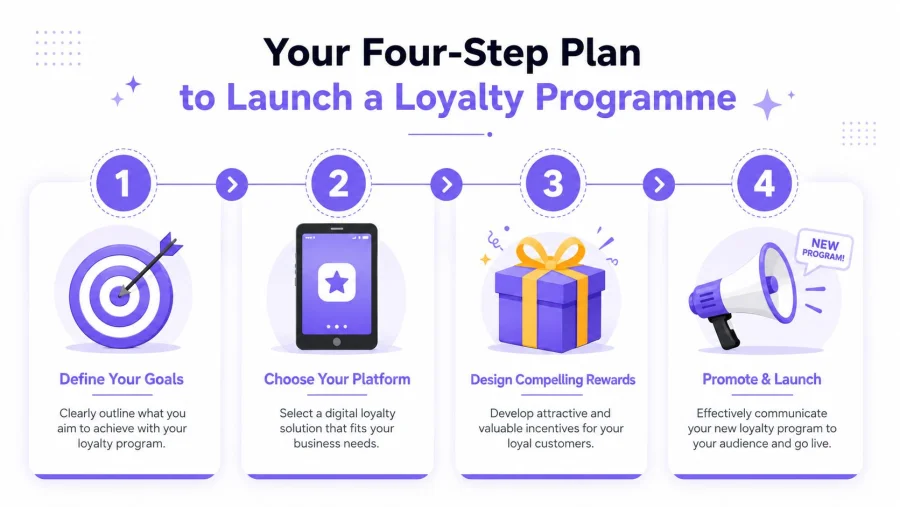
Step 1 Define the goal
Start with one business problem.
For a café, that might be getting more second visits from first-time customers. For a salon, it may be shortening the gap between appointments. For a restaurant, it could be filling quieter midweek slots. One goal makes the programme easier to explain, measure, and improve.
If the goal is “build loyalty,” the setup will usually be too broad to work well.
Step 2 Choose the reward logic
Match the reward to how people buy.
A stamp card works well for repeat, predictable purchases such as coffee, car washes, or lunch deals. Points make more sense when spend varies, such as in salons, beauty, or retail. A fixed perk, like a birthday reward or members-only offer, can work better when you want a simple reason to come back without teaching customers a full points system.
There is a trade-off here. Simple rewards get better staff adoption and faster customer understanding. Flexible rewards can give you more control, but they are harder to explain at the counter. Small businesses usually get a better return from simplicity first, then add complexity later if customer behaviour justifies it.
If you are comparing formats, these loyalty card software solutions show what is practical without building a custom system.
Step 3 Plan the launch properly
A loyalty programme needs attention on day one. If customers have to discover it on their own, sign-up rates stay low.
Use:
- Front-counter signage: Show the offer where the purchase happens.
- Staff prompts: Give the team one short line they can repeat naturally.
- Social posts: Explain the reward with one clear visual and one clear call to join.
- Post-visit reminders: Follow up while the visit is still fresh and the next purchase is easy to picture.
Keep the join process quick. If customers need several steps, staff will skip it during busy periods.
Step 4 Measure and adjust
Do a basic bench test before launch. Can a staff member explain the offer in one sentence? Can a customer understand the benefit in a few seconds? If not, simplify it.
Then watch the numbers that matter to your goal. Track joins, repeat visits, reward redemptions, and whether the programme changes buying behaviour in a profitable way. If customers join but rarely redeem, the reward may feel too distant. If too many people redeem too quickly, the margin may be wrong. As noted earlier, large loyalty schemes are deliberate about reward maths. Small businesses should be too, even with a much simpler setup.
A clubcard should not become another admin job. It should help you get more repeat business with a format your team will use.
The Easiest Way to Start Your Digital Clubcard
For most small businesses, the biggest barrier isn't the idea of loyalty. It's the fear that setup will be expensive, technical, or time-consuming.
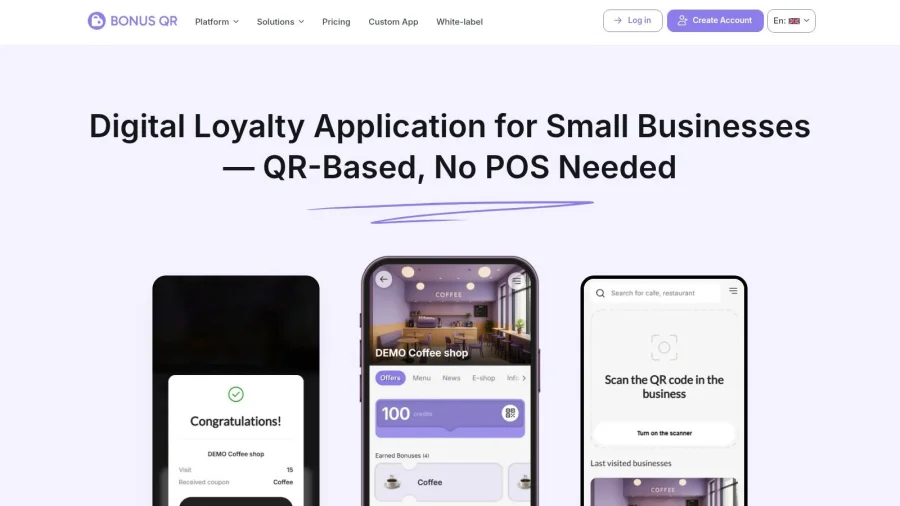
That's why QR-based systems are gaining ground. They remove the usual friction. No piles of printed cards. No extra hardware on the counter. No complicated customer journey.
What a modern setup should include
A practical digital clubcard system should let a business:
- Launch quickly: Without a long build process or technical project
- Use QR codes: So customers can access rewards on their phones
- Track activity: So the owner can identify strong repeat behaviour
- Run more than one offer: Such as stamps, points, welcome rewards, or seasonal coupons
Tesco's more advanced loyalty tactics show where things can go over time. Personalised Clubcard Challenges allow members to choose from specific goals over six weeks and can reward up to £50 in points, or £100 with reward partners, according to this Tesco loyalty analysis. A local business doesn't need that level of sophistication on day one, but it does need a platform that won't trap it in a single basic mechanic forever.
Where BonusQR fits
For cafés, salons, restaurants, gyms, and local shops, BonusQR stands out because it strips away the usual complexity. Customers use a personal QR code, staff scan and redeem inside the app, and the business gets a dashboard for tracking loyalty activity without relying on POS integration or extra devices.
Owners comparing tools can review loyalty card software solutions to see which setup best matches their business model, reward style, and budget.
Stop Guessing and Start Growing Your Business
A clubcard is a loyalty system that helps a business recognise customers, reward repeat behaviour, and learn what keeps people coming back. That's the plain answer to what is a Clubcard.
The bigger answer is commercial. A good clubcard turns repeat custom into something a business can see, manage, and improve. It replaces memory with process. It replaces generic promotions with targeted rewards. It gives small businesses access to the kind of loyalty thinking that used to belong only to major chains.
Owners thinking more broadly about growth often look at funding alongside retention. For anyone reviewing expansion options, acquisitions, or capital planning, this guide to GoSBA Loans SBA financing is a useful reference point.
The fastest next step is to start simple. Launch one digital reward. Train staff to mention it. Track who joins and who comes back.
If the goal is to turn anonymous transactions into loyal, recognised regulars, BonusQR is the simplest place to start. It gives small businesses a fast QR-based loyalty system without the usual cost or complexity. Start a free BonusQR trial and launch a digital clubcard that customers will use.