Restaurant Email Marketing: What Works in 2026
Email was preferred for restaurant promotions across 100% of the generational groups surveyed in SevenRooms' 2024 UK report, based on a survey of 1,004 UK adults, according to SevenRooms' report announcement. That doesn't mean every diner wants every promotion. It means restaurants have a useful channel, provided they earn permission and send something relevant.
Good restaurant email marketing starts with a smaller, defensible guest list, uses visit history to choose the message, and measures revenue rather than applause. A large database isn't an asset if the restaurant can't explain why those people are receiving marketing.
Email Campaign Types and When to Send Each
A restaurant needs five manual campaign types, each with a distinct job. The following is a recommended planning calendar, not a set of industry benchmarks.
Manual campaign types, timing and frequency
| Campaign | Purpose | Timing or trigger | Suggested frequency |
|---|---|---|---|
| Weekly newsletter | Keep the venue top of mind | Fixed weekday send | Weekly or fortnightly |
| Menu launch | Drive first visits to new dishes | Seasonal menu change | Two to four a year |
| Midweek offer | Fill quiet sessions | Tuesday or Wednesday lull | One to two a month |
| Event announcement | Sell tickets or tables | Two to three weeks before the event | Once per event |
| Seasonal promotion | Win bookings for busy dates | Four to six weeks before the date | Once a year per occasion |
Give each send a commercial job
The weekly newsletter should earn its place with something useful: an available Sunday lunch service, a dish worth trying, or an upcoming tasting. A fixed weekday makes planning easier for the manager.
A menu launch needs a reason to taste something new, not a list of kitchen changes. Lead with a distinctive dish and link directly to the menu or booking page.
For a midweek offer, protect the busy services. Restrict the benefit to the session that needs demand, and make the eligible days obvious before the guest books.
An event announcement should state what happens, what's included and how to reserve. A seasonal promotion needs practical booking information, including sitting times and any deposit arrangements.
Calendar rule: Cap promotional messages at one per guest each week. Replace a routine newsletter when a more relevant campaign is scheduled.
Keep the operation manageable
Every email should open with the guest's reason to care, rather than the restaurant's internal news. A new grill matters less than the dishes guests can now order from it.
For operators managing several restaurant identities, WebinOne's guide to email marketing for multi-brand teams is a useful resource when comparing platform organisation. Separate brand permissions, templates and approvals matter more than an impressive collection of design features.
These are calendar-led sends. Behaviour-triggered messages need separate scheduling controls so guests don't receive overlapping promotions.
UK Consent Rules Restaurants Must Follow
A booking address isn't automatic permission to send offers. UK restaurants must consider both the Privacy and Electronic Communications Regulations, known as PECR, and UK GDPR when deciding who can receive marketing.
The Information Commissioner's Office guidance on planning direct marketing explains that consent must be freely given, specific, informed and based on positive action. For restaurant email, that means a separate, unticked marketing choice, not a preselected box or acceptance buried inside general terms.
Make permission understandable
The consent wording should identify the restaurant, describe the promotional emails and explain withdrawal. A practical form might describe menu news, restaurant offers and event invitations, with a clear statement that unsubscribing remains possible.
A dessert or loyalty incentive can make joining attractive, but access to the core dining service shouldn't depend on accepting marketing. Email permission also shouldn't automatically become permission for text messages.
The soft opt-in is a limited exception, not a workaround. Under the ICO's electronic mail marketing rules, it requires details collected during a sale or negotiations for a sale, marketing of the restaurant's own similar products or services, an opt-out at collection, and an easy opt-out in every subsequent message.
An old reservation spreadsheet with no evidence of an original refusal option doesn't establish those conditions.
Apply these checks before sending
- Keep evidence of permission. Retain the timestamp, collection source, channel and wording shown when the person agreed. A generic consent flag doesn't explain what happened.
- Keep booking addresses out of promotional lists by default. Only include them when documented consent or a valid soft opt-in supports the campaign. A group organiser can't automatically enrol everyone attending.
- Honour every unsubscribe immediately. Maintain suppression records across lists so an import doesn't accidentally restore someone who opted out.
A smaller, permissioned list gives the restaurant an audience it can confidently contact. A larger list that can be challenged adds operational risk without proving commercial value.
How to Build a Guest List People Want to Join
Start with the sign-up moment, not the email tool. A guest standing beside the till needs an obvious benefit and a page that works comfortably on a phone.
Make enrolment part of service
Put the QR code where guests pause. Use table tents, a till card and the booking confirmation, all leading to a short sign-up page. Keep the invitation separate from essential booking instructions.
Name one reason to join. A dessert on the next visit or early access to a menu is easier to understand than a vague promise of exclusive updates. Staff should be able to explain the benefit naturally.
Offer the choice at booking and payment. The invitation should feel optional, with the marketing checkbox separate from the transaction. Staff shouldn't tick the box on a guest's behalf.
Keep the form lean. Beyond the email address, request a first name and an optional birthday only when useful. Avoid demanding a full date of birth when a day and month will support the birthday benefit.
Send the welcome promptly. Aim for an automatic acknowledgement within minutes, while the guest still remembers joining. Explain where the reward appears and how staff will redeem it.
Review acquisition sources monthly. Label table, till and booking-page enrolments separately. Compare completed registrations against page visits, rather than judging placements by raw sign-up totals alone.
Test the invitation, not everything together
A practical test might compare different table-tent wording over two or three weeks while leaving the reward unchanged. Changing the incentive, placement and form simultaneously makes the result hard to interpret.
Before expanding collection, OrderOut's guide to restaurant data privacy best practices provides useful operational context for handling guest information. Keep access limited to staff who need it, and remove unnecessary fields rather than collecting information just because the form allows it.
A successful sign-up journey makes the benefit clear before asking for personal information.
Segmenting Diners for Relevant Offers
Common restaurant segments and the offer that fits
These are suggested starting rules for an operator's own database, not universal definitions of loyalty.
| Segment | How to define it | Offer that fits |
|---|---|---|
| Regulars | Three or more visits in 90 days | Early access to new dishes |
| Lapsed guests | No visit for 90 days | Win-back offer with a clear reason to return |
| Big spenders | Top 10% by spend in 12 months | Chef's table or wine pairing invitation |
| Event guests | Booked a specific event before | Invitation to the next event in the same series |
| Birthday guests | Birthday recorded in profile | Birthday treat during birthday week |
In its UK restaurant-diner analysis covering February through May 2024, SevenRooms reported that targeted sends achieved 23% higher open rates, 28% higher click-to-open rates and twice the revenue per email than non-targeted sends. Those findings support relevance, but they don't guarantee the same improvement for another restaurant.
Define behaviour before choosing the offer
Regulars should be identified through completed visits, not reservations that were cancelled. Recognition suits this group better than routine discounts, so send early-access invitations when there's something new.
For lapsed guests, use the last recorded visit and exclude anyone with an upcoming booking. Send a focused return invitation, then pause rather than repeatedly chasing the same person.
Big spenders need careful interpretation. A large group bill attached to the organiser's profile doesn't necessarily mean that person is a frequent high-value diner; check the underlying transactions before offering scarce chef's-table places.
Match timing to the occasion
- Event guests should receive invitations when the next relevant event opens for booking. Attendance at a wine dinner doesn't establish interest in every entertainment night.
- Birthday guests need a usable treat and clear redemption conditions during their birthday week. Keep the birthday communication separate from unrelated promotions.
BonusQR's automatic customer groups can support behaviour-led targeting; its customer grouping for retail loyalty programs also provides a useful starting point for restaurant loyalty planning.
As an operating rule, merge groups with fewer than about 50 contacts into a broader, relevant audience. That's a practical simplicity threshold, not a statistical requirement, and incompatible permissions must never be merged.
Automated Workflows That Run Without You
Core automated workflows for a restaurant
Each workflow needs a trigger, a timing rule and a clear message. These are recommended starting settings, to be adjusted around the venue's service pattern.
| Workflow | Trigger | Timing | Message |
|---|---|---|---|
| Welcome | Sign-up completed | Immediately | Thank-you and a welcome reward |
| Birthday | Birthday in profile | Three to four days before | Birthday treat for the week |
| Post-visit thank-you | Visit recorded | One day after | Thanks and a review request |
| Reservation follow-up | Booking completed | Day after the booking | How was it and a next-booking offer |
| Win-back | No visit for 60 days | Day 60 | Clear reason to return with a deadline |
Make the timing useful
The welcome workflow should arrive while registration is still fresh. A modest reward works best when the message explains the redemption process instead of leaving staff to interpret a screenshot.
A birthday message arrives ahead of the occasion so the guest has time to act. Give the benefit a usable window, and make any purchase conditions clear.
The post-visit thank-you belongs after a completed visit, while the experience is easy to recall. Keep a feedback request short, and avoid asking for a glowing public review before establishing whether the meal went well.
A reservation follow-up must use the completed dining date, not the date someone created the reservation. If a post-visit message is already scheduled, choose one workflow rather than sending duplicate requests.
The win-back workflow is an early intervention. Its inactivity trigger can run before someone qualifies for the longer-lapsed audience, but the same guest shouldn't enter both campaigns repeatedly.
Add exclusions before switching on
Use the existing segments to select entrants, then apply safeguards:
- Stop after a return visit. Remove guests from the win-back sequence when a new completed visit is recorded.
- Exclude conflicting messages. Suppress a calendar promotion when a relevant automated offer is already due.
- Check marketing eligibility. A trigger doesn't create permission to send promotional email.
The distinction between operational confirmations and promotional follow-ups matters, as Toast's UK restaurant email guidance explains. Keep reservation confirmations focused on delivering the booking service; don't use them as a covert route for offers.
Email Templates and Examples Worth Copying
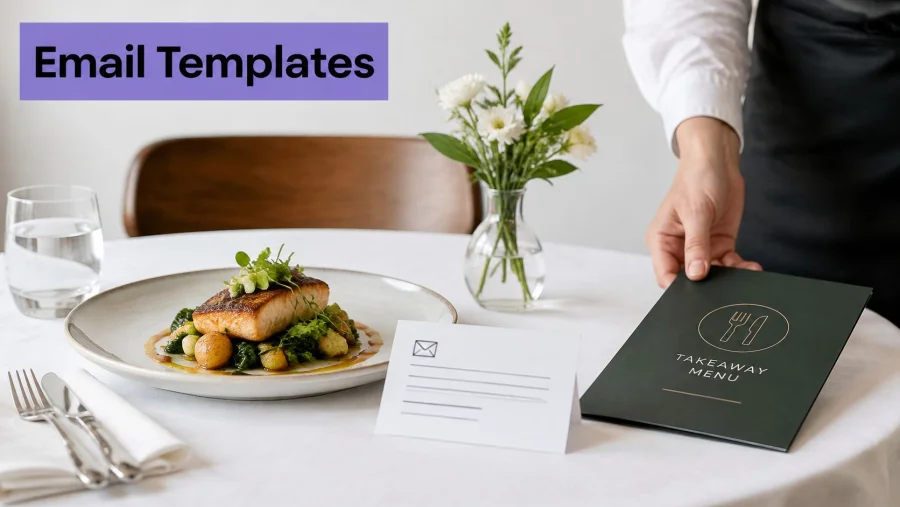
A neighbourhood restaurant has a quiet Tuesday service and wants to invite suitable guests back. Its email doesn't need a brand essay: one headline, one relevant photo, one invitation and one button will do.
The subject line should describe the guest's opportunity. The body should explain enough to make the decision easy.
Subject lines with a reason to open
- Tuesday lull offer: A relaxed Tuesday supper, with dessert included. The benefit and eligible service are immediately clear.
- New menu launch: Fresh spring dishes for the next dinner out. The message centres on a dining occasion rather than the kitchen's announcement.
- Win-back message: Something new for the next visit. It offers a reason to return without guilt or an exaggerated claim of personal familiarity.
These are sample copy suggestions, not performance-tested winners. The offer must match what the restaurant can deliver.
A workable email layout
The sample message opens with a short greeting using the guest's first name only when that field is reliable. Its opening sentence introduces Tuesday supper and the included dessert, followed by a photograph of the actual dish.
The next sentence explains the eligible service, the genuine end date and any minimum purchase requirement. A single Book Tuesday supper button leads to the relevant booking route, not the website homepage.
Beneath the button, a short fallback text link can help when images or buttons don't display properly. Important offer conditions should remain readable text, rather than being embedded inside a photograph.
The footer should include the restaurant's name and address, a functioning unsubscribe link and an accurate explanation of why the recipient received the message. The ICO's small-business marketing guidance requires sender identification and a way to opt out; an unsubscribe shouldn't require a login or telephone call.
Before every send, the manager should check:
- Sender name: The restaurant is recognisable in the inbox.
- Main link: The destination works on a phone.
- Offer date: The email and booking page agree.
- Unsubscribe link: The mechanism works in a test message.
Metrics That Show Whether Email Pays
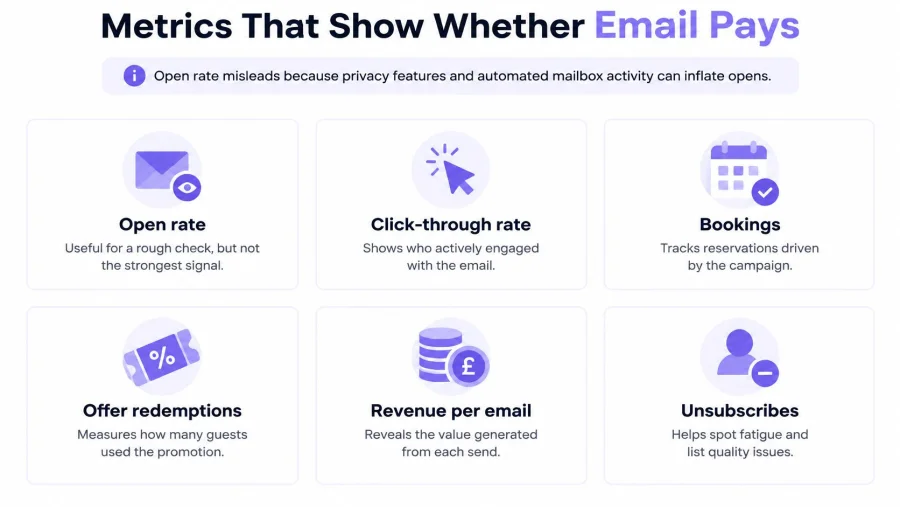
Open rate isn't proof that a guest read the offer. Apple Mail Privacy Protection and automated mailbox activity can inflate recorded opens, so clicks, booking activity and redemptions provide stronger evidence of engagement.
The email benchmark compiled by Anthony McGrath, using 3.6 million MailerLite campaigns sent between December 2024 and November 2025, reports a 44.32% median open rate and a 1.06% median click rate for restaurants and cafés. These are reference points, not promises or required targets.
Restaurant email KPIs and what each one tells you
| Metric | What it tells you | Benchmark |
|---|---|---|
| Open rate | Subject line appeal, inflated by privacy features | Published sector median noted above |
| Click rate | Active interest in the content | Published sector median noted above |
| Revenue per delivered email | Commercial value of each send | Set a venue-specific baseline |
| Reservation starts from email | Intent to visit | Set a venue-specific baseline |
| Offer redemptions | Offer strength and reach | Set a venue-specific baseline |
| Unsubscribe rate | List health and message fit | Set a venue-specific baseline |
Connect the message to the till
Calculate revenue per delivered email by dividing campaign-attributed revenue by successfully delivered messages. Use delivered emails rather than the original mailing-list size.
Give every campaign a unique tracked link, offer identifier or QR code. Record reservation starts separately from completed bookings, and distinguish booked revenue from money taken after the visit.
Attribution still isn't proof of incremental sales. Some recipients would have visited anyway, so a comparable group that doesn't receive the promotion can help an operator judge whether the campaign changed behaviour.
A profitable email brings worthwhile business into the restaurant. A high open rate merely records an inbox event.
Build a baseline before chasing benchmarks
Compare several campaigns, then change one variable at a time: audience, offer, send time or button wording. Keep the landing page unchanged during that test.
Statlyst's citable email statistics for reporting can help provide wider context, but a manager's report should prioritise the restaurant's own results. Definitions matter more than a flattering comparison.
Finally, check reward cost and repeat visits alongside attributed revenue. Broader customer retention strategies for local businesses help connect campaign results with lasting customer value, rather than isolated discounted transactions.
Start Your First Campaign This Week
Start with the welcome workflow. It supports every new registration and requires a manageable promise: a reward the team can fulfil and a message that explains it.
Put the welcome into service
- Choose a practical reward. A free coffee or dessert should be easy for staff to recognise and redeem.
- Place the QR invitation. Use the till and tables so guests can join while the visit is fresh.
- Check the permission journey. The sign-up page needs an unticked marketing choice, and promotional messages need a working unsubscribe mechanism.
BonusQR automatically sends a welcome coupon after registration, using the reward the business chooses. Setup needs no POS integration or extra hardware, making it a practical, cost-conscious route to encourage repeat dining visits without adding another complicated till process.
Businesses can start with Free, but shouldn't assume it includes the complete email setup. Basic adds email notifications and automatic grouping; the reservation system, PDF menu, online store, HTML widget and WooCommerce, Shopify and Zapier integrations are included in Basic and Premium, not Free.
Arrange BonusQR's free consultation this week to select the appropriate loyalty setup, choose the welcome reward and prepare the QR sign. The immediate objective is concrete: give the next eligible guest a clear reason to return.


