Yes, loyalty points can expire, but only when the program states the rule clearly and the law where you operate allows it. A points expiration policy is the written rule for when unredeemed points lapse. Set well, it keeps your reward liability under control and gives customers a reason to come back. Set badly, it breeds anger, complaints and members who quietly stop participating.
This guide explains the four expiry models, shows how real programs word them, covers the legal limits that matter, and walks you through writing a policy a small business can run without a full-time loyalty manager.
Key Takeaways
- A points expiration policy is a disclosed rule for when unredeemed points lapse. It exists to limit the liability of outstanding rewards and to encourage return visits, within consumer-protection law.
- The four common models are inactivity, rolling age, fixed calendar date, and status-based expiry. Inactivity expiry is usually the gentlest for customers.
- Rules differ by place. Ontario, for example, bans expiry based on the passage of time alone, while U.S. regulators scrutinize buried or vague conditions on earned rewards.
- Plain wording, a clear definition of “activity”, and reminders that show the balance at risk matter more than the length of the window.
- Research suggests that helping customers redeem more often reduces expired points more effectively than making rewards harder to reach.
What a Points Expiration Policy Actually Covers
Think of points as a currency with an optional expiry date. Every point you issue is a promise to deliver a future reward, and until it is redeemed, it sits on your books as a liability. An expiration policy decides when that promise ends.
A complete policy answers five questions:
- What starts the clock? The date points were earned, the date of the last purchase, or a fixed date such as December 31.
- How long is the window? Three months for a coffee shop is common in practice; three years for a travel-style program is not unusual.
- What counts as activity? A purchase only, or also a redemption, a review, a referral, or a login?
- How will members be told? Reminder timing, channel and content.
- What happens at closure? What becomes of balances if you change the rules or end the program.
If your policy cannot answer all five in a few plain sentences, it is not ready to publish.
The Four Expiration Models Compared
The Loyalty Register guide to points expiration names four principal models: inactivity, rolling age, fixed calendar date, and status-based expiry. It also notes the operational trade-offs: fixed dates can cause spikes in complaints and service contacts, while rolling age can be hard for members to track.
| Model | How it works | Best for | Main risk |
|---|---|---|---|
| Inactivity | Points lapse only after a set period with no qualifying activity | Cafes, salons, gyms, grocers with frequent visits | Unclear definition of “activity” |
| Rolling age | Each batch of points expires a set time after it was earned | Programs that want a steady, predictable liability | Hard for members to track, so surprise expirations |
| Fixed calendar date | All points expire on one date, such as year-end | Seasonal businesses, annual campaigns | Complaint and support spikes around the date |
| Status-based | Points or tier benefits lapse when a member drops tier | Tiered programs with real status perks | Feels punitive if not explained |
Inactivity expiry
Points stay alive as long as the customer does something that counts. This model matches the intent behind most small-business programs: you want to keep active customers and stop carrying balances for people who left. Heathrow’s MyHeathrow terms use a 36-month rule measured from the last earning transaction, and redeeming or converting points does not reset the expiry of the existing balance. World360 Rewards works similarly: a balance expires 36 calendar months after the last qualifying earning transaction, and passive earning activities do not reset the date.
Both examples show the key design choice: they say exactly which events extend the balance and which do not.
Rolling age expiry
Every point has its own birthday. Wrangler’s UK rewards terms state that points expire 365 days after earning unless converted into reward value. Points convert on a first-earned, first-converted basis, and the resulting reward value then expires nine months after it is added. Revolut’s RevPoints terms take a similar approach: unredeemed points stay valid for three years after earning, then permanently expire without refund, and customers can see expiry dates in the app.
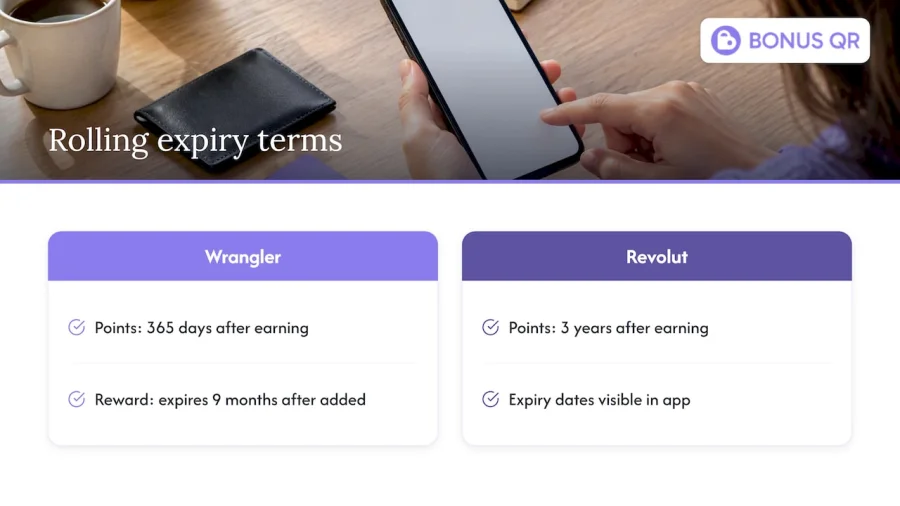
That last detail is what makes rolling expiry fair. If members cannot see which points are about to lapse, the model punishes them for something they could not track.
Fixed calendar date expiry
All points reset on the same day. It is simple to explain and simple to account for, and it can create a useful end-of-year rush. The downside is a predictable wave of unhappy customers and support requests right after the date. If you choose it, send reminders well ahead and consider a short grace period.
Status-based expiry
Points, or the benefits attached to them, lapse when a member loses tier status. One study of customer reactions found that customers exposed to point expiration showed more anger and perceived problem severity than customers exposed to status demotion. When both happened, extending points reduced perceived unfairness more effectively than extending status (Shin, 2021). If you run tiers, that is a useful signal about where your goodwill gestures should go.
Do Points Expiration Rules Differ by Country?
They do, and the differences are large enough that a business serving customers across borders should check local rules before publishing terms. This article is not legal advice; a consumer-law attorney in your jurisdiction should review the final wording.
Ontario, Canada. The Protecting Rewards Points Act prohibits expiry of rewards points because of the passage of time alone, and allows expiry for other reasons within prescribed limits. The province’s official guidance on reward points explains that points may still be lost when a program closes an account for prolonged inactivity, provided that rule is stated in the membership agreement. It also lists exemptions, including vouchers treated as gift cards and points that cannot be redeemed for a single item worth more than C$50.
Quebec, Canada. The Canadian Marketing Association’s guide for marketers says inactivity expiry in Quebec requires at least one year and advance notice focused specifically on the expiry. For Ontario, the same guide advises defining activity clearly and disclosing the rule plainly rather than using a blanket time-based expiry.
United States. The statute-by-statute picture is less uniform, and a federal rule on retail loyalty expiry is not what readers should assume exists. What is clear is the enforcement attitude toward credit-card rewards. The CFPB’s December 18, 2024 Circular 2024-07 says operators may violate the prohibition on unfair, deceptive, or abusive acts by devaluing already-earned rewards, revoking rewards through buried or vague conditions, or deducting points without delivering the corresponding benefit. That circular addresses credit-card programs, but its logic is a sensible benchmark for any business: do what you said, say it plainly, and do not change the deal after customers have earned.
Notice when rules change. Revolut’s Romania RevPoints terms say the operator will try to give 14 days’ notice when changing or removing earning or redemption activities, with exceptions where notice is not possible. Even where no law requires a notice period, a similar courtesy is good practice.
If you serve customers in several countries, write to the strictest rule you face, or segment your terms by region.
How Expiration Affects Trust and Behavior
Expiry is a behavioral lever as well as an accounting tool, and it pulls in both directions. Academic research by Liu and Thompkins finds that expiration can motivate purchases among customers who can adapt to it, but may frustrate customers who cannot reach the reward threshold in time, provoke reactance, and lower participation and attitudes toward the program. The effect depends on customer flexibility and on how well the program communicates (Liu and Thompkins).
Consumers notice this too. EY’s 2026 Loyalty Market Study reports that expiring points or limited redemption periods remain a leading consumer frustration.
For a small business, the practical reading is this: expiry works when customers feel they had a fair chance to use what they earned. A weekly coffee customer who collects points over three months and loses them at month four will not blame the calendar. They will blame you.
Breakage and what really reduces it
Breakage is the share of accrued points that expire before redemption. A 2025 study in the International Journal of Research in Marketing by Goić, Montoya and Troncoso found that breakage varies substantially across customers and markets, and concluded that promoting more frequent redemptions is more effective at reducing breakage than requiring more points for rewards (study abstract).
That has a direct design consequence. Instead of using expiry to squeeze more out of a stingy reward ladder, make the first reward reachable quickly. A low first threshold, such as a free drink on the third or fourth visit, creates early wins and a redemption habit. Our guide to a points reward system that actually works covers how to calibrate those thresholds.
When to Use Expiry and When to Hold Back
Not every program needs a points expiration policy. Ask yourself:
- Is your purchase cycle short? Cafes, bakeries, car washes and gas stations see customers weekly. A 6 to 12 month inactivity window is easy for them to respect.
- Is your purchase cycle long? A furniture store or a hotel sees repeat customers once or twice a year. Short windows will feel hostile.
- Are you using stamps or points? Digital stamp cards with a small goal (ten stamps) naturally finish quickly and often need no expiry beyond a card-level validity period.
- Do you carry large balances? If points convert to cash value, outstanding balances are a real liability, and an inactivity rule is a reasonable control.
- Do you sell in regulated jurisdictions? If yes, start from the legal limits above, not from your preferred window.
If you are undecided, inactivity-based expiry for core points is the safest default: customers who stay engaged never lose anything.
How to Write Your Policy in Seven Steps
- Choose a window that fits your purchase cycle. Look at your own data: how long is the gap between visits for your typical repeat customer? Set the window at a comfortable multiple of that gap.
- Pick the model. Inactivity for core points is the gentlest. Use rolling or fixed-date models only when you can display expiry dates to members.
- Define activity precisely. Say which events reset the clock: a purchase, a redemption, a referral, a review. Say which do not. World360’s exclusion of passive earning from resetting the date is a good example of precision.
- Write the rule in plain language. Put it where members sign up and where they see their balance, not only in the general terms. The CMA’s view is that material limitations should be prominent and understandable, not hidden in general terms or promotional messaging.
- Plan your reminders. Send at least one reminder before expiry and ideally a second closer to the date. Each should show the balance at risk, the expiry date and the simplest action that keeps points alive (Loyalty Register). Heathrow’s opted-in members receive email notices six and three months before expiry, which shows how a long window can still carry two reminders.
- Make small balances usable. Let members redeem a modest reward without waiting to hit a big threshold. Small balances are where frustration builds.
- Test before removing points. Run the policy in notice-only mode first, then track complaints, reinstatements, and how many members come back after a reminder.
Sample policy wording
Adapt this to your business and have it reviewed locally:
Points stay in your account as long as you earn or redeem at least once every 12 months. If your account has no activity for 12 months, we will email you 60 days and 14 days before your points expire, showing your balance and the date. Any purchase or reward redemption keeps your points active. Your current balance and next expiry date are always shown in your account.
Notice what it does: one trigger, one window, one definition of activity, two reminders, and a visible balance.
Communicating Expiry Without Losing Goodwill
The wording of a reminder matters as much as the rule. Compare two messages:
- “Your points will expire.” Vague, alarming, no action.
- “You have 240 points worth a free coffee. They expire on the 30th. One visit before then keeps them active.” Specific, helpful, easy.
Good reminders share four traits: they name the balance, show the date, say what the points are worth, and make the next step a single tap or one visit. Pair them with a small nudge, such as a bonus stamp for visiting before the date, and expiry becomes a reason to visit rather than a reason to leave.
If you want to build the habit of checking results, the operational side is covered well in this guide to measuring customer loyalty results, including the testing mindset that suits an expiry change.
Handling complaints and reinstatements
Some customers will miss the notice. Decide ahead of time how you will respond. A reasonable approach is to reinstate recently expired points once, for a short window after expiry, and log each case. If reinstatements climb, that tells you your reminders or your window need work, not that your customers are careless.
Putting Expiry Into Practice With a Digital Program
The hardest part of expiry for a small business is administration: tracking each member’s last activity, sending timely reminders, and keeping balances visible. Doing that on paper cards or a spreadsheet is where policies quietly fail. Platforms that automate loyalty management can take over the tracking, the notifications and the reporting. For a hands-on look at how software supports reward rules, see this walkthrough of loyalty program integration, which also touches common expiration models.
Once your policy is written, your program examples matter too. If you are still choosing the reward structure itself, browse loyalty program examples for small businesses, and for restaurants specifically, our customer retention strategies show how return-visit rewards fit the rest of your marketing.
Our Perspective
Most small businesses do not fail at loyalty because their expiry window was wrong. They fail because nobody was watching the balances. A customer collects points, forgets, loses them, and never returns. The policy was technically fine, yet the relationship ended.
We built BonusQR around the idea that rules like this should run themselves. A QR-based program needs no POS integration, so you can launch quickly with points, stamps or cashback, and the system is designed to handle rewards distribution, customer insights and promotional notifications while you run your shop. For expiry, that matters: the reminder is only useful if it is sent on time, to the right person, with the right balance.
Our advice is simple. Pick an inactivity-based rule you would be comfortable explaining to a regular at the counter. Show the balance at all times. Remind early. Track what the reminders bring back. If your numbers show members returning rather than complaining, the policy is doing its job.
Michal Palus
Start a Loyalty Program With Clear Rules
If you want a program that tracks balances and sends reminders for you, BonusQR offers a Free plan, a Basic plan at €19 per month and a Premium plan at €69 per month. You can compare what each includes on the pricing page. Larger businesses that want their own branded app can look at the white-label option, which has a one-off setup fee of €690 and a monthly subscription of €69.
Frequently Asked Questions
Do loyalty points expire?
Only if the program says so. Many programs apply an expiry rule, such as a period of inactivity or a set time after earning, while others let points last indefinitely. Some places restrict expiry by law. Ontario, for instance, prohibits expiry based on the passage of time alone.
How long should loyalty points last?
Long enough that an engaged customer never loses points by accident. Match the window to your natural purchase cycle: for weekly visits, 6 to 12 months of inactivity is workable, while businesses with rare purchases should allow far longer. Real examples range from 365 days after earning at Wrangler’s UK program to 36 months of inactivity at Heathrow and World360.
What counts as activity for keeping points alive?
That is for your policy to define, and it must be stated clearly. Many programs count earning transactions only, and some exclude passive earning or redemption from resetting the clock, as Heathrow’s and World360’s terms show. A broader definition that includes redemptions or referrals is friendlier to customers.
How should I notify customers before points expire?
Send at least one reminder, and ideally a second closer to the date. Each message should show the points balance, the expiry date and the simplest action that keeps the points active. Display the next expiry date beside the balance in the customer’s account too.
Can a business change its expiry rules later?
It can change future rules, but changing the terms for points already earned is risky. The CFPB’s circular on credit-card rewards treats devaluing earned rewards and relying on buried conditions as potential unfair or deceptive practices. Give advance notice, apply new rules going forward where you can, and check local law.
Sources
- Should loyalty points expire? Triggers, windows, notice (Loyalty Register)
- Rewards Terms and Conditions (Wrangler UK)
- RevPoints terms (Revolut)
- RevPoints Terms (Revolut Romania)
- MyHeathrow terms and conditions
- World360 Rewards terms
- Protecting Rewards Points Act, Ontario
- Rules for loyalty reward points, Ontario
- Loyalty Program Rules for Marketers (Canadian Marketing Association)
- CFPB Circular 2024-07 on credit card rewards programs
- Liu and Thompkins, loyalty program expiration policy study
- Shin, reward point expiration and status demotion research
- 2026 EY Loyalty Market Study
- Breakage analysis for profitability management (IJRM, 2025)


