A café owner may already have a loyalty card by the till, a booking link in social media and customer details scattered across messages. A mobile app could bring some of that together, but it can also add another task for staff and another thing for customers to download. The sensible first question isn't how to build an app. It's whether an app will do a better job than a QR loyalty card or a mobile web page.
Which Route Fits
Choose the lightest option that solves the business's actual loyalty problem. A branded app adds control, but it also brings a higher setup cost and more responsibility for choosing and maintaining features.
Build routes compared on cost, speed and control
| Route | Upfront cost | Time to launch | Third-party integrations | Brand and ownership |
|---|---|---|---|---|
| BonusQR Free plan | $0, no credit card | Available immediately | Not included. Phone scanner needs no POS | Shared BonusQR app that also lists nearby businesses |
| White Label app | $690 one-time plus ¥449 per month | About 14 days | Not included | Your icon, logo and brand colours, published on Google Play and App Store |
| Custom app | $1,690 one-time plus ¥449 per month | Built on demand from your requirements | POS or CRM integration | Fully custom design published under your brand |
| DIY build with a no-code builder | Quote required | Depends on the builder and scope | Depends on the builder and plan | Your brand, within the builder's limits |
| Full custom build from scratch | Quote required | Depends on the requirements and development scope | Depends on the build | Your brand, with control over the agreed features |
A no-code builder may suit a business with simple requirements, but available features and integrations depend on the platform. A full custom build allows more control and also leaves the business responsible for development, testing and ongoing maintenance.
BonusQR Free is available immediately and uses a shared app that shows customers nearby businesses. White Label and custom apps show only your store. A QR loyalty web application gives customers a way to join without downloading an app.
Choose White Label if your business needs its own icon, logo and colours in an app published under its brand. Choose a custom app when a POS or CRM connection, or a specific feature, justifies the extra cost and can remove a real operating bottleneck. BonusQR's custom app is built to your requirements, with custom design, features and rules.
Route test: Does the app need to connect to anything the business already uses?
If not, start with the simplest option that can show whether customers use the reward. If so, specify what information needs to pass between systems and which staff task the connection should remove. That requirement should determine the route.
Testing Whether an App Pays for Itself
The break-even calculation is straightforward: extra visits per month from returning customers × average spend × profit margin, compared with the route's monthly cost and the staff hours needed to run it. For example, if a loyalty scheme brings customers back more often, the value is the profit from those extra visits, not the total sales customers would have made anyway. Staff time matters too. A reward that adds admin at the till may cost more than its subscription suggests.
A mobile web page or QR card may already be enough. That's especially worth considering for microbusinesses. In a 2025 UK government survey of 4,595 businesses, 63% of small businesses had adopted at least one surveyed technology, compared with 48% of microbusinesses (UK government survey summary). The practical question isn't how many features a business can add. It's whether a digital route earns more than it costs in money, customer effort and staff attention.
Run a 30-day pilot
Start on the cheapest route that can measure the behaviour the business wants to change. Before launch, write down the current pattern for repeat visits and decide how staff will record reward redemptions and time spent supporting the scheme.
- Track the useful measures: Repeat visits, redemption rate, average spend, inactive customers and staff minutes spent each day.
- Continue if repeat visits and redemptions rise without extra staff work.
- Simplify if customers like the reward but ignore the app. Keep the offer and remove steps, or make the QR route more visible.
- Stop if neither visits nor redemptions move. Don't keep paying to maintain a feature customers don't use.
Different businesses should read the same measures through their trading patterns. A café can look for more return visits between routine purchases. A salon should consider how repeat bookings fit its service cycle, rather than expecting customers to return like café regulars. A gym can assess whether a reward encourages ongoing attendance, while an independent shop can look at whether a customer returns to buy again across its product range.
A dashboard can help distinguish sign-ups from meaningful activity. For practical ideas on reading engagement measures, see this guide to app analytics from Mega Income Stream. For BonusQR, owners can compare loyalty platform pricing against the specific costs and staff effort being tested.
The decision metric is the increase in second visits within 30 days among enrolled customers, compared with a similar group who didn't join. Downloads and scans can show interest, but a return visit is the more useful test of whether the scheme changes customer behaviour.
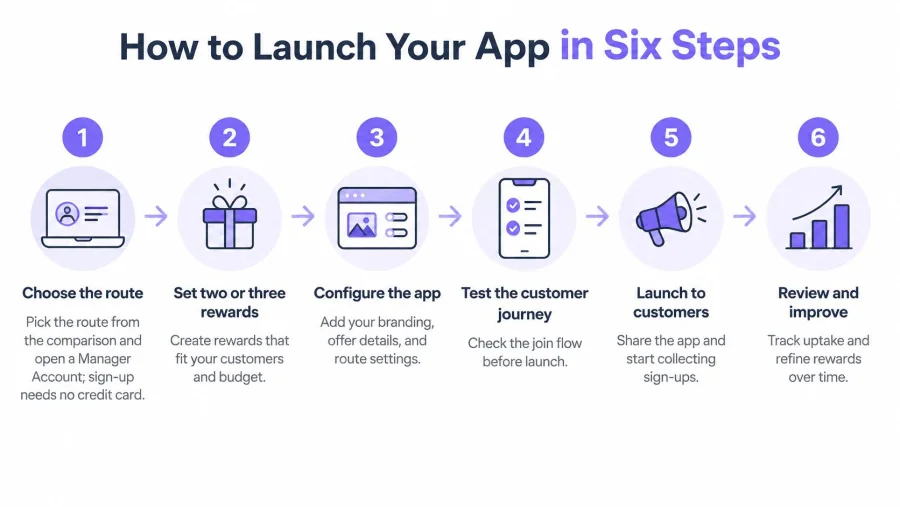
How to Launch Your App in Six Steps
A launch works best when the customer can join quickly and the owner can see what happens after the scan. The practical sequence below keeps setup focused on a working reward, not a long feature list.
Choose the route and open a Manager Account. Select the option that fits the comparison, then set up the business through a BonusQR Manager Account. Sign-up needs no credit card, so the initial setup doesn't require a payment commitment.
Set two or three rewards that fit the margin. Choose an offer customers can understand, such as a stamp reward after a set number of visits or a reward at a spend threshold. Write each condition in one sentence so staff can explain it without improvising at the till.
Put the join route where customers can use it. Place a QR code at checkout and on receipts, then direct scans to a mobile web registration page with only the identity details the scheme needs. Customers can scan and see the rewards available to them; an optional Apple Wallet or Google Wallet pass gives them another way to keep the offer handy.
Help customers enrol during the first week. Staff can show where to scan and ask where the process feels unclear. This is more useful than assuming a quiet sign-up counter means the offer has been understood.
Test the whole journey before promoting it. Use staff accounts and synthetic test users to try sign-up, reward redemption, marketing opt-out and account deletion. Check for duplicate profiles, confirm that a redemption records properly, and make sure the customer sees the right reward after joining.
Launch, then review the funnel weekly. Measure scan to registration, registration to first reward and first to second visit. Use separate QR destinations or campaign identifiers for counter, receipt, social and staff-assisted sign-ups, so the business can see which source brings back customers.
A wallet-first, low-friction setup fits established UK payment behaviour. In 2024, 57% of UK adults were registered for at least one mobile-payment service, up from 42% in 2023, and 87% of registered users used such services at least monthly, according to UK Finance's UK Payment Markets 2025 summary. Those figures don't predict how a particular loyalty scheme will perform, but they support making mobile access straightforward.
Common slip: Requiring a native-app download before customers can register or redeem adds a conversion step. Let the web or wallet journey work first, then offer a download as an option.
A healthy first month isn't defined by install volume. The useful signs are that scans lead to registrations, customers claim or redeem a first reward, and the second-visit measure begins to move within 30 days. BonusQR's phone scanner works without a POS connection, so the basic loyalty flow doesn't require a new till system or extra scanning hardware.
Consent and Marketing Rules Before You Send
A customer joining a loyalty scheme hasn't automatically agreed to receive promotional emails or texts. For individual subscribers, electronic marketing generally requires prior consent under PECR, unless the business meets every condition of the soft opt-in, according to the ICO's guidance on electronic mail marketing.
The soft opt-in applies only when the contact details were collected during a sale or negotiation of a sale, the message promotes the business's similar products or services, the customer had a clear chance to refuse marketing when their details were collected, and every later message provides a way to opt out. If one condition isn't met, the business shouldn't treat the exception as permission to send.
Keep loyalty access separate from marketing
Customers should be able to join and use the reward without agreeing to promotional messages. Put the marketing choice in its own clear, unticked box, and explain the channels involved. That way, a customer who wants stamps or points but not marketing can still participate.
The rules also distinguish between types of subscribers. Marketing emails or texts to limited companies generally don't need consent, but sole traders and some partnerships count as individual subscribers. A business-looking email address isn't proof that the recipient is a company subscriber. Where a message uses someone's personal data, data-protection obligations can still apply.
Consent should be recorded in a way the business can act on. Keep the notice version, timestamp, channel and customer's affirmative action. Check a suppression list before each send, propagate withdrawals across the relevant channels, and remove or anonymise inactive histories when the information is no longer needed. Clear records also make it easier to answer a customer who asks what they agreed to.
For a useful grounding in the information a loyalty programme may collect directly from customers, see this explanation of customer data insights from Data Hunters Agency. Collecting more details isn't automatically more valuable. If a birthday, address or preference won't improve the offer or service, leave it out.
Before the first campaign, check:
- No pre-ticked boxes: Customers must make an affirmative marketing choice.
- Separate permission: Reward access doesn't depend on agreeing to advertising.
- Simple unsubscribe: Every promotional message offers a clear opt-out.
- Tested withdrawal: A test customer who opts out is suppressed from queued campaigns.
- Written retention rule: Staff know when customer histories should be deleted or anonymised.
Getting Customers to Join and Return
A customer standing at the counter should understand the reward before deciding whether to join. A QR code that opens a mobile web page keeps sign-up simple, with a wallet pass available for customers who want one. Explain how to collect and redeem rewards, and avoid asking for account details the scheme does not need.
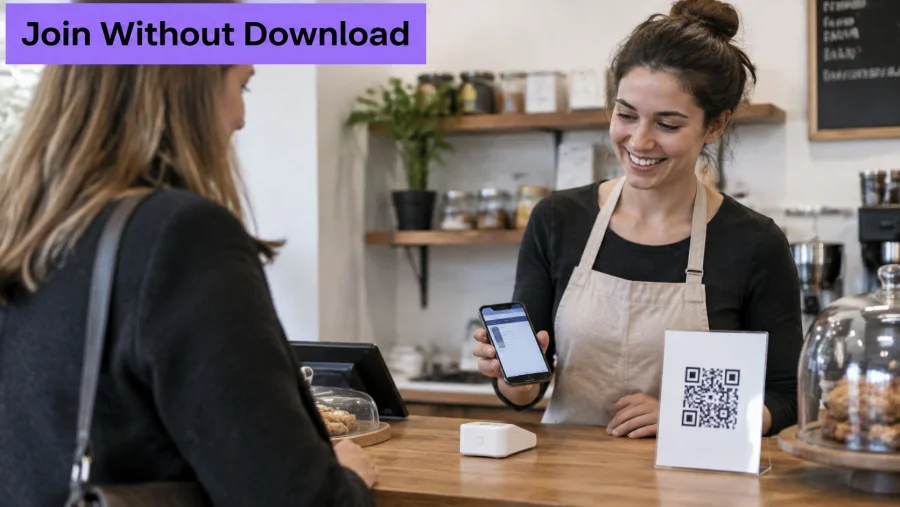
Place the QR code where customers can scan it without reaching around the till or sorting through other notices. Keep the sign direct: “Scan to collect a stamp.” Staff should be ready to explain the offer or help customers who cannot scan, and printed instructions should be easy to read at the counter.
Collect only information that helps run the reward or improve the service. A visit count or spend threshold may be enough. Keep the join process short, and make access usable for customers who prefer a phone browser or wallet pass over installing an app.
Give customers a reason to come back
Show customers their progress and what reward they can earn next. BonusQR displays current progress and upcoming rewards, and loyalty can appear in Apple Wallet or Google Wallet. Customers can also use iOS, Android or web apps.
A relevant message can be more useful than a broad campaign. BonusQR lets a business send a push notification to its top 10% of customers in two taps. Use that option for a timely offer to frequent visitors, and send promotional messages only with the appropriate permission and a working opt-out.
Try these simple retention tactics:
- Reward the second visit: Give customers a clear reason to return soon after joining.
- Rotate seasonal offers: Feature one reward at a time so customers can understand the offer.
- Ask after redemption: Request feedback while the reward experience is still fresh.
Check whether each feature helps customers return. Extra questions and account steps can make joining harder, so compare repeat visits by sign-up source, such as counter, receipt, social or staff-assisted. That shows which route brings back customers, rather than just generating scans.
Run a 30-Day Pilot First
Start with a 30-day pilot on the free route before paying for a White Label or custom build. Record the business's repeat-visit pattern for the previous 30 days, launch one reward through one QR location, then review second visits and staff minutes each week. At the end, continue, simplify or stop based on the results, not on how many people scanned once.
Use the same test discipline when weighing up a small product idea. This founder's guide to testing ideas offers a useful way to think about a pilot as a limited test of customer demand, rather than a commitment to build everything at once. For hospitality businesses, tracking repeat visits at restaurants can help focus attention on the behaviour the scheme is meant to change.
BonusQR's Free plan costs $0 forever, requires no card and has no commitment. Its team also offers a free consultation to help a business choose a loyalty setup, so owners can check whether the route fits before paying for a branded app.
Start a free loyalty card this week, watch who returns, and only pay for a branded app if the results justify it.
The best small business app is the one customers scan.


