
 Deutsch
 Español
 Français
 Italiano
 Magyar
 Polski
 Slovenčina
 Čeština
The truck is clean. The food is good. Service is fast. Yet the same problem keeps showing up every week. A busy lunch spot on Tuesday doesn't automatically create a queue on Friday, because customers don't know where the truck is next.
That's the hard truth about advertising for food trucks in the UK. Most advice assumes a fixed address, a steady stream of walk-ins, and a loyalty scheme that lives on a paper card in someone's wallet. Mobile food businesses don't work like that. They trade in changing postcodes, temporary pitches, event calendars, and short windows to capture attention.
Good food matters, but it doesn't solve discoverability or retention. Strong advertising does both. It helps the right people find the truck today, and it gives them a reason and a way to come back next week when the truck is parked somewhere else.
The operators who grow don't treat marketing as random posting on Instagram or the occasional festival flyer. They build a system. It covers budget, positioning, visual presence, local targeting, and a way to keep past buyers connected as locations change.
Laying Your Marketing Foundation
Random marketing wastes money. A truck posts a few menu photos, boosts a social post, prints some flyers, then wonders why trade still feels unpredictable. The missing piece usually isn't effort. It's direction.
A clear foundation starts with one question. What should advertising achieve for the business? For one truck, it may be filling a quiet lunch window near office parks. For another, it may be building enough repeat trade to rely less on one-off events. Without that clarity, every channel becomes guesswork.
In the UK, food trucks generate an average annual gross revenue of £100,000, with net profit margins ranging from 25% to 35% after deducting significant operating costs. Marketing expenses alone consume a dedicated 5–10% of revenue, which means operators typically allocate £5,000 to £10,000 annually toward promotion, according to eTakeaway Max on starting a food truck. That figure matters because it turns marketing from a vague idea into a real operating line.
Start with a target, not a tactic
Most food truck owners don't need more channels. They need sharper goals.
Useful goals are specific and tied to trading reality, such as:
- Lunch trade goal. Increase weekday lunch orders from office workers at one regular stop.
- Event goal. Turn festival visitors into future direct customers instead of losing them after the weekend.
- Quiet-day goal. Improve sales on slow midweek pitches with time-sensitive offers.
- Repeat-visit goal. Give regulars a reason to buy again even when the truck rotates locations.
That approach changes how advertising decisions get made. If the goal is lunchtime footfall, local search, Google Maps visibility, and short-range paid ads matter more than broad awareness campaigns. If the goal is repeat custom, the priority shifts toward data capture and follow-up.
Practical rule: If a campaign can't be linked to a business outcome, it shouldn't get budget.
Define the buyer in real-life terms
“Hungry people” isn't an audience. It's everyone.
A useful customer profile describes the buying situation. A food truck near an office cluster serves people on a short break who need speed, clear pricing, and confidence that the queue will move. A truck outside a brewery serves groups who are social, less rushed, and more likely to share photos if the food looks good. A truck at a weekend market serves browsers who may need sampling, visual cues, and a reason to choose one vendor over ten others.
That level of detail sharpens everything:
- Offer design. Fast combos for office workers, sharers for events, hero items for social posting.
- Ad timing. Mid-morning reminders for lunch, late afternoon nudges for evening trade.
- Creative choices. Convenience-led messaging for commuters, indulgence-led imagery for festival crowds.
Build a budget that can survive reality
A realistic marketing budget should reflect the truck's model, not a copied percentage from a café or restaurant with a fixed site. The annual baseline above is a useful starting point, but monthly allocation matters more in day-to-day trading.
A practical split often includes core items such as branded print materials, social ad spend, event-specific promotion, photo and video creation, and customer retention tools. The exact mix changes, but the rule stays the same. Spend where a mobile business can measure response.
Three questions keep that budget honest:
- Does this help people find the truck now?
- Does this help turn buyers into repeat customers?
- Can the team track whether it worked?
If the answer is no to all three, the spend is probably cosmetic.
Nail the basics before chasing reach
Before expanding into paid campaigns, the truck needs a recognisable identity. Customers should be able to remember the name, spot the colours, understand the menu, and describe the truck to a friend without effort.
That means getting the fundamentals right:
- Name and visual identity. Keep it readable from a distance and memorable after a quick visit.
- Core message. Make the offer obvious. People should know what the truck sells in seconds.
- Consistent brand voice. Social posts, signage, menus, and event banners should feel like the same business.
- Repeat-visit system. Build a method to boost restaurant repeat visits instead of relying only on passing foot traffic.
A strong foundation doesn't look flashy. It looks organised. That's what makes the rest of advertising for food trucks work.
Mastering Your Digital Kerb Appeal
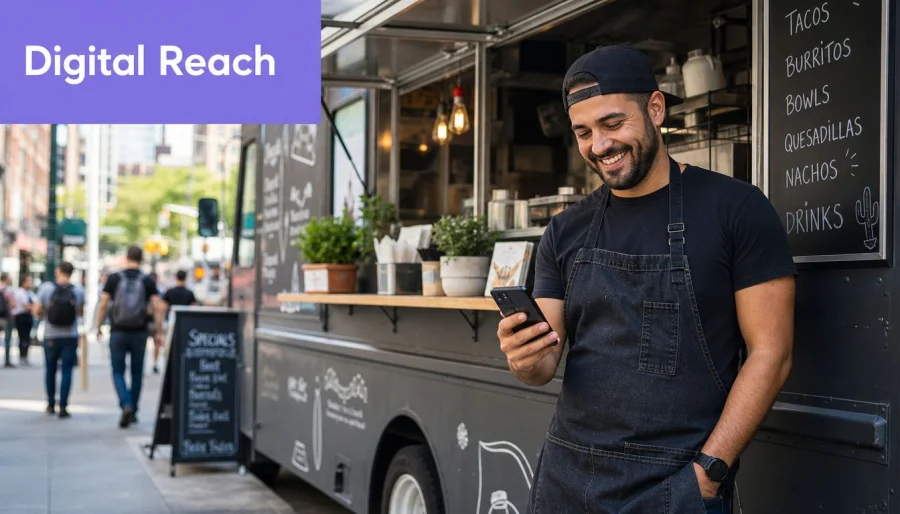
A mobile food business lives or dies on “Can people find you right now?” Digital presence has to answer that question fast. Not with a polished brand manifesto. With today's location, today's menu, and a reason to walk over now instead of scrolling on.
The biggest mistake is treating social media like a gallery. Pretty food shots help, but a food truck needs a live operating system. Every digital touchpoint should reduce friction between craving and purchase.
Make Google work for a moving business
Many trucks neglect Google because they assume it only suits fixed premises. That leaves money on the table. People still search for food nearby, check Maps, read reviews, and decide quickly.
For a mobile operator, Google Business Profile should be managed like a daily trading tool:
- Update location details regularly. If the truck is at a new pitch, that information needs to be visible.
- Use posts for today's spot. A short update with the current location, service window, and a hero menu item helps buyers act fast.
- Upload current photos. Show the truck, the queue, the food, and the serving setup so buyers recognise it on arrival.
- Collect reviews consistently. Reviews don't just build trust. They help convert people who are deciding between nearby options.
Mobile operators need discipline. A stale profile with last month's event photo tells customers the business may not be active.
Social content should solve two jobs
Instagram, Facebook, and TikTok each matter, but not for the same reasons. The best performing food truck content usually does one of two things. It triggers appetite or it reduces uncertainty.
Appetite content includes tight shots of signature dishes, sizzling prep, sauce pours, steam, crunch, or the first cut into a loaded wrap or burger. Uncertainty-reducing content shows where the truck is, how long service takes, what the queue looks like, what the menu costs, and whether there are vegetarian or family-friendly options.
A useful weekly content mix looks like this:
- One hero food post. Put the best-looking item front and centre.
- One location-led update. Make it obvious where the truck is trading and when.
- One behind-the-scenes clip. Prep footage builds trust and personality.
- One customer moment. A real queue, a smiling handoff, or a short event clip makes the truck feel active and popular.
For operators who want more ideas from the wider hospitality space, this guide to restaurant customer attraction is useful because many of the same local attention principles apply, even though a truck has to move faster and communicate location more aggressively.
The best-performing post often isn't the prettiest one. It's the one that tells customers exactly where to stand and what to order.
Use short-range paid ads for immediate trade
Broad targeting wastes spend for a food truck. Local targeting is where digital ads become practical.
Radius-targeted digital advertising, or geo-fencing, within a 2 to 5 mile radius of the truck's current location can increase repeat order rates by approximately 35% compared with non-geofenced campaigns, according to RestoLabs on food truck marketing ideas. That's why paid social for a truck should usually be narrow, time-sensitive, and linked to an active pitch.
A simple local ad works when it includes:
A clear location Name the street, market, brewery, office park, or event.
A service window Tell people whether they have until lunch, late afternoon, or evening.
One reason to choose the truck Signature item, limited menu special, convenience, or event pairing.
A simple call to action “Find us today”, “Order direct at the hatch”, or “Walk over now”.
Don't separate digital presence from operations
Digital kerb appeal isn't just a marketing issue. It's an operations habit.
If the truck arrives late, the social post needs updating. If a hero item sells out, the story or post should reflect it. If the queue is long but moving, showing that can reassure people instead of scaring them off. Mobile food businesses that treat digital channels as real-time communication tools usually outperform those that post only when someone remembers.
A truck doesn't need to be everywhere. It needs to be easy to find, easy to trust, and easy to choose today.
Winning the Streets with Events and Branding
Two trucks can stand at the same event, serve similar food, and get very different results.
One has a plain exterior, a cluttered menu board, and staff who hand over food without saying much. People walk past because nothing stops them. The truck looks competent but forgettable.
The other truck is visible from a distance. Colours are bold. The menu is readable in seconds. The counter area feels lively, the team talks to people in the queue, and the setup gives customers something to photograph. The food may be no better, but the business gets more attention before the first order is even placed.
That difference isn't superficial. It affects buying behaviour. More than 88% of consumers say the visual appeal of a food truck is a primary factor in their decision to purchase, according to research published by Georgia Southern University. For street food, branding isn't decoration. It's salesmanship at kerb level.
What the stronger truck gets right
The better-performing truck usually makes fast visual decisions easy for the customer.
- The truck itself stands out. Large, high-contrast graphics beat small logos and muted colours.
- The menu can be read from a few steps back. Long descriptions and tiny text kill impulse purchases.
- The hero product is obvious. A passer-by should know the signature item immediately.
- The queue experience feels active. Samples, friendly staff, or visible prep make waiting feel worthwhile.
Packaging also plays a quiet role. Buyers notice whether the food is easy to carry, whether it photographs well, and whether the presentation fits the price point. Operators reviewing smart choices for hospitality packaging often spot simple improvements that make serving cleaner and branding more consistent.
Choose events that fit the truck
Not every event is worth attending. Some have traffic but poor buyer fit. Others draw the right crowd but leave vendors buried in the wrong corner.
The strongest operators judge events using practical filters:
- Audience fit. Does the event attract the kind of buyer who already likes this menu?
- Operational fit. Can the truck serve quickly enough for the site and queue pattern?
- Visibility fit. Will the truck have enough frontage, signage space, and footfall?
- Follow-up fit. Is there a good chance to capture customer interest for later visits?
A local brewery partnership, recurring office park stop, or neighbourhood market can outperform a flashy event if it creates routine. Predictability matters. A regular monthly or weekly pitch trains people to expect the truck.
A good event doesn't just create sales on the day. It helps the truck become part of a local habit.
Turn presence into an experience
Street-level advertising works best when the truck feels like part of the event, not a side vendor parked nearby. Staff should know how to greet, recommend, and keep energy up without sounding scripted. Clear menu guidance helps undecided buyers move faster. A branded collection point, visible prep station, or tasting sample can pull people in who might otherwise keep walking.
For food trucks, the street is the advert. Branding, service style, packaging, and setup all communicate before the first bite does.
The Secret to Survival Turning One-Time Buyers into Regulars
The biggest leak in most food truck marketing isn't awareness. It's memory.
A customer buys at a street market, likes the food, and means to come back. Then the truck moves. The customer forgets the name, doesn't know the next location, loses the paper loyalty card, and ends up buying from whoever is nearby next time. That cycle erodes growth.
This is why generic retention advice fails mobile vendors. A fixed-site café can rely on routine. A truck can't. It needs a system built for movement.
A critical gap in food truck advertising is the lack of UK-specific guidance for rotating-location loyalty. Generic loyalty cards don't solve the challenge of mobile vendors, where 68% of repeat customers are lost between visits. The same source notes that UK vendors need to move from physical stamp cards to real-time QR codes that update daily through Apple Wallet or Google Wallet passes, and that 82% of UK consumers prefer digital loyalty over physical cards, according to Expondo's guidance on effective food truck marketing and advertising.
Why paper punch cards fail on the street
Paper cards were built for businesses with one address and habitual footfall. A customer passes the same coffee shop each morning, keeps the card in a wallet, and redeems it on the next visit. That logic breaks when the business rotates across multiple sites.
Paper fails because:
The card gets lost Customers don't value it enough to keep it ready for a business they may not see for days.
The truck's location changes Even loyal buyers can't return if they don't know where to find the business.
There's no customer data The truck learns nothing about buying patterns, top customers, or redemption behaviour.
Staff can't follow up No direct communication means no way to announce a new stop, a rain-day offer, or a lunch special.
That's why retention for a food truck has to be digital, lightweight, and easy at the point of sale.
What a smarter loyalty flow looks like
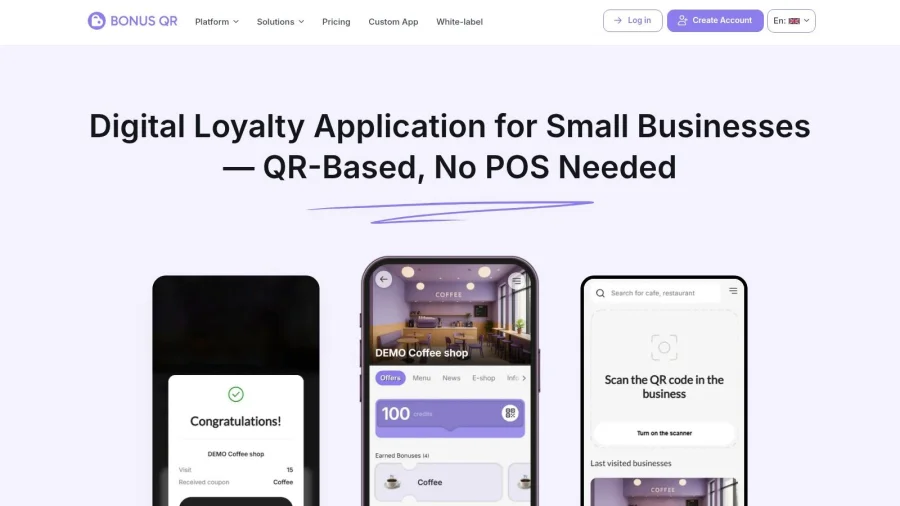
The strongest setup is simple. A customer scans a QR code at the truck, joins in seconds, and keeps a digital pass handy in a phone wallet. From there, the business can keep loyalty visible and connect updates to real trading locations.
That model solves several problems at once:
The sign-up happens while buying No one needs to download a heavy app before collecting rewards.
The pass stays accessible Apple Wallet and Google Wallet make it easier for customers to find and use than a paper card.
The truck can communicate changing locations That's the retention problem most competitors ignore.
The business owns the relationship Instead of depending entirely on social algorithms or third-party delivery apps, the truck builds direct contact.
A moving business needs moving loyalty. Static cards belong to static premises.
What to capture at the hatch
Food truck owners often overcomplicate loyalty. They ask for too much information, slow the queue, and end up with poor uptake. The better approach is minimal friction.
At sign-up, the truck usually only needs the essentials required to identify and reward the customer properly. The value exchange should be obvious. Scan, collect, return, redeem.
A practical in-person setup includes:
A visible QR sign at the order point It should be impossible to miss while waiting.
A staff prompt The team should mention it naturally during ordering or collection.
A first-use incentive Give buyers a clear reason to join on the spot.
A follow-up habit Use the loyalty system to support location announcements, not just reward tracking.
For operators comparing options, it's worth reviewing BonusQR stamp card features because the format fits the operational reality of a truck better than traditional paper-based methods.
Loyalty is part of advertising, not separate from it
Many owners treat loyalty as something that happens after the sale. For food trucks, that's too late. Loyalty is an advertising channel because it gives the business a repeatable way to bring customers back when the location changes.
That's the strategic shift. Advertising for food trucks isn't only about filling the queue once. It's about making every queue more valuable by turning first-time buyers into reachable future customers.
Measuring What Matters and Planning for Growth
Plenty of food truck owners can describe a “good post” or a “busy event,” but fewer can say which activity brought in the most profitable customers. That gap matters because marketing only improves when it can be measured against revenue, repeat visits, and buying behaviour.
Vanity metrics distract. Likes feel good. Views can look impressive. Neither pays ingredient bills unless they lead to orders and return visits.
A data-driven loyalty programme is critical for survival because it can improve customer retention by over 40% among participating vendors, according to AOFund's food truck marketing resource. The implication is simple. If the truck wants more stable growth, it needs measurement tied to repeat buying, not just exposure.
The numbers that actually help decision-making
A small operator doesn't need a complex dashboard. A few working metrics are enough.
Customer acquisition cost Divide campaign spend by the number of new customers acquired from that campaign. If a local ad, printed QR signage, or event fee brings in new buyers, the owner should know the rough cost per first visit.
Lifetime value Estimate how much an average customer spends across repeated visits over time. Even a simple working figure helps owners decide how much they can afford to spend to win a new customer.
Repeat visit rate This shows whether the truck is becoming a habit or staying a one-time purchase.
Redemption behaviour Which offers get used, and which ones get ignored? That's what separates attractive promotions from margin-draining noise.
Measure campaigns by trading outcomes
A sensible review rhythm is weekly for active campaigns and monthly for budget decisions. The truck should ask practical questions.
Did the Tuesday office-park lunch push produce a stronger service window? Did the brewery partnership create customers who returned elsewhere later? Did the event generate sign-ups that led to future visits, or did it only produce one-day revenue?
Benchmark to watch: If the business can't tell which campaign brought in repeat buyers, the tracking is too weak.
Operators who want to track business loyalty program success should focus on top customers, reward redemptions, visit patterns, and which offers move people back to the hatch.
Sample monthly marketing budget
A small monthly budget can still work if it's allocated with discipline.
| Channel | Activity | Estimated Cost (£) | Key Metric (KPI) |
|---|---|---|---|
| Social media ads | Local paid campaigns around active trading locations | 150 | Walk-up traffic during service window |
| Content creation | Food photos, short videos, menu visuals | 75 | Post engagement that leads to location views or enquiries |
| Print materials | QR signs, counter cards, event handouts | 50 | Loyalty sign-ups at the truck |
| Event promotion | Pre-event posts and on-site branded materials | 100 | Sales and post-event customer capture |
| Loyalty and follow-up | Customer retention tools and message campaigns | 125 | Repeat visits and reward redemption |
This kind of table does two things. It forces trade-offs, and it makes underperforming spend easier to cut. If one line item isn't moving the right KPI, the owner can shift budget into something that does.
Keep a simple campaign brief
Before any campaign goes live, write down five points:
- Location or event
- Audience
- Offer
- Budget
- Success metric
That one-page habit prevents “try it and see” marketing. It also builds a record of what worked in one pitch, one season, or one customer segment. Over time, those notes become an operating advantage.
Conclusion Your Roadmap to a Queue Around the Block
Successful advertising for food trucks doesn't come from doing more. It comes from doing the right things in the right order.
The strongest operators start with a proper foundation. They know who they're targeting, what result they need from each campaign, and how much budget they can commit without pretending marketing is free. They build digital kerb appeal that helps people find the truck now, not eventually. They treat branding and event presence as sales tools, not decoration.
Critically, they stop accepting the biggest weakness in the food truck model. People like the food, then disappear between locations.
That's the gap that hurts mobile vendors more than fixed-site businesses. A rotating truck needs a retention system built for movement. It needs something customers can join quickly at the hatch, keep on their phone, and use again when the truck pops up somewhere new. That's how one-time event buyers become regulars. That's how busy days stop depending entirely on luck, weather, or walk-by traffic.
There's also a bigger mindset shift here. Loyalty isn't separate from marketing. For a food truck, it is marketing. It's the only channel that keeps working after the queue clears and the truck drives away.
The practical next step is simple. Stop relying on paper cards, scattered social followers, and memory. Start building a direct, repeatable connection with customers using a QR-based loyalty system designed for mobile trade.
BonusQR is the simplest place to start. It gives food trucks a fast, cost-effective way to launch QR-based rewards, keep loyalty digital, and stay connected with customers across changing locations. If the goal is to stop losing regulars between visits and turn foot traffic into predictable repeat revenue, explore BonusQR and put a smarter retention engine behind the truck.