A café owner watches a lunchtime queue form outside a national chain and thinks the same thing many local operators think. They've got the app, the points, the offers, the polished checkout, and a budget that seems impossible to match.
That reaction is understandable, but it's also misleading. Large brands don't win loyalty because loyalty is complicated. They win because they make repeat visits easy, visible, and worthwhile. The mechanics behind Jimmy John's Rewards aren't reserved for giant restaurant groups. They're a set of practical choices any small business can learn from.
The useful question isn't whether a neighbourhood café, salon, gym, or shop can copy a national chain exactly. It can't, and it shouldn't. The better question is which parts of the model matter to customers, and how a smaller business can apply those same principles with less cost and less operational friction.
Why Your Small Business Needs a Loyalty Strategy
A local business usually loses customers unnoticed.
Not because the product is poor. Not because service fails. Customers drift into habits, and habit often favours the brand that gives them a reason to come back one more time. A free item, an easy sign-up, a birthday perk, a visible progress bar. Those small triggers shape behaviour.
That's why loyalty matters. It turns repeat business from hope into a system.
For a small operator, the instinct is often to assume loyalty programmes belong to chains with mobile apps, data teams, and complex marketing stacks. In reality, most customers don't care how intricate the back end is. They care whether the reward feels fair, whether the rules are obvious, and whether claiming it feels easy.
What small businesses usually get wrong
Many local businesses either skip loyalty entirely or make it too vague to matter. They offer occasional discounts, punch cards that go missing, or rewards staff explain differently from one day to the next.
Those aren't loyalty systems. They're ad hoc promotions.
A stronger approach starts with the same thinking behind effective customer retention strategies for local stores. Give regular customers a reason to identify themselves, track progress, and return before a competing option becomes their default.
Practical rule: Customers return more often when the next reward feels close, clear, and worth claiming.
What Jimmy John's shows smaller brands
Jimmy John's is useful as a case study because the programme isn't just about free food. It combines structure, speed, and habit-building. That's what small businesses should pay attention to.
A coffee shop can apply this with visits or spend thresholds. A salon can reward pre-booking and product add-ons. A retailer can use points, welcome bonuses, and time-sensitive offers. The principle stays the same. Reward the behaviour that matters most, and make the path visible.
The Evolution of Jimmy John's Rewards Programme
Jimmy John's didn't start with a fully mature loyalty model. It started with something simpler, then adjusted as customer expectations changed.
The first national programme, Freaky Fast Rewards, launched in 2019 after a test in 45 locations, and it eventually reached 12 million participants across the US, according to Payments Dive's reporting on the launch and rollout. That matters because it shows a familiar pattern in loyalty strategy. Start with a format customers can understand, then refine it when the business needs more precision.
Why the early model made sense
A visit-based structure is easy to explain.
Buy enough times, earn something. Staff can describe it quickly. Customers don't need a calculator. For many businesses, that simplicity is the right entry point because a complicated programme often collapses under its own rules before customers even join.
For a chain expanding a national programme, that kind of simplicity can accelerate adoption. It creates a low-friction starting point while the business learns which behaviours to reward and which offers customers use.
Why brands evolve beyond visit-based rewards
Visit-based loyalty has limits. It treats a low-spend transaction and a high-spend transaction similarly. It gives the brand fewer ways to steer behaviour toward profitable items, upsells, or specific ordering habits.
A points structure gives more control.
It lets the business reward spend directly, set different redemption levels, and create a stronger sense of progression. That doesn't mean visit-based programmes are weak. It means they're better for some goals than others.
A loyalty programme shouldn't stay frozen just because customers understand it. It should change when the business needs better alignment between rewards and revenue.
The small business lesson
This is the part smaller operators often miss. A loyalty programme doesn't need to be perfect on day one. It needs to be clear enough to launch and flexible enough to improve.
A café might begin with a simple visit reward. Later, it might add spend-based thresholds for higher-margin items. A salon might start by rewarding appointments, then introduce product-purchase bonuses. A shop might test member-only offers before moving into points.
The larger lesson from Jimmy John's is straightforward. Programmes are built, learned from, and adjusted. That's a strategic advantage, not a flaw.
Inside the New JJ Rewards Points System
The current version of Jimmy John's loyalty is easier to analyse because the mechanics are explicit. In September 2025, Jimmy John's replaced its old model with JJ Rewards, a points-based programme that offers 10 points per $1 spent, with redemptions ranging from 150 points for sauces to 1,700 points for toasted subs, as detailed by Restaurant Dive's coverage of the new programme.
How the system works in practice
A points programme works like a visible digital piggy bank. Each purchase adds value to the account, and the customer can see progress building towards specific rewards.
That visibility matters. A visit-based card answers one question: how many times has the customer come in? A points system answers more useful ones. How close is the next reward? Is it worth spending slightly more today? Should the customer save for a bigger redemption or use a smaller one now?
Why tiered redemption is effective
JJ Rewards doesn't force every member into one all-or-nothing prize. It offers small redemptions and larger ones. That creates flexibility.
For operators, this structure solves a common loyalty problem. If the reward threshold is too high, customers stop caring. If it's too low, the programme can feel cheap or financially sloppy. Multiple reward levels create a better balance.
A small business owner thinking about rewards points to boost customer spend should focus on that balance first, not on copying exact mechanics. A key insight is that customers engage more consistently when they can choose between quick wins and bigger goals.
What works well in this model
Here's what makes a points programme like this easier for customers to understand:
- Clear earning rule: Customers know what happens when they spend. There's no guesswork.
- Visible redemption ladder: Small rewards and larger rewards both exist, which keeps momentum alive.
- Behaviour shaping: Spend-based earning naturally encourages larger baskets more than visit-only systems do.
What small businesses should watch carefully
Points systems can also become messy if they aren't designed with discipline.
| Decision area | What works | What fails |
|---|---|---|
| Earning logic | One obvious rule | Different rules staff can't explain |
| Reward menu | A few appealing redemption options | Too many options that slow decisions |
| Threshold design | Mix of easy and aspirational rewards | Rewards so distant they feel unreachable |
The strongest lesson here isn't that every business needs points. It's that customers respond well to progress they can see and rewards they can choose.
The Technology Making It All Seemless
The reason a modern loyalty programme feels smooth usually isn't the reward itself. It's the removal of friction around the reward.
JJ Rewards uses a real-time architecture that instantly syncs points between the POS and the app. It also triggers a 600-point welcome bonus on sign-up, and it integrates with Apple Pay and Google Pay, allowing payment tokens to act as the earning method, according to Yahoo's description of the programme's technical flow.
Why real-time syncing matters
Customers don't want to wonder whether points have posted. They want confirmation immediately.
That's not just a technical preference. It's behavioural design. When a customer sees points land straight after payment, the reward feels real. When there's delay, confidence drops. The programme starts to feel like an afterthought rather than part of the purchase.
For local operators exploring loyalty apps for local businesses, this is one of the biggest practical lessons. Fast feedback increases trust. Slow feedback creates support questions and staff confusion.
The welcome bonus does more than reward sign-up
A welcome incentive isn't just a giveaway. It's a nudge into first use.
That's important because many loyalty programmes fail between sign-up and first redemption. Customers join, then forget the programme exists. A reward available immediately after registration changes that. It gives the customer a reason to return attention to the app and complete the next action.
Wallet integration removes a hidden barrier
The smartest part of this setup may be the least flashy. Apple Pay and Google Pay integration shortens the path between payment and earning.
When loyalty requires extra steps, customers skip it. They forget to scan. They don't open the app. They hold up the queue and give up. When payment and earning feel connected, participation rises because the customer doesn't have to change behaviour very much.
Smooth loyalty is often invisible loyalty. The customer pays, the points appear, and the process doesn't interrupt the visit.
What a small business should copy from the tech approach
A smaller operator doesn't need to replicate enterprise architecture line by line. It does need to borrow the principle.
- Keep sign-up short: Fewer steps lead to more completed registrations.
- Show progress fast: Customers should see that the system worked.
- Reduce staff dependence: If every redemption needs manual explanation, the setup is too fragile.
- Use familiar mobile behaviour: Customers already understand QR codes, wallet passes, and simple mobile check-ins.
The technology lesson is simple. Convenience is part of the reward.
Beyond Points With Gamification and Exclusivity
Discounts get attention. Challenges create stories.
That's why one of the more interesting parts of Jimmy John's loyalty approach isn't a standard food reward at all. A mechanic called The Gauntlet asks members to purchase all 25 core menu sandwiches by a deadline in order to earn a physical bean bag chair rather than additional food points, as described by The Daily Meal's coverage of the challenge.
Why a challenge works differently from a discount
A challenge changes the psychological frame. The customer isn't just saving money. The customer is completing something.
That shift matters because achievement-based loyalty creates a stronger identity effect. A person who finishes a named challenge feels different from a person who redeemed a routine offer. The reward becomes memorable because the journey had shape.
What exclusivity adds
The prize in The Gauntlet isn't just another menu item. It's a non-food reward with novelty. That gives it status.
For a business, this is a useful reminder that loyalty doesn't always need to pay out in discounts. Sometimes the better reward is recognition, merchandise, access, or a limited badge that signals belonging. Those rewards can create more emotional value than a routine price cut.
When customers chase completion, they're not only buying more. They're participating in a branded experience.
Small business versions that actually work
A local business can use this idea without building a complex app feature set.
Consider approaches like these:
- Coffee shop passport: Reward customers for trying every house drink or seasonal special.
- Salon challenge: Offer a premium add-on or exclusive perk after booking a sequence of different treatments.
- Retail discovery quest: Encourage shoppers to buy across categories rather than repeating the same single-item visit.
- Gym attendance streak: Give members a named badge or bonus after a consistent run of check-ins.
The key is to make the challenge specific enough to feel earned, but simple enough that staff can explain it quickly.
Where businesses overdo gamification
Gamification fails when it becomes confusing or childish. If customers can't tell what they need to do, the challenge won't motivate them. If the prize doesn't feel relevant, participation drops. If only a tiny group will ever care, it becomes noise.
Good gamification has three traits:
| Trait | Why it matters |
|---|---|
| Clear objective | Customers understand the finish line |
| Visible progress | Momentum builds during the journey |
| Worthwhile reward | Completion feels satisfying |
That's the larger lesson. Points drive repetition. Challenges drive attachment. The best loyalty strategy often uses both.
Critical Loyalty Lessons for Your Small Business
The biggest opportunity for a small business isn't to outspend a chain. It's to be clearer than a chain.
That sounds modest, but it's powerful. Large programmes often add layers of rules, exceptions, and hidden eligibility requirements that weaken trust. One of the clearest examples around Jimmy John's loyalty is the birthday reward. To qualify, members must sign up at least 14 days before their birthday and have made a purchase in the prior 6 months, as outlined by The Birthday Freebies page covering the eligibility details. Those details are easy to miss, and that's exactly the problem.
Clarity is part of the reward
A loyalty offer loses value when customers believe they've earned something and then discover a buried condition.
That disappointment lands harder than having no offer at all. Customers don't separate the reward from the communication around it. If the rule feels hidden, the programme feels unfair.
Small businesses can do better by putting the qualification rules where customers look:
- At sign-up: State the birthday window clearly before registration is complete.
- In the reward screen: Show whether the customer is eligible, not just what the reward is.
- In staff training: Make sure everyone explains it the same way.
- In reminder messages: Use plain language, not legal-style terms.
Simplicity beats sophistication
A neighbourhood business doesn't need a dozen reward types. It needs one system customers can understand in seconds.
That could be points, stamps, visits, spend thresholds, or a hybrid of two simple mechanics. The wrong move is layering on too much too soon. If customers need staff help every time they ask how loyalty works, the design is too complicated.
Field note: The best local loyalty programmes are often the easiest to explain in one sentence.
Friction kills participation
Many loyalty efforts underperform because the customer has to remember too much.
Bring a paper card. Open an app. Find an email. Mention a phone number. Ask staff whether the offer still applies. That chain of effort is enough to stop participation, especially during busy checkout moments.
A stronger setup reduces customer memory load. The business should do the heavy lifting. Sign-up should be fast. Earning should be automatic or near-automatic. Redemption should feel obvious.
Fun matters, but relevance matters more
Gamification can help, but only when it fits the brand. A coffee shop can run tasting challenges naturally. A beauty salon can create tiered privileges that feel premium. A grocery or retail business might do better with practical milestones tied to categories people already buy.
Use this test before adding a challenge or special badge:
- Would regular customers understand it immediately?
- Does it encourage profitable behaviour?
- Would the reward feel worth discussing with a friend?
If the answer is no to any of those, refine it.
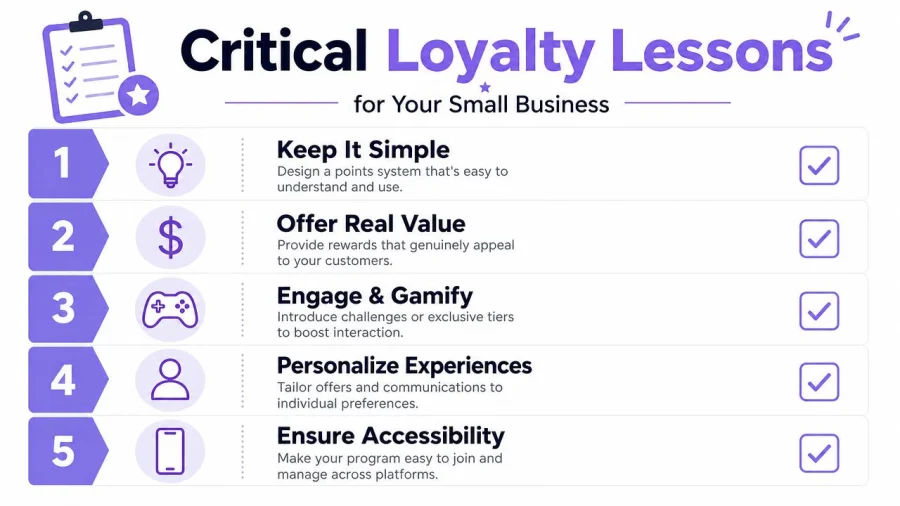
The five loyalty rules worth keeping
| Lesson | What to do |
|---|---|
| Keep the rules visible | Put eligibility details in customer-facing copy |
| Reward behaviour that matters | Focus on visits, spend, category exploration, or upsells |
| Make progress visible | Show customers what they've earned and what's next |
| Reduce checkout friction | Minimise steps for earning and redemption |
| Add personality selectively | Use challenges when they strengthen the brand |
The broader point is simple. Loyalty works best when the customer never feels tricked, delayed, or confused. That's where small businesses can outperform larger brands.
Build Your Own Loyalty Programme in Minutes
A small business doesn't need custom development, POS integration, or a long rollout to apply these lessons. It needs a tool that keeps the programme simple for customers and manageable for staff.
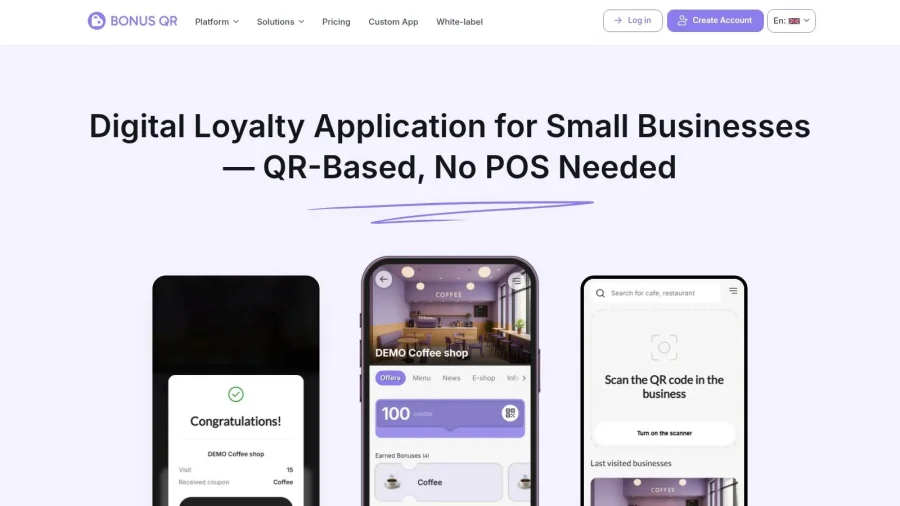
That's where BonusQR fits. It gives brick-and-mortar businesses a fast, QR-based way to launch points, stamps, cashback, visit rewards, spend thresholds, fixed discounts, welcome bonuses, birthday coupons, and seasonal campaigns without adding extra hardware.
What this looks like for a local operator
A café can create a points or stamp programme that rewards repeat drink purchases, then add a welcome bonus for first-time sign-ups.
A salon can set visit thresholds, automate birthday offers, and send seasonal promotions without building a branded app from scratch. A retail shop can mix spend-based rewards with targeted coupons and keep everything tied to a customer profile that staff can access quickly.
Why this approach is practical
BonusQR removes several of the operational barriers that usually stop local businesses from launching loyalty:
- No extra hardware: Staff scan and redeem inside the platform.
- No forced POS integration: That reduces setup complexity for smaller teams.
- Mobile-friendly customer profiles: Customers can track points, rewards, and visit history in one place.
- Wallet compatibility: Apple Wallet and Google Wallet passes keep offers visible.
- Built-in analytics: Businesses can review top customers, coupon performance, and visit trends.
Simple comparison for decision-making
| Option | Setup effort | Flexibility | Cost control | Speed to launch |
|---|---|---|---|---|
| Custom-built loyalty system | High | High | Lower predictability | Slow |
| Manual paper or punch-card method | Low | Low | Cheap upfront | Fast |
| BonusQR | Low | High | Strong | Fast |
This is the practical middle ground most local businesses need.
How to start without overcomplicating it
The best rollout is usually the simplest one:
- Choose one main reward logic. Start with points, stamps, or visits.
- Add one joining incentive. A welcome bonus works well because it creates immediate value.
- Set one recurring trigger. Birthdays or seasonal campaigns are easy wins.
- Promote it at the counter and online. Customers need repeated prompts.
- Review the data and adjust. Keep what customers use. Remove what they ignore.
BonusQR also supports a free start, an affordable white-label app option, and a custom app path for businesses that want more advanced branding or integrations later. That means the system can match the size of the business today without limiting what it can become later.
Start Building Customer Loyalty Today
The lesson from Jimmy John's Rewards isn't that big brands have better tools. It's that they use clear mechanics to make repeat business feel natural.
A local business can do the same without enterprise complexity. Start with one clear reward, make the rules obvious, remove friction at checkout, and give customers a reason to come back sooner.
BonusQR makes that process simple. It's built for brick-and-mortar businesses that want loyalty without technical headaches. Start free with BonusQR and turn occasional customers into regulars with a programme that's easy to launch and easy to use.


