Most advice about gamification in loyalty starts with the wrong question: which game mechanic should a business add? In a crowded UK market, the better question is which mechanic still feels useful enough for customers to notice, understand, and use. Spin wheels, streaks, badges, and prize draws can create a burst of attention, but novelty rarely creates a durable reason to return.
The UK already has a well-established reward habit. Nine in ten British consumers belong to one or more loyalty schemes, and 77% of GB adults believe every brand should offer one, according to YouGov's 2024 UK loyalty schemes survey. For cafés, restaurants, salons, gyms, and independent retailers, that creates an opportunity, but it also raises the standard. Customers know how loyalty programmes work. They quickly recognise a mechanic that adds effort without adding value.
A practical programme therefore treats gamification as a behaviour-design tool, not decoration. It makes progress visible, connects a customer action to a relevant reward, and removes unnecessary friction. The most effective version may be a digital stamp card with one well-timed bonus, not a catalogue of badges and missions.
Why Most Gamified Loyalty Programmes Fail Before They Start
Adding a game mechanic does not automatically create loyalty. It can create extra screens, notifications, rules, and decisions for customers who already have plenty of reward programmes competing for their attention. The practical question is not how many mechanics a business can launch. It is which single mechanic makes the next valuable action clearer and more rewarding.
UK customers already understand loyalty schemes. Supermarket programmes such as Tesco Clubcard and Nectar are especially familiar, particularly among older consumers, according to YouGov's UK research. A café, salon, gym, or independent retailer is therefore not teaching customers what rewards are. It is asking them to give attention to one more programme. The value, progress, and next step must be immediately clear.
Trade reporting points to a saturated market. It reports that 93% of UK fast-food loyalty schemes use gamified elements, while another roundup found that the average shopper belongs to 4.7 loyalty schemes, although only one to four are used regularly. The same coverage reports that 57% feel frustrated when rewards take too long and 47% abandon schemes when rewards seem low-value or irrelevant. These findings appear in Retail Times' coverage of gamification fatigue.
Novelty is not the same as motivation
A spin wheel may make a first visit memorable, yet it rarely gives someone a strong reason to choose the same café next week. A badge shows activity but adds little if customers cannot explain what it earns them. A streak can support a real routine, but it can also penalise customers whose visits naturally include gaps.
The distinction is practical:
- Useful gamification makes a desired action easier to understand and more rewarding.
- Decorative gamification adds game language without improving the customer's value exchange.
- Fatiguing gamification asks customers to complete too many actions, receive too many messages, or wait too long for a reward.
Research covered by Bournemouth University's loyalty research material reported that 93% of shoppers found visual progress bars attractive. It also reported that 32% cited excessive notifications as their biggest frustration, 26% said rewards weren't worthwhile, and 21% mentioned poor in-store connectivity. A progress bar earns its place when it answers, “How close am I to something I want?” Otherwise, it is another prompt competing for attention.
Practical rule: If a customer cannot explain the reward and the next step in one sentence, the mechanic is probably too complicated.
The local-business test
Large retailers can support several reward types, personalised missions, and specialist product teams. A neighbourhood business usually needs a programme staff can explain during a busy service and customers can use without downloading another app.
Use this behavioural test:
- Identify the repeat action that matters, such as another coffee, a second treatment booking, or another gym visit.
- Choose one mechanic that makes that action visible.
- Attach a reward customers already value.
- Remove every rule that does not help customers reach that reward.
- Check whether participation continues after launch excitement fades.
The strongest programmes respect attention. They show progress, reward the behaviour that matters, and avoid making customers work through a catalogue of badges, missions, and spin wheels. In a crowded UK market, simplicity is a competitive advantage.
The Core Building Blocks of Gamified Loyalty
Every gamified loyalty programme uses a small set of building blocks. The difference between a helpful programme and an exhausting one lies in how those blocks are combined.
Objectives give the mechanic a job
A loyalty mechanic needs one clear objective. A café may want more frequent weekday visits. A salon may want clients to rebook before leaving. A gym may want members to attend consistently. A retailer may want customers to try a category they rarely buy.
Without an objective, the programme becomes a collection of activities. With one, the business can decide whether stamps, points, tiers, or challenges fit.
Stamps make repetition visible
Digital stamps suit businesses with a clear visit rhythm and a reward that feels achievable. A coffee shop could award one stamp per qualifying purchase and earn a free drink after the chosen threshold. A quick-service restaurant might use stamps for visits during quieter periods. A salon could award a stamp after each completed appointment, provided the reward doesn't encourage customers to delay higher-value bookings.
QR systems work well here because the customer can scan a code, see progress, and return to the same profile without carrying a physical card. The mechanic stays visible while the redemption process remains straightforward.
Points create flexibility
Points work when customers make varied purchases or when the business wants to reward more than visits. A retailer might award points for spending, selected categories, referrals, or reviews. A salon could combine appointment spend with a birthday bonus. A gym might reward attendance and participation in a specific class.
Points are more flexible than stamps, but flexibility creates explanation costs. Customers need to know how points are earned, what they're worth, and whether they expire. UK programmes often use strict or conditional expiry rules, such as Tesco Clubcard vouchers being valid for two years after issue, Nectar's inactivity condition, and Boots Advantage Card points being removed after two years of account inactivity, as outlined by ClearScore's loyalty points guidance.
Tiers signal progress and recognition
Tiers suit businesses with customers who have meaningful differences in value or commitment. A beauty salon could offer standard, preferred, and premium status, with benefits such as priority booking or an extra service rather than constant discounts. A gym could connect tiers to attendance or class participation, but it should avoid making less active members feel excluded.
Tiers need a visible benefit at each stage. A label alone isn't enough. Recognition, access, convenience, and relevant extras can matter more than a larger discount.
Challenges add focus
Challenges are useful when the business needs to promote a particular action for a limited period. A café might challenge customers to visit at selected times. A restaurant could encourage trial of a new menu category. A gym might connect a challenge to attendance or class variety.
The challenge should be achievable, specific, and linked to a reward customers understand. It shouldn't require customers to monitor several conditions at once.
Customer communication is part of the mechanic: Welcome messages, progress reminders, and reward notifications should build a relationship rather than push constant sales. Guidance on email marketing beyond selling helps businesses keep those messages useful and human.
Finally, reward cadence determines whether the system feels generous or distant. Small businesses usually benefit from visible, reasonably near-term value rather than an elaborate accumulation journey. UK and Ireland research reports that 75% of consumers name discounts and rewards as their main reason for joining, 88% consider scanning receipts for a reward worthwhile, and 59% prefer a mobile app as the loyalty channel, according to Eagle Eye's 2025 grocery loyalty report. The lesson is practical: make earning easy, make progress clear, and avoid forcing a customer to understand a complicated economy before receiving value.
Choosing the Right Mechanic for Your Business
The right mechanic depends on three questions: how often customers visit, how consistent the purchase is, and whether the business wants to reward frequency, spend, or a specific action.
A coffee shop with daily traffic can use a short stamp loop. A salon with longer gaps between appointments needs a reward structure that recognises completed visits without making the customer wait through an unrealistic sequence. A gym can use challenges because attendance itself is the behaviour that needs encouragement.
| Business Type | Best Mechanic | Reward Type | Why It Works |
|---|---|---|---|
| Coffee shop or café | Digital stamps | Free drink, upgrade, or selected extra | Customers understand the loop immediately and can see progress after each visit |
| Restaurant or quick-service eatery | Stamps with selected challenges | Side dish, dessert, free add-on, or targeted offer | The business can encourage repeat visits or trial without discounting every order |
| Beauty salon or wellness centre | Visit threshold with birthday or seasonal bonus | Treatment upgrade, add-on service, or relevant voucher | The mechanic respects a lower visit frequency while recognising appointment value |
| Gym or fitness studio | Attendance challenge or streak | Guest pass, class access, merchandise, or recognition | The reward supports the behaviour the business wants to strengthen |
| Retail store | Flexible points system for retailers | Category offer, fixed discount, or product-related reward | Varied baskets need a system that can recognise different purchase types |
Match the mechanic to visit frequency
A stamp card is usually the clearest option where customers buy the same type of item repeatedly. Points become more useful when transaction values and product categories vary. Tiers make sense when a business can offer meaningful recognition over a longer relationship, not just a different coloured icon.
Challenges should solve a specific commercial problem. A restaurant might use one to fill quieter periods. A gym might use one to encourage attendance across different classes. A salon might use a seasonal challenge to promote an underused service, but the reward should remain relevant to the client.
BonusQR can support stamps, points, cashback, visit and spend thresholds, fixed discounts, welcome bonuses, birthday offers, seasonal coupons, challenges, and progress tracking through a QR-based customer profile. Businesses considering a points-led model can compare it with a flexible points system for retailers.
Avoid the obvious mismatches
Complex points rules often underperform for businesses with infrequent visits because customers forget the balance or lose sight of the reward. A tier system can feel excessive for a small café if customers only want a simple free drink. A daily streak can frustrate gym members whose attendance pattern is regular but not daily.
The selection process should end with a one-line explanation:
“Scan after each visit, track progress on your phone, and receive a reward when you reach the next milestone.”
If staff need several sentences to explain the programme, reduce the number of mechanics. If the reward isn't immediately relevant to the customer's usual purchase, change the reward before adding more game elements.
Launching Your QR-Based Loyalty Programme
A QR-based launch should feel like a service improvement, not a technology project. The business needs one mechanic, a clear reward menu, trained staff, and visible prompts at the moments customers are most likely to join.
Days one to three
Start by configuring the rule. Choose what earns a stamp, point, visit credit, or challenge completion. Decide how staff will verify the action and how customers redeem the reward. Test the full journey from registration to redemption before placing anything in front of customers.
Create a reward menu with a small number of clear options. A café could offer a free drink or upgrade. A salon might offer an add-on treatment. A gym could offer a guest pass or class-related benefit. Each reward should be easy to describe and operationally simple to fulfil.
Set up the welcome message, first-reward notification, birthday communication, and a restrained re-engagement message. The programme should communicate at useful moments, not after every minor action.
Days four to seven
Prepare the customer-facing material. Place a QR code at the till, reception desk, counter, table, treatment room, or checkout. The sign should state the benefit first, then the action:
- Join in seconds: Scan to start collecting rewards.
- Show your progress: Track visits and rewards from your phone.
- Claim useful value: Receive a reward connected to regular purchases.
Train staff with one sentence and two answers to common objections. A suitable script is: “Scan this code to join the rewards programme and track your progress on your phone.” If a customer asks whether a separate app is required, staff should explain the available mobile or wallet access clearly. If a customer worries about messages, staff should explain how communications are managed and keep the explanation concise.
Days eight to fourteen
Launch first with the team, then with customers. Each staff member should complete a test scan and redemption. The business should also check that the QR code remains readable in the intended lighting and that the reward can be fulfilled during busy periods.
Customers can sign up through a mobile or web experience, receive a personal QR code, and track their progress. Wallet passes can keep access close at hand, while a mobile web application to manage points on phone avoids making a dedicated app download the first barrier to participation.
The first 30 days
The opening month is for observation, not constant redesign. Watch where customers stop, which questions staff receive, whether rewards are redeemed smoothly, and whether the mechanic encourages the intended action. Correct broken steps quickly, but don't add badges, tiers, or extra challenges just because the launch feels quiet.
A QR programme can run without POS integration or extra hardware when staff scan and redeem through the loyalty system. That keeps the initial launch accessible for smaller businesses, while wallet access and automated messages provide useful retention tools without requiring a complex build.
Tracking Performance and Running Smart Experiments
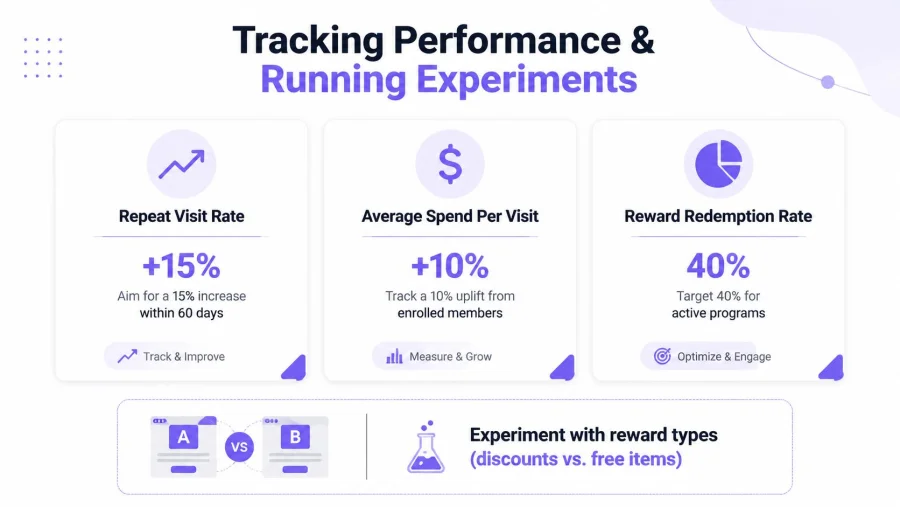
Sign-ups are a starting point, not proof of loyalty. A customer may register once and never scan again, so programme reporting must separate enrolment from active behaviour.
The first review should examine five measures:
- Enrolment rate: How many eligible customers join after seeing the offer?
- Active participation: How many enrolled members earn or redeem during the review period?
- Visit frequency: Do participating customers return more often than their previous pattern?
- Average transaction value: Does the reward encourage a larger or more relevant purchase?
- Redemption rate: Do customers claim rewards, or do they stop before reaching them?
The available evidence supports a disciplined measurement approach. A UK longitudinal study of a gamified consumer-engagement app found that knowledge-focused game affordances were the strongest driver of attitudinal loyalty, while behavioural data explained 11.3% of the variance in attitudinal change, according to the Bournemouth University study.pdf). For a small business, the practical implication is to measure which feature customers use instead of assuming that a more entertaining feature creates more loyalty.
Run one clean experiment
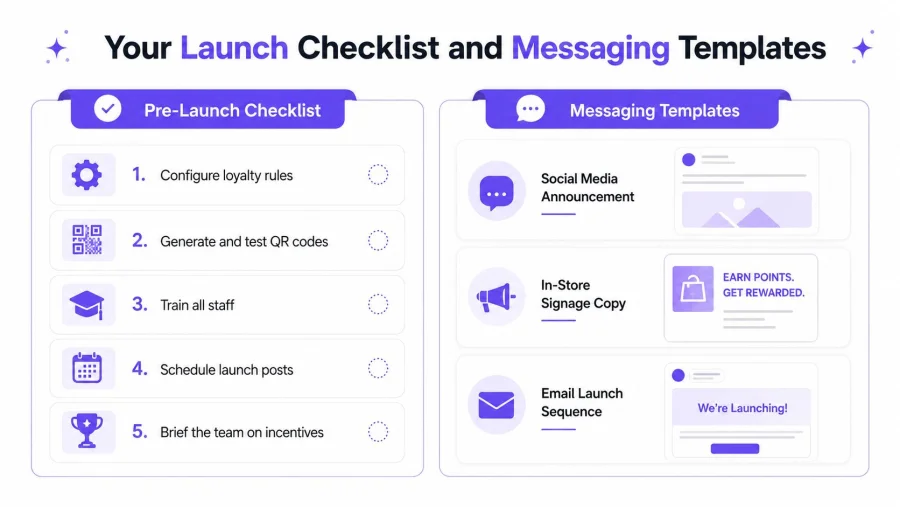
Choose one variable. A café might compare a standard stamp day with a double-stamp Tuesday. A salon could compare a treatment upgrade with a fixed discount. A gym might compare an attendance challenge with a simple visit reward.
Keep the audience and period as comparable as possible, then record participation, repeat visits, average spend, and redemptions. The result doesn't need advanced statistical modelling. It needs a consistent question and a decision rule, such as keeping the mechanic only if it produces useful behaviour without creating unsustainable reward costs.
A business can also segment members by exposure. Compare customers who saw a challenge with those who only used the standard reward loop. The Bournemouth study's suggested rollout approach is practical: instrument app events, group users by feature exposure, then compare loyalty shifts by affordance type.
For broader campaign reporting, a social media data analysis guide can help teams organise channel-level observations around launch posts and customer engagement. Loyalty reporting should still prioritise business actions over likes or impressions.
Review monthly and act carefully
Use BonusQR analytics stats to inspect customer activity, reward performance, and visit trends. A useful monthly review asks:
- Which mechanic generated completed actions?
- Which reward was redeemed most often?
- Where did customers abandon progress?
- Which members have stopped participating?
- Did the reward cost remain proportionate to the behaviour gained?
If participation falls, simplify before adding an incentive. If customers earn rewards but don't redeem them, check whether the reward is relevant and whether redemption is clear. If messages generate complaints, reduce frequency. The purpose of analytics is not to prove that the programme is busy. It's to show which parts deserve to remain.
Your Launch Checklist and Messaging Templates
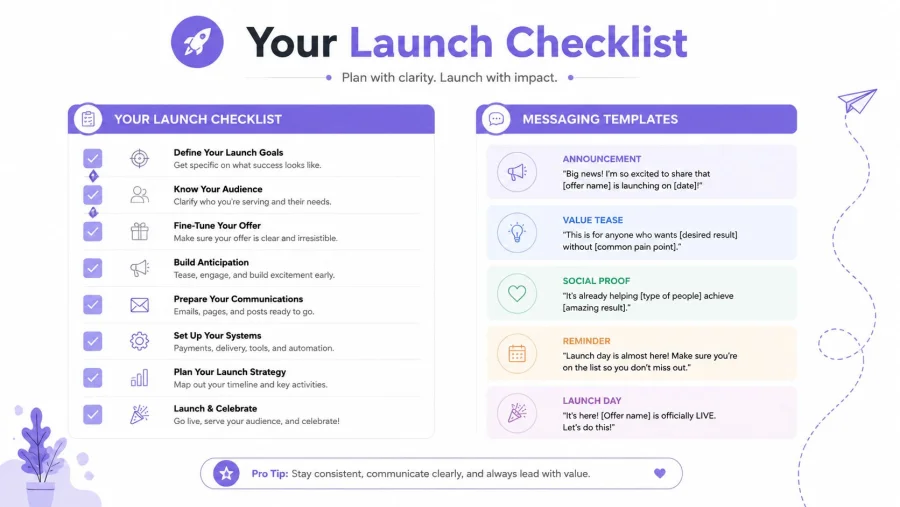
A practical launch can fit on one working sheet. The owner or manager should assign each item, test it before launch, and review customer questions during the first week.
Pre-launch checklist
- Choose one behaviour: Decide whether the programme is designed to increase visits, support rebooking, encourage attendance, or promote selected purchases.
- Select one primary mechanic: Start with stamps, points, a threshold, or a challenge. Add another element only when the first one works.
- Write the reward rule: State what customers earn, what they receive, and how redemption works.
- Test every QR code: Scan from each planned location and complete the customer journey before printing.
- Train the whole team: Every staff member should know the one-sentence explanation and the redemption process.
- Place the prompt well: Put signage where the customer can act without blocking service.
- Prepare the messages: Schedule welcome, reward, birthday, seasonal, and restrained win-back communications.
- Review the first week: Check scans, active members, questions, redemptions, and any points of confusion.
Messages customers can understand
Welcome message
“Welcome to [Business Name]. Scan after each visit to track your progress and receive [reward]. The next step is ready whenever you are.”
First reward notification
“You've earned your [reward]. Show this message at [location] when you're ready to claim it. Thanks for coming back to [Business Name].”
Win-back message
“[Business Name] has missed you. Your rewards are still available, and the next visit brings you closer to [benefit].”
Birthday or seasonal offer
“Happy birthday from [Business Name]. Enjoy [specific offer] during [valid period]. We hope to see you soon.”
Each message should explain the benefit without creating pressure. Customers should know what to do, what they'll receive, and whether any condition applies.
BonusQR lets small businesses configure QR-based stamps, points, cashback, thresholds, coupons, challenges, and progress tracking without POS integration or extra hardware. Businesses can start with a free setup, use mobile or wallet access, and review customer activity before deciding whether a more customised app is necessary.
The next step is straightforward. Choose the single repeat behaviour that matters most, create one QR reward loop around it, and invite customers to join this week. Start with BonusQR for free, launch the simplest version, and use the first month of customer behaviour to decide what deserves to grow.


