
 Deutsch
 Español
 Français
 Italiano
 Magyar
 Polski
 Slovenčina
 Čeština
A café membership programme is a structured scheme that gives regular customers guaranteed perks, either in exchange for a recurring payment (paid subscription) or through earned rewards tied to visit behaviour (points or stamp systems), with hybrid models combining both. The core distinction matters: paid memberships grant value upfront and deliver predictable monthly revenue, while free loyalty programmes reward behaviour over time and reach a wider customer base. For a small-to-medium café in Central Europe, a membership programme makes sense when you have a loyal core of regulars, a clear unit-economics case, and the operational capacity to manage enrolment without slowing your morning queue. Platforms like Bonusqr make the technical side manageable, and GDPR-compliant data capture is non-negotiable from day one. The key performance indicator to anchor everything to is customer lifetime value (LTV): if your programme does not increase it within 90 days, the model needs adjusting.
What types of café membership programme should you consider?
Choosing the right model starts with understanding what each type actually demands from you operationally, not just what it promises in revenue.
-
Paper stamp or punch card. The simplest entry point. Customers collect stamps per visit or purchase and redeem a free drink after a set number. Zero digital infrastructure required, which makes it ideal for single-site cafés with fast morning rushes and cash-heavy transactions. The trade-off: no customer data, no way to re-engage lapsed members, and easy to abuse with duplicate cards.
-
Points-based digital programme. Customers earn points per euro spent and redeem them against drinks or food. Works well for cafés that want to capture first-party data (email, visit history) and run targeted campaigns. Best suited to multi-site operators or any café investing in a customer database for future marketing.
-
Paid monthly subscription (coffee pass). Customers pay a fixed monthly fee for a defined benefit, such as one filter coffee per day or a percentage discount on every order. This is the model that delivers predictable revenue and stabilises cash flow, but it only works when your variable cost per drink is modest and average daily redemptions stay low. Community-focused independents in Central Europe are increasingly testing this model.
-
Tiered premium membership. Two or three membership tiers at different price points, each unlocking progressively better perks: a base tier for a daily discount, a mid tier adding a monthly free drink, a top tier including event invitations or early access to new roasts. Tiering increases average revenue per member but adds complexity to staff training and enrolment.
-
Hybrid loyalty plus paid tier. A free loyalty layer (stamps or points) sits beneath a paid premium tier. Customers can participate at no cost and upgrade when they see enough value. This model has the widest reach and the best conversion funnel, though it requires more careful programme design to avoid cannibalising paid-tier revenue with free-tier generosity.
Operational fit at a glance: paper cards suit single-site, cash-heavy cafés; digital points apps suit data-driven or multi-site operators; paid subscriptions suit community-focused independents with a loyal core; tiered and hybrid models suit cafés ready to invest in a platform and staff training.
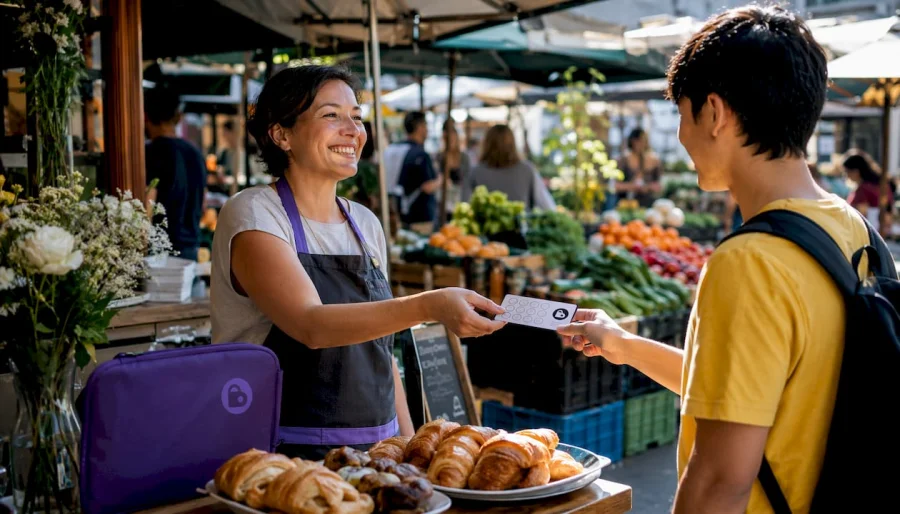
How café membership mechanics work in practice
Understanding the day-to-day flow, from the moment a customer signs up to the moment they redeem a reward, is where most café owners find the gaps in their original plan.
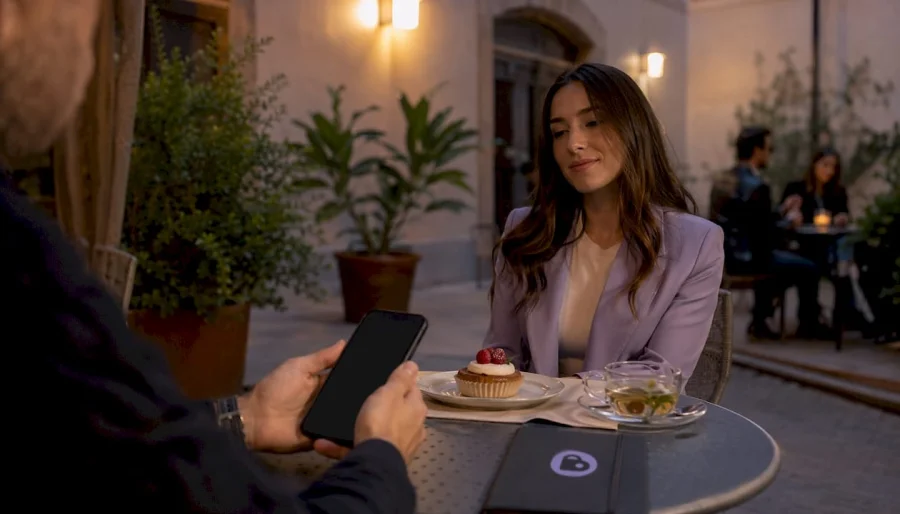
Enrolment can happen in four ways: in-person sign-up at the till (staff enter a phone number or hand over a card), QR code scan that opens a web form or adds a wallet pass to the customer’s phone, POS-integrated enrolment triggered automatically at checkout, or a web or app sign-up completed at home. The fastest path for a busy café is a QR code on the counter that takes under 30 seconds to complete. For GDPR compliance, that sign-up form must include a clear consent checkbox, collect only the data you genuinely need (name, email or phone, consent date), and state how long you will retain it.
Reward triggers differ by model. Paid members receive their benefit immediately on enrolment, no earning required. Points and stamp members earn incrementally: a stamp per visit, or one point per euro spent. The trigger should be as automatic as possible. Friction at the till is the primary reason loyalty projects fail, so the best implementations require zero extra steps at the point of sale: a wallet pass tapped, a QR code scanned, or a phone number entered once and recognised automatically thereafter.
Redemption works best when it mirrors the enrolment simplicity. A staff member scans a QR code on the customer’s phone, the system confirms the reward, and the transaction completes. For paid subscription members, the benefit is pre-loaded: they show their pass and the discount applies. No manual voucher, no paper coupon, no staff discretion required.
Renewals for paid subscriptions should be automatic via direct debit or card-on-file, with a clear cancellation policy stated at sign-up. For points-based programmes, there is no renewal, but you should set a points-expiry rule (typically 12 months of inactivity) to keep your database clean and your liability manageable.
What business benefits does a café membership deliver, and which metrics matter?
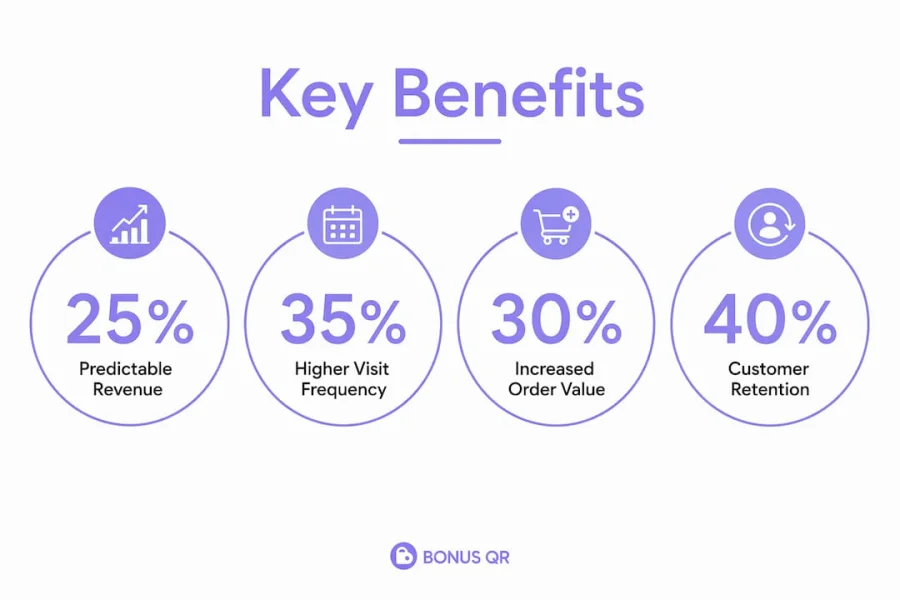
The business case for a café membership programme rests on four measurable outcomes, and tracking them from week one separates operators who scale successfully from those who quietly discontinue after three months.
Predictable revenue is the most immediate benefit of a paid subscription model. Knowing your monthly recurring revenue (MRR) from memberships allows you to plan staffing, stock and marketing spend with far more confidence than relying entirely on foot traffic. Seasonal dips, which hit Central European cafés hard in January and February, become less damaging when a portion of revenue is locked in.
Higher visit frequency follows naturally from any well-designed programme. Members who have paid upfront, or who are close to a reward threshold, visit more often than non-members. This is the psychology behind loyalty rewards: commitment and progress both drive behaviour.
Increased average order value (AOV) is a benefit many café owners underestimate. A member collecting their free filter coffee is also the customer most likely to add a pastry, a bag of beans, or an oat-milk upgrade. Subscription members at cafés that have tested this model have seen meaningful food attachment rates alongside their drink redemptions.
Stronger customer relationships come from treating membership as a community product rather than a discount scheme. Events, partner tastings, and early access to seasonal menus increase perceived value well beyond the monetary benefit.
KPIs to track from launch:
- Retention rate: the percentage of members still active after 30, 60, and 90 days. Watch for a drop-off at the first renewal point.
- Visits per member per month: compare members against non-members to quantify the frequency uplift.
- Redemption rate: for points programmes, a very low rate means rewards feel unattainable; a very high rate may signal over-generosity.
- LTV (lifetime value): total revenue per member over their active period. This is the number that justifies your programme cost.
- AOV: track separately for members and non-members to measure upsell effect.
- MRR: for subscription models, monitor monthly to catch churn early.
Use data-driven loyalty strategies to build a simple weekly dashboard from these six metrics. You do not need sophisticated software to start; a spreadsheet works for a pilot.
What makes a café membership programme succeed or fail?
Most café membership programmes that fail do so for the same handful of reasons, and most of them are avoidable with a clear design checklist before you launch.
Design principles that work:
- Start with one model, not three. Complexity at launch kills momentum.
- Match the model to your customer profile: a café with 80% regulars suits a subscription; one with 60% passing trade suits a points scheme.
- Price to your unit economics, not to what feels generous. Calculate your variable cost per drink before setting a subscription fee.
- Prioritise zero till friction. If redemption takes more than five seconds, staff will start skipping it under pressure.
- Plan the first meaningful reward to arrive quickly. A customer who earns nothing in their first two visits will not return for a third.
Common mistakes:
- Over-discounting: setting a subscription price so low that every redemption is a loss.
- Complex enrolment: requiring an app download, email verification, and a profile photo before the first stamp.
- Poor data compliance: collecting email addresses without a consent record, which creates GDPR exposure under EU Regulation 2016/679.
- Scaling community activities faster than your team can service them: promising monthly events when you have no capacity to run them.
Pro Tip: Run a four-week pilot with 20–30 of your most loyal regulars before opening the programme to all customers. Measure retention at week four and redemption rate daily. If retention is below 70% at week four, adjust the reward structure before scaling.
The loyalty programme optimisation process recommended for cafés follows the same logic: start simple, measure retention, and expand features only once core KPIs are stable.
How should you price a café membership for Central Europe?
Pricing a café membership in Central Europe requires honest unit-economics work before you set a number. The region’s café market spans a wide range of price points, from budget-conscious Czech and Slovak cities to premium urban cafés in Vienna and Warsaw, so there is no single correct price. What matters is that your subscription fee covers your variable costs at the expected redemption rate and leaves a margin contribution.
Common pricing shapes:
| Model | Typical monthly price (Central Europe) | Best for |
|---|---|---|
| Free loyalty (points/stamps) | €0 to customer | Widest reach, habit formation |
| Monthly subscription (1 drink/day) | €15–€30 | Community-focused independents |
| Annual prepay (discount vs monthly) | — | Cash-flow boost, committed regulars |
| Tiered membership (2–3 levels) | €8–€15 / €20–€35 | Cafés with varied customer segments |
A simple break-even example. Suppose your variable cost per filter coffee is €0.80 (beans, milk, cup, labour allocation) and your retail price is €3.00. A member paying €20 per month for one coffee per day, five days per week, redeems roughly 22 coffees per month. Your variable cost for those 22 coffees is €17.60. At €20 per month, you retain €2.40 per member per month before any fixed-cost contribution, and you have a customer in your café 22 times who may buy food or a second drink. The model works. If that same member redeems twice daily, your variable cost rises to €35.20 against a €20 fee: an immediate loss. This is why subscription viability depends on variable cost per drink staying under one-third of retail price and average daily redemption staying below two drinks per member.
Anti-abuse rules to build in from day one:
- One redemption per visit, with a minimum gap of two hours between redemptions.
- Daily cap of one drink per membership tier (or two for premium tiers, priced accordingly).
- Clear terms and conditions stating that the membership is non-transferable and non-refundable after the first 14 days (in line with EU consumer protection rights).
Which technology should you use to run your café membership?
The right technology choice depends on your speed of service, your appetite for data, and how much you want to spend before you have validated the model.
| Option | Cost to launch | Data capture | Staff friction | Best for |
|---|---|---|---|---|
| Paper stamp card | Near zero | None | Very low | Single-site, cash-heavy, fast morning trade |
| Digital wallet pass (Apple/Google Wallet) | Low–medium | Email/phone | Very low | Any café wanting low friction with basic data |
| Hosted loyalty platform (e.g. Bonusqr) | Low monthly fee | Full (email, visits, spend) | Low | Single or multi-site cafés wanting analytics |
| POS-integrated system | Medium–high | Full | Very low | High-volume cafés with existing POS investment |
| Custom white-label app | High (one-off) | Full + brand control | Low | Multi-site or roastery-cafés scaling membership |
Loyalty tools for cafés in 2026 consistently prioritise wallet passes and QR-enabled enrolment for independents, precisely because they add no hardware cost and require no app download from the customer.
Operational checklist before go-live:
- Staff training: every team member must be able to explain the programme in two sentences and process a redemption without hesitation.
- In-shop signage: counter card, table tent, and a QR code at eye level near the till.
- Written terms and conditions: programme rules, cancellation process, refund policy, and data retention statement.
- Cancellation and refund process: under EU consumer protection law, customers who sign up online have a 14-day cooling-off right; state this clearly and build a simple cancellation flow.
- GDPR consent record: store the date, channel, and wording of consent for every member. A hosted platform handles this automatically; a paper card does not.
Operational fit by profile:
- Single-site, high-volume morning trade: paper stamp card or wallet pass. Speed is everything; data can come later.
- Multi-site or data-driven café: hosted platform with analytics and campaign automation.
- Roastery-café or premium independent: tiered membership on a hosted platform, with the option to upgrade to a white-label app as membership grows.
How do you launch a café membership in 30–90 days?
A structured pilot removes the guesswork and gives you real data before you commit to a full rollout. Here is a practical timeline.
-
Days 1–7: Define your model and economics. Choose one programme type. Calculate your break-even using the worked example above. Set your price, your reward structure, and your daily redemption cap. Write your terms and conditions.
-
Days 8–14: Choose and configure your technology. Set up your chosen platform (paper, wallet pass, or hosted app). Configure enrolment flow, reward triggers, and redemption rules. Test the full customer journey yourself, from sign-up to first redemption.
-
Days 15–21: Train your team. Run a 30-minute briefing with all staff. Cover: how to explain the programme, how to process a redemption, what to do when a customer has a problem. Print a one-page reference card for the till.
-
Days 22–28: Soft launch to existing regulars. Invite your 20–30 most loyal customers personally, by name if possible. Offer a small launch incentive (a free drink on sign-up, or double stamps in week one). This group will surface problems before the public launch.
-
Days 29–45: Public launch. Put up in-shop signage, add a QR code to your counter and receipts, and post on your social channels. Use a first-reward offer to accelerate early sign-ups: an immediate free drink or a double-stamp week makes the value tangible from visit one.
-
Days 46–60: Measure and adjust. Review your weekly KPIs: retention rate, visits per member, redemption rate, and AOV. If retention is below 70% at day 45, investigate why before adding more members. If redemption rate is very low, the reward may feel too distant.
-
Days 61–90: Decide on full rollout. If your pilot metrics are positive, open the programme fully, expand your marketing, and consider adding a second tier or a community event. If metrics are mixed, adjust one variable at a time: price, reward threshold, or enrolment friction.
Weekly measurement template: track total active members, new sign-ups, cancellations, total redemptions, and total member revenue. Monthly, calculate LTV and compare member AOV against non-member AOV. These six numbers tell you everything you need to know about whether the programme is working.
How does Bonusqr help cafés run a membership programme?
Bonusqr is a modular loyalty platform built for exactly the operational profile described throughout this guide: a small-to-medium café that needs rapid setup, low till friction, and real analytics without a complex POS integration.
Feature mapping to café needs:
- Stamp cards and points modules: configure a digital stamp card or points scheme in minutes, with reward triggers set by visit count or spend amount. No hardware required; customers interact via QR code or mobile app.
- Subscription and cashback modules: set up a paid monthly membership with automatic renewal, daily redemption caps, and cashback or fixed-discount mechanics.
- Apple and Google Wallet passes: customers add their membership pass to their phone wallet, making redemption a single tap with no app download required.
- Push notifications and campaign automation: re-engage lapsed members with automated messages, run limited-time onboarding offers, and send birthday rewards without manual effort.
- Analytics dashboard: track visits per member, redemption rate, retention, and revenue contribution in real time, giving you the weekly KPI data the pilot plan above requires.
- GDPR-compliant data capture: consent records, data minimisation, and retention controls are built into the enrolment flow, removing the compliance burden from your team.
A café using Bonusqr for a 30–90 day pilot would typically configure a digital stamp card in the first week, launch a wallet-pass enrolment QR code in week two, and use the analytics dashboard from week three onwards to track retention and redemption daily. The loyalty application for coffee shops includes templates and use-case examples that match the pilot structure above.
[Insert author Michal’s professional background and credentials here.]
[Insert first-hand case studies or customer testimonials showing Bonusqr’s impact on businesses here.]
For a deeper look at which loyalty programme modules suit different café profiles, Bonusqr’s module guide covers stamp cards, subscriptions, and cashback in detail.
Key takeaways
A café membership programme succeeds when unit economics are validated before launch, enrolment friction is eliminated, and the first meaningful reward arrives within the customer’s first two visits.
| Point | Details |
|---|---|
| Choose one model first | Start with a single programme type matched to your customer mix before adding tiers or hybrid features. |
| Validate unit economics | Variable cost per drink should stay under one-third of retail price; daily redemptions should average fewer than two per member. |
| Eliminate till friction | Use a wallet pass or QR code so redemption takes under five seconds and requires no staff discretion. |
| Track six KPIs from day one | Monitor retention rate, visits per member, redemption rate, LTV, AOV, and MRR weekly from your pilot launch. |
| Use Bonusqr for rapid setup | Bonusqr’s modular platform covers stamp cards, subscriptions, wallet passes, and analytics without mandatory POS integration. |
The subscription vs points debate: a pragmatic view
The most common question small café owners ask is whether to start with a paid subscription or a free points scheme. The honest answer is that it depends on one thing: how well you know your regulars.
If you can name 30 customers who visit at least three times a week, a paid subscription pilot is worth testing. Those customers already have the habit; you are simply formalising it and giving them a reason to stay exclusive. The risk is low because you are not trying to create new behaviour, only to reward existing behaviour with a structure that also benefits your cash flow.
If your customer base is more transient, or if you are in a location with significant passing trade, a free points or stamp scheme is the lower-risk starting point. It costs you nothing to launch, captures data gradually, and builds the habit before you ask for a financial commitment.
The mistake many owners make is treating the two models as permanent choices. They are not. Start with whichever fits your current customer profile, measure for 90 days, and then decide whether to add a paid tier on top. The cafés that build the most durable membership communities in Central Europe tend to follow exactly this sequence: free loyalty first, paid tier second, community events third.
One practical rule of thumb: if your average customer visits fewer than twice a week, a subscription will struggle to justify itself to them. Price it accordingly, or start with points and revisit the subscription question at the six-month mark.
Ready to launch your café membership with Bonusqr?
Running a café membership programme without the right platform means managing consent records manually, chasing lapsed members by hand, and guessing at redemption rates. Bonusqr removes all three problems. You can set up a digital loyalty card in under an hour, launch a wallet-pass enrolment QR code the same day, and have your first retention dashboard live before your pilot’s week-three review.
The platform requires no POS integration, handles GDPR consent automatically, and gives you the analytics to make the go/no-go decision on full rollout with confidence. [Insert internal proprietary data on Bonusqr’s platform performance and user success metrics here.]
Three features that matter most for a café pilot: rapid setup with no hardware, wallet-pass and QR redemption that adds zero seconds to your till flow, and a real-time analytics dashboard that tracks the six KPIs your pilot depends on. Visit Bonusqr’s café loyalty page to see café-specific templates and start your free account today.
Useful sources for café owners going deeper
These resources are worth bookmarking depending on where you are in the process.
-
For unit economics and subscription pricing: Coffee shop subscription: the indie operator’s guide covers the margin trade in detail, with practical thresholds for variable cost and daily redemption.
-
For choosing between loyalty and membership models: Restaurant memberships vs loyalty programmes sets out the structural differences clearly, with a focus on revenue predictability vs reach.
-
For real-world subscription design: How Palace Coffee designed a profitable coffee shop subscription is the most practical case-level account of moving from a paper mug club to an app-managed monthly model.
-
For technology selection and 2026 tooling priorities: Top 6 loyalty tools for cafés 2026 on the Bonusqr site covers wallet passes, QR enrolment, and hosted platforms for independents.
-
For launch checklists and marketing tactics: 6 loyalty marketing tips for cafés covers first-reward offers, push notifications, and on-site signage in practical detail.
-
For optimisation after your pilot: Loyalty programme optimisation for cafés walks through the measurement and iteration process once your core programme is live.