UK grocery retailers generated over £5 billion from loyalty-priced products between November 2023 and January 2024, equal to roughly 22% of grocery revenues for supermarkets running those promotions, according to the UK government review of grocery loyalty pricing. For a small business, the lesson is straightforward. Incentives change customer behaviour, and they do it fast when the offer is easy to understand.
The gap between a good incentive and a margin-killing one usually comes down to execution. A café may need a second visit within seven days. A salon may care more about pre-booking the next appointment before the client leaves. A studio may need attendance consistency, not one discounted drop-in. The right offer depends on the buying pattern, the gross margin, and whether staff can explain it in one sentence at the counter.
That is why this guide focuses on incentives you can run. Each option is paired with BonusQR setup steps, including where a QR-based loyalty program fits, plus small business examples, budget guardrails, compliance checks, and the metrics that show whether the incentive is driving repeat purchases or just training customers to wait for a deal.
1. Tiered Loyalty Programs
Tiered rewards work because they turn passive customers into progress-driven customers. Once someone can see they're close to a better level, they often change behaviour to get there. Starbucks Rewards, Sephora VIB Rouge, and Planet Fitness membership tiers all use that logic well.
This model suits businesses with frequent purchases and clear customer value bands. A coffee shop might recognise casual buyers, regulars, and heavy regulars differently. A salon might reward clients who book recurring services and retail products, not just one-off treatments.
How to build tiers that people actually use
Most failed tier programmes suffer from one problem. The next level feels too far away.
A practical setup inside BonusQR is to start with a QR-based loyalty program, then define simple earning rules and visible tier benefits. Bronze might enable standard earning, Silver might add faster points, and Gold might add priority booking or a birthday extra.
Useful rules:
- Keep progression believable: Customers should feel they can reach the next tier through normal behaviour, not heroic spending.
- Make each tier different: Faster point earning, bonus coupons, or early access work better than vague “member benefits”.
- Show progress clearly: A visible progress bar matters more than a long policy page.
Practical rule: If staff can't explain the tiers in one sentence at the till, the structure is too complicated.
A salon example is straightforward. Every visit earns points, but clients who reach a higher tier gain earlier access to peak-time appointments and occasional upgrade rewards. That changes behaviour without requiring deep discounting.
Budget and measurement
Tiered programmes are best when the richer rewards go to customers already showing repeat behaviour. That protects margin better than blanket discounts. They also help stop reward leakage because not everyone qualifies for top-level benefits.
For compliance, keep terms visible. Explain how points are earned, when they expire, and what happens if an account goes inactive. Avoid collecting more personal data than needed for account operation and reward delivery.
Measurement should stay simple:
- Tier migration: Are members moving upward over time
- Repeat purchase rate: Are tier members coming back more often
- Average basket value: Are upper-tier customers buying more each visit
- Reward redemption by tier: Are benefits being used or ignored
2. Stamp Cards and Visit-Based Rewards
Some incentives for customers work due to their intricate design. This one works because everyone understands it in seconds.
Buy nine coffees, get the tenth free. Visit five times, earn a free add-on. Book six blow-dries, receive a treatment upgrade. Local coffee shops, beauty salons, and frozen yoghurt chains have used this logic for years because it matches habit-driven buying.
Paper cards still appear in many small businesses, but they create avoidable problems. They get lost, staff forget to stamp them, and there's no reliable redemption history. A digital version fixes those issues without changing the underlying offer.
Best-fit use cases
Visit-based rewards are strongest when frequency matters more than basket size. That makes them ideal for cafés, car washes, quick-service food, barber shops, and fitness classes.
Inside BonusQR, a business can launch modern digital loyalty stamps with visit rules tied to scans instead of paper cards. Staff scan once, the visit is recorded, and the customer sees progress in the same profile.
A practical café setup might look like this:
- Core offer: One stamp per drink purchase
- Quiet-period push: Double stamps on slow midweek afternoons
- Near-reward reminder: Trigger a message when someone is close to redemption
That simple structure often beats a more complex points system in high-frequency businesses because customers remember it without effort.
Trade-offs and controls
The biggest weakness of stamp programmes is that they can reward low-value transactions too generously. If someone buys the cheapest item repeatedly, the free reward can eat margin. The fix is to restrict qualifying products or tie stamps to minimum spend categories.
A salon can solve this by awarding one stamp only for qualifying services, not for every small retail item. A café can exclude bottled water and focus the card on house drinks with better margin.
A visit programme should create a habit, not train customers to cherry-pick the cheapest transaction.
For compliance, publish the rules where customers sign up. Make expiry and exclusions easy to find. For measurement, watch visit frequency, redemption rate, time between first and final stamp, and whether redemptions lead to additional purchases on the same visit.
3. Referral and Advocacy Incentives
Referral rewards can turn happy customers into a low-friction acquisition channel. Uber popularised the “give one, get one” structure. Dropbox made referral sharing feel native to the product. Small local businesses can use the same principle with far less complexity.
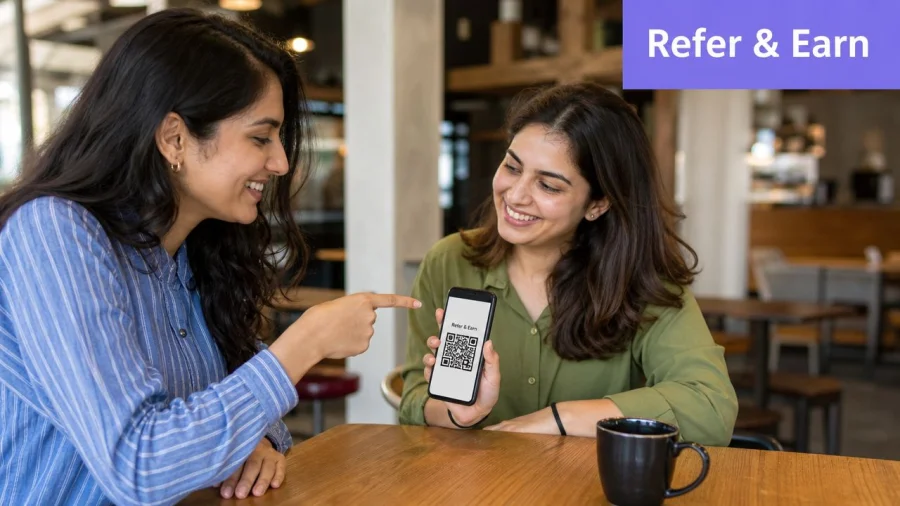
The rule is simple. A current customer shares a code or QR link. A new customer joins and completes a first qualifying purchase. Both people receive something useful.
Why referral offers fail
Most referral schemes break down for one of three reasons. The reward is too weak, the sharing process is clumsy, or the trigger is vague. “Invite friends for exciting benefits” won't move anyone. “Share this code. Your friend gets a welcome discount. You get credit after their first purchase” is clear.
A practical restaurant example is easy to picture. A regular shares a referral from the loyalty profile with two nearby colleagues. One uses it for a first lunch order. The new customer gets a joining incentive. The referrer receives stored credit after the qualifying purchase is completed.
Inside BonusQR, referral flows can be tied to each customer's QR identity so the business can track who referred whom and apply dual-sided rewards without manual chasing.
Reward design, fairness, and brand tone
The reward should feel worth sharing, but it shouldn't attract the wrong behaviour. Overly aggressive referral offers can invite abuse, fake sign-ups, or bargain-only traffic. The safest structure is to reward completed first purchases, not just sign-ups.
There's also a softer issue. Incentive design affects brand perception. Research discussed in this PubMed record on public attitudes toward incentive schemes highlights that incentives can be received differently depending on perceived fairness. For a café, salon, or wellness brand, that means referral messaging should feel appreciative, not manipulative.
Good wording matters:
- Keep the tone friendly: “Invite a friend and both enjoy a treat” lands better than hard-sell copy
- State the trigger clearly: Reward applies after a first qualifying purchase
- Limit abuse: One reward per new paying customer, not per click
A gym might offer a guest pass benefit for the friend and account credit for the member once the friend joins. A salon might offer a service add-on instead of cash-like credit, which often protects margin better.
The metrics that matter are referral share rate, referred customer conversion, first-purchase completion, and repeat visit rate of referred customers. If referred customers redeem the first reward but never return, the offer is attracting deal-hunters rather than advocates.
4. Welcome Bonuses and Sign-Up Incentives
A welcome offer has one job. Remove hesitation at the exact moment someone is deciding whether joining is worth the effort.
That can be a first-order discount, a free add-on, bonus points, or a limited-time sign-up coupon. Sephora, CVS ExtraCare-style onboarding offers, and DoorDash's first-order discounts all use that opening nudge to make enrolment feel immediately useful.
Strong welcome offers are short-lived and clear
The common mistake is making the reward either too small to matter or so generous that it attracts one-time bargain seekers. Better incentives for customers sit in the middle. The reward should be easy to understand and expire soon enough to prompt action.
A practical café version is simple. Join the loyalty programme, receive a welcome reward valid on the next purchase within a short redemption window. That gives the customer a reason to come back quickly, not “sometime”.
Inside BonusQR, this is straightforward to configure:
- Create a welcome coupon: Trigger it automatically at sign-up
- Tie it to a clear condition: Valid on a first or next qualifying order
- Add a time limit: Short windows create action and reduce long-tail liability
Budgeting and list-building
A welcome bonus should be treated as an acquisition cost, not as random discounting. If the average customer comes back often enough, the initial incentive is justified. If they don't, the business needs to tighten the offer or improve the follow-up sequence.
This is also where data discipline matters. It's reasonable to ask for the minimum details needed to operate the programme and send the offer. It's less wise to ask for a long form on day one, especially when customers are already cautious about data collection.
The Nesta discussion of hidden levers and skewed incentives is a useful reminder that incentive systems can create distrust when people feel nudged into giving more than they expected. For local businesses, a simpler sign-up flow often beats a “collect everything now” approach.
A salon example works well here. A new client joins by scanning a QR code at reception, enters only the essential details, and receives a first rebooking incentive before leaving. The offer does more than boost sign-ups. It also increases the chance of turning a first appointment into a second.
Watch sign-up rate, welcome reward redemption, time to second purchase, and whether customers who redeem the welcome offer become active members or fade out.
5. Birthday and Anniversary Rewards
Birthday offers still work because they feel personal without being complicated. Starbucks, Sephora, Dunkin', and Chipotle all use date-based rewards because they arrive at a moment when customers are already more open to treating themselves.
Anniversary rewards deserve just as much attention. For a salon, that could be the anniversary of a first visit. For a gym, it could mark a membership milestone. For a restaurant, it could be one year since joining the loyalty scheme.
Make the reward feel special, not generic
A birthday incentive shouldn't look like a recycled weekly coupon. If the same discount runs every Thursday, sending it again with “Happy Birthday” added won't create much emotional lift. The offer needs a different wrapper or a slightly richer benefit.
BonusQR can automate date-based campaigns so the business doesn't rely on staff memory or manual exports. The cleanest approach is to make birthday collection optional, explain why it's requested, and offer a small reason to provide it.
Examples that fit local businesses:
- Café: Free bakery item with a drink purchase during the birthday window
- Salon: Complimentary upgrade added to a booked service
- Gym: Anniversary guest pass or class credit
Some offers win because they feel human. Birthday rewards are one of the few incentives where tone matters almost as much as value.
Data trust and operational details
Date-based rewards come with a privacy trade-off. Some customers are happy to share birth dates. Others aren't. Optional entry is usually the safer approach, especially for businesses that don't need extensive profiles to operate the programme.
Timing also matters. Send the offer before the actual date so people have time to plan a visit. A short but reasonable redemption window helps customers use it without letting the liability sit forever.
From a measurement angle, date-based incentives are less about mass uptake and more about reactivation quality. Track redemption rate, average transaction size on redemption, and whether birthday or anniversary users make another purchase afterwards.
This incentive is often underestimated because the audience is segmented. That's exactly why it works. The message reaches people at a relevant moment instead of becoming another generic promotion in a crowded inbox.
6. Spend-Based Thresholds and Bonus Rewards
Visit rewards build frequency. Spend thresholds build basket size.
That distinction matters in businesses where transaction values vary widely. A restaurant wants add-ons and higher-value orders. A salon wants clients to bundle services or add retail. A gym may want members to buy class packs, coaching, or merchandise. Spend-based incentives are designed for those situations.
The right threshold changes buying behaviour
Examples from large brands such as Whole Foods, Ulta Beauty, Nordstrom, Costco, and Target show the logic well. Customers receive an extra reward once they cross a spending milestone in a defined period. The target can be monthly for frequent retail, or longer for less frequent services.
BonusQR can track cumulative spend and trigger the reward once the threshold is reached. That removes the usual staff headache of checking receipts manually or trying to maintain a side spreadsheet.
A practical setup might include:
- Set a realistic milestone: High enough to encourage a larger basket, low enough to feel reachable
- Show progress in the customer profile: Hidden targets don't motivate action
- Message at key points: Halfway and nearly-there prompts often outperform broad promotional blasts
Margin control and what to avoid
Spend incentives can damage profit if the reward applies to items with already thin margin. The fix is to aim the threshold at categories where upsell behaviour is healthy. A café might push breakfast bundles. A salon might tie the milestone to colour services and home-care products. A grocery or specialist retail store might exclude tobacco, gift cards, or regulated products.
This strategy also works well when paired with timing. Running a spend challenge around pay days, seasonal launches, or local events gives the threshold context and urgency.
A useful external signal supports the broader direction. The Queue-it roundup of loyalty programme statistics notes that members of loyalty programmes in the UK generate more incremental annual revenue growth than non-members, and that top-performing programmes can produce stronger annual revenue gains from participating customers. That doesn't mean every spend threshold works. It means the upside exists when the offer is designed properly.
For compliance, make the counting period, qualifying spend, excluded items, and reward conditions visible. Track threshold completion rate, average order value, attachment rate of add-ons, and whether threshold earners continue spending after reward redemption.
7. Limited-Time Flash Offers and Seasonal Promotions
Flash offers are useful when a business needs traffic at a specific time, not just “more loyalty” in the abstract. Starbucks has used app-led happy hour formats. Sephora and Target Circle-style member offers rely on the same principle. A short window creates urgency, and urgency compresses decision time.
This incentive works especially well in businesses with visible quiet periods. A café may need slower afternoons filled. A restaurant may want midweek dinner traffic. A gym may want underused class slots booked.
Use urgency carefully
A flash offer should feel like a real event, not constant background noise. If every week has a “limited” offer, customers stop reacting. The strongest flash campaigns are occasional, tightly timed, and relevant to inventory or footfall needs.
BonusQR's push and campaign tools fit this format well because the business can send one clear message, define the reward window, and track redemptions without paper vouchers.
Examples that are easy to execute:
- Café: Members-only drink and pastry bundle on a quiet Tuesday afternoon
- Salon: Last-minute fill offer for selected off-peak slots
- Gym: Weekend guest access for members who attend a specific class window
Seasonal structure beats random discounting
Seasonal campaigns work best when they match customer behaviour. Summer can support lighter menus, iced drinks, or fitness challenges. Autumn can support back-to-routine offers. December can support giftable services and prepaid bundles.
A projection also points toward why digital delivery matters more now. The UK loyalty market is projected to reach US$2.64 billion in 2026, with annual growth of 13.5%, and the software segment is forecast to grow at a CAGR of 19.8% through 2033, according to Research and Markets reporting on the loyalty market. For small businesses, that means digital loyalty expectations are rising even when the business itself is local and offline.
The operational rule is simple. Tie every flash offer to a business goal. Fill seats, move a category, reactivate lapsed members, or reward top customers first. Then measure redemption timing, margin impact, and whether the offer shifted traffic into the target period instead of just discounting people who would have bought anyway.
8. Cashback and Direct Discounts
When customers are overwhelmed by loyalty mechanics, cashback and direct discounts cut through the noise. People understand savings instantly. There's no mental conversion from points into value, and no confusion about what the reward is worth.
That simplicity matters in the UK. Only 57% of UK loyalty programme owners say they're satisfied with their current programmes, lower than the global average of 70%, according to Antavo's review of UK loyalty programme trends. Many programmes lose people because the structure feels harder than the payoff.
Why simple beats clever
Cashback is often strongest for businesses where repeat spending matters but customers don't want another complicated system to learn. Direct discounts are especially effective when there's strong price sensitivity or when the business wants immediate action.
BonusQR supports cashback and fixed discount structures, which makes this format practical for brick-and-mortar use. The customer scans, earns visible value, and can see available balance without carrying a card or remembering a promo code.
Examples that work in local settings:
- Café: Small cashback on every qualifying drink purchase, visible as available credit
- Salon: Discount earned after a set number of completed services
- Restaurant: Fixed credit after cumulative spend or repeat lunch visits
Privacy, trust, and communication
This category is also a good answer to the active-versus-passive loyalty problem. Customers already belong to many schemes, but they only use a few regularly. The Mintel retail market report on UK customer loyalty highlights that the market is highly saturated, while active use remains concentrated in a limited number of programmes. The programmes that get used tend to be the ones with low friction and obvious value.
Cashback and direct discounts fit that pattern because they don't ask customers to decode a complicated reward chart. They also let businesses operate with a lighter data ask if needed, which can help trust.
For budgeting, decide whether the savings come from margin, marketing spend, or from a category-specific strategy. A business can afford higher discounts on high-margin items and tighter rewards on low-margin essentials. Track active user rate, redemption frequency, repeat visit interval, and whether the credit drives full-price add-ons on the same order.
9. Exclusive Member Benefits and VIP Perks
Not every incentive has to be a discount. Some customers care more about access, convenience, and recognition than another small monetary reward. Sephora Beauty Insider, Starbucks higher-tier treatment, Equinox-style access perks, and premium gym privileges all build loyalty through status and ease.
This approach works best when the business can offer something customers value without creating major delivery costs.
The best VIP perks solve real annoyances
A salon client may care more about priority booking than about a minor price cut. A restaurant regular may value a reserved seating perk on busy nights. A gym member may prefer early booking on popular classes.
BonusQR's tier setup can gate those benefits inside the same customer profile used for stamps, points, or coupons. That matters because staff need one place to confirm eligibility. If VIP perks live in a separate manual process, they usually break down.
Good examples include:
- Salon: Priority slots for top members
- Restaurant: early access to special menus or event nights
- Gym: first access to peak class booking or guest privileges
Exclusive perks only work when staff can recognise them and honour them consistently.
Where UK loyalty fatigue changes the playbook
There's a reason to use VIP perks carefully. Mintel's 2025 retail insight on loyalty programmes says 80% of consumers in the UK are actively engaging in at least one loyalty programme, the highest participation share since 2018. That means loyalty is normal. It also means “member-only” alone isn't enough to impress people.
Exclusive benefits need to connect to the business's actual value proposition. If a café's service is quick convenience, then express ordering or a priority collection line might matter. If a wellness business sells calm and care, then VIP treatment should reinforce that, not feel like a tack-on gimmick.
From a compliance and fairness standpoint, explain eligibility clearly so standard customers don't feel misled. Measure perk usage, retention among VIP members, staff fulfilment consistency, and whether members who qualify for status continue engaging with the programme.
10. Gamification and Interactive Challenges
Gamification is where many businesses overcomplicate things. Bad gamification feels childish or confusing. Good gamification adds momentum to behaviour that already matters.
Starbucks seasonal challenges, Nike Training Club streaks, Duolingo leaderboards, Fitbit badges, Apple Fitness competitions, and McDonald's Monopoly all show the same idea. Progress, achievement, and light competition can keep people engaged when basic rewards start to feel ordinary.
Keep the game tied to the business goal
For a café, a challenge might reward five weekday visits before noon. For a gym, it could reward a class attendance streak. For a salon, a challenge could reward rebooking plus a retail add-on over a defined period.
BonusQR can be used to boost repeat visits with gamification through badges, challenges, and milestone mechanics layered on top of the core loyalty setup. That's the right order. Core loyalty first, game layer second.
A practical rollout looks like this:
- Start small: One weekly or monthly challenge is enough
- Reward meaningful behaviour: Check-ins, repeat visits, referrals, or category trials
- Rotate themes: Seasonal refresh keeps the format from going stale
Caution on fatigue and fairness
Gamification should never hide the value. If the customer can't tell what they're getting, engagement drops fast. It also shouldn't depend on endless notifications or public competition if that doesn't fit the brand.
A useful market signal sits behind that caution. Emarsys reports that 48% of UK consumers show incentivised loyalty, meaning they stay loyal because of rewards and perks rather than brand affection alone. That supports using game mechanics, but only if the reward at the end still feels tangible.
A coffee chain-style challenge might award a badge and then offer a real drink benefit. A gym streak can grant guest access or credit. A restaurant challenge can provide a fixed-value reward after a set run of visits.
Track challenge enrolment, completion, repeat visit change during the challenge period, and post-challenge retention. If people engage while the game runs and vanish after, the mechanic may be entertaining but not commercially strong enough on its own.
Customer Incentives: 10-Point Comparison
| Strategy | 🔄 Implementation Complexity | ⚡ Resource Requirements | 📊 Expected Outcomes | ⭐ Ideal Use Cases | 💡 Key Advantages |
|---|---|---|---|---|---|
| Tiered Loyalty Programs (Points-Based Rewards) | High, multi‑tier rules & tracking | Medium, app/CRM & analytics | Strong retention uplift (≈25–40% LTV) | Cafés, retail, gyms with frequent visits | Drives repeat spend; rich behavioural data |
| Stamp Cards & Visit-Based Rewards | Low, fixed visit counts, simple flow | Low, minimal tech or digital stamps | Increases visit frequency; predictable traffic | Coffee shops, QSRs, fitness studios | Easy to understand; low friction for customers |
| Referral & Advocacy Incentives | Medium, attribution & reward logic | Low–Medium, referral links/dashboard | Lower CAC (25–50%); higher retention (16–25%) | All sectors, esp. growth-focused businesses | Scalable acquisition; strong social proof |
| Welcome Bonuses & Sign‑Up Incentives | Low, one‑time reward setup | Low, coupons/points delivery | Boosts signups (≈5–15%); encourages first purchase | New locations, email acquisition, e‑commerce | Reduces signup friction; immediate conversion |
| Birthday & Anniversary Rewards | Low, date-trigger automation | Low, CRM date & messaging | High engagement (open +40–50%); good redemptions | Any recurring-customer business | Personalised, high emotional impact; automatable |
| Spend-Based Thresholds & Bonus Rewards | Medium, spend tracking & resets | Medium, transaction tracking, analytics | Increases AOV and total revenue | Retail, restaurants, upscale salons | Directly drives higher spend; clear ROI alignment |
| Limited‑Time Flash Offers & Seasonal Promotions | Medium, frequent campaign ops | Medium, creative, scheduling, inventory mgmt | Short-term spikes; clears inventory; boosts engagement | Retail, cafés for slow periods, seasonal sales | Creates urgency/FOMO; flexible & fast to deploy |
| Cashback & Direct Discounts | Low, simple checkout application | Medium, financial tracking, liability mgmt | Immediate repeat visits; appeals price-sensitive customers | QSRs, cafés, price‑sensitive retail | Transparent value; easy to communicate |
| Exclusive Member Benefits & VIP Perks | Medium–High, service delivery & gating | High, staff training, experience ops | Strong emotional loyalty; higher LTV | Upscale restaurants, premium salons, high‑end gyms | High perceived value w/o heavy discounting |
| Gamification & Interactive Challenges | High, design, UX & ongoing content | High, development, creative & analytics | Big engagement uplift (≈30–50%); viral potential | Brands targeting younger audiences, apps | Boosts non‑purchase actions; highly engaging |
Turning Incentives into Growth and Your Next Steps
A crowded loyalty market creates a simple operating reality. Customers already have plenty of schemes in their wallets, so another generic offer will not get much attention. The programmes that grow revenue are the ones tied to one clear business problem, priced properly, explained in seconds, and measured from day one.
Start with the bottleneck, not the incentive type. If repeat visits are soft, use stamps or visit rewards. If basket size is stuck, test spend thresholds or tiers. If paid acquisition costs too much, put referrals and sign-up offers first. If regulars buy often but do not feel attached, birthday rewards, VIP treatment, and selective seasonal promotions usually do more than another blanket discount.
Execution decides whether the idea makes money.
I have seen modest offers outperform generous ones because staff could explain them quickly, customers could see progress without asking, and the reward arrived at the right moment. I have also seen attractive offers fail because the rules were fuzzy, redemption was awkward, or the discount went to people who would have bought anyway.
A practical rollout usually looks like this:
- Choose one primary behaviour to change: repeat visits, higher average order value, rebooking, referrals, or slow-period traffic
- Match it to one incentive mechanic: avoid stacking multiple offers at launch
- Set the budget before launch: decide the maximum reward cost per visit, order, or referred customer
- Write rules customers can understand fast: earning criteria, expiry, exclusions, and redemption steps should be clear at the counter and on the sign-up page
- Track a short list of metrics: repeat rate, redemption rate, average order value, active member rate, and margin after reward cost
- Review monthly: keep the incentive if behaviour changes profitably, tighten the rules if redemptions are high but incremental revenue is weak
The measurement piece is where many small businesses get sloppy. Redemptions alone are not a win. A free coffee after eight visits can work well if visit frequency rises and paid add-ons hold up. The same reward fails if regulars claim what they were already on track to earn. A salon offering a birthday credit should check rebooking within 30 days, not just message opens. A retailer running a threshold reward should compare average basket size before and after launch, then subtract the cost of the reward from the gross margin gained.
Budget discipline matters just as much as creativity. Keep reward cost in line with the behaviour you are trying to change. Referral credits need a cap and a fraud check. Cashback needs liability tracking. VIP perks need staff training, or the promise turns into confusion at the till. If you collect customer data, ask for what you will use, explain why you need it, and make the terms easy to find. Clear consent, simple redemption rules, and honest expiry policies protect trust and reduce complaints.
For physical locations, the practical test is simple. Can staff enroll someone in under a minute, can the customer see progress instantly, and can the owner tell whether the offer drove an extra visit or just reduced margin. If the answer is no, simplify the setup before adding more mechanics.
The next step should be small and specific. A café might launch a digital stamp card aimed at weekday lunch traffic, then watch repeat visits and reward cost per active member for six weeks. A salon might start with rebooking plus a birthday offer and measure client return rate against the previous quarter. A gym might test a challenge tied to attendance streaks and track class frequency, not just sign-ups. A retailer might run a spend-threshold bonus with a minimum margin target and stop it if basket growth does not cover the discount.
Keep the first version tight. Make the value obvious. Measure incremental behaviour, not vanity metrics. Then expand only after the first incentive proves it can pay for itself.


