
 Deutsch
 Español
 Français
 Italiano
 Magyar
 Polski
 Slovenčina
 Čeština
Small business owners often overlook one powerful retention tool: branded loyalty programs increase customer retention by 5-25%, boosting profits 25-95%. While most SMBs recognize they need repeat customers, many underestimate how structured digital loyalty systems transform casual buyers into devoted advocates. The gap between knowing you need retention and actually achieving it comes down to implementation. This guide reveals how branded loyalty programs deliver measurable profit growth, why members spend significantly more than non-members, and exactly how you can launch effective programs that rival enterprise competitors without enterprise budgets.
Key Takeaways
| Point | Details |
|---|---|
| Retention boosts profits | A 5 percent rise in retention can lift profits by 25 to 95 percent through more frequent purchases, higher transaction values, and lower marketing costs. |
| Loyalty ROI advantage | Branded loyalty programs deliver an average ROI of 4.8x, with 90 percent of programs generating positive returns. |
| Lower retention costs | Retaining existing customers costs roughly one fifth of acquiring new ones, making retention five times as efficient. |
| Spending and visits rise | Loyalty members spend 12 to 67 percent more and visit 30 to 60 percent more often, driven by rewards and perceived value. |
How branded loyalty programs boost customer retention and profits
The mathematics of retention create a compounding effect most SMBs don’t fully grasp. When you increase customer retention by just 5%, you’re not adding 5% to your bottom line. Research from Bain & Company shows profits increase 25-95% because retained customers buy more frequently, spend more per transaction, and require less marketing investment. This exponential return happens because loyalty compounds over time.
The financial case becomes even stronger when you examine loyalty program ROI averages of 4.8x, with 90% of programs generating positive returns. Compare this to traditional advertising where measuring direct attribution remains challenging and returns often disappoint. Branded loyalty programs create trackable, repeatable revenue streams you can optimize continuously.
Acquisition costs continue climbing across every channel. Social media advertising, search marketing, and traditional outreach all demand higher budgets for diminishing returns. Meanwhile, retaining an existing customer costs roughly one-fifth of acquiring a new one. This cost differential means every dollar invested in retention generates five times the efficiency of acquisition spending.
Increasing customer retention rates by 5% increases profits by 25% to 95%. This dramatic impact comes from the compound effect of repeat purchases, higher transaction values, and reduced marketing costs per customer.
Branded loyalty programs deliver retention through several interconnected mechanisms:
- Creating habitual purchase patterns through reward anticipation that keeps your business top of mind
- Building emotional connections beyond transactional relationships by recognizing and valuing customer loyalty
- Generating switching costs that make competitors less attractive even when they offer similar products
- Providing data insights that enable personalized experiences customers can’t get elsewhere
- Reducing price sensitivity as customers focus on accumulated benefits rather than individual transaction costs
The branded loyalty apps transforming retention work because they integrate seamlessly into customer routines. When checking rewards becomes as natural as checking email, you’ve created a persistent touchpoint competitors must overcome. This psychological ownership of accumulated points or status creates powerful inertia favoring your business.
Why loyalty members spend more and visit more often
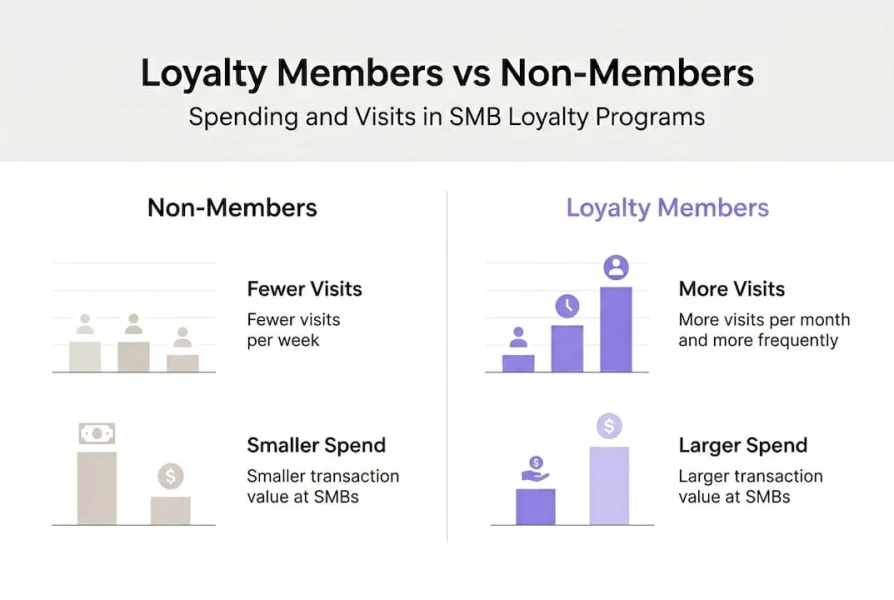
Behavioral economics explains why loyalty members spend 12-67% more than non-members, but the specific mechanisms matter for program design. Average order value increases 47% among program participants, while purchase frequency rises 30-60%. These aren’t marginal improvements. They represent fundamental shifts in customer behavior that directly impact your revenue.
The spending increase stems from several psychological drivers working simultaneously. Customers rationalize larger purchases when rewards offset perceived costs. The mental accounting that separates “regular money” from “reward points” removes normal spending constraints. Someone hesitant to spend an extra $20 readily does so when earning points toward a future reward.

Frequency increases follow a different pattern. Loyalty programs create artificial deadlines and goals that motivate visits. Points expiring, status tiers requiring minimum activity, or limited-time bonus offers all generate urgency non-members don’t experience. You’re engineering reasons to visit beyond natural purchase cycles.
Ways loyalty programs drive higher spending and visit frequency:
- Reward thresholds encourage customers to increase basket size to reach the next tier or unlock benefits
- Exclusive member pricing and early access create perceived value that justifies premium purchases
- Personalized recommendations based on purchase history introduce customers to higher-margin products they otherwise wouldn’t consider
- Gamification elements like progress bars and achievement badges tap into completion psychology
- Status tiers create social proof and aspirational goals that motivate increased engagement
Pro Tip: Analyze your top 20% of customers to identify their preferred reward types, then structure your program around those preferences rather than generic discounts. Personalized rewards generate 2-3x higher redemption rates.
Loyalty member vs. non-member spending comparison
| Metric | Non-Members | Loyalty Members | Increase |
|---|---|---|---|
| Average order value | $45 | $66 | +47% |
| Monthly visit frequency | 1.8 visits | 2.7 visits | +50% |
| Annual spend per customer | $486 | $802 | +65% |
| Referral likelihood | 12% | 34% | +183% |
The data reveals loyalty members don’t just spend more per transaction. They fundamentally change their relationship with your business. The 183% increase in referral likelihood particularly matters because it compounds your retention gains with lower-cost acquisition of similar high-value customers. Your best customers become your most effective marketing channel.
Implementing customer retention strategies for SMBs requires understanding these behavioral patterns. Generic programs that simply offer points per dollar spent miss the psychological levers that drive outsized returns. Structure matters as much as the rewards themselves.
Key challenges and strategies for effective branded loyalty programs
While 90% of loyalty programs generate positive ROI, the remaining 10% fail spectacularly, often due to preventable mistakes. Complexity and friction kill participation faster than any competitor. When customers need a manual to understand your reward structure, you’ve already lost them. The restaurant industry particularly struggles with this, launching ambitious programs that end quietly when participation stalls.
Successful programs require engagement beyond initial signup. Many SMBs celebrate hitting 1,000 enrolled members while ignoring that only 80 actively participate. Enrollment metrics deceive. What matters is ongoing engagement measured by redemption rates, visit frequency among members, and percentage of transactions involving loyalty interactions. These operational metrics predict program success far better than signup counts.
The economic case for retention grows stronger as acquisition costs climb. Acquiring new customers costs 5x more than retaining existing ones, yet many SMBs still allocate 80% of marketing budgets to acquisition. This misallocation persists because acquisition feels active and controllable while retention seems passive. Flipping this mindset transforms profitability.
Data-driven personalization once belonged exclusively to enterprise brands with sophisticated CRM systems and data science teams. Modern loyalty platforms democratize these capabilities, letting SMBs compete on personalization despite resource constraints. When you know a customer’s purchase history, preferences, and visit patterns, you can deliver experiences that feel custom-built. This levels the playing field against larger competitors.
Common loyalty program pitfalls that reduce effectiveness:
- Complicated reward structures requiring calculators to understand point values and redemption options
- Poor user experience with clunky apps, slow load times, or confusing navigation that frustrates rather than delights
- Lack of personalization treating all customers identically despite different preferences and purchase patterns
- Weak promotion leaving customers unaware of program benefits or how to maximize value
- Ignoring customer feedback and failing to iterate based on actual usage patterns and satisfaction data
- Setting reward thresholds too high, making benefits feel unattainable and demotivating continued participation
Pro Tip: Track your “active participation rate” (percentage of enrolled members who engage monthly) as your primary success metric. If this drops below 40%, your program needs immediate restructuring regardless of total enrollment numbers.
The effective loyalty program strategy addresses these challenges through continuous optimization rather than set-it-and-forget-it implementation. Treat your loyalty program as a living system requiring regular attention, not a marketing campaign with a launch date and completion. The most successful SMB programs dedicate time weekly to analyze performance data and test improvements.
Friction points deserve particular attention because they accumulate. A slightly confusing signup process plus a moderately slow app plus unclear reward communication creates compounding frustration that drives abandonment. Audit every customer touchpoint ruthlessly, eliminating any step that doesn’t add clear value. Simplicity wins.
How SMBs can apply branded loyalty programs to grow customer lifetime value
Launching an effective branded loyalty program follows a systematic process that balances simplicity with strategic sophistication. The average ROI of 4.8x with 90% of programs achieving positive returns proves the model works, but execution determines whether you join the successful majority or struggling minority.
Choosing your reward structure represents your first strategic decision. Spend-based programs (points per dollar) work well for businesses with variable transaction sizes. Visit-based programs (stamps or check-ins) suit businesses with consistent pricing like coffee shops or car washes. Hybrid approaches combine both, rewarding frequency and spend simultaneously. Your business model and customer behavior should dictate structure, not industry trends.
Types of loyalty program rewards and their applications
| Reward Type | Best For | Engagement Driver | Implementation Complexity |
|---|---|---|---|
| Points per dollar spent | Retail, variable transactions | Encourages larger purchases | Medium |
| Visit-based stamps | Coffee shops, car washes | Drives frequency | Low |
| Tiered status levels | Premium services, high-value customers | Creates aspirational goals | High |
| Gamification with challenges | Younger demographics, experiential brands | Generates excitement and social sharing | Medium |
| Digital wallet integration | Mobile-first customers | Removes friction | Low |
Implementation best practices for SMB loyalty programs:
- Choose a platform that integrates with your existing systems without requiring expensive POS upgrades or technical expertise
- Design reward structures with achievable early wins (first reward within 3-5 visits) to hook participation before requiring larger commitments
- Promote aggressively at point of sale, through email, on social media, and via in-store signage to maximize enrollment
- Analyze participation data monthly to identify drop-off points, popular rewards, and customer segments for targeted improvements
- Iterate continuously based on feedback and performance metrics rather than waiting for major overhauls
- Train staff thoroughly so they can explain benefits confidently and enroll customers smoothly during transactions
Pro Tip: Launch with mobile app and digital wallet integration from day one rather than adding it later. Customers expect seamless digital experiences, and retrofitting creates technical debt that hampers future improvements.
The practical guide to customer retention strategies for SMBs emphasizes starting simple and expanding based on results. Many businesses over-engineer their first program, adding complexity that confuses customers and staff. Begin with one clear reward mechanism, perfect the experience, then layer additional features as you learn what resonates.
Studying successful loyalty program examples reveals common patterns worth emulating. The best programs make enrollment effortless, provide immediate value, communicate clearly, and reward behaviors that matter to business goals. They also maintain engagement through regular communication that feels helpful rather than promotional.
Technology selection matters more than most SMBs realize. Your loyalty platform becomes customer-facing infrastructure that must work flawlessly. Slow apps, confusing interfaces, or unreliable point tracking destroy trust instantly. Prioritize platforms with proven reliability, intuitive design, and responsive support. The cheapest option often costs more in lost participation and damaged relationships.
Timing your launch strategically increases initial momentum. Avoid slow periods when you can’t service increased traffic. Launch during moderate activity periods when staff can focus on enrollment without overwhelming existing operations. Build your member base steadily rather than creating unsustainable spikes that strain resources.
Discover BonusQR branded loyalty solutions for SMBs
Implementing everything we’ve covered becomes dramatically simpler with the right platform partner. BonusQR specializes in customizable electronic reward loyalty programs designed specifically for SMB needs and budgets. Our platform eliminates the technical complexity that derails many loyalty initiatives while preserving the strategic flexibility that drives results.
Our mobile and web application features deliver the seamless digital experience customers expect without requiring you to build custom apps or manage complex integrations. Everything works together out of the box, from signup through redemption, with real-time analytics showing exactly how your program performs. You’ll know which rewards drive behavior, which customers engage most, and where opportunities for improvement exist.
The BonusQR loyalty programs scale with your business, starting simple and expanding as your needs grow. Whether you need points, stamps, cashback, tiers, or hybrid approaches, our modular system adapts to your strategy rather than forcing you into rigid templates. This flexibility means you can test, learn, and optimize continuously.
What are the main benefits of branded loyalty programs for SMBs?
Branded loyalty programs increase customer retention by up to 25%, which translates to profit increases of 25-95% according to research. They encourage customers to spend more per transaction (47% higher average order value) and visit more frequently (30-60% increase). Beyond direct revenue impact, loyalty programs provide valuable customer data that enables personalized marketing and helps SMBs compete with larger brands through sophisticated targeting.
How can small businesses ensure their loyalty program succeeds?
Success requires focusing on three core elements: simplicity, engagement, and personalization. Make enrollment and participation effortless by removing friction at every touchpoint. Engage customers across multiple channels rather than relying solely on in-store promotion. Leverage your customer data to personalize rewards and communications based on individual preferences and behaviors. Track active participation rates monthly and iterate quickly when engagement drops below 40%.
What types of rewards work best in branded loyalty programs?
The most effective reward type depends on your business model and customer preferences. Spend-based points work well for retailers with variable transaction sizes, while visit-based stamps suit businesses with consistent pricing. Tiered status programs create aspirational goals for premium service businesses. The key is matching reward structure to customer behavior patterns and business objectives rather than copying competitors. Test different approaches with small customer segments before full rollout.
Why is customer retention more valuable than acquisition?
Retaining existing customers costs approximately one-fifth of acquiring new ones, making retention dramatically more cost-efficient. Retained customers also deliver higher lifetime value through repeat purchases, larger transaction sizes, and referrals that reduce future acquisition costs. The compound effect of retention creates exponential profit growth, with just a 5% increase in retention potentially boosting profits by 25-95%. This mathematical reality makes retention the highest-ROI activity for most SMBs.