
 Deutsch
 Español
 Français
 Italiano
 Magyar
 Polski
 Slovenčina
 Čeština

Loyalty programs boost profits, but most SMEs are leaving serious money on the table by ignoring one critical ingredient: customer feedback. Loyalty program members generate 12-18% more revenue, and retention improvements can drive up to 95% profit growth. Yet points and discounts alone rarely keep customers engaged long-term. The businesses that consistently outperform competitors use feedback to continuously refine their programs, turning passive members into active advocates. This article breaks down exactly how to build that feedback-powered advantage, with practical frameworks, real benchmarks, and actionable steps built for SMEs.
Key Takeaways
| Point | Details |
|---|---|
| Feedback drives retention | Customer feedback is proven to boost loyalty program adoption and long-term customer value. |
| Closed loops build trust | Communicating changes from feedback increases loyalty by up to 30 percent. |
| Benchmark and personalize | Use industry benchmarks and zero-party data to tailor rewards and improve performance. |
| Avoid common pitfalls | Don’t let feedback fatigue, over-discounting, or gimmicks sabotage your loyalty program’s effectiveness. |
| Use simple, integrated tools | SMEs can automate feedback and loyalty integration using modern, user-friendly platforms. |
Why feedback is the life of your loyalty program
Most loyalty programs launch with excitement and then quietly stall. Members sign up, earn a few points, and then disappear. In fact, up to 54% of loyalty memberships are inactive at any given time. The culprit is almost always the same: the program stopped evolving because no one was listening to customers.

Feedback transforms a static rewards scheme into a living system. The key is understanding that feedback loops involve collecting, analyzing, acting, and closing the loop with your customers. Skipping any one of those steps breaks the cycle and erodes trust.
Here is what a healthy loyalty feedback loop looks like in practice:
- Collect input through surveys, reviews, and in-app prompts
- Analyze patterns to find what is working and what is frustrating members
- Act by updating rewards, thresholds, or communication based on findings
- Communicate the changes back to your members so they know their voice mattered
That last step is where most SMEs drop the ball. Closing the feedback loop by telling customers what changed because of their input can boost loyalty by 10-30%. It signals respect, and respect builds retention. Explore feedback collection methods that fit your business model to get started.
“The best loyalty programs are not built once and left alone. They are shaped continuously by the customers who use them.”
With the importance of feedback now established, let’s break down the practical framework for putting it to work.
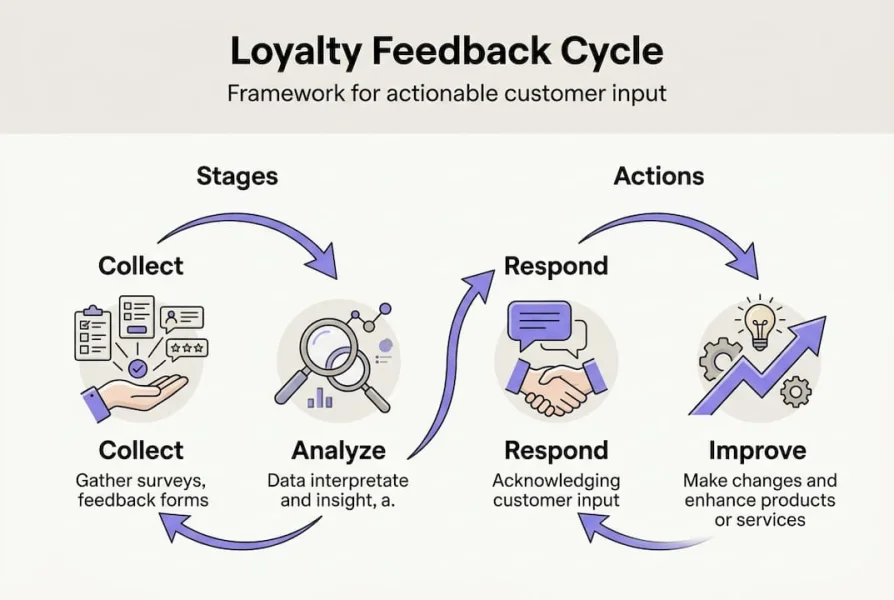
A simple framework: The closed-loop feedback cycle
You do not need a data science team to run an effective feedback cycle. You need a repeatable process. Here are the four steps every SME should follow:
- Collect from multiple channels. Gather feedback from surveys, social media, and in-app tools to capture a full picture. One channel gives you a slice; multiple channels give you the story.
- Analyze with simple metrics. Use Net Promoter Score (NPS) to measure overall loyalty sentiment, and Customer Effort Score (CES) to spot friction in the redemption process.
- Prioritize high-impact changes. Not every piece of feedback deserves immediate action. Focus on issues that affect the most members or the highest-value segments first.
- Communicate your actions. Send a push notification, email, or in-app message explaining what changed and why. This step is what separates programs that grow from programs that fade. You can close the feedback loop with even a simple message.
| Feedback stage | Recommended channel | Useful tool | Action to take |
|---|---|---|---|
| Post-purchase | Email survey | NPS tool | Identify satisfaction gaps |
| In-program | In-app prompt | CES survey | Spot redemption friction |
| Social listening | Review platforms | Sentiment tool | Catch public pain points |
| Re-engagement | SMS or push | Short poll | Win back dormant members |
Pro Tip: Keep surveys to three questions or fewer. Long surveys kill response rates. Use easy feedback tools that integrate directly with your loyalty platform to automate collection without adding manual work.
Now that you have the framework, let’s look at the numbers that tell you whether it is actually working.
What metrics reveal: Loyalty program benchmarks for SMEs
Knowing your numbers is the difference between guessing and growing. Here are the core metrics every SME should track:
- Redemption rate: The percentage of earned rewards that members actually use
- Activation rate: How many enrolled members make at least one redemption
- Revenue share from loyalty: The portion of total revenue driven by loyalty members
- Customer lifetime value (CLTV): Total revenue a customer generates over their relationship with your business
Here is how your program likely compares to industry averages:
| Metric | Industry average | Strong performer |
|---|---|---|
| Redemption rate | 5.6% (sports) to 12.3% (beauty) | 20%+ |
| Revenue from loyalty | 18% of total revenue | 51% of total revenue |
| Member activation | 40-50% | 70%+ |
| CLTV uplift | 10-15% | 20%+ |
If your redemption rate sits below 10%, that is a signal worth investigating through feedback. Members may find rewards too distant, too generic, or too hard to redeem. A 5% retention increase equals 25-95% profit growth, which means even small improvements driven by feedback deliver outsized financial returns.
Feedback helps you pinpoint exactly which stage is underperforming. Low activation? Ask new members why they have not redeemed yet. Low redemption? Survey active members about reward relevance. Check 2026 industry benchmarks to see where your category stands, and review loyalty trends for 2026 to stay ahead. For a deeper look at reward design, explore reward strategy examples and sharpen your approach to customer retention metrics.
Understanding how feedback fits into your ongoing measurement, let’s look at what actually works in the field.
SME case study: Feedback-fueled loyalty program revamp
A Shopify-based beauty brand was running a standard points program with decent sign-up numbers but poor engagement. Redemption was low and repeat purchase rates were flat. They decided to let customer feedback drive a full program revamp.
Here is what they did, step by step:
- Surveyed members about reward relevance and redemption friction
- Discovered customers wanted experiential perks, not just discounts
- Introduced tiered rewards with exclusive early-access offers at higher tiers
- Added progress messaging so members could see how close they were to the next reward
- Sent a campaign explaining every change and crediting member feedback for the update
The results were significant. Loyalty penetration rose to 51%, CLTV increased 14-18%, and redemption climbed to 19.6% after the revamp. Discount reliance dropped by 15 percentage points because customers were motivated by exclusivity, not just price cuts.
Pro Tip: Use feedback to move beyond points. Ask members what non-discount rewards would excite them. Early access, birthday perks, and community recognition often outperform cash-back for building genuine loyalty. Pair this with strong customer engagement strategies and you will see the benefits of customer retention compound quickly.
This SME’s transformation proves feedback’s ROI. Still, all approaches have their pitfalls, so let’s look at critical dos and don’ts.
Common pitfalls and expert tips for loyalty feedback
Even well-intentioned feedback programs fail when they fall into predictable traps. Here are the most common mistakes and how to fix them:
- Over-relying on discounts. Discount-heavy programs dilute loyalty and margins. Customers trained to expect discounts only return when prices drop, not because they value your brand.
- Ignoring feedback after collecting it. Asking for input and then doing nothing is worse than not asking at all. It signals that you do not care, which accelerates churn.
- Feedback fatigue. Bombarding members with survey requests kills response quality and goodwill. Space out requests and keep them short.
- Misaligned rewards. Offering rewards that do not match what your customers actually want is a fast way to tank redemption rates.
- Rewarding only purchases. Rewarding non-transactional actions like reviews and referrals dramatically increases engagement and gives you richer feedback data.
“Loyalty is not bought with discounts. It is earned through consistent, personalized experiences that make customers feel understood.”
The fix for most of these issues is the same: use zero-party data, meaning information customers voluntarily share, to personalize rewards and track incrementality carefully. Customers who feel seen stay longer. Build a solid retention workflow and a clear customer engagement workflow to keep the cycle running. For broader context on what customers expect, the customer experience expectations report from BCG is worth reviewing.
You now have a blueprint for collecting and acting on feedback. Let’s see how modern tools make implementation easier.
Easy tools for SME loyalty and feedback success
You do not need an enterprise tech stack to run a feedback-powered loyalty program. The right combination of simple tools gets you most of the way there.
Here is a practical toolkit for SMEs:
- Survey tools: Typeform, Google Forms, or built-in NPS tools for post-purchase and re-engagement surveys
- In-app feedback: Loyalty platforms with native feedback prompts remove friction and increase response rates
- Social listening: Google Reviews, Facebook, and Instagram comments surface unsolicited, honest feedback
- Analytics dashboards: Most loyalty platforms include built-in reporting; use them to track redemption, activation, and churn weekly
- AI-assisted analysis: AI simplifies analyzing large volumes of feedback and integrates with loyalty platforms to surface trends automatically
Your quick-start checklist for setting up a feedback loop today:
- Choose one primary feedback channel and set it up this week
- Define the three metrics you will track (start with redemption rate, NPS, and activation)
- Schedule a monthly review of feedback data
- Plan one communication per quarter to tell members what changed based on their input
- Revisit your reward catalog every six months using feedback findings
For a deeper guide on collecting customer feedback efficiently, that resource walks through channel selection and tool setup in plain language.
Unlock your next level of loyalty: Seamless feedback and rewards with BonusQR
Putting this article’s frameworks into practice is much faster when your loyalty platform is built for it. BonusQR gives SMEs a flexible, all-in-one system where you can launch points programs, stamp cards, cashback, and tiered rewards without needing POS integration or a development team. The platform’s real-time analytics let you spot low redemption or activation issues the moment they appear, so you can act on feedback before members go dormant. Explore the full range of loyalty features for SMEs, find tailored loyalty solutions for services businesses, or set up electronic rewards that deliver instant, personalized value to your best customers. BonusQR’s push notification and campaign automation tools also make closing the feedback loop effortless, so your members always know their voice is shaping the program.
Frequently asked questions
What are the most effective channels for collecting loyalty program feedback?
Post-purchase surveys, in-app feedback prompts, and social listening are the strongest combination because they capture both structured data and honest, unprompted opinions. Multiple channels including surveys, social media, and in-app tools give you the fullest picture of member sentiment.
How does feedback directly improve loyalty program ROI?
Feedback identifies the exact friction points that suppress activation and redemption, and fixing those points drives measurable revenue gains. Members in improved programs show higher CLTV and redemption rates, which compounds over time.
What is closed-loop feedback and why does it matter?
Closed-loop feedback means telling customers what changed in your program as a direct result of their input, which builds trust and keeps them engaged. Communicating actions from feedback can boost loyalty 10-30%, making it one of the highest-return steps in the entire cycle.
How can SMEs avoid feedback fatigue?
Keep surveys short (three questions or fewer), space out requests, and always follow up with a message showing how the feedback was used. Over-asking without acting on responses lowers engagement and trains members to ignore future requests.