
 Deutsch
 Español
 Français
 Italiano
 Magyar
 Polski
 Slovenčina
 Čeština

Most small business owners assume that sending more emails, posting more often, or running more promotions automatically means better customer engagement. It does not. Real engagement is about building genuine connections that make customers want to come back, not just react to your latest message. A 5% retention increase can boost profits by 25% to 95%, which means the quality of your engagement matters far more than the quantity. This guide walks you through practical, evidence-based strategies to help you build loyalty, reduce churn, and grow your business sustainably.
Key Takeaways
| Point | Details |
|---|---|
| Focus on true engagement | Build connections that go beyond activity for higher retention and loyalty. |
| Measure what matters | Track retention, CLV, and churn—these drive business growth, not just clicks. |
| Tailor your strategy | Choose the engagement and loyalty tactics that fit your unique customer base and business goals. |
| Balance automation and empathy | Automate what you can, but personalize with a human touch for lasting relationships. |
Understanding customer engagement: More than just frequent contact
Customer engagement is not about how often you reach out. It is about whether your customers feel a genuine connection to your brand. Many business owners confuse activity with loyalty, sending weekly newsletters, running flash sales, and posting daily on social media, only to watch customers quietly stop returning.
True customer engagement in retail and other SMB sectors means creating experiences that resonate emotionally, not just transactionally. The metrics that actually matter are retention rate, customer lifetime value (CLV), and churn, not just email open rates or social media likes.
Here is what modern customer engagement actually involves:
- Building emotional connections through personalized experiences
- Responding to customer needs proactively, not just reactively
- Using technology to scale personal touches without losing the human feel
- Measuring outcomes like retention and CLV, not just activity
“70% of centricity initiatives fail due to misaligned focus.” Activity does not equal loyalty. High message volume can actually mask churn if emotional loyalty is never built.
SMBs have a real advantage here. You can combine personal relationships with smart digital tools in ways that large corporations struggle to replicate. Check out this engagement guide for retail to see how other small businesses are putting this into practice. The key is knowing which retention benchmarks apply to your industry so you can set realistic, meaningful goals.
The building blocks: Retention, loyalty, and customer value
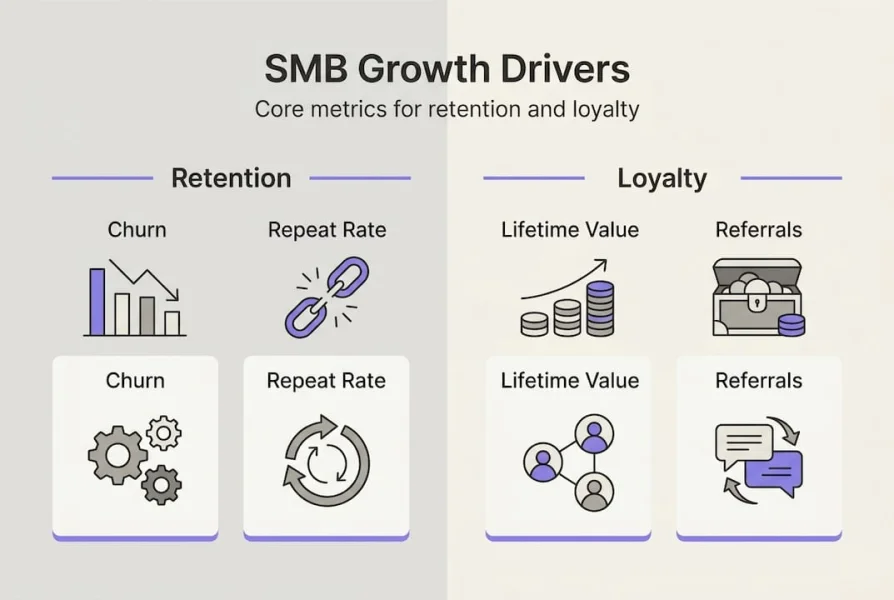
Before you can improve your engagement strategy, you need to understand the three core metrics that drive SMB success.
Retention rate is the percentage of customers who continue doing business with you over a set period. Churn is the opposite: the percentage who stop. Customer lifetime value (CLV) measures the total revenue a customer generates over their entire relationship with your business.
Here is how retention rates compare across common business types:
| Business type | Average retention rate |
|---|---|
| SaaS and software | 85% or higher |
| Retail (brick and mortar) | 60 to 70% |
| E-commerce | 55 to 65% |
| Micro businesses (under 10 staff) | 64 to 68% |
| Small businesses (10 to 50 staff) | 70 to 76% |
A 5% retention increase can boost profits by 25% to 95%. That is a significant return for a relatively small improvement. SMBs that focus on retention consistently outgrow those that spend most of their budget chasing new customers.
Here is how to calculate and use these metrics:
- Calculate retention rate: Divide the number of customers at the end of a period by the number at the start, then multiply by 100.
- Estimate CLV: Multiply average purchase value by purchase frequency, then multiply by the average customer lifespan in years.
- Track churn monthly: Identify patterns, such as customers dropping off after a first purchase or after a specific time period.
- Set benchmarks: Compare your numbers to your industry average to know where you stand.
For practical guidance on applying these metrics to a loyalty program, explore loyalty app best practices designed specifically for small businesses.
Top customer engagement strategies for SMBs
Not all engagement strategies deliver equal results. The most effective ones are built around your customers’ actual behavior, not assumptions.
Behavioral segmentation and the RFM model are two of the most powerful tools available. RFM stands for Recency (how recently a customer bought), Frequency (how often they buy), and Monetary value (how much they spend). Key mechanics like RFM segmentation allow you to target your most valuable customers with the right message at the right time, rather than blasting everyone with the same offer.

Proactive, context-driven touchpoints consistently outperform routine messaging. A birthday reward, a follow-up after a first purchase, or a re-engagement offer triggered by inactivity all feel personal and timely. Proactive outreach beats reactive communication because it shows customers you are paying attention.
Here is a comparison of popular loyalty program types to help you choose the right fit:
| Program type | Best for | Key benefit |
|---|---|---|
| Punch cards (stamp cards) | Cafes, salons, retail | Simple, low barrier to entry |
| Tiered rewards | Retail, e-commerce | Encourages higher spend over time |
| Visit-based rewards | Restaurants, gyms | Drives repeat foot traffic |
| Spend-based cashback | Any product-based business | Rewards high-value customers |
You can explore a full breakdown of types of loyalty programs to find the best match for your business model. For deeper strategy, review loyalty program strategies and real-world loyalty program examples from businesses like yours.
Building community is another underused strategy. Private social groups, referral programs, and brand ambassador initiatives create relational loyalty that goes beyond transactions. These engagement solutions work because they give customers a sense of belonging.
Pro Tip: Automation saves time, but it should never replace human judgment. Review your automated sequences regularly and add personal touches, like a handwritten note or a direct phone call, for your top-tier customers.
Common mistakes and how to avoid them
Even well-intentioned engagement strategies can backfire. Here are the most common mistakes SMBs make and how to fix them.
- Over-messaging: Sending too many emails or push notifications leads to fatigue. Over-messaging causes fatigue and disengagement, which is the opposite of what you want.
- Lack of targeting: Sending the same message to every customer ignores their individual needs and purchase history.
- Ignoring feedback: Customers who give negative feedback and receive no response are likely to leave quietly.
- Too much automation: Fully automated journeys can feel robotic. Balance automation with empathy by adding human checkpoints.
- Data silos: When your customer data lives in separate tools that do not talk to each other, personalization becomes nearly impossible.
One of the most dangerous patterns is hidden churn. A customer who stops engaging but has not formally canceled or unsubscribed is still counted as active in many systems. Watch for signals like declining purchase frequency, unopened messages, or reduced visit rates. These are early warning signs.
For inspiration on programs that actually retain customers, look at loyalty program growth examples from successful SMBs.
Pro Tip: Use your data to identify your top 20% of customers and your most at-risk segment. Then check in with both groups personally, not just through automated messages. A quick phone call or personalized email can recover a relationship before it is lost.
Your customer engagement action plan
Knowing the strategies is one thing. Putting them into action is another. Here is a straightforward framework you can start using this week.
- Map your core customer journeys. Identify the key moments in your customer relationship: first purchase, repeat visit, referral, and re-engagement after inactivity. Each of these is an opportunity for a meaningful touchpoint.
- Segment your customers. Use RFM or simple purchase history to group customers by value and behavior. Start with three segments: high value, occasional buyers, and lapsed customers.
- Design targeted engagement steps. Build specific messages or offers for each segment. High-value customers might get early access to new products. Lapsed customers might get a win-back offer.
- Launch a small pilot. Do not try to overhaul everything at once. Pick one segment and one engagement sequence, then run it for 30 to 60 days.
- Measure what matters. Track ROI-tied metrics like retention rate, CLV, Net Promoter Score (NPS), and conversion rate, not just open rates.
- Iterate based on results. Use what you learn to refine your approach. Engagement strategy is not a one-time project; it is an ongoing process.
“Start with core journeys, measure ROI-tied metrics, and keep your tech stack simple.” This advice holds true whether you are running a single-location cafe or a growing e-commerce brand.
For a structured starting point, use this loyalty program guide to build your program from the ground up. You can also draw ideas from the loyalty campaign ideas that are working for small businesses right now.
Boost engagement with tailored digital loyalty solutions
For SMBs looking to turn plans into action, powerful yet easy-to-use tools make a significant difference. BonusQR is built specifically for businesses like yours, offering flexible electronic rewards that automate personalized engagement without requiring complex POS integrations. Whether you want to run a stamp card program, a tiered cashback system, or visit-based rewards, the platform lets you set it up quickly and manage it from one place. With mobile loyalty apps and real-time analytics built in, you can track retention, send targeted push notifications, and adjust your strategy based on actual customer behavior. The loyalty platform scales with your business, from a free starter plan to fully branded white-label solutions. If you are ready to move from strategy to results, BonusQR gives you the tools to do it.
Frequently asked questions
What are the best customer engagement metrics for SMBs?
Key metrics include retention rate, customer lifetime value, churn rate, and Net Promoter Score. These business-outcome metrics directly reflect real engagement and loyalty, unlike surface-level stats such as open rates.
How often should I message my customers for maximum engagement?
Message only as often as needed to provide genuine value or address a real customer need. Over-messaging causes fatigue and pushes customers to disengage, so prioritize relevance over frequency.
What kind of loyalty program works best for small businesses?
Simple programs like punch cards or tiered rewards tailored to your customer base often perform best. Punch cards or tiered rewards are easy to implement and easy for customers to understand, which drives participation.
How do I avoid data silos when building digital engagement strategies?
Use integrated platforms that centralize customer data in one place. Data silos hinder personalization and make it harder to deliver consistent, relevant experiences across channels.
Why do some engagement strategies fail even with high customer activity?
High activity without emotional loyalty can hide churn. Activity does not equal loyalty, so focus on building genuine connections rather than simply increasing the volume of your communications.