
Customers who find a loyalty program easy to use on their phone are 71% more likely to join and stick with it. That single fact should matter to every retail or service business owner who has watched regulars drift away without a clear reason why. Mobile-first loyalty programs put your rewards system where your customers already spend their time, on their smartphones, and the results show up in repeat visits, higher average spend, and stronger long-term relationships. This guide walks you through what mobile-first loyalty actually means, why it works so well for small and medium-sized businesses, and how to launch one without overcomplicating the process.
Key Takeaways
| Point | Details |
|---|---|
| Mobile loyalty powers retention | Switching to mobile-first loyalty can boost customer retention rates by up to 40 percent in small retail and service businesses. |
| Simple features yield results | Focus on automated, action-based rewards and easy onboarding to maximize engagement and minimize costs. |
| Avoid overcomplication | Too many reward tiers or a complex setup can discourage customers—keep programs easy and accessible. |
| Measure and adapt | Track retention and spend metrics from launch and refine your loyalty strategy to maximize profits. |
What is mobile-first loyalty?
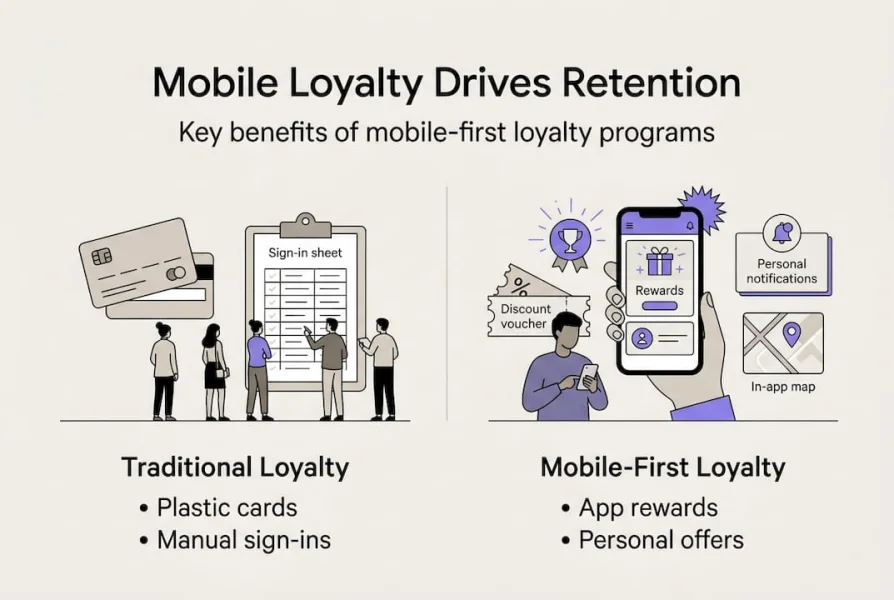
A mobile-first loyalty program is built around the smartphone experience from the ground up. Rather than treating mobile as an add-on to a desktop portal or a physical punch card, it puts the app, SMS, or digital wallet at the center of how customers earn and redeem rewards. Mobile-first programs prioritize apps, SMS, and mobile wallets for seamless earning and redeeming, eliminating physical cards and desktop friction entirely.
For a small business, this could look like a coffee shop using a digital stamp card that customers access through their phone’s wallet app. A salon might send SMS reminders when a client is close to earning a free service. A boutique retailer could offer personalized discount codes through a branded app. The common thread is that the customer never needs to carry a card, log into a website, or remember a PIN.
Here is how mobile-first loyalty compares to traditional approaches:
| Feature | Traditional loyalty | Mobile-first loyalty |
|---|---|---|
| Customer access | Physical card or desktop login | Smartphone app, SMS, or wallet |
| Reward tracking | Manual or in-store only | Real-time, automatic |
| Communication | Printed mailers, email | Push notifications, SMS |
| Onboarding speed | Slow, form-heavy | Fast, often one scan or tap |
| Data insights | Limited | Rich, behavioral data |
For retail loyalty solutions, the shift to mobile removes the biggest barrier to participation: inconvenience.
How mobile-first loyalty boosts customer retention
Your customers check their phones dozens of times a day. A loyalty program that lives on that device has a natural advantage over one that requires a separate action or a card they might leave at home. The numbers back this up clearly.
Businesses using mobile loyalty programs see 30 to 40% higher retention compared to those without one. Customer lifetime value rises by up to 48%, and average spend per visit increases by around 15%. Perhaps most striking, a 5% retention boost can translate into a 25 to 95% increase in profits, depending on your margins.
| Metric | Impact with mobile loyalty |
|---|---|
| Customer retention rate | 30 to 40% higher |
| Customer lifetime value | Up 48% |
| Average spend per visit | Up 15% |
| Profit uplift from 5% retention gain | 25 to 95% |
| Preference for mobile apps | 60% of loyalty members |
The psychology behind this is straightforward. Mobile loyalty programs tap into habit loops, where checking points or stamps becomes a routine tied to each visit. They also use loss aversion, the discomfort people feel when they are close to a reward but have not yet earned it. That feeling drives return visits. Mobile-first programs drive retention through convenience and psychology, making them ideal for retail and service businesses with frequent transactions.
“The most effective loyalty programs are not the most generous ones. They are the ones customers actually remember to use.”
Here is why mobile-first loyalty works so well in practice:
- Customers always have their phone, so they never miss a reward opportunity.
- Push notifications remind them to return before points expire.
- Real-time balance updates create immediate satisfaction after each purchase.
- Personalized offers based on purchase history feel relevant, not generic.
- Digital access removes the “I forgot my card” excuse entirely.
The retention benefits for SMBs are well documented, and the benefits of SMB loyalty programs extend beyond retention to brand awareness and word-of-mouth referrals.
Pro Tip: Use the behavioral data your app collects to send personalized offers. A customer who always visits on Fridays is a great candidate for a Friday-only double points promotion. That level of targeting is only possible with mobile.
Core mechanics and must-have features for SMBs
Not every loyalty feature is worth your time or budget. For small and medium-sized businesses, the goal is to pick mechanics that deliver results without requiring a dedicated IT team or expensive POS upgrades.
The most effective features for SMBs include points systems where customers earn per purchase or visit, digital punch cards that replace paper versions, visit-based rewards that trigger after a set number of check-ins, and personalized offers based on customer behavior. Key mechanics also include push notifications, gamification elements like badges and challenges, and cashback options that work well in high-frequency retail and service settings.
Here are the top five must-have features for any SMB loyalty app:
- Points or stamp tracking that updates automatically after each transaction
- Push notifications to re-engage customers who have not visited recently
- Simple onboarding via QR code scan or phone number, with no lengthy forms
- Reward automation so you are not manually issuing discounts or stamps
- Basic analytics showing visit frequency, top customers, and redemption rates
70% of SMBs prefer platforms with no or low POS integration requirements, and for good reason. Simpler platforms reduce setup time and ongoing costs. You can explore SMB loyalty app features and see examples of SMB loyalty apps to find the right fit for your business type.
Pro Tip: Start with one action-based reward, such as a free item after five visits, before adding more complex tiers. Fast, visible rewards drive early adoption and build the habit loop you want.
Common pitfalls and how to avoid them
Even a well-designed loyalty program can underperform if you make a few common mistakes. Knowing what to watch for saves you time and money.
“Frictionless onboarding is the single most overlooked factor in loyalty program success. If signing up takes more than 60 seconds, you will lose most customers before they ever earn a reward.”
Here are four mistakes SMBs make most often, and how to fix them:
- Overly complex tiers: Complex tiers overwhelm customers and reduce participation. Keep your structure simple: earn points, reach a threshold, get a reward.
- Poor onboarding: If joining requires downloading an app, filling out a form, and verifying an email, most people will not bother. Use QR codes or phone numbers to get customers in fast.
- Ignoring data privacy: Customers are increasingly aware of how their data is used. Collect only what you need and be transparent about it. Zero-party data, information customers share willingly, is more valuable and less risky.
- No omnichannel sync: If your in-store and online loyalty experiences are disconnected, customers get frustrated. A unified platform prevents this and keeps your data clean.
SMBs that prioritize simplicity and avoid manual processes consistently outperform those that try to replicate enterprise-level complexity on a small business budget. For more ideas, check out retail engagement tips and small business loyalty best practices.
Steps to launch a mobile-first loyalty program for your business
Launching does not have to be complicated. Follow these steps to go from zero to a running program without wasting resources.
- Set clear goals. Decide what you want to achieve: more repeat visits, higher average spend, or better customer data. Your goal shapes every other decision.
- Choose your core reward mechanic. Start with visit-based rewards or spend-based points. These are easy to understand and quick to adopt.
- Select a platform. Look for one with no POS integration requirement, built-in automation, and mobile wallet support. 70% of SMBs prefer low-complexity platforms for exactly this reason.
- Promote at the point of sale. Train your staff to mention the program at checkout. Use table cards, window stickers, or receipts with a QR code to drive sign-ups.
- Track your KPIs. Monitor retention rate, redemption rate, and average visit frequency from day one. These numbers tell you what is working and what needs adjustment.
- Iterate based on data. After 60 to 90 days, review your analytics and adjust your reward structure or notification timing if needed.
Looking at successful SMB loyalty programs can give you practical inspiration for your own setup.
When is mobile-first not the answer?
Mobile-first loyalty is a strong fit for most retail and service businesses, but it is not the right choice in every situation. Being honest about this helps you invest your resources wisely.
While 60 to 71% of loyalty members prefer mobile access, desktop remains better for complex research-driven purchases or B2B relationships where decisions involve multiple stakeholders. Not every business needs a full app either. For simpler programs, digital wallets or SMS-based rewards may be enough without the overhead of app development or management.
Here are three situations where mobile-first loyalty may not be the best fit:
- B2B or high-consideration purchases: When customers spend weeks researching before buying, a points program adds little value. Relationship-based incentives or account management tools work better.
- Very low transaction frequency: If customers buy from you once or twice a year, the habit loop that makes mobile loyalty effective simply does not have time to form.
- Older or less tech-savvy customer bases: If your core customers rarely use smartphones for shopping, a simpler SMS or card-based approach may see higher adoption.
For businesses in sectors like grocery, grocery store loyalty options and top retail loyalty models offer a range of approaches suited to different customer profiles.
Get started: Simple mobile-first loyalty for your business
If you are ready to put what you have learned into action, bonusqr.com makes it straightforward. The platform’s electronic rewards platform gives you points, stamp cards, cashback, and visit-based rewards in one place, with no POS integration required. The mobile loyalty features include push notifications, real-time analytics, and full branding customization so your program looks and feels like your business. You can even offer Apple Wallet loyalty integration so customers access their rewards without downloading a separate app. Setup is fast, pricing includes a free tier, and you can scale as your program grows. It is built specifically for retail and service businesses that want results without the complexity.
Frequently asked questions
What’s the difference between mobile-first and traditional loyalty programs?
Mobile-first loyalty uses apps, SMS, or digital wallets to manage rewards, while traditional programs rely on physical punch cards or paper-based systems that customers frequently lose or forget.
How quickly can small businesses see results with mobile loyalty?
Many businesses see measurable improvements within the first few months, with benchmarks showing 30 to 40% higher retention once a mobile program is actively promoted at the point of sale.
Is a full-featured app always necessary for mobile loyalty?
No. As loyalty software trends show, digital wallets and SMS-based programs work well for simpler reward structures without requiring customers to download anything.
What’s the biggest mistake SMBs make with loyalty programs?
Making the program too complicated. Complex tiers and slow onboarding are the top reasons customers never engage after signing up, so simplicity should always come first.


