Customer loyalty is the powerful connection that turns a first-time buyer into a lifelong fan who chooses you every time-even when a competitor is cheaper or closer. It's the difference between a one-time transaction and a predictable, growing revenue stream.
For a small business owner, understanding what is customer loyalty isn't just theory; it's the key to sustainable growth.
What is Customer Loyalty and Why Does It Matter?
Think of customer loyalty as the difference between an acquaintance and a true friend. An acquaintance might visit your coffee shop when it's convenient. A true friend goes out of their way because they value the relationship.
That's the core of it. Customer loyalty is a customer's ongoing emotional commitment to your brand, driven by positive experiences that make them feel seen and valued.
This connection is one of the most powerful tools in your arsenal. The loyalty management market is projected to hit $41.21 billion by 2032 for one simple reason: it’s far more profitable to keep a customer than to acquire a new one.
The Real Value of a Loyal Customer
For a small business, a loyal customer is an asset-the foundation of stable revenue. While chasing new leads feels productive, delighting the customers you already have is the single most powerful move you can make.
This is a cornerstone of smart growth. To learn more about keeping customers, our guide on retention marketing is a great next step.
A loyal customer doesn't just buy from you; they believe in you. They become your best marketers, your most honest critics, and your most stable source of income.
The table below breaks down just how different these two types of customers are.
One-Time Buyer vs. Loyal Customer at a Glance
This table shows the tangible differences between a transactional shopper and a truly loyal customer.
| Characteristic | One-Time Buyer | Loyal Customer |
|---|---|---|
| Spending Behavior | Motivated by a single need or discount. Spends less on average. | Buys more frequently and spends up to 67% more per purchase. |
| Price Sensitivity | Highly sensitive to price. Easily swayed by competitor deals. | Less sensitive to price increases because they value the experience. |
| Marketing Impact | Requires costly advertising to attract. | Acts as free word-of-mouth marketing, bringing in new customers. |
| Feedback | Provides little to no feedback. If they have a bad experience, they just leave. | Offers valuable, honest feedback to help you improve your business. |
| Business Value | Unpredictable and transactional. | Provides a stable and predictable revenue stream, making forecasting easier. |
As you can see, the value goes far beyond the initial sale. Understanding customer loyalty means seeing it as a relationship you build over time, one positive experience at a time. It’s the most reliable and cost-effective way to ensure your small business doesn't just survive, but thrives.
The Financial Benefits of Customer Loyalty for SMBs
For any small business, loyal customers are more than just repeat sales. They’re your secret weapon for real, sustainable growth. While it's tempting to chase a constant stream of new leads, focusing on the customers you already have pays off in tangible ways.
Think of it this way: a steady base of loyal fans creates predictable revenue. That stability makes it easier to manage cash flow, forecast earnings, and make smart decisions about inventory or hiring.
Turn Customers Into Your Best Marketers
One of the biggest wins from customer loyalty? Your best customers become your most authentic advocates. They generate word-of-mouth recommendations that new leads trust far more than any paid ad.
When a regular at your coffee shop tells their coworker it’s the best in town, that’s marketing gold. These brand champions don't just bring you new business; they bring you the right kind of business-people who are already primed to love what you do.
The infographic below breaks down the clear financial wins from prioritizing loyalty.
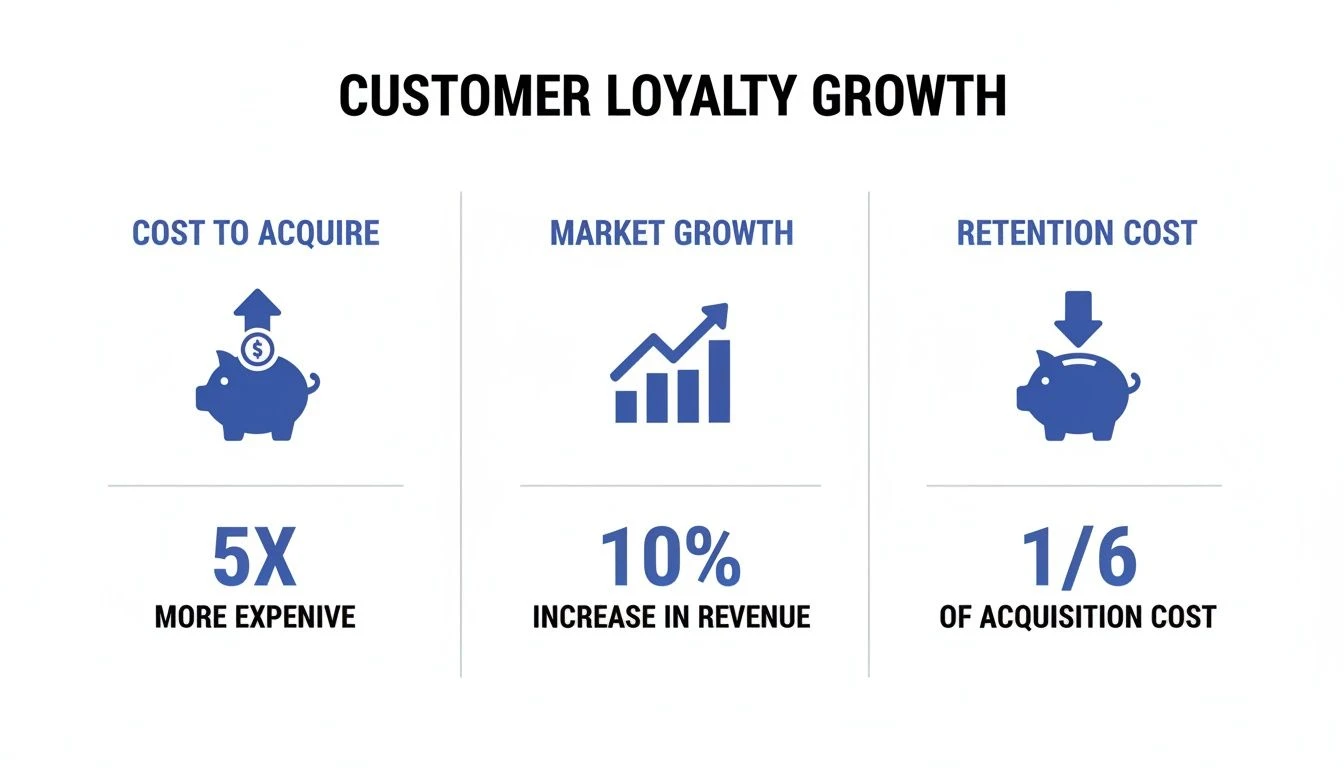
The numbers don't lie. Investing in keeping current customers happy is far more cost-effective than constantly chasing new ones.
Build Resilience and Gather Priceless Feedback
Loyal customers are your business's shield. They make you more resilient to price wars or a new competitor. Because they choose you based on trust and great experiences, they’re far less likely to jump ship for a slightly lower price. That emotional connection is a competitive advantage that’s hard to copy.
Even better, these fans are your best source of honest, constructive feedback. They want you to succeed and are often happy to share what’s working and what isn’t. This direct line to what your customers think is invaluable.
In short, customer loyalty is a growth engine. It lowers your marketing spend, stabilizes your income, and gives you the insights you need to improve. It's a self-perpetuating cycle of success.
This isn’t just a hunch. A massive 86% of customer experience professionals say loyalty is becoming more critical, and 87% confirm that loyalty programs deliver a strong ROI. This is a huge opportunity for SMBs-from salons to cafes-who can use simple tools like BonusQR to get an effective loyalty program running fast. The key is making customers feel valued-something 44% of shoppers say their favorite brands do well. You can dive deeper into these trends by checking out the latest customer loyalty statistics for 2025.
The Two Types of Loyalty: Transactional and Emotional
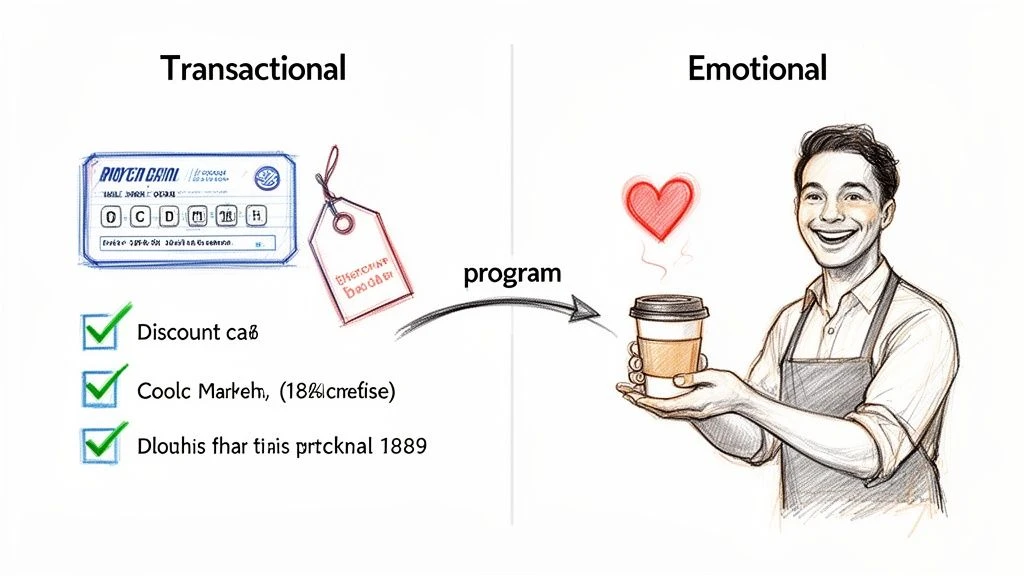
To truly understand what customer loyalty is, you need to know it comes in two flavors: transactional and emotional. Recognizing the difference is the first step toward building a customer base that sticks with you through thick and thin.
A simple way to think about it: transactional loyalty comes from the head, while emotional loyalty comes from the heart.
Transactional Loyalty: The Head Decision
Transactional loyalty is a logical exchange. Customers stick around because it’s a smart thing to do. They’re driven by tangible benefits that save them money, time, or hassle.
This kind of loyalty is built on a foundation of straightforward incentives. It’s a rational calculation where the customer decides your business offers the best deal.
Key drivers of transactional loyalty include:
- Discounts and Deals: The customer who always shows up with a coupon.
- Points and Rewards: The classic "buy nine, get the tenth free" model.
- Convenience: The person who shops at your store because it’s on their commute.
Transactional loyalty is like a friendly acquaintance. It’s reliable, but the connection is conditional. If a competitor offers a better deal, this customer will likely switch.
Emotional Loyalty: The Heart Decision
Emotional loyalty is a much deeper-and more powerful-bond. It happens when customers feel truly seen, valued, and connected to your brand on a personal level. It goes way beyond price and convenience.
This type of loyalty is built on trust and consistently great experiences. It’s the feeling a regular gets when the barista knows their name and starts their usual order the moment they walk in. It’s what keeps them coming back even when a cheaper option opens next door.
Emotional loyalty is created through:
- Exceptional Service: Making customers feel genuinely cared for.
- Personalization: Remembering a customer's name, order, or preferences.
- Shared Values: Aligning your brand with causes your customers believe in.
- Community: Making customers feel like they belong to a group.
Bridging the Gap From Transactional to Emotional
While emotional loyalty is the goal, transactional rewards are the perfect way to start the relationship. A simple, cost-effective loyalty program gives customers a logical reason to return.
With every repeat visit, you get another chance to deliver a great experience, learn their name, and build that priceless emotional connection.
A tool like BonusQR makes this easy. It starts with a simple digital punch card (the transaction) but gives you the power to consistently recognize and reward your regulars, turning casual buyers into true fans.
The Four Key Drivers of Lasting Customer Loyalty
Loyalty programs are fantastic tools, but they don't create loyalty on their own. Real, lasting loyalty grows from the consistently positive experiences you deliver every single day.
Think of it this way: lasting loyalty is built on four essential pillars. If one is weak, the whole thing gets wobbly. Nailing these fundamentals is the surest way to create fans who stick around.
1. An Exceptional Product or Service
This is the non-negotiable foundation. Before you think about points or perks, what you sell must be excellent. A customer might try you for a great deal, but they won’t return if your coffee is bland, your haircuts are sloppy, or your product falls apart.
Quality is the price of admission. Research shows that 59% of consumers say high-quality products are the #1 reason they stick with a brand. For a local business, this means:
- Consistency: The amazing latte a customer gets on Monday must be just as amazing on Friday.
- Reliability: Your product or service has to do its job, every single time.
- Value: It doesn't have to be the cheapest, but it must be worth the price.
2. Stellar Customer Service
This is where small businesses can outshine large corporations. Stellar customer service turns a simple purchase into a memorable, human moment.
Exceptional service is about making people feel seen and heard. It’s the barista who remembers a name, the owner who tracks down a special item, or the team that resolves an issue with speed and empathy. This principle also applies to nonprofits, where maintaining donor trust through communication and appreciation is key.
A single negative interaction can erase months of hard work. On the flip side, one standout moment of service can create a customer for life.
3. Smart Personalization and Recognition
People are tired of generic marketing. Personalization cuts through the noise. It tells customers you see them as individuals, not just numbers. For an SMB, this can be simple:
- Remembering Preferences: Knowing a customer’s usual order.
- Acknowledging Milestones: Sending a "Happy Birthday" discount.
- Personalized Recommendations: Suggesting a new dish based on past orders.
A simple digital loyalty app like BonusQR is a huge help here. By tracking visits, you can easily spot your regulars and offer them special perks, making them feel recognized.
4. Community and Consistency
The final driver is creating a sense of belonging. This could be as simple as a warm, welcoming vibe in your shop or an online group for your biggest fans.
Consistency holds it all together. When your branding, messaging, and experience are cohesive, you build a brand people trust.
While trends are important, basics sway loyalty most. An easy purchasing process (43%) and positive in-person experiences (43%) are huge factors. On the other hand, a bad product experience is why 36% of customers switch brands, and negative staff interactions push another 30% away. Focusing on a smooth, pleasant journey is the most powerful path to loyalty, as seen in these recent consumer loyalty findings.
How to Start a Simple Loyalty Program That Works
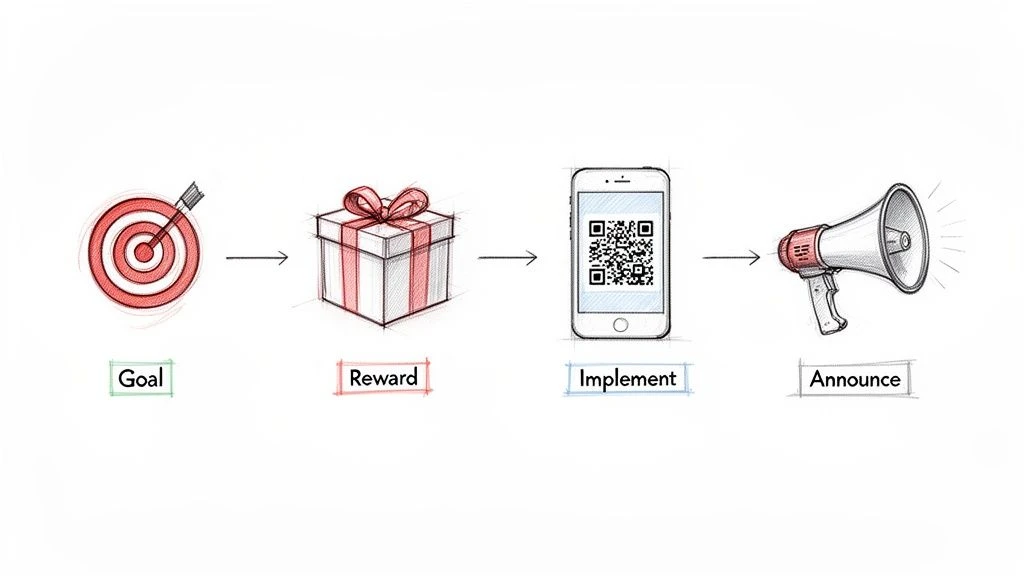
Ready to put this knowledge into practice? The good news is that launching your first loyalty program doesn't have to be complicated or expensive. For a small business, simplicity is your superpower.
Follow this simple four-step process to get an effective program running in minutes.
Step 1: Define One Clear Goal
Before you think about rewards, ask yourself: "What's the #1 behavior I want to encourage?" Trying to do everything at once creates a confusing program that no one will use.
Pick one clear, measurable goal to start.
Here are a few solid starting goals for SMBs:
- Increase visit frequency: Turn a monthly visitor into a twice-monthly regular.
- Boost off-peak traffic: Fill quiet hours (like weekday mornings).
- Increase average spend: Nudge customers to add one more item to their order.
For most businesses, increasing visit frequency is the perfect place to start. It builds the habit of choosing you.
Step 2: Choose a Simple, Irresistible Reward
Once you have a goal, pick a reward that’s exciting enough to change behavior but simple enough to manage. The best rewards are tied directly to what you already sell.
The golden rule for rewards: make them both desirable and attainable. If the prize is boring or feels impossible to earn, customers won't bother.
A free item is often the most powerful and easy-to-understand reward.
Good Reward Examples:
- Coffee Shop: Buy 9 coffees, get the 10th free.
- Salon: Get 5 haircuts, receive $20 off the 6th.
- Car Wash: After 4 washes, the 5th is on us.
- Restaurant: Spend $100 over any number of visits, get a free appetizer.
These rewards are dead simple, valuable to the customer, and a breeze for your staff to handle.
Step 3: Implement with an Easy Digital Tool
This is where many business owners get stuck and fall back on paper punch cards. But paper cards get lost, offer no data, and feel dated. A simple digital tool is a much smarter move.
This is where a tool like BonusQR shines. It transforms the classic punch card into a slick digital experience on your customer’s phone-with no app to download. They just scan a QR code.
This fixes all the problems with paper cards:
- No Lost Cards: The loyalty "card" is always on their phone.
- Actionable Insights: Finally see how often customers visit and redeem rewards.
- Effortless Management: The system handles all tracking automatically.
Globally, 31% of marketing budgets now go toward loyalty. While big brands invest in complex AI, small businesses win with simple, rewarding systems. A QR-code-based app lets you tap into this trend without an enterprise-level budget.
Step 4: Announce and Promote Your Program
A brilliant loyalty program is useless if nobody knows about it. Treat the launch like a mini-event.
Get the word out across all your touchpoints:
- In-Store Signage: Put a clear sign at your checkout counter.
- Personal Invitation: This is huge. Have your staff personally invite every customer. A simple, "Have you joined our new rewards program? You're just a few visits from a free coffee!" works wonders.
- Social Media: Announce the launch on all your social channels.
As you grow, you might leverage marketing automation to manage communication. By starting small and smart, you build a powerful system for turning casual visitors into loyal fans.
How to Measure if Your Loyalty Program Is Working
So, you’ve launched your loyalty program. But how do you know if it’s actually working? Measuring success shouldn't require a data science degree.
By tracking just a few powerful numbers, any business owner can see the real-world impact and make smarter decisions.
The goal of measurement isn't just to get data; it's to get answers. Is your program encouraging more visits? Are customers spending more? Answering these questions is key.
Think of these metrics as your program’s health check.
Key Metrics to Track Your Program’s Success
You don't need to track dozens of numbers. These three key performance indicators (KPIs) give you all the insight you need.
Customer Retention Rate (CRR): This is the big one. CRR tells you what percentage of customers you're keeping over a period. A high CRR means your loyalty efforts are working. We break down the simple math in our guide on how to calculate customer retention rate.
Repeat Purchase Rate: This metric shows the percentage of your customer base that has made more than one purchase. It's a direct signal of whether your program is driving repeat visits.
Average Order Value (AOV): This is the average amount a customer spends per transaction. If AOV climbs among program members, it's a fantastic sign your strategy is boosting sales.
Let Data Drive Your Decisions
Tracking these KPIs is a must, but it doesn't have to be a chore. This is where a simple digital tool becomes a game-changer. A paper punch card gives you zero insight.
A digital loyalty app like BonusQR automates all of this for you. It provides a simple dashboard showing visit frequency, rewards redeemed, and your most loyal customers at a glance. You can see your program's performance instantly, without guesswork.
Data shows that loyalty leaders have achieved an impressive 68% loyalty rate by focusing on convenience and a solid digital program. For a small business, this proves that a straightforward, easy-to-use digital approach is a winning formula. You can discover more insights on customer loyalty statistics that show how simple programs drive powerful results.
Your Questions About Customer Loyalty Answered
Even with all the benefits, it's normal to have questions. Most small business owners worry: "Is this too expensive? Will it work for me? How much time will it take?"
Let's tackle those common hesitations head-on.
Is a loyalty program too expensive for my business?
Not anymore. While old-school programs could be expensive, modern tools like BonusQR are designed to be affordable for small businesses. Honestly, the cost is a tiny fraction of what you'd spend acquiring just one new customer. Think of it as a small investment in the people who already support you-it’s the highest ROI you can get in marketing.
Will a loyalty program actually work for my business type?
Yes. Loyalty programs are incredibly effective for almost any business that relies on repeat visits: coffee shops, salons, car washes, retail stores, restaurants-you name it.
The logic is simple and universal:
- You reward customers for choosing you again.
- This makes them want to return more often.
- The principle is the same whether you sell lattes or lawn care.
How much time does it take to manage?
This is where digital tools are a game-changer. Getting set up on a platform like BonusQR can take just a few minutes. Seriously.
After that? The program runs on autopilot. Customers scan a QR code, and the system does all the tracking. This frees you up to do what you do best-run your business-while your loyalty program works its magic in the background.
What's better: a digital program or a paper punch card?
While paper cards feel familiar, digital is the smarter choice. In fact, 41% of consumers already use digital loyalty cards, so you're meeting them where they are.
A digital program is the simpler, smarter, and more effective choice. It's loyalty that's always in your customer's pocket, not lost in their car.
Just look at the differences:
- Convenience: Customers can't lose their "card" when it's on their phone.
- Data: You get real insights to see what’s working and who your best customers are.
- Modern Feel: It shows your business is up-to-date and offers a smooth, hassle-free experience.


